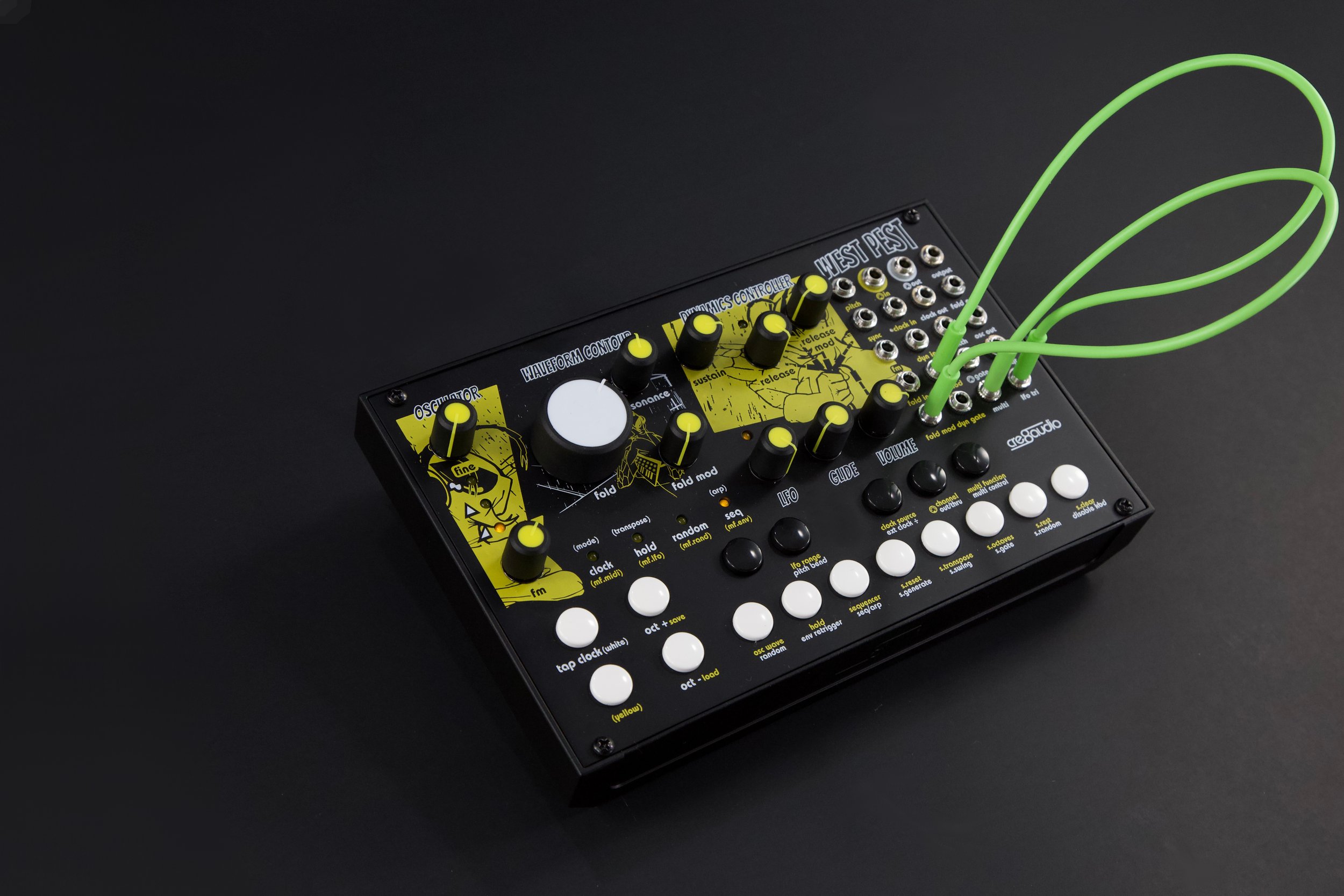
The West Pest is a semi-modular analog synth with some serious power. This semi-modular synthesizer burst onto the scene around NAMM and has been catching some serious attention for its affordability, ability to generate an intense harmonic character and the fact that it plays well with others (at least in terms of other synths). We had a chance to review one of these powerful synths to break down exactly what we found most appealing.
With three different waveforms to start with, you can create rich, full sounds that were never before possible. You can add beautiful harmonic elements to your soundscape by engaging in robust wave folding.
The Dynamics Controller uses a process of modification to the incoming signal to make it respond differently to changes in volume, replicating the way soundwaves behave in the natural world. You can also use an LFO to shape your sound, and there are 18 patch ports for connecting other devices, as well as MIDI capabilities which make this Pest very versatile!
Learn More About This Synth Here
What Is West Coast Synthesis?
The “West Coast” approach to synthesis typically involves adding harmonics to simple waveforms instead of removing them from complex waveforms.
This can be done by using two oscillators (sometimes combined into one “complex oscillator”), where one modulates the frequency (FM) or amplitude (AM) of the other. Another standard West Coast module is a waveshaper or wavefolder.
Different envelope generators include those with two stages, such as an AD or AR, and more voltage control manipulation. A common feature is also voltage-controlled amplifiers that have low-pass filters, creating what is known as a Low Pass Gate.
This approach also includes non-standard controllers, such as touch plates. Nowadays, it is not uncommon to use a mixture of East Coast, and West Coast approaches in the same system.
My Favorite Features On The Cre8audio West Pest Synth
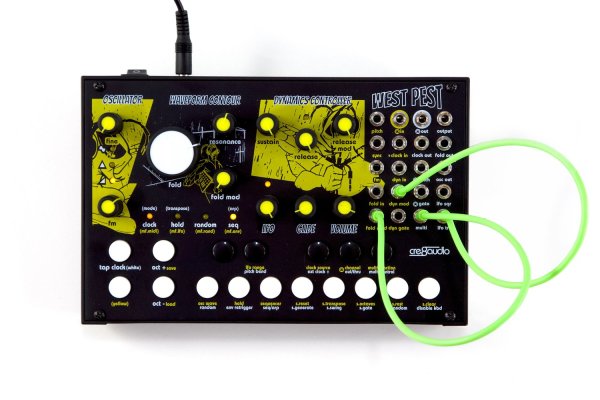
This desktop synthesizer packs some fantastic features for such a small hardware synth. Here are some of my favorite features in this synth that instantly stood out to me.
The Resonance knob
I’m not entirely sure where the Resonance knob is supposed to sit to get optimal results. It highlights the blurred nature of this synthesizer, where everything seems to affect everything else in subtle and unsubtle ways.
The manual states that Resonance is part of the Dynamics Controller, but it is located next to the Fold knob in the Waveform Contour section on the synth front panel. I had to experiment a bit to understand how to use it, but eventually, it could produce some screeching results.
Resonance increases the amplitude of the waveform’s peaks, which can then overload the input to the Dynamics Controller. Therefore, it occupies a middle ground between the two. It also gives the sound a more “waspy” quality. I’ve found a relationship between Fold and Resonance, which, combined with Sustain and Release, gives you a four-knob approach to sound manipulation. So let’s get into the dynamics.
Sequencing Arpeggiator
The sequencing engine originates from the East Beast and is uncomplicated and diverting. In sequencer mode, it just begins playing whichever note you press. As you play more notes, they are added to the looping sequence, up to 32 notes. You can enter pauses to break it up, but otherwise, it keeps going.
The arpeggiator seamlessly integrates into the same experience. You can change modes while the sequence is playing and then hold some notes, and it will become an arpeggiation without skipping a beat. Swap back to sequence mode, and you can add more notes to what the arpeggiation was. It’s brilliant and playable even on the slightly crappy plastic button keyboard.
The Generate button is the most exciting feature of the sequencer. It uses algorithms to change your notes slightly, creating new and unique melodies each time. It’s an excellent tool for coming up with new ideas.
Randomization
The synth has a lot of randomization features. For example, West Pest has random patterns, random notes, and a randomized output option on the multi-function output. East Beast can also randomize the oscillator waveforms. If you hit the right button combo, each note will roll the dice on which waveform to use. This makes for very dynamic and exciting sequences.
I should mention the control system integrated into the keyboard. Two buttons to the side give access to the white and yellow writing beneath the keys. These include the LFO range, clock source, sequencer, arpeggiator options, and the Multi-Function.
Some options come with these options that have four LEDs that sit beneath the Fold knob. The manual tells you how to decipher them, but usually, you can get an understanding of what is happening just by listening.
Why Buy The Cre8audio West Pest Synth?
Adding new gear to your music studio can be tempting but not always necessary. Here are a few reasons why I think this synth would be a justifiable investment in your music-making setup.
The Price
First and foremost, this synth is damn affordable. With a retail price of only $250, you won’t likely go broke trying to afford this synth. In fact, that makes it a reasonably approachable budget synth. And it includes all the features mentioned above for less than most of the other most popular synths on the market; it’s an easy buy!
To Learn Synthesis
Modular synths are a significant investment, both in learning the complex routing, it takes to get any usable sounds from them and in terms of money.
But semi-modular synths allow you to practice your routing and learn the complex art of modular synths without feeling overwhelmed by the process. Sure, it still takes a bit of getting used to, but this fully patchable synth is easy to learn and makes the transition into a fully modular setup all the easier.
It Simply Sounds Awesome
The nature of the synth produces some compelling sounds. They often have a warped and mangled tonality to them that I’ve never heard of any soft synth produce, which is exactly why I have been leaning more and more toward hardware soft synths lately.
Too many people are able to whip up the same patches on soft synths, and the fact that these patches and harmonic content is so unique means this synth has quickly been a go-to weapon in my quest to sound unique.
Cre8audio West Pest Specs
Analog/Digital: Analog
Type of Keys: 13 x Key Buttons
Polyphony: Monophonic
Oscillators: 1 x Analog VCO
Waveforms: Sawtooth, Triangle, Sine ; Frequency Modulation, Wave Folding
Envelope Generator: 1 x EG (sustain, release)
LFO: 1 x LFO
Arpeggiator: Yes
Sequencer: 32-step, 13 presets
Analog Outputs: 1 x 1/8″
MIDI I/O: 2 x 1/8″ (in, out/thru)
Other I/O: 17 x 1/8″ patch points
Power Supply: Power Supply (included)
Power Usage: Eurorack: +12V/250mA, -12V/190mA
HP Size: 40HP
Depth: Eurorack: 0.98″ (25mm)
Manufacturer Part Number: West Pest
Snag This Synth Here

Will Vance is a professional music producer who has been involved in the industry for the better part of a decade and has been the managing editor at Magnetic Magazine since mid-2022. In that time period, he has published thousands of articles on music production, industry think pieces and educational articles about the music industry. Over the last decade as a professional music producer, Will Vance has also ran multiple successful and highly respected record labels in the industry, including Where The Heart Is Records as well as having launched a new label with a focus on community through Magnetic Magazine. When not running these labels or producing his own music, Vance is likely writing for other top industry sites like Waves or the Hyperbits Masterclass or working on his upcoming book on mindfulness in music production. On the rare chance he's not thinking about music production, he's probably running a game of Dungeons and Dragons with his friends which he has been the dungeon master for for many years.






![The Bass Station II Swifty Edition Made Me Wonder Why I Waited So Long to Try One [Review]](https://magneticmag.com/wp-content/uploads/2025/08/528330002_1972340326912305_2985999559739582632_n-e1755036302515.jpg)