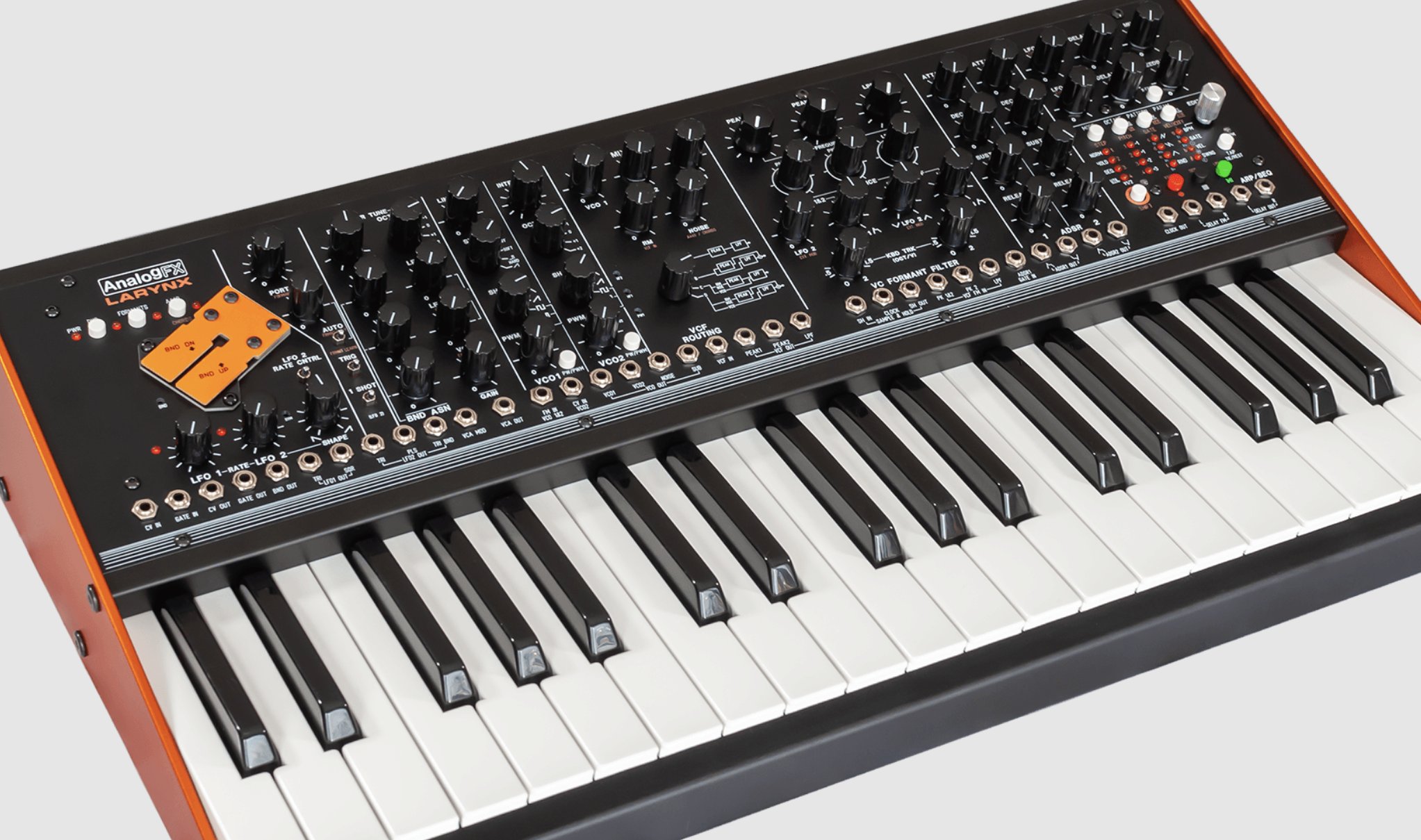
A lot of modern synths give you power first and personality second. AnalogFX’s LARYNX seems to come at the problem from the opposite direction.
The Dutch company is positioning LARYNX as a performance-focused analogue formant synthesizer, and that word, performance, is doing a lot of work here. This isn’t just a desktop box with a keyboard bolted on. It feels like an attempt to take the weirder vocal-filter DNA of the Synton Syrinx idea and make it something a player can actually push, lean into, bend, and fight with in real time.
That is the part I find interesting. Formant synthesis can get academic fast.
Talk about vowels, peaks, filter shapes, and speech-like timbres long enough, and the whole thing starts to sound like a lab project instead of an instrument. LARYNX seems more focused on getting those sounds under the hands, where pressure, velocity, modulation, and muscle memory can turn odd circuitry into something musical.
The first production run is limited to 50 units, which puts it firmly in boutique synth territory. That is not surprising. This is a niche instrument by design. The pitch is not “here is another bread-and-butter polysynth.” The pitch is closer to: here is a rare kind of analogue voice, rebuilt into a modern performance synth for people who want the machine to answer back.
That is also why this sits naturally beside the broader analogue conversation I covered in my article on processing analogue synths for more original sounds. The best hardware often gives you something slightly unstable and physical, then asks you to make decisions with your ears instead of your eyes.
The Syrinx Reference Is the Right Kind of Obscure
LARYNX is inspired by the Synton Syrinx, which is exactly the kind of reference that will make synth people either lean forward or start Googling immediately.
That matters because the Syrinx was never a normal synth reference point in the way a Minimoog, Prophet, Juno, or MS-20 is. It had a vocal, unusual, formant-heavy character that made it feel less like another subtractive synth and more like a strange analogue throat. AnalogFX has already worked in that space with its SER-2020, and LARYNX evolves that platform into a keyboard instrument with more performance emphasis.
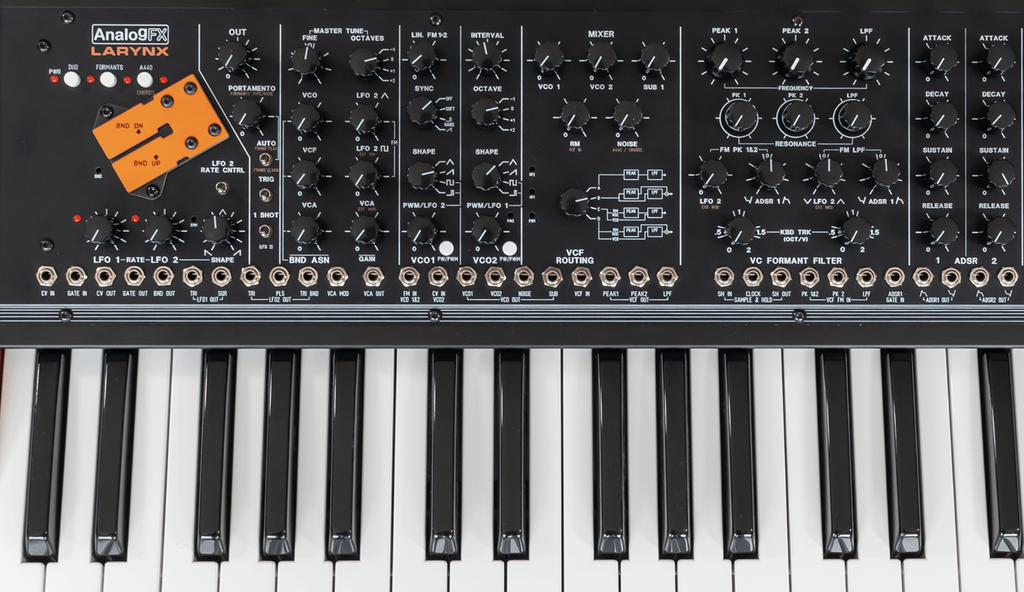
The core architecture is where the personality lives. LARYNX includes two CEM3340-based VCOs, a sub oscillator, ring modulator, noise generator, and a triple CEM3350-based filter section made up of PEAK 1, PEAK 2, and LPF. That means the sound is not only passing into a basic low-pass filter and calling it a day. The peak filters give it a way to carve speech-like shapes, animated resonances, and stranger vowel-ish movements that typical subtractive instruments do not reach as quickly.
That is the difference between “analogue warmth” as marketing language and an actual design decision. LARYNX is not only trying to sound thick. It is trying to sound alive in a specific, almost vocal way.
I have a soft spot for synths that commit to a strange identity instead of trying to cover every possible use case. The market already has plenty of generalists. A synth like this is more interesting when it knows exactly what kind of odd behavior it wants to encourage.
The Modular Side Matters
LARYNX also looks built for people who already live around cables.
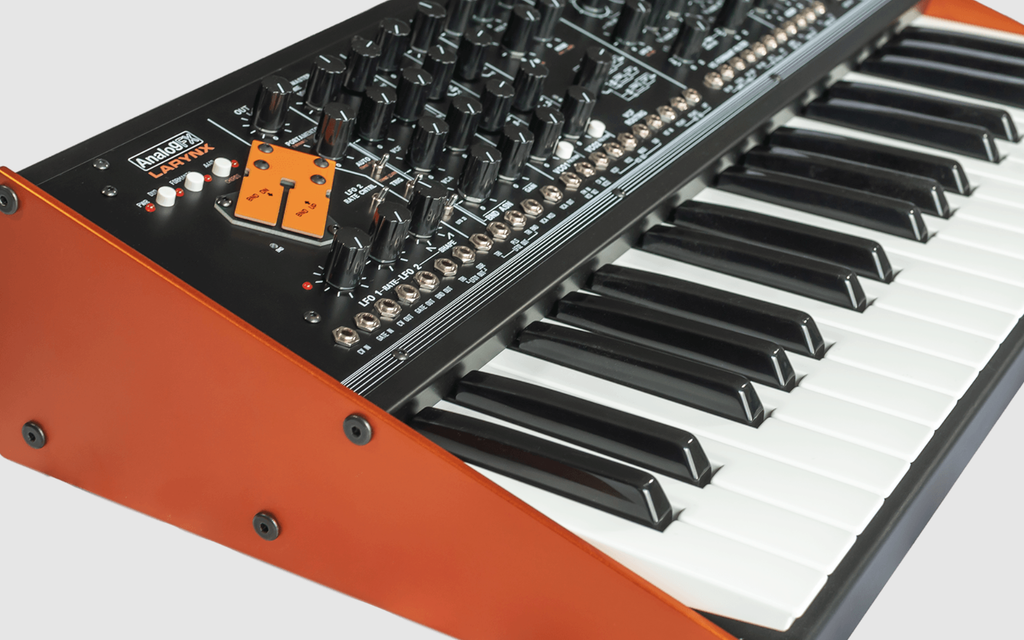
The front panel CV inputs and outputs give it a way to talk to Eurorack systems, while the rear panel adds MIDI IN/OUT, USB MIDI, expression, sustain and hold pedal input, stereo line output, and headphone output. That makes it useful as a standalone keyboard synth, but also as a modular voice inside a bigger setup.
That is the kind of flexibility that can justify a boutique instrument. If it only worked as a self-contained oddball, the audience would be narrower. If it can sit beside Eurorack, take modulation, send control, respond to MIDI, handle pedal input, and still operate as a playable keyboard instrument, it has more room to become part of a real studio.
I covered some of that thinking in my article on semi-modular synths, where the best instruments give users a defined voice but still let them break the normal routing. LARYNX belongs near that conversation, even if its formant focus gives it a very different flavor.
The built-in stereo delay helps too. A dry formant synth can already be animated, but delay gives those vowel-like shapes a tail, a smear, and a sense of space. I would be curious to hear how far the delay can push the speech-like material before it turns into something more textural and unstable.
That is probably where LARYNX will be most fun. Not in polite bass patches, although it can do those. More in the space where the filters start moving like a mouth, the oscillators push into the peaks, the delay catches the edges, and the whole thing starts feeling less like a synth line and more like a creature making an argument.
LARYNX Feels Built for Players Who Want a Voice
The best way to understand LARYNX is probably not as a synth with formant features. It is more like a formant voice that happens to be a synth.
That distinction matters. A lot of instruments can make basses, leads, drones, and effects. Fewer have a vocal-like identity baked into the architecture. Fewer still pair that with aftertouch, Touch’n’Bend control, MPE, CV connectivity, scene memory, sequencing, and a keyboard meant for real-time expression.
LARYNX is not going to be for everyone. That is fine. The most interesting synths usually are not.
It feels built for players who want a machine that can snarl, bend, talk, sweep, and resist them a little. For sound designers who want speech-like motion without staying inside software. For producers who already have the clean stuff covered and want a hardware voice that can get weird fast.
AnalogFX’s LARYNX is available now in a first run of 50 units.

Will Vance is a professional music producer who has been involved in the industry for the better part of a decade and has been the managing editor at Magnetic Magazine since mid-2022. In that time period, he has published thousands of articles on music production, industry think pieces and educational articles about the music industry. Over the last decade as a professional music producer, Will Vance has also ran multiple successful and highly respected record labels in the industry, including Where The Heart Is Records as well as having launched a new label with a focus on community through Magnetic Magazine. When not running these labels or producing his own music, Vance is likely writing for other top industry sites like Waves or the Hyperbits Masterclass or working on his upcoming book on mindfulness in music production. On the rare chance he's not thinking about music production, he's probably running a game of Dungeons and Dragons with his friends which he has been the dungeon master for for many years.