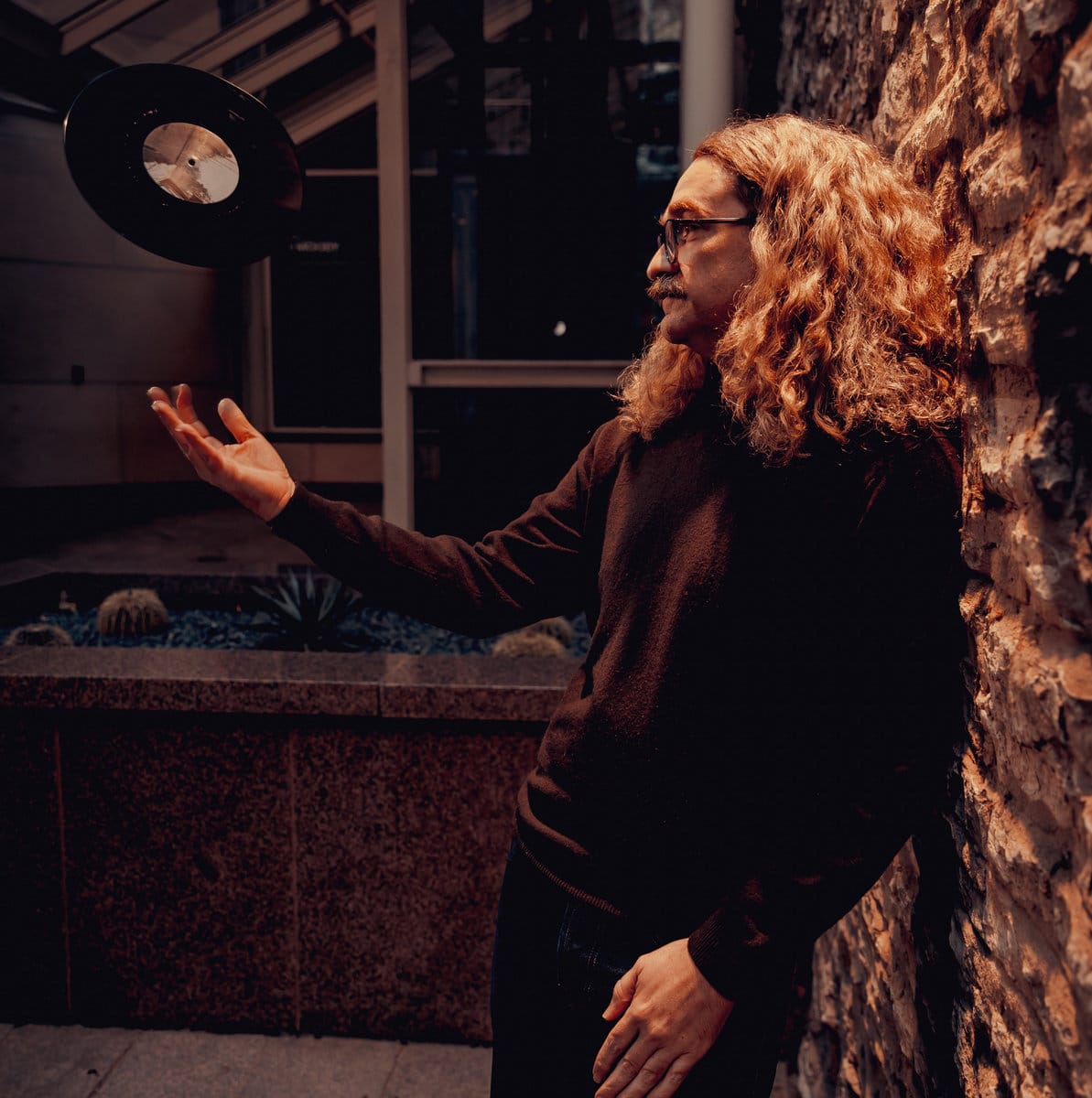
There’s a certain kind of dance music that feels less concerned with chasing the moment and more interested in creating one. Austin-based DJ, producer, and lifelong vinyl obsessive Nathan Stewart has spent years cultivating exactly that space, blending deep house, slo-mo disco, funk, acid, and Balearic influences into a sound that feels both deeply rooted and effortlessly timeless.
Now returning to Whiskey Pickle Records for his fourth release on the label, Stewart presents Return To Reverie EP, a three-track journey through warm analogue grooves, hypnotic rhythms, and slow-burning acid-disco territory. The EP opens with “Another Orbit,” featuring fellow Austin musician and producer Claude 9 on cosmic, spacey keys, before moving into the dubbed-out acid romance of “Bring It Back.” “Dream Sequence” closes the original EP with a deeply hypnotic modern-funk groove, while UK expat and Tokyo resident Max Essa adds his own unmistakable Balearic touch with a dreamy, sun-soaked remix.
With the digital and streaming release arriving August 7, 2026, and the vinyl edition still to come, we caught up with Nathan to talk about Return To Reverie, working with Claude 9 and Max Essa, his obsession with records, the importance of taking things slow, and why following your musical instincts can still lead somewhere special.
1. Return To Reverie feels like a very natural meeting point between deep house, acid, disco, funk, and Balearic music. What was the initial idea or feeling you wanted to capture when you started working on the EP?
At the time that the Dream Sequence track was coming together, I remember finding immense delight in this mental image of a person being abruptly awoken from a dream state and immediately attempting to fight their way back into a sleep state. That became the seed for the musical theme I wanted to explore for this EP – being pulled from a daydream just as it is getting good and attempting to reject the waking state in order to get back to the dream state.
As the project developed, I began seeing each track as a different part of that musical theme. The filter work and splashy delays of Dream Sequence evoked the spirit of the initial dream state. Bring It Back, with its deliberate pacing and gradual unfolding, felt like an attempt to get back to that dream state. And finally, Claude 9’s stellar synth work made Another Orbit feel you had finally made it back and were reveling in the return.
2. “Another Orbit” features Claude 9 on some seriously cosmic keys. How did that collaboration come together, and what did his contribution bring to the track that you weren’t expecting?
Claude’s name has been on my radar since the early 2000s, but I had never met or chatted with him. Fast forward to 2025, and I heard from Ken Christensen that he and Claude are collaborating for their New Human Music label. At some point, I ended up in a group chat with them both (which is how I got his number). I knew early on while working on Another Orbit that it needed some keys or a good synth line to bring it all together. As I was kicking around potential musicians to reach out to, it occurred to me that I had Claude’s number. So I essentially just cold-called him (or cold-texted in this case) asking if he would be interested. He gave the track a whirl and said he was down.
The most surprising thing for me was how easy it was. There’s sometimes an expectation when collaborating with someone new that there will be a lot of back and forth trying to get on the same page and land on a mutually agreeable idea. None of that was necessary because the first version Claude sent was exactly what I was envisioning for the track. The two synth lines he sent (I definitely was not expecting more than one) fit perfectly on the track. His synth work was exactly what the track needed.
3. “Bring It Back” has that wonderfully dubbed-out, filtered acid quality while still maintaining a soulful groove. What draws you to acid, and how do you approach using those sounds without letting the acid element take over the entire track?
The 303 has a distinct sound that can easily steal the show and is one of those instruments that is easy to get carried away with. You get a pattern dialed in and you just want to let it rip. Because of that, I tend to be very restrained in how I integrate acid to a track, using it more to accentuate rather than dominate.
One of the main appeals for me to the acid sound is the programming. I’ve spent a lot of time getting my fingers nimble on the keys so I can play bass lines and key licks with a bit of confidence. 303 programming feels very rudimentary in that you are iterating through each step, choosing the notes and deciding accent/slide rather than fluidly playing it out on the keys. It feels like the decision-making is more deliberate. Working like that transports me back to when I was first dabbling in music production and using the piano roll to program everything.
4. “Dream Sequence” already has a hypnotic, slow-burning quality, but Max Essa takes it into much more of a sun-soaked Balearic direction. What made Max the right person for the remix, and what was your reaction when you first heard his version?
I have been a Max Essa fan for years, so when Adam casually dropped his name as a possibility for a remixer, the excitement was immediate. To me, his music has this dreamy, somewhat whimsical sense of hope that makes me feel l am in exactly the right place at the right time. I could not wait to hear how he would wrap those musical sensibilities around Dream Sequence.
I was in a hotel in Vegas when Adam sent Max’s remix my way and I didn’t even bother digging out earbuds – I just played it from the integrated phone speaker. Even under those subpar listening conditions, it blew me away. I just remember repeatedly saying to myself, “I knew it” while giving it a listen. He did a brilliant job of keeping the original elements of the track while flipping it through his signature vibe. It was magnificent, and that damn phone was not doing it justice.
5. You’re returning to Whiskey Pickle for your fourth appearance on the label. What keeps bringing you back to the label, and how has your relationship with Whiskey Pickle evolved over the years?
The easy answer to what keeps bringing me back to Whiskey Pickle is label boss and head honcho Adam Warped. I’ve known Adam for what feels like two decades, and what began as a meeting behind the decks as a fellow DJ has over time developed into a treasured friendship. He is a wealth of musical knowledge that is always eager to share musical discoveries. More importantly, he always has an available ear when I’m kicking around ideas (musical or otherwise) and is honest with his feedback. I feel that is a hard thing to find in this industry. The foundation of the relationship with the label is the great friendship, which makes it easy to come back to the label when Adam wants to release something of mine.
6. You’re also a serious vinyl collector, and that relationship with records seems deeply connected to your production and DJing. Has digging for records changed the way you make music, or do the two sides of your musical life operate independently?
The relationship between digging for records and how I make music has always been present. When I first started producing, I leaned heavily on disco records as the source of inspiration for track ideas. Over time, I started booking gigs that were less dance-floor oriented, which broadened the scope of the kinds of records I was adding to my collection. These new records acted as an inspiration for new studio ideas, whether it be direct samples, interesting arrangements, or musical motifs, which motivated me to dig for an even wider variety of music. This bin-to-studio pipeline keeps me curious and open to discovering new music, which means not immediately breezing past unfamiliar or less interesting-looking records and being willing to give anything a listen. I try to maintain that same approach in the studio. Where I was once quick to discard ideas before trying them out, as I felt they “wouldn’t work,” I am now more willing to just follow these whims to see what comes of them. The digging feeds the creativity in the studio, which feeds the desire to dig for more records.
7. You’ve released music under several different names and projects, including The New Black, Hideo Takamini, Sir Stewart, and Backseat Bingo. What do you enjoy about working under different aliases, and how do those projects allow you to explore different sides of your musical personality?
There are a few different elements that make me truly adore working under aliases. Part of it is that the alias acts as an anchor point to an era in my music. Based on what name was in use, I can distinctly recall what style of music I was creating and what themes I was exploring. Aliases also bring a bit of light-heartedness to music making. There is a tendency when creating music to take things too seriously and I forget that this is supposed to be fun. So some of the joy of the alias is the absurdity, the silly references (for example Hideo Takamini being a call back to the 1980s movie Space Camp). It reminds me that it’s just music and it is perfectly ok to enjoy it for the sake of enjoying it. Finally, much like an actor taking on a new role, the alias allows me to venture off the beaten path and let my curiosity take the wheel. I have the freedom to get weird with ideas and try new things. It is kind of an easy exercise to stay fresh.
8. There’s a real sense of patience and restraint in your music—grooves are allowed to breathe rather than being rushed toward a big payoff. Do you think the current dance music landscape gives producers enough space to make slow, subtle records?
I think the current landscape absolutely allows for this. At the moment, I think that dance music is in this wonderful space where there is something for everyone. If you want a record that rushes towards a big payoff, it’s there. If you want a record that is a 3-minute, radio-ready bop, it is there. If you want a record that is slow, subtle, and deliberately paced, it is there. Dance music has become so accessible and the audience is so diverse that it allows producers the freedom to make records like this. Really, the only thing preventing a producer from making slow, subtle records is the producer deciding for themselves not to make slow, subtle records.
9. Austin has such a distinctive musical history and culture, from funk and soul to electronic music and the wider underground scene. How much does living in Austin influence the music you make and the way you approach DJing?
I’d say that Austin’s influence on my music and my approach to DJing has less to do with the rich musical history and culture of the city and more to do with the fact that this is the environment where I have existed for the last decade or so. My daily experiences, from which I draw inspiration, result from my being geographically located here. The influence comes from a trip to Breakaway Records for a quick dig through their used bins. The influence comes from the initial shock of diving into the 68° waters of Barton Springs. The influence comes from my landlord going on a bender and leaving a 4.5L tank of Cookies & Cream Cosmic Gas on my porch. Existing in this environment is how living in Austin influences the music I make.
10. Your bio talks about following your heart and having a “hot, steamy love affair with music.” After all these years of collecting, DJing, producing, and releasing records, what still makes you fall in love with music—and what are you currently excited to explore next?
The thing that has kept this steamy love affair with music so hot has been music’s reliable nature. Regardless of whether I am riding high on the successes of life or being mercilessly beaten down by the world, music is always there. There is no way to replicate the feeling I experience when I hear an amazing song for the first time. Think about a song that you absolutely adore and think about what it was like hearing it for the first time; that feeling keeps me falling in love with music. And there is so much of it! There is so much good music in the world (both old and new) and I can never hear it all. Knowing that the limit exists means that it is a precious commodity, which makes me treasure what I can hear even more.
I have a few exciting projects on the horizon including a fresh collab with Claude 9, assembling tracks for a few new EPs, a bit of remix work, and finally getting Outdoor Activities Recordings off the ground and pressing up some records. I am also excited to explore creativity in other mediums as a way to inspire new musical ideas. There was a time in my life where I was fairly decent at drawing and it seems like that could be fun to take back up. Finally, I would be remiss if I did not mention the unadulterated pleasure I have been experiencing writing my monthly Small Delights newsletter (https://small-delights.beehiiv.com).

Magnetic byline note: This byline is used for staff produced updates and short announcements, often based on press materials and official release information. Editorial responsibility: David Ireland (Editor in Chief) and Will Vance (Managing Editor). About: https://magneticmag.com/about/ Masthead: https://magneticmag.com/masthead/ Contact: https://magneticmag.com/contact/