AI music software has spent the past few years dealing with an identity problem. Most of the public conversation has focused on text prompts generating complete songs, usually followed by arguments about copyright, authorship, training data, and whether the person entering the prompt can claim any genuine creative ownership over the result.
Those questions remain unresolved, although they represent one section of a much larger production category. The AI features gaining ground in 2026 are often narrower in scope. Producers are using them to extract stems, test vocal ideas, create temporary demos, repair recordings, and explore arrangements before committing several hours to a direction.
That distinction has become increasingly important. Entering a sentence and downloading a finished song removes most of the decisions that allow an artist to develop a recognizable identity. Asking software to isolate a vocal from an authorized recording or convert your own vocal performance into another approved voice model presents a different creative relationship. The producer still decides what stays, what gets removed, and how the generated material fits within the record.
This is where AI is earning a place in production. It can reduce the time spent on technical preparation while leaving the musical decisions with the person making the record.
AI is becoming part of the regular production process
One of the clearest changes in 2026 is where these features live. Stem separation previously meant uploading a file to a website, waiting for it to process, downloading several files, and importing everything back into the DAW. The process worked, although the interruption made it feel separate from production.
That barrier is disappearing.
In my article on Ableton Live 12.4, I covered the company’s updated stem-separation system, which lets producers divide audio into separate elements from within Live. LALAL.AI has taken a related approach with its VST plug-in, as discussed in my coverage of its six-stem expansion. AI processing now sits much closer to editing, sampling, and arrangement.
That placement changes how producers use it.
A vocal can be isolated and tested over a new progression before someone commits to a remix. A drum recording can be divided so that individual elements can receive different processing. A rough song can become reference material for tempo, arrangement, or instrumentation without being treated as a finished record.
Text-to-song generation has also started moving toward early-stage development. Lalals’ AI music composer allows someone to describe a musical idea and generate audio from that request. I would treat this type of result as a sketch. It can help determine whether a tempo, vocal approach, or arrangement concept warrants further work, after which the producer can rebuild the idea using their own performances and production decisions.
This approach also answers some of the concerns I raised in my previous article on companies combining AI and music production in 2026. The ethical question depends heavily on what the software was trained on, what rights are granted, and how much of the released recording is generated. Producers need to read the commercial terms before releasing any generated material.
Five AI voice and music tools producers should know
Lalals
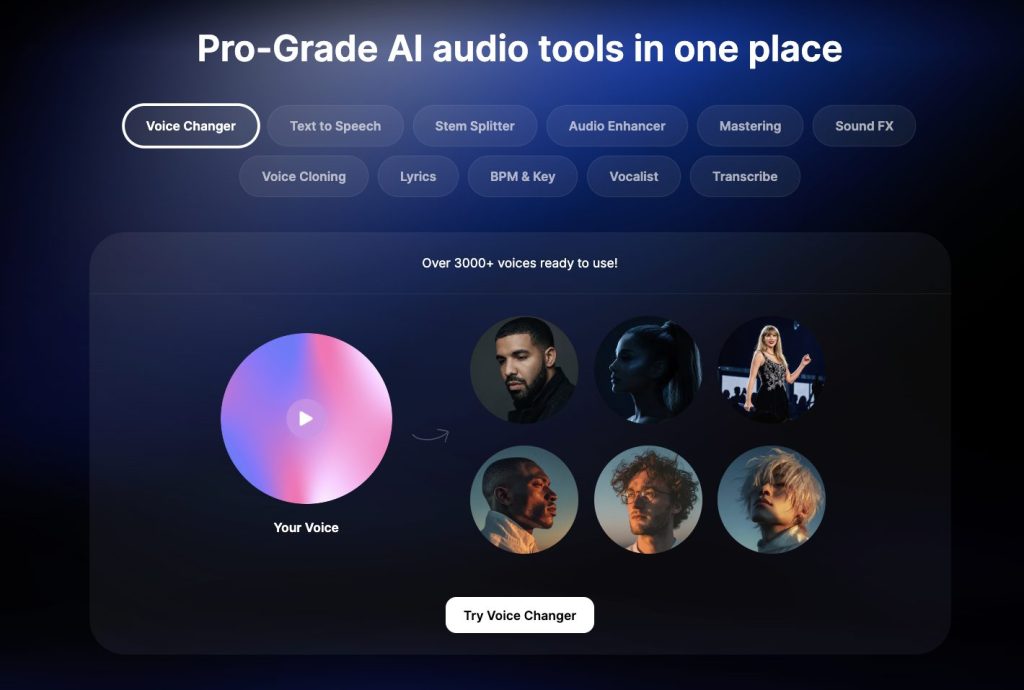
Lalals combines song generation, voice conversion, stem extraction, voice cloning, and audio processing inside one browser-based platform. The broad feature set makes it suited to producers who want to test several AI-assisted processes without maintaining separate accounts for every task.
Its AI-powered stem splitter has clear applications for remix preparation, authorized sampling, reference analysis, and recovering individual elements when original project files are unavailable. Separation quality will depend on the source recording. Dense mixes, heavy distortion, reverb, and overlapping frequencies can still produce audible artifacts.
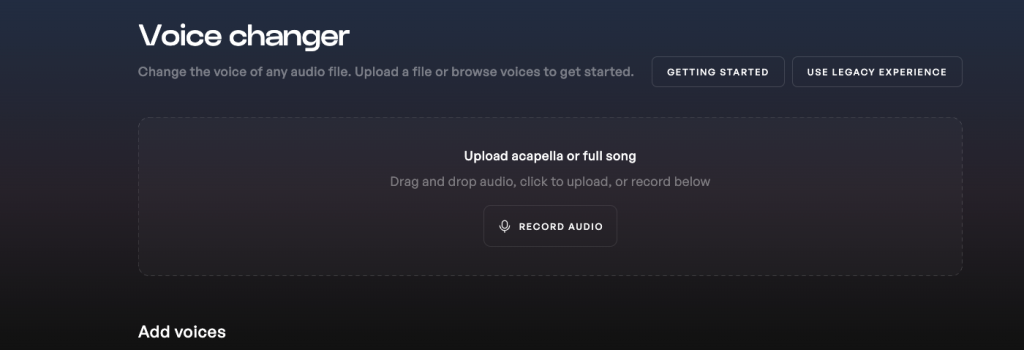
The platform also includes an AI voice changer tool, which converts an uploaded vocal into a selected voice model. This can help a producer test whether a topline suits a different register or vocal character before approaching a singer. Consent and licensing remain essential. A recognizable person’s voice should never be cloned or released without permission.
Suno

Suno remains closely associated with prompt-generated songs, although its recent development has moved toward editable production. Its song editor, audio-upload features, stem exports, and Studio environment give producers greater access to the material behind each generation.
The best application is rapid composition testing. A producer can upload an original melody, explore arrangement directions, and identify sections worth rebuilding. The weaker application is treating the generated file as a complete substitute for writing, recording, and arranging. That approach can produce acceptable audio quickly, although it gives the artist fewer personal decisions to carry into future releases.
Udio
Udio provides text-based generation alongside audio uploading, extension, editing, and stem-related features. It works well when a producer has an unfinished section and wants to test how it could develop over a longer arrangement.
Copyright remains central to any use of generative music. Udio has faced continuing legal scrutiny concerning training material, so producers should check its current terms before using output commercially. For private sketches and arrangement studies, it can still offer a fast way to compare possible directions.
Kits AI
Kits AI concentrates on vocal production. Its features include licensed voice models, custom voice creation, voice conversion, harmony generation, vocal removal, and text-to-singing. The company states that its vocal generator is trained on licensed data, which gives producers a clearer starting point when assessing potential release rights.
I see the main application in demo preparation. A producer who can write melodies without delivering a finished vocal performance can record a basic take, convert it, and send collaborators a clearer representation of the intended phrasing. The converted result can then be replaced by a vocalist once the song moves toward release.
ACE Studio

ACE Studio approaches AI vocals from the perspective of detailed vocal programming. Producers can enter lyrics and MIDI information, select a singing voice, and edit pronunciation, pitch, timing, and expression. This gives it a closer relationship to vocal synthesis than one-click song generation.
It suits producers who already have a melody and need a controlled demo. The MIDI-led process keeps composition decisions in the producer’s hands while providing an audible vocal part for arrangement work. It can also expose problems in a topline early, including awkward ranges, crowded phrasing, or sections that fail to leave enough space for breathing.
The defining change in 2026 is that AI music software is becoming less focused on replacing the entire production process. Stem extraction, vocal prototyping, repair, and arrangement testing address specific jobs that already exist inside a producer’s routine.
That still leaves responsibility with the artist. In my interview with O’Flynn about AI and the human production process, the broader concern was what gets lost when software removes the time spent experimenting and personally developing ideas. Speed can aid preparation, although an artist’s identity still comes from repeated decisions made throughout the record.
The best AI music tool is therefore the one that solves a defined production problem while allowing the producer to retain authorship, judgment, and control over the finished music.

Magnetic byline note: This byline is used for staff produced updates and short announcements, often based on press materials and official release information. Editorial responsibility: David Ireland (Editor in Chief) and Will Vance (Managing Editor). About: https://magneticmag.com/about/ Masthead: https://magneticmag.com/masthead/ Contact: https://magneticmag.com/contact/