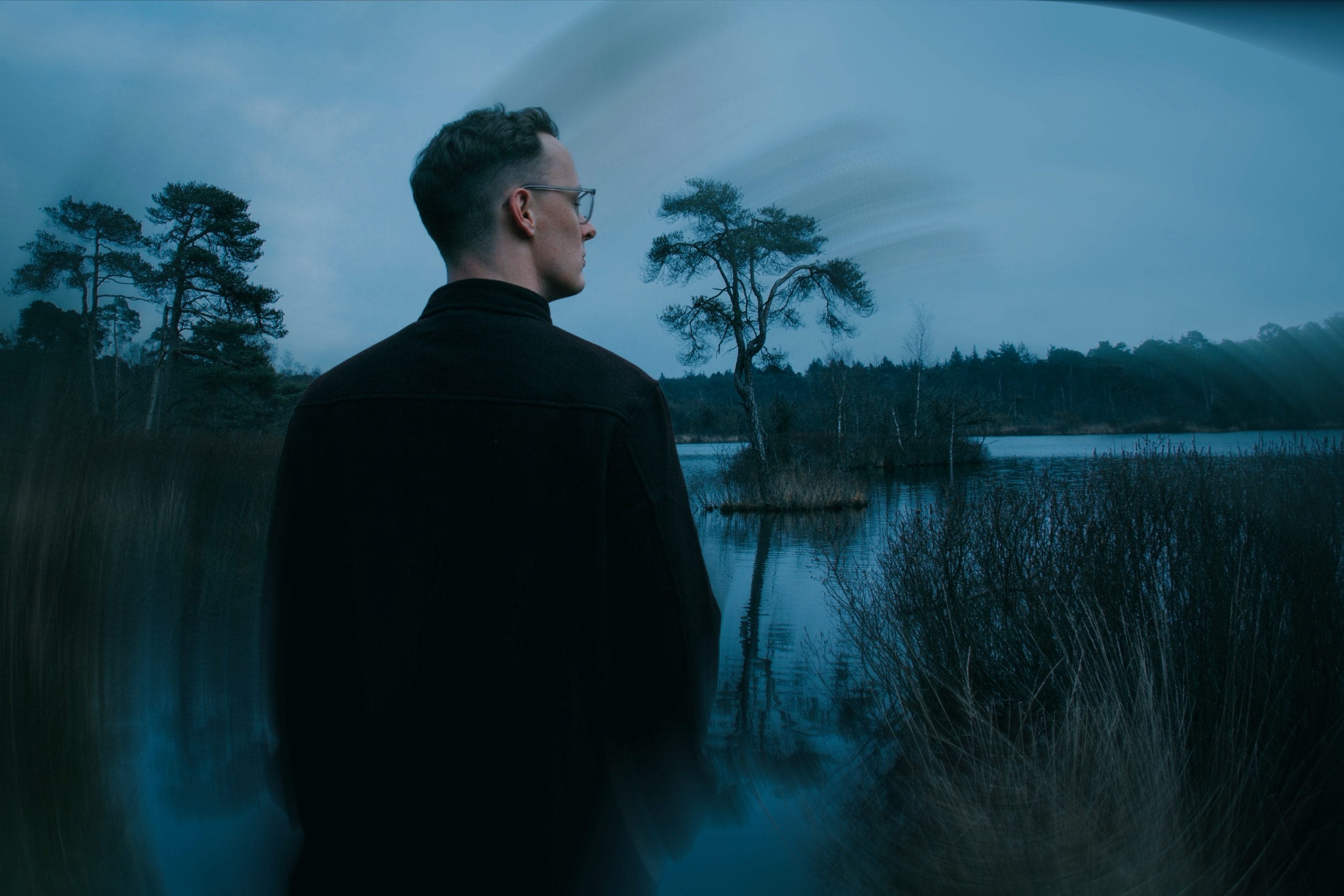
Corren Cavini’s new single “Agoraphobia” marked the start of a major creative chapter for the Utrecht-based producer. Released on Purified Records as the lead single from his forthcoming debut album A Place To Call Home (due October 10, 2025), the track carried his signature melodic techno style into more cinematic territory. Built on orchestral inspiration and textured electronic layers, Agoraphobia was both a tribute to the Dutch event series Pleinvrees and a reflection on music as sanctuary.

In this feature, Cavini breaks down how he achieved its orchestral weight and electronic intensity inside the studio. From pushing Kontakt’s Session Strings 2 to its limits, to layering multiple libraries and synths, to reshaping transients with Ableton’s new Roar and Native Instruments’ Transient Master, every choice was aimed at creating impact. The result was a production that blended harmonic depth with club-ready power.
Cavini’s approach is as much about mindset as tools. By treating the arrangement like an orchestral score and deliberately bending production “rules,” he found the balance between personal storytelling and dancefloor energy. Agoraphobia offered the first glimpse into his upcoming album—one that promises to merge emotional weight with finely tuned electronic detail.
The rest of the words are from the man himself, Corren Cavini…
Session Strings2
Kontakt is up there with the most used and most well-known audio plugins in the world. It’s been the leading multisampling device for as long as I have been producing, and with the near endless amount of banks you can find out there nowadays it offers limitless options. It’s famous for arguably being the best tool to emulate acoustic sounds like orchestral strings and horns, and for Agoraphobia I set myself the challenge to blend the sound of a bombastic orchestra with hard hitting melodic techno.
With that idea in mind, it makes sense that I ended up using one of Kontakt’s most famous libraries: Session Strings 2. Since I was chasing a blend between orchestral and hard hitting electronic sounds, I ended up ‘blowing up’ the cellos and double basses that come from the plugin. There’s a couple of steps I took to achieve that.
Achieving a big sound by harmonic layering
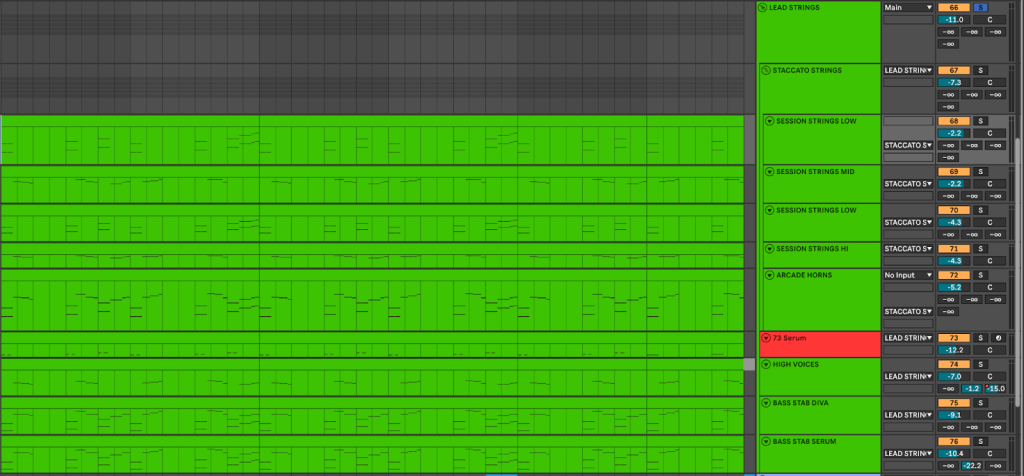
The most important part of making the stabs in Agoraphobia as big as they are, is the layered harmony. Like how a good orchestra sounds impressive by having a lot of highly skilled instrumentalists play a score, there are various complementary melodies played by multiple instances of Session Strings, supplemented by sounds from Output Arcade, Arturia Augmented Voices and bass stabs from U-He Diva and Xfer Serum.
In my production style, it is absolutely key that harmonic layering is not just a matter of copying the same midi clip into multiple instruments. I try to get into the mindset of an orchestral arranger, listening thoroughly to which notes should be played by which instrument. For example, in this case the cellos and double basses are playing the low notes in two low octaves, while different cellos and violas answer those stabs with a movement that starts a minor third above those bass notes. Meanwhile, horns that come from Output Arcade follow the melody of those string instruments combined and have more of a ‘backbone’ function in this part. A high vocal chop goes along with the violas, except that one is two octaves above, giving a more ethereal energy. Finally, the low stabs get ‘beefed up’ by some strongly distorted digital synths that play plucky notes in the mid bass range.
Increasing the impact of single string hits
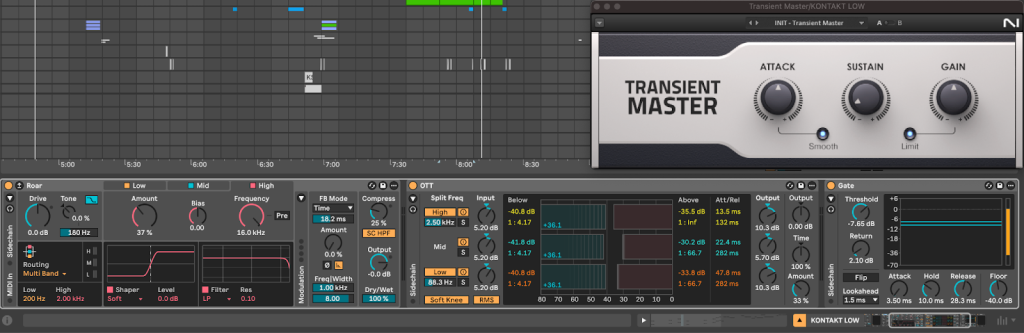
The way notes are played straight out of Session Strings 2 doesn’t have a lot of impact. To increase that drastically, I made a simple plugin chain that consists mainly of Ableton native plugins.
The most important and first step in the chain is Roar, on multiband mode. This is a really nice sounding distortion/saturation unit, with a lot of possibilities. For distortion and saturation, I’m a big fan of Fabfilter Saturn 2, but since the introduction of Roar in Ableton 12 it has been overtaken almost entirely, to my own surprise. What I love about Roar is not it doesn’t just sound insanely good, it’s also very easy and quick to use and light on CPU.
After supplementing Roar with some medium OTT processing, the strings sound really strong and beefed up. However, the transients are still quite messy. In this case I opted to solve that with really specific gating and transient shaping rather than finicky compression (although on the bus with all layers there is some of that going on). I used Ableton’s native gate to stop the sound ‘echoing’ through after its initial hit. To soften the harsh stop of the sound, I set the release of the gate to around 30ms. After that, the incredible Transient Master by Native Instruments does the final job on the individual stems, strongly decreasing the sustain.
Learning from this approach
As I’m going through this project, I’m realizing the most important aspect of the process is how methodical I am with all of these choices. There are certain conventions about how to write orchestra voicings, how to use mixing tools and handle dynamics, and I’m quite sure I break most of them in this project.
However, I managed to make this track sound exactly the way I wanted because I made these decisions very consciously. Rules and conventions don’t matter, but they exist because they can be a guide. When, with enough time and effort, you become experienced in your own artistic skills and taste, you develop the confidence and know-how to deliberately ignore the rules.

Will Vance is a professional music producer who has been involved in the industry for the better part of a decade and has been the managing editor at Magnetic Magazine since mid-2022. In that time period, he has published thousands of articles on music production, industry think pieces and educational articles about the music industry. Over the last decade as a professional music producer, Will Vance has also ran multiple successful and highly respected record labels in the industry, including Where The Heart Is Records as well as having launched a new label with a focus on community through Magnetic Magazine. When not running these labels or producing his own music, Vance is likely writing for other top industry sites like Waves or the Hyperbits Masterclass or working on his upcoming book on mindfulness in music production. On the rare chance he's not thinking about music production, he's probably running a game of Dungeons and Dragons with his friends which he has been the dungeon master for for many years.