A bass-rich, powerful new project from the London duo ARKELL LDN
One of the UK’s most revered and respected duo of performers ARKELL LDN share a powerful, breaks-driven project. The new EP, featuring three tracks—”LIVE FOREVER,” “Contact,” and “Horizon”—showcases the duo’s unique fusion of drum & bass and electronica. John Arkell and Ali Thynne, seasoned drummers with a rich history of performing with notable UK artists, bring their extensive experience to this project.
Inspired by acts like The Prodigy and Soulwax, ARKELL LDN crafts an uplifting sound with an “irrepressible energy,” also drawing euphoric influences from artists like Fred Again and Caribou. The duo aims to create a soundtrack for moments of intense energy and focus, evoking feelings of euphoria and achievement. Their music is described as a “natural high,” perfect for moments of inspiration or deep immersion.
We asked the duo to talk us through their studio setup, tips and tricks for their unique bass-driven sound
Listen to the full project below
SERUM
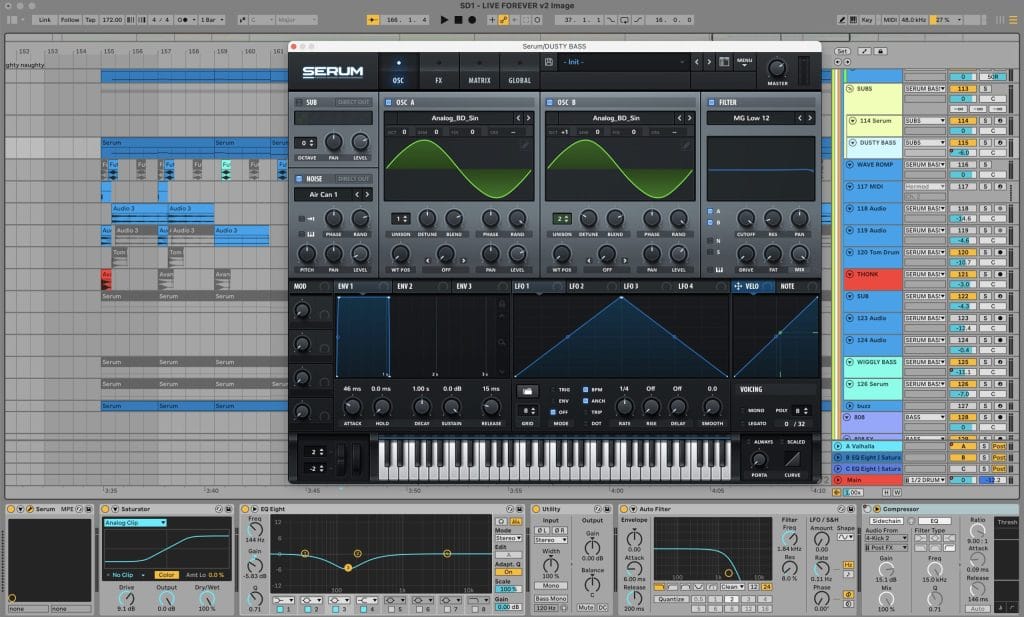
Serum, everyone loves Serum, it’s powerful but playful. I wish we had some cool obscure soft synth to reveal but this really is our go-to for getting initial ideas together. Two oscillators and clean sub in the right places is all you need sometimes. I like that you can see how gnarly you’re making things as you’re working. You’ve got to be careful though because this plugin can very quickly sound like some kind of face-tearing EDM lead which we’re not really after. Lately using its basic waveforms usually gets what we need from a bassline, whilst having so much control means you can tickle and tidy your sounds and add a bit of spice.
Live Forever has lots of layering, and lots of instances of Serum which are great alongside Ableton’s ‘Analogue’ synth and ‘Saturator’ plugins. We selected which work together, but each instance is as strong and as simple as possible, and only used in that section or even bar of the track for the right reason, where it feels good.
I used to do a lot of resampling, before deleting the plug in and saving the project as a new version. It’s a good way to force yourself to move forward and commit to an idea, and saves tons of CPU. Ali Prefers to keep absolutely everything, then mute and unmute the previous ideas and blend them that way, so you hang onto the initial idea and stay true to the first idea/feeling for the track. You can get into trouble and find yourself stuck with both ways, either by going off on a tangent based on a bad idea that can’t be undone, or by getting too precious over something that just needs to be deleted. A combination of the two usually gets us to a happy place.
If we can’t make the sound that’s in our heads or were trying to reference, there’s no shame in going on YouTube and looking for help. I would say try and build the sound from scratch a few times once you find what you are looking for, so you can really understand what’s going into making it and can have more fun with it next time. In Live Forever we have a preset called ’Sam’s Bass’ and another called ‘Arkell Dusty’ which are just slightly tweaked versions inspired by a guy called Sam Smyers on YouTube. One is super clean Reese FM sound to start with or go back too, the other is based on a simple sine wave which just always manages to glue two ideas together for a bit more wallop.
AUTOTUNE PRO
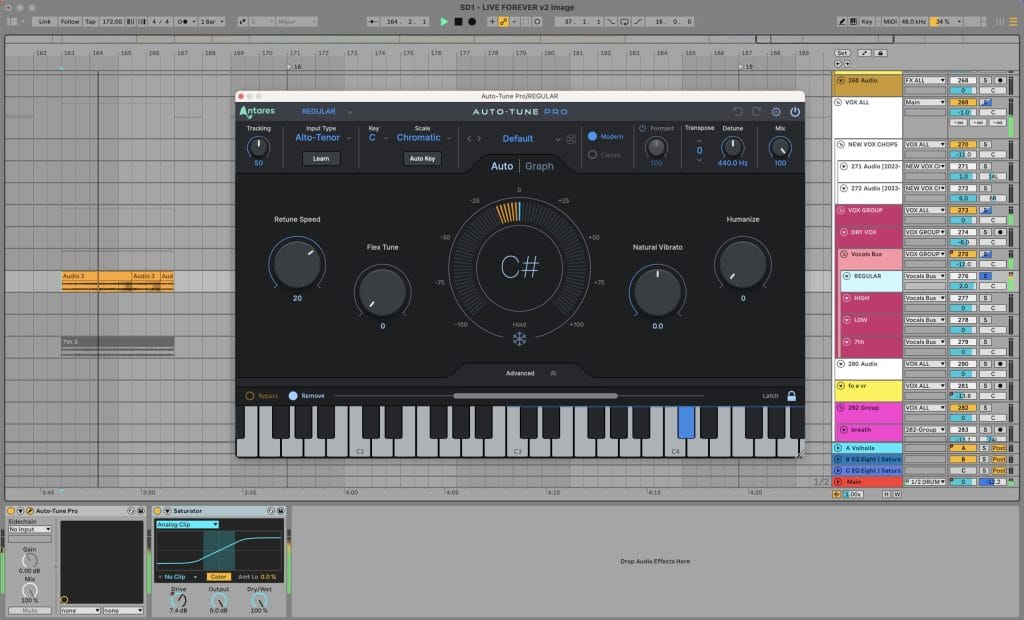
I can’t sing for sh*t, and my tone is like a toddler whining, it’s terrible. But I can weirdly hold a note quite high, so me wailing through Autotune with a bucket load of reverb and delay is a sound I use in most of our demos once they start to take shape. Mixing in “real” sounds with all the synths can really add depth, the imperfections and subtle organic modulations in a voice for instance are something a digital source just can’t replicate. I think it’s important to play to your strengths no matter how uncomfortable they seem at first, you never know what you’re going to find, especially if you’re not afraid to admit you tune your terrible vocals.
In Live Forever it’s all over the Outro, a few of the tracks have an extended section like this, where we can introduce a new idea and not have to conform to any of the previous ideas or structures, it’s all feeling. In the outro for Live Forever we strip it all down to pretty much just a kick & sub, whilst all the vocal clips and cuts that have gone through Autotune are soaking wet, re-sampled, reversed and mangled to create atmospheric vocal stabs and samples that has kinda become part of our sound. We actually come up with some of the sickest ideas in these sections that could totally become whole new tracks in their own right. I think when you feeling free from trying to make something specific you make the best music, plus we can really go to town and flesh out these sections when we play live.
It’s definitely an addition or decoration, and rarely the starting point for a riff, but DnB/Bass music goes hand in hand with vocals. There’s something about having a bit of natural human emotion all mushed up against weighty digital sounds that always works for me. There are all kinds of vocal AI tricks out there now, which I don’t really care for, at least with this plug in or similar you can use a real voice or try some mad vocal ideas that are truly original.
SPITFIRE LABS

We use Spitfire LABS plugin a lot to add more organic, real world sounds to our productions. It’s a sample-based plugin that has tons of different instruments which all have amazing character to them straight out the box, plus it’s totally free! There’s not a great deal of sound customisation available but the samples already sound so good that it’s never a problem. It has everything from pianos, to whale song, to ambient atmospheres, to choirs. The Foghorn preset in particular is amazing for adding excitement on top of a simple sine wave sub bass.
We use the Tape Orchestra and Frozen Strings presets in Live Forever. Just adding a bit of Ableton stock reverb and saturation then LFO Tool for some movement creates some lush pad sounds. Soft Piano is also a favourite if you want a beautiful, organic sounding piano.
LABS is another great way to add original character and organic, unpredictable sounds to a production. It both softens and compliments the more aggressive, in your face sounds of this kind of music. It’s very useful to help songs breathe a bit more and not just sound like a collection of fake plastic synths.
MODULAR SETUP
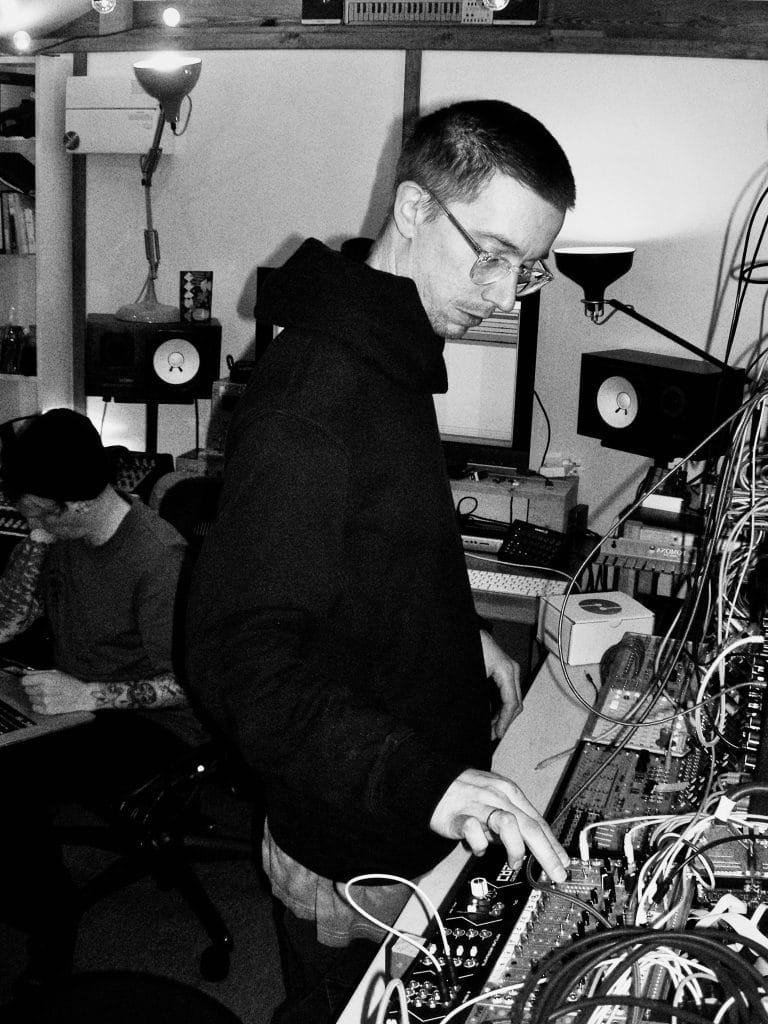
Not technically a plugin but we make use of sounds and take inspiration from ideas built on a modular synth as often as we can. It’s a hardware synthesizer that can be patched to create an endless stream of possibilities. While you can approach it with an idea its unpredictable nature makes it something you need to work with, see how it reacts, listen to and respond to. It always leads you to a place of creating ideas and sounds you could never conceive alone.
The main 808-ish bass sound towards the start of the song was made using the Audio Damage BOOMTSCHAK running through the Retro Mechanical Labs Fuzz Custom to create a big fuzzy 808 with a long decay. The main lead sound was made using the Mutable Instruments Rings module which is a resonator synth that’s great at creating organic, plucky sounds and running it through Mutable Instruments Clouds to add granular pitching effects and reverb. We also used Make Noise’s Erbe-Verb as a reverb send for some sounds and the atmospheric textures at the start of the track.
We find modular synthesis is great as a starting point for inspiration and can be used to help create ideas and soundscapes you wouldn’t otherwise think of. It can be really useful as a way to add more unconventional and organic sounding parts to a production that can really bring it to life. While it can be tricky to wrangle and the sounds often need some heavy eq and processing to get them where you want, the effort is almost always justified. Also, it always pays to be constantly recording when experimenting as you never know when an exciting idea will materialise that you don’t want to lose.