Table of Contents
A lot of modern bass music achieves its loudness with ear-splitting volume through heavy compression that squashes all the dynamics of the music. Sure, that has its benefits and stylistic purposes, but what I loved about old-school dubstep, back when I was really a bass head, was how it used saturation, texture, and sonic characteristics like warmth, grit, and attitude to achieve the same level of edge, fullness, and punch.
Maddy O’Neal is a modern dubstep producer who relies on these old-school sonic characteristics in her productions, and she’s completely knocking it out of the park. She gets that modern punch and power while retaining everything that made dubstep cool and swaggy back in the day. With her latest track, “Locked In,” featuring the vocals of ProbCause, we invited her to share how she made this song.
Unsurprisingly, she uses popular plugins like Serum, Volume Shaper, and Glitch 2 to create warble and artifact-filled details, along with tools from one of my favorite plugin companies, Minimal Audio. So, sit back and listen to the song below a few times to acclimate your ears before diving into the latest iteration of “How It Was Made,” featuring Maddy O’Neal and her track “Locked In,” an old-school dubstep banger for the summer of 2024.
SERUM
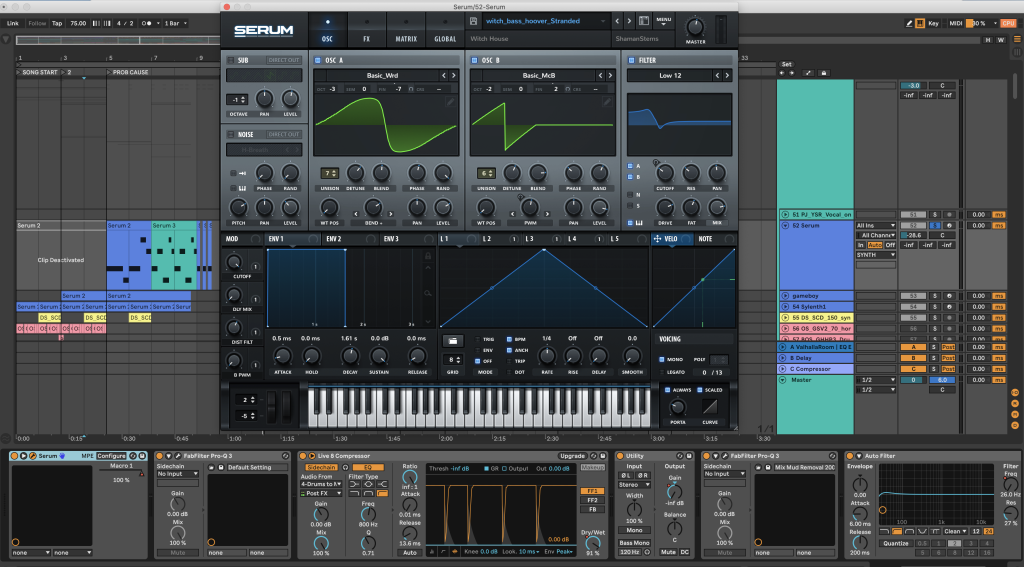
This track in particular is chalk full of Serum-based synth tones. Serum is usually one of my main go-to synth’s in general but this track in particular has layers and layers of lead tones, stacked on top of one another to make that huge main synth line pop. This plugin is so user friendly and easy to navigate that it has become a main ingredient in my projects. This advanced wavetable synthesizer makes it so easy to navigate and manipulate tones.
One of my favorite things to do is automate the wavetable position to give your synth tones some subtle movement as they flow through the track. Some of my other favorite features of Serum are the drag-and-drop modulation automation and the unison tuning modes per oscillator, which allow you to beef up any sound and add so much more depth.
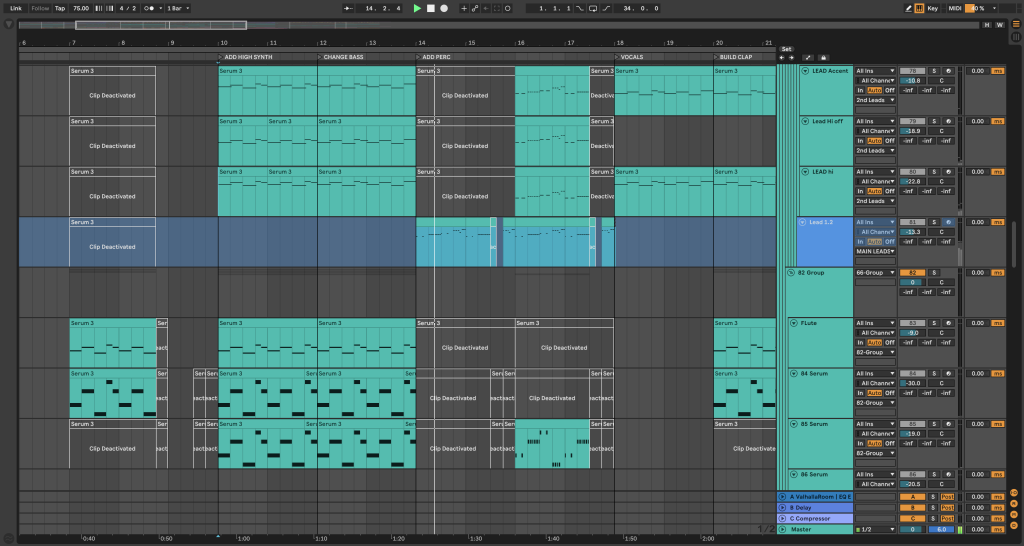
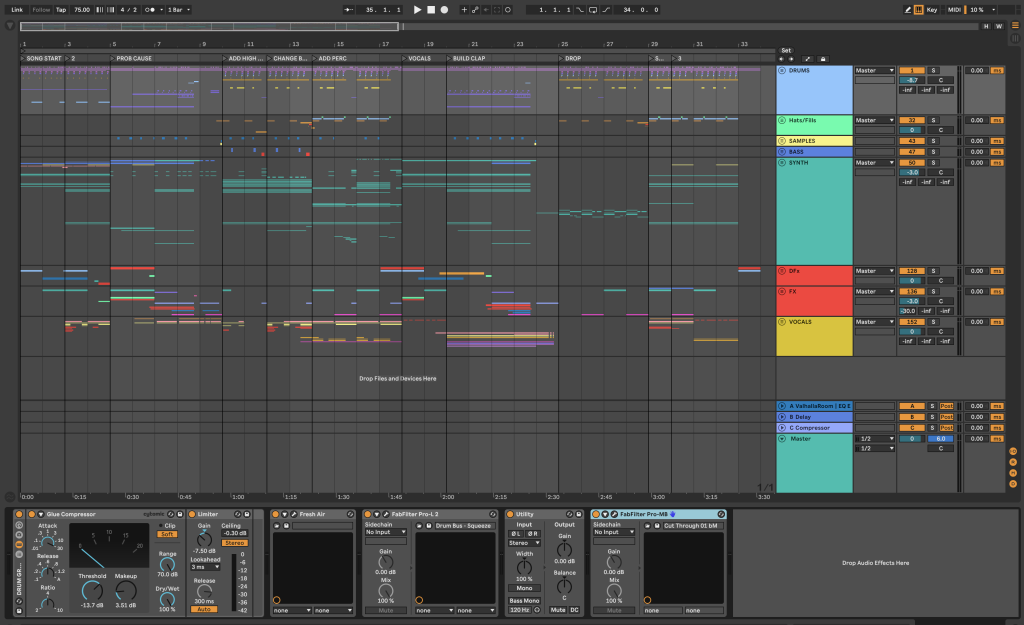
In this particular project I have used Serum to stack seven or eight layers of synth tones on top of eachother to create that main synth tone in the drop. There are six layers of lead tones with voicing and filters/wavetable automation in the mix. I was really trying to create a massive tone that spread across a wide range of frequencies to sound BIG in the mix. That main synth line is driving the whole track and I needed to make it stand out.
I even added some extra 7ths in unison to join in the chorus. I alternate the layers depending on the section to flip up the tonality and vibe while keeping the theme alive. Using volume shaper to duck/side-chain to different sounds in the mix was also crucial in this track to let the other elements shine underneath and create moments of push and pull. The layers range from a flute tone to a reece bass to synth leads named “Witch Bass Hoover” and “Big MEANY.”
This track was a fun mix of old school dubstep vibes using more future bass/warmer tones. I think when you are leading more towards the warmer synth vibes it’s important to make sure your sonic choices still sound THICK in the mix. You can still deliver power without it feeling like an aggressive tone and that’s the beauty in it. Serum has so many useful tools to help do that – the tips I mentioned above, and even just duplicating the same sound and changing up the wavetable, WT position, filter or octave can add so much depth.
Serum’s oscillators allow you to use up to 16 voices, and stack settings add so much when it comes to getting a fuller sound even in a single synth.
VOLUME SHAPER
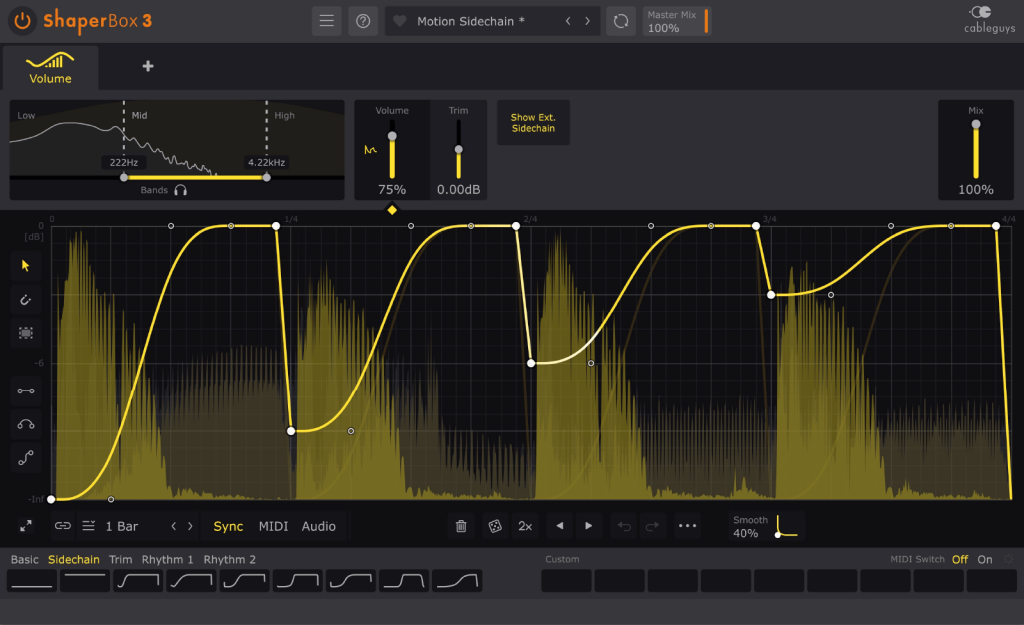
Volume shaper has been a godsend plugin to use for mixing and creative decisions alike. It is a multiband sidechain tool that you can use to gate, envelope, stutter or compress. When creating such massive projects, I am guilty of using so many tiny “sparkle” elements that add dimension but are super subtle sometimes. Not only do I use Volume shaper to simply side-chain and duck elements when others come in to create the space for them to exist, but I also use it to create stutter and tremolo with different envelope settings on different frequency ranges.
When it comes to using a side-chain effect of any kind there are the classic forms of use for mixing. Sidechaining the kick and bass to create space for the kick to gain punch and give the low end more definition, so the two hits are not competing. The more creative use of the tool is using it to carve space or modulation curve to give a section more pump/flow. I used volume shaper on all of the layers of the main leads, not only side-chaining them to the drums but chaining them to the glitch vocals and chopped sounds in the mix so they completely pull back to let the other elements breathe. It gave the synths more movement, flexibility and dynamic range that way. When ProbCause’s vocal samples – “gotta keep moving no stopping,” “locked in” and“moving” – are sprinkled in the mix, the synth tones ride the wave and get out of the way to provide punch for those moments.
Layering is key in any style of production, but the hard part is figuring out how to let all the sounds coexist. This tool is one of the best around to really define those spaces with precision. You can draw your own transients and tighten the decay elements to make certain things hit harder – choose what the main element in a section is and make it shine whether that be the bass, drums or synth.
Learn More About This Plugin Here
GLITCH 2
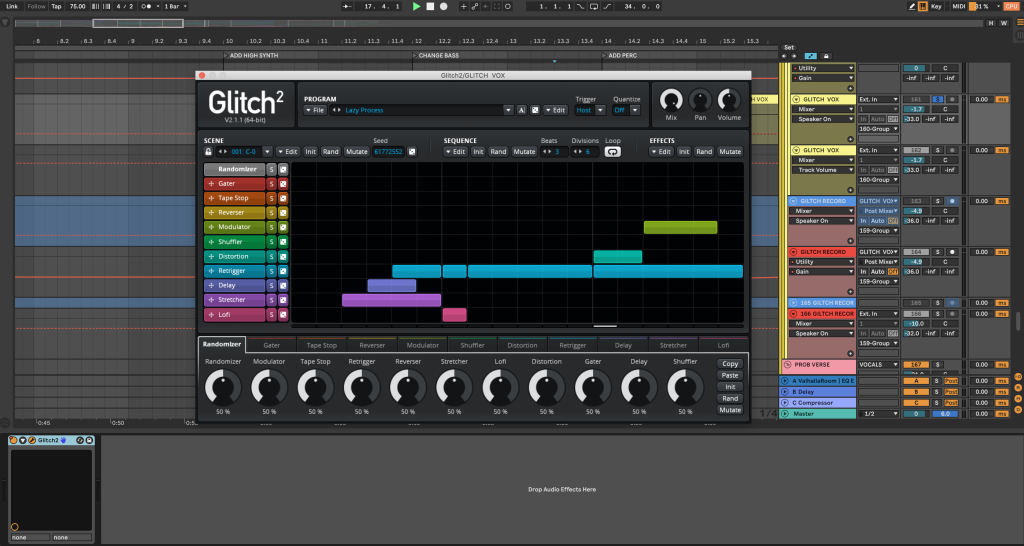
This plugin is one of the oldest tricks I discovered early on when producing and actually just came back around to using it. It is an Fx sequencer that can play and apply multiple effects simultaneously. You can draw in Fx notes or trigger them with midi to create a more random effect. Some of the Fx include: tape stop, shuffler, distortion, retrigger, stretcher and reverser. It is also tempo synced and each Fx module is controlled individually with mix filter and volume parameters to make precise glitches.
I use this particular effect on ProbCause vocals in this track. When I get vocals from any artist, I am always thinking about ways to chop and screw tidbits in the mix so we can keep the theme rolling while the heavier elements hit. I picked key portions of his hook “locked in/drop in/no stoppin,” and I threw a glitch on the channel and started to experiment. Some of the layers turned out much more textural than clearly defined vocals and that’s fun too. Distortion, stretch, modulate and delay were some of the go to Fx used for these particular chops.
One of my favorite parts of producing is the experimental/ random elements that can come into play while working that can transform an idea into something totally different. When you add random factors into the mix. it’s almost like you are being fed possibilities for creation. Glitch 2 is great for that – even if you get stuck or something sounds flat or dull, you could throw on Glitch and experiment with parameters to create the next section in a tune. It’s definitely a useful tool in taking things that exist in the track and creating the next version of that for the next section of the song to evolve.
MINIMAL AUDIO – RIFT
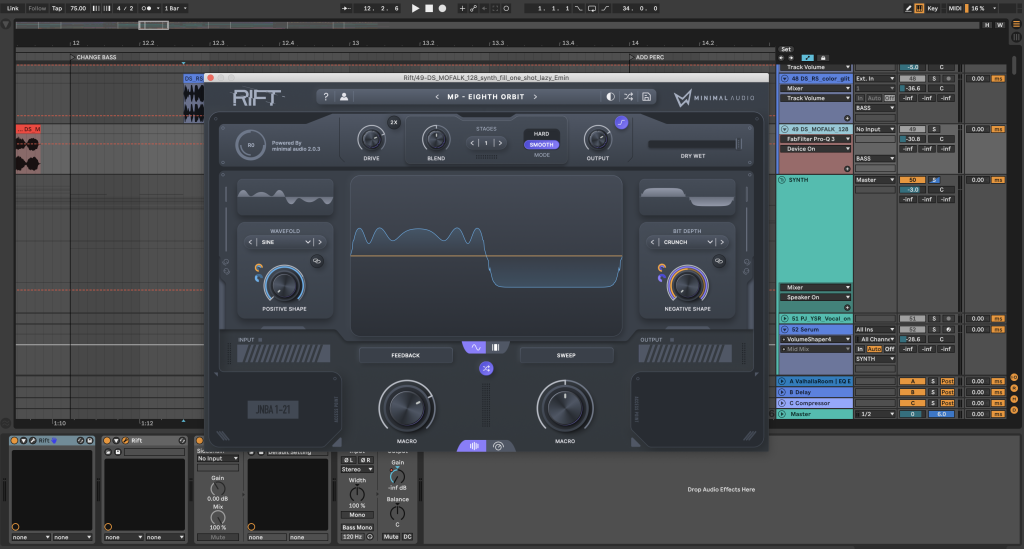
Rift has become one my new favorite Multi-Fx distortion plugins. It has a multi-polar processing engine with 30 different algorithms to quickly morph a sound into a grimey resonant tone with Fx, filters and distortion parameters that are so easy to use. You can literally slap this on any bass or synth tone and transform a simple sound into a beast in a few clicks.
Because I had so many different synths interacting with each other in this track I had to be careful that the choices I was making were intentional. A good rule of thumb is if you solo something and you can’t put it in the mix, it may not be serving you and just causing mud instead. I transformed some of the synth layers using rift distortion presets to make them stand out and take up a totally different space than they did before. Even adding a little bit of “sizzle” on top can make a tone cut through the mix in a totally different way. The distortion allows for a sound to take up or expand a frequency range in a way that sometimes tracks are lacking. If I’m going to have eight layers of leads on top of it, then they all better be doing their part.
Sound design can be so tedious and overwhelming sometimes. RIFT is such an easy tool as an additive to any tone to really spice it up. You can even take a simple sine wave and toss RIFT on top and scroll the presets and be amazed by how much a simple tone can be transformed or given body and motion with this tool. I have also used it on vocals and other instruments. For example, I turned a sample guitar into a bass tone using RIFT. That can be a really creative way to get some unique tones as well – transforming samples into texture or distortion chops to add as nuggets in a track.
Learn More About This Plugin Here
Quick Fire Tips For Making Dubstep
Tip #1: Identify the track’s central theme and get rid of anything that does not accompany it. Simplicity always wins.
Tip #2: Less is more. Treat the empty space as a note in itself.
Tip #3: Think of your mix in a 3D sense – let each frequency have its moment.
Tip #4 : Tension and release is the way. Make sure your arrangement has that moment where your mind isn’t quite sure where it’s going to go.

Will Vance is a professional music producer who has been involved in the industry for the better part of a decade and has been the managing editor at Magnetic Magazine since mid-2022. In that time period, he has published thousands of articles on music production, industry think pieces and educational articles about the music industry. Over the last decade as a professional music producer, Will Vance has also ran multiple successful and highly respected record labels in the industry, including Where The Heart Is Records as well as having launched a new label with a focus on community through Magnetic Magazine. When not running these labels or producing his own music, Vance is likely writing for other top industry sites like Waves or the Hyperbits Masterclass or working on his upcoming book on mindfulness in music production. On the rare chance he's not thinking about music production, he's probably running a game of Dungeons and Dragons with his friends which he has been the dungeon master for for many years.