The world of guitar pedals is massive and growing faster than ever as more and more music producers realize how much power and functionality they can add to their hardware synthesizer setups. Amid the ever-growing market of guitar and FX pedals, the UAFX 1176 Studio Compressor by Universal Audio seeks to be a compact pedal that promises a blend of vintage emulation with modern-day versatility. It boasts a meticulous emulation of the legendary 1176LN Limiting Amplifier, bringing studio-quality compression to your feet.
For many, the allure of analog sound in the digital age is hard to resist. With the UAFX 1176 Studio Compressor, musicians and producers can integrate the revered sonic qualities of an iconic studio tool into their setups. As we dive deeper into this review, we’ll explore the features, strengths, and areas of improvement for this promising stompbox and whether it holds up to the legacy of the 1176LN.
Learn More About This Pedal While Supporting Our Team Of Writers Through Our Affiliate Partnership With Sweetwater Here
What Is UAFX 1176 Studio Compressor Pedal?
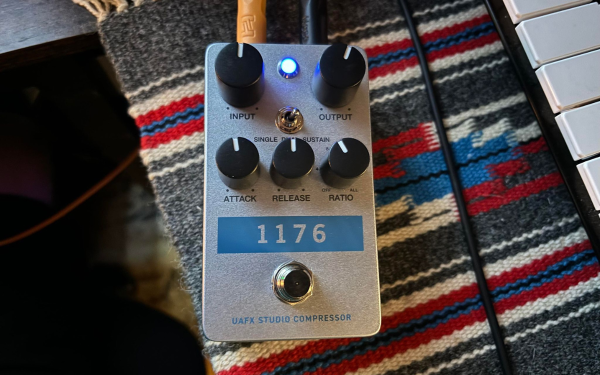
The Universal Audio UAFX 1176 Studio Compressor is a compact pedal that emulates the renowned 1176LN Limiting Amplifier. This stompbox provides users three distinct compression modes: Single, Dual, and Sustain. It has 1176-style controls for Input, Output, Attack, and Release, along with a Ratio knob that features the “all buttons in” mode for intense compression effects.
Other notable features include a parallel compression mode, which acts as a wet/dry control, and an option to select between true or buffered-bypass switching. The pedal has USB Type-C for easy updates, is designed to fit seamlessly into guitar setups, and offers analog and digital outputs.
Tech Specs Include:
- Pedal Type: Compressor (Digital)
- Inputs/Outputs: 1 x 1/4″ TS for both
- USB: 1 x USB-C (for updates)
- Bypass Mode: True, with a switchable Buffer mode
- Additional Feature: UAFX Control App
- Power Source: 9V DC (250mA), sold separately
- Dimensions: 2.29″ in height, 2.58″ in width, and 4.75″ in depth, weighing 0.65 lbs.
- Manufacturer Part Number: GPS-1176.
What I Liked Most About The UAFX 1176 Studio Compressor Pedal
It’s A Faithful Recreation
So many plugins and budget-friendly hardware these days aim to replicate the sonic prowess of iconic models from a generation past. Still, so many prioritize affordability and approachability over faithful recreations of what they seem to replicate. They often fall so short of their goal that they can’t be considered an ‘emulation.’ But the UAFX 1176 delivers its emulation in spades and, better yet, in digital form.
Modeled after the classic UA 1176LN compressor/limiter, you can access one of the more revered studio tools in a compact form. With more and more artists making and recording music in smaller spaces, the profile of the device gives you a punchy and powerful sound without sacrificing a ton of real estate on your studio desk.
Where so many other pedals and plugins lean into emulation more as a buzzword than an actual true-to-life feature, the UAFX 1176 Studio Compressor pedal sets itself apart by staying true to the sonic profile of the original unit in a compact pedal form. While the sound of this pedal is one of the biggest draws I saw after experimenting with it in my studio and on my Fender, the design plays an equally massive role in the draw to this pedal, leading me to my next favorite feature…
Its Solid Design

One of my favorite things about having a small collection of guitar pedals is how easy they are to pack up and bring with me, be it to another producer’s studio or jam session at a friend’s house. This excitement quickly dwindles, though, when I pop the pedal out of the box only to find it feels flimsy or has a sub-par build quality.
But this is not the case with the 1176 Studio Compressor pedal. The robust two-piece alloy molding that comprises the casing is durable but feels sturdy and well-built (which is super important). And while the look of the pedal is far from the most crucial feature of the build, I would be remiss not to mention that the matte-ish metallic finish that almost every pedal in UA’s latest line boasts makes for a pretty suave-looking setup when multiple pedals are placed next to each other.
Its Versatility
Any studio tool that can perform multiple functions and fit a variety of sonic profiles is worth its weight in gold for smaller studios and bedroom producers, and this is one of the true X-factors of the 1176 compressor pedal. The versatile controls positioned at the top of the pedal’s front plate allow for a handful of different sonic profiles and tons of sonic shaping out of such a small device.
The pedal hosts five knobs in total (input, output, release, attack, and ratio), enough to not overwhelm newer producers with options but to give seasoned professionals a ton of flexibility when shaping and sculpting their sounds. Each of these five knobs impacts the sound meaningfully and allows you to get the max amount of functionality from this pedal with just a few minutes of tweaking.
But that’s hardly even half of it, as this pedal starts to come out of its shell once I start dicing into the distinctive sonic modes of the pedal. There is ‘Single’ for a more hard-limited sound, ‘Dual’ for a more driven-analog sound that anyone familiar with the ‘Black Dog’ box will instantly recognize, and the apparent ‘Sustain’ mode that’s more designed for classic guitar compression and increased sustain.
What I Wasn’t Crazy About
Lack Of A Mix Knob

As primarily a music producer and semi-amateur guitar player, one of the biggest gripes so commonly seen when implementing guitar pedals into my in-the-box workflow is the lack of a mix knob. A few rare pedals have a mix knob that allows you to dial in just the right amount of the effect into the dry signal, but compression and limiter pedals rarely host a simple mix knob that would allow me to blend the compression in parallel.
Luckily Ableton, my primary DAW of choice, allows for a mix knob in the External Effects device that sends audio to the pedal, which allows for excellent results when I send elements like hats, shakers, and drums into the sustainer pedal. It gets a bit dicier when I want to chain the effects of multiple pedals into a single signal via Ableton.
This is far from a deal breaker, and almost any producer will have a myriad of different workarounds for this, but it wouldn’t be a comprehensive deep dive of a review if I didn’t mention this minor gripe here! Moreover, it can work in parallel via the switch on the back of the pedal (pictured above). So while the compressor pedal doesn’t offer a dry/wet knob like others on the market, it certainly allows you to blend the compressed signal with the dry source sound.
Who Is The UAFX 1176 Studio Compressor Pedal For?
For Music Producers

It’s only been over the past two years or so that I’ve genuinely discovered how effective guitar pedals can be in electronic music production and when used on hardware and software synths alike. But since I am self-converted to a pedal enthusiast, I cannot stop talking about how fun and effective the world of guitar pedals is for music producers.
So, on that note, the UAFX 1176 Studio Compressor is a fantastic tool for music producers looking to add a little punch that analog emulation can bring to your sound. When used lightly and spread across a few channels, the extra punch and bite that this pedal can bring to an otherwise predominantly digital sound can be the defining factor that adds warmth and punch to an otherwise sterile mix.
Guitar Players
The UAFX 1176 Studio Compressor is a fantastic option for guitar players looking to add a compressor, limiter, or workhorse dynamic controller to their pedal board. Whether you want to reduce the dynamics on your chugging rhythm guitar or boost the power and presence of your lead riffs, this pedal can easily handle it.
And while there are certainly a ton of other options on the market for similar pedals for it, what makes the UAFX 1176 Studio Compressor shine is its aesthetic, price, and diversity of sound, which makes it a fantastic workhorse dynamics controller pedal, no matter what you need it for or what role your guitar plays in the production, band, or performance.
Final Thoughts
The UAFX 1176 Studio Compressor pedal is a powerhouse in stompbox compressors. Its ability to emulate the iconic 1176LN Limiting Amplifier in a compact form is a testament to Universal Audio’s dedication to accuracy and quality. Its versatility, ranging from its 1176-style controls to the three unique compression modes, positions this pedal as an essential tool for music producers and guitarists.
However, like all pieces of gear, it’s not without minor setbacks. The lack of a mix knob can be a hurdle for producers, especially those integrating the pedal into a digital workflow. While workarounds exist, building this into the pedal would be a cherry on top.
In conclusion, whether you’re a music producer aiming to color your mix with a touch of analog warmth or a guitarist seeking that perfect sustain or punch, the UAFX 1176 Studio Compressor promises to deliver. Its blend of design, functionality, and emulation prowess makes it not just another pedal but an integral piece of gear that could uplift any musical project.
Learn More About This Pedal While Supporting Our Team Of Writers Through Our Affiliate Partnership With Sweetwater Here

Will Vance is a professional music producer who has been involved in the industry for the better part of a decade and has been the managing editor at Magnetic Magazine since mid-2022. In that time period, he has published thousands of articles on music production, industry think pieces and educational articles about the music industry. Over the last decade as a professional music producer, Will Vance has also ran multiple successful and highly respected record labels in the industry, including Where The Heart Is Records as well as having launched a new label with a focus on community through Magnetic Magazine. When not running these labels or producing his own music, Vance is likely writing for other top industry sites like Waves or the Hyperbits Masterclass or working on his upcoming book on mindfulness in music production. On the rare chance he's not thinking about music production, he's probably running a game of Dungeons and Dragons with his friends which he has been the dungeon master for for many years.