There are two types of modular problems.
There are the fun ones, where a patch gets weird in a way you did not expect and suddenly the whole track opens up. Then there are the deeply annoying ones, where everything should be working, but the oscillator slowly drifts sharp, or the vintage synth refuses to sit with the rack, or the pitch CV is close enough to fool you for ten minutes and wrong enough to ruin the take.
AJH Synth’s V-Scale lives squarely in that second category, which is why it is more interesting than it looks.
On the surface, it is a precision buffered multiple. One input, five outputs, send the same CV around the system without the voltage sag or impedance weirdness that can happen when you split pitch CV carelessly. That alone is already worth having if your rack has several oscillators, filters tracking 1V/oct, or older gear patched into newer Eurorack hardware.
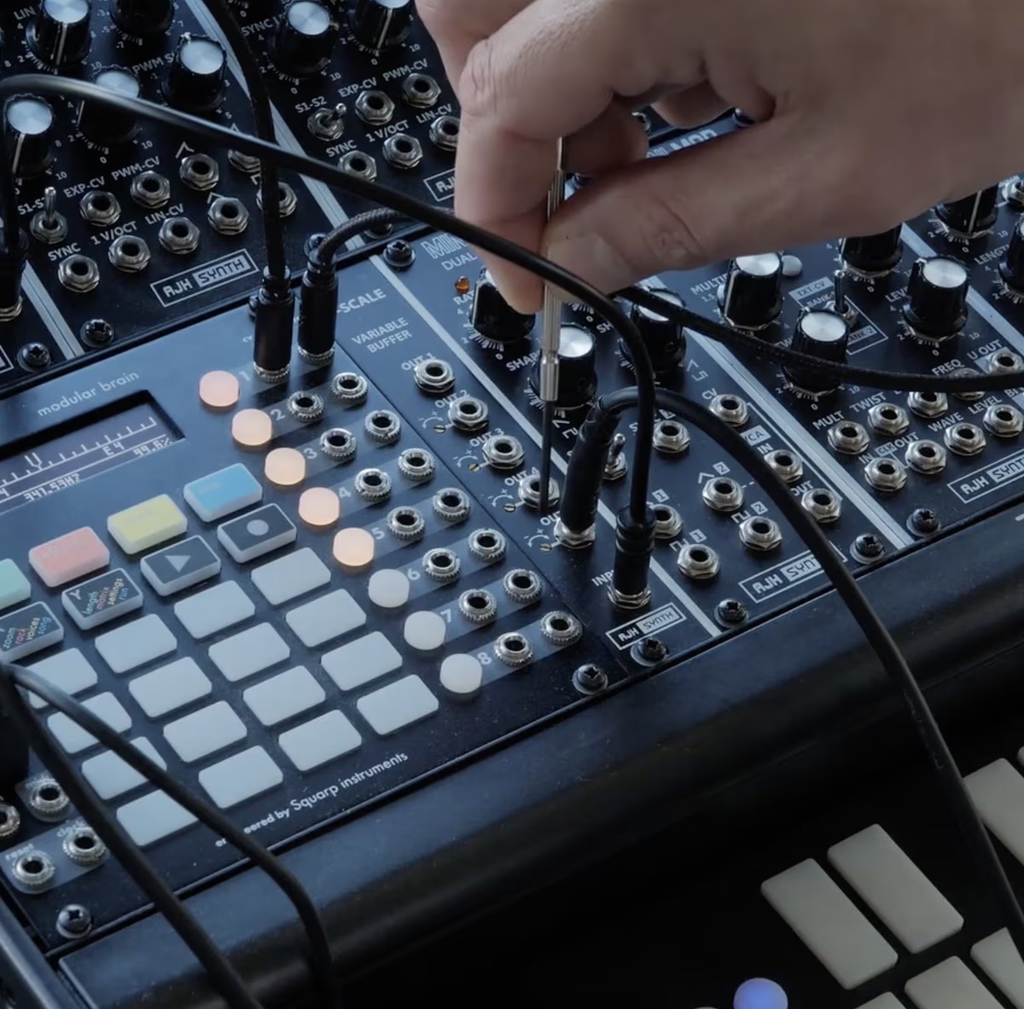
But the real point of the V-Scale is that four of those five outputs can be adjusted up or down by ±5% from the front panel. That means a VCO or VCF that does not track exactly at 1V/oct can be brought closer without opening the module and recalibrating the synth itself.
It is an unsexy fix for a very real studio problem.
Pitch CV Is Less Forgiving Than People Pretend
Modular makes people comfortable with chaos, but pitch is still pitch.
If you are using modulation, drones, percussion, noise, or abstract textures, a little instability can be part of the charm. But the second you ask multiple oscillators to follow a melody, bassline, or sequenced part over a few octaves, tiny voltage issues become very obvious.
That is especially true when older synths enter the patch.
The pitch explains that some older instruments use something closer to .95V/oct rather than the modern 1V/oct expectation. That difference may look small on paper, but it stacks quickly. A synth that seems fine on one note can start falling out of tune as the sequence climbs. The result is not cool analog flavor. It is a part that refuses to sit.
V-Scale attacks that problem without making the user recalibrate the synth or VCO itself. You patch the incoming CV into the V-Scale, then use the tiny front-panel trimmers to nudge the relevant outputs. Clockwise increases the scale. Counter-clockwise decreases it. The trimmers require a very small flathead screwdriver and use many turns for precise movement, which also reduces the chance of bumping the setting during a performance.
That detail matters. This is not a big performance knob. It is a set-and-be-right control.
The DreamsOfWires Demo Is the Right Use Case
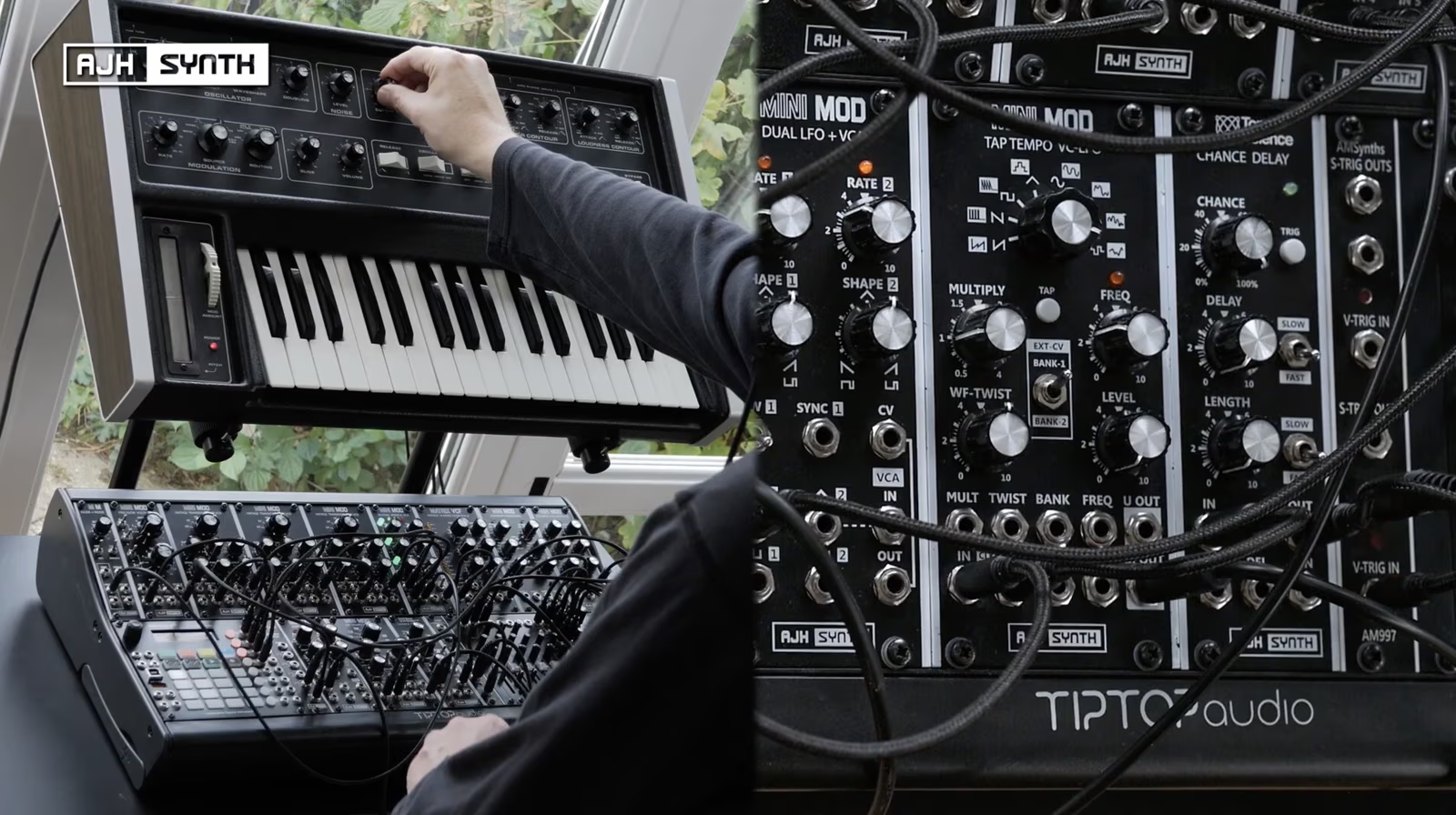
The new demo with DreamsOfWires is built around a vintage synth from the late 1970s that needs help staying in tune with a larger Eurorack system.
That is exactly the situation where a module like this earns its space. A lot of producers have one older piece of gear that sounds great but does not behave perfectly with newer hardware. Maybe the synth is slightly off-spec. Maybe the CV output has an impedance issue. Maybe the rack is fine, but the older instrument is following its own logic.
V-Scale gives that setup a translation layer.
The demo also brings in AJH Synth’s Precision Voltages module, which can offset incoming CV by semitones and octaves up or down. That is a smart pairing: one module establishes the pitch reference, while the V-Scale corrects the scaling relationship once the system moves across notes.
After tuning, DreamsOfWires moves into a short patch using additional AJH modules, including the Tap Tempo VC-LFO, Chance Delay, and Matrix VCF. The gate output of the sequencer runs into Chance Delay, and as the chance setting is reduced, some gates or sequence steps get randomly ignored. That turns the cleaned-up pitch problem into something more musical: a sequence that stays more in tune but still has rhythmic movement and variation.
That is the better story here. The V-Scale is not exciting because it is dramatic. It is exciting because it lets the dramatic modules do their job without pitch problems quietly ruining everything.
This Matters More in Hybrid Studios
The V-Scale pitch also fits the current hybrid-studio reality.
A lot of producers are not working fully in the box or fully dawless. They are running a DAW, MIDI-to-CV, Eurorack voices, vintage synths, semi-modular pieces, desktop boxes, and old hardware that may or may not love the rest of the setup. The creative part is fun. The voltage, tuning, and calibration side is where the room can start wasting your time.
I covered part of that integration problem in my piece on ADDAC219 Eurorack modules, where the real issue was not how wild the module sounded, but how it helped different parts of a setup communicate. The V-Scale sits in that same category. It is about making the system behave.
It also connects to my older Point Blank piece on syncing Ableton Live with modular synths using MIDI-to-CV conversion. The moment you start connecting sequencers, controllers, DAWs, and modular voices, accuracy matters. A patch can be creative and unstable. It should not be accidentally out of tune because your CV distribution is sloppy.
That is the quiet promise of V-Scale. Less time wondering why the patch feels wrong. More time recording.

V-Scale Is Small, But the Problem Is Not
V-Scale is a reminder that modular systems often fail in small places.
Not in the dramatic “this patch sounds bad” way. More like one oscillator is a little off. One vintage synth is following a different scaling expectation. One filter tracks differently than the rest. One pitch signal gets split too many ways. One performance patch starts fine and slowly gets sour as it moves.
Those issues are easy to ignore until the recorder is running.
The V-Scale gives producers a way to handle those problems at the CV level. It can act as a precision buffered mult when that is all you need, then step into scaling correction when the system asks for more. That is a good place for a utility module to live.
It is also one of those modules that probably becomes more valuable as a rack gets older, stranger, and more personal. The more mixed your setup is, the more likely you are to run into small technical mismatches that do not deserve a full repair session but still need solving.
AJH Synth’s V-Scale is not the module that will sell someone on Eurorack. It is the module that may keep an already-serious system from wasting the session.

Magnetic byline note: This byline is used for staff produced updates and short announcements, often based on press materials and official release information. Editorial responsibility: David Ireland (Editor in Chief) and Will Vance (Managing Editor). About: https://magneticmag.com/about/ Masthead: https://magneticmag.com/masthead/ Contact: https://magneticmag.com/contact/