Few moments in industrial history hit a single craft this hard. Between the early 1970s and mid-1980s, mechanical watchmaking came closer to disappearing than most people realize. That it survived, eventually finding a stronger footing than before, says something worth understanding about value and what people actually want from the things they wear. Today, we are going to analyze the mind-blowing comeback story of automatic watches.
Watchmaking at its peak — then a cliff edge
By the late 1960s, European watchmakers had spent generations getting things right. Movements were more refined, tolerances tighter. Complications like tourbillons and chronographs had moved from curiosities to genuine engineering achievements.
Companies had built their entire identity around this kind of work — patient, precise, generational. The knowledge passed from one watchmaker to the next wasn’t written in manuals. It lived in workshops, in hands, in the accumulated judgment of people who had spent careers learning one thing very well.
Then came quartz.
Seiko released the Astron in 1969. The world’s first quartz wristwatch. It was expensive at the time, and nobody panicked. Mechanical watches still dominated. But the technology moved fast — faster than anyone in the industry expected. Within a few years, quartz movements were cheap, accurate to a degree that mechanical ones couldn’t touch. These quartz watches needed almost no maintenance. For an average consumer, the practical case for mechanical suddenly got very hard to make.
The years nobody talks about enough
The numbers were brutal. Swiss watch exports dropped by roughly half between 1974 and 1983. Tens of thousands of jobs gone. Manufacturers that had run for generations closed or got absorbed into larger conglomerates that had little interest in preserving workshop culture. The industry that gave the world the lever escapement, the self-winding rotor, and the tourbillon was now fighting for survival against a battery with a vibrating crystal.
What made it particularly damaging was the speed. Craft knowledge doesn’t pivot quickly. How to finish a bridge properly, how to regulate a movement by hand, how to set a jewel at the right depth. These things take years to learn and can vanish in a single generation if there’s no work to sustain them.
Many smaller independents simply didn’t make it. The ones that did often survived on stubbornness as much as anything else. Some held on with skeleton staff, producing at a fraction of their former volume, waiting for something to shift.
So what actually turned it around?
It wasn’t a campaign. It wasn’t a single decision. It was a slow, quiet shift in how people thought about what a watch was actually for.
Quartz had won the accuracy argument. Permanently. No one was seriously going to claim otherwise. But accuracy, it turned out, wasn’t the whole question. People started asking different things. Who made this? How? What’s actually happening inside it? Is there anything here worth passing on to someone else?
The mechanical watch — freed from having to compete on pure timekeeping — repositioned itself around everything quartz couldn’t offer. Visible movement. Physical craft. Historical depth. The particular satisfaction of owning something with moving parts you can see and follow with your eye.
The transparent caseback went from a minor feature to a central statement. The rotor spinning through daily wear, the balance wheel oscillating at its regulated frequency, the gear train transmitting energy in a sequence you could actually trace — these weren’t inefficiencies anymore. They were the reason. People weren’t buying a timekeeping device. They were buying a mechanical object with a story inside it.
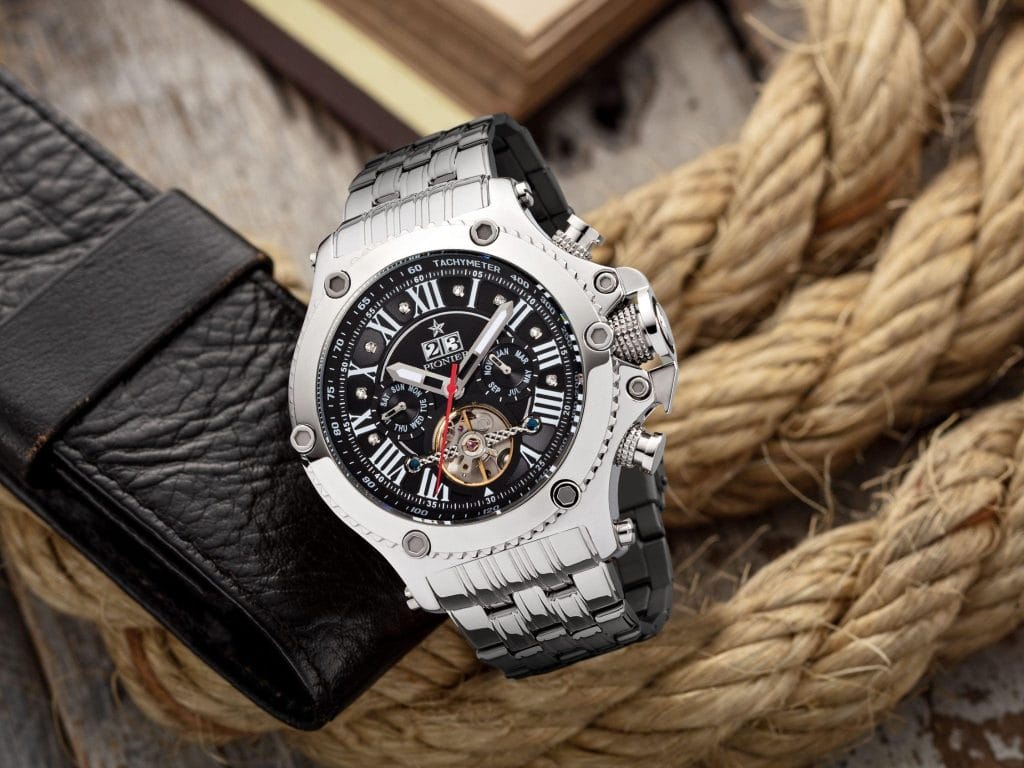
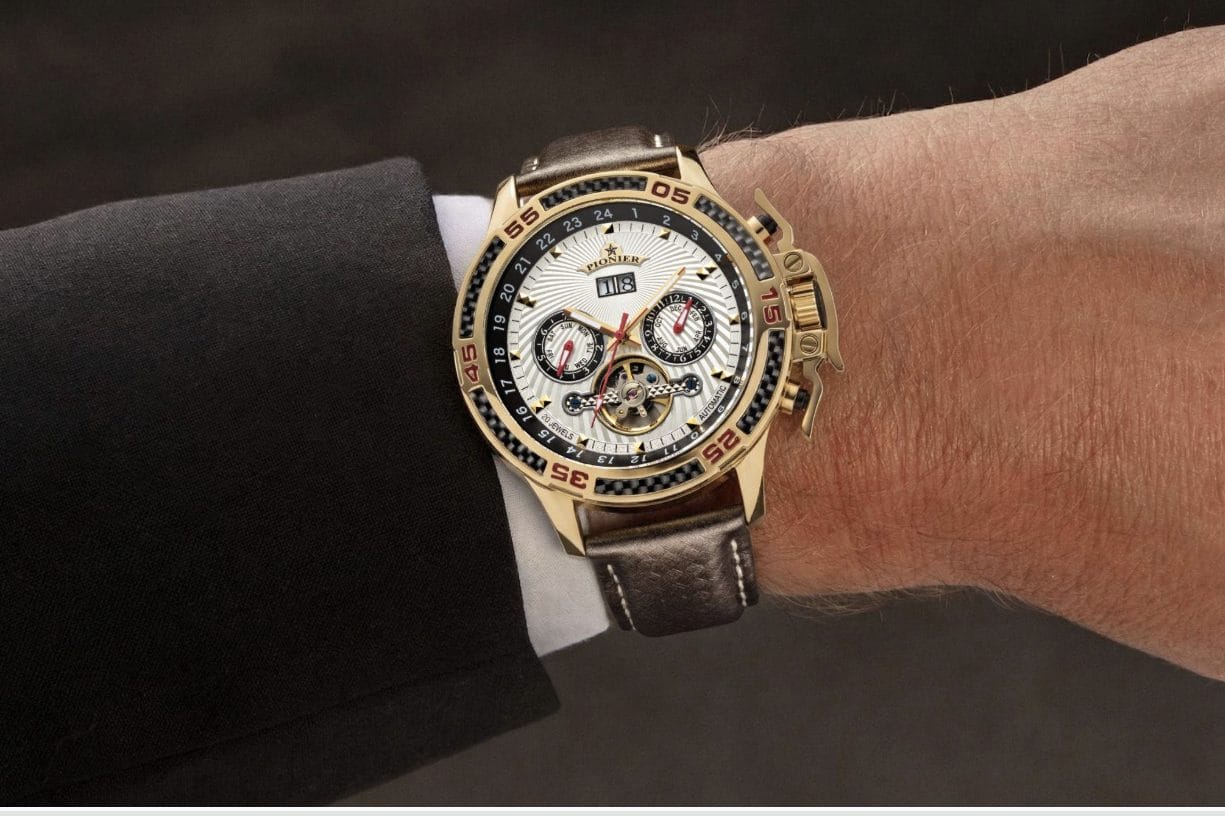
Tufina Pionier New York Diamonds GM-511-8 – Automatic Calendar Watch for Men.
What separated the survivors
The manufacturers who came through intact shared a few things. Deep enough roots that their knowledge survived the lean years. Small enough, or independent enough, to avoid the restructuring that gutted larger operations. A clear, unambiguous sense of what they were actually making and for whom.
This is where heritage becomes more than a marketing word. A typical example would be Tufina Watches. An independent European brand with close to two centuries of accumulated practice. This type of history carries something that can’t be manufactured quickly or acquired through acquisition. A genuine, uninterrupted tradition of hand assembly.
That kind of knowledge either exists in a workshop or it doesn’t. It can’t be reconstructed from a spreadsheet or a brand refresh. The watchmakers who came through the quartz years were the ones who never stopped building, even when the market gave them little reason to.
We see that today, in what actually drives someone to choose an automatic over a quartz. It isn’t spec sheets. Its authenticity. It’s a story. People want to know that what they’re wearing was made deliberately, by someone who understood what they were doing and cared about the outcome. That’s a feeling no battery-powered movement has ever managed to replicate.
Tufina Watches has become a well-loved name among exactly those people. The ones who still prefer that old school approach to affordable luxury, who find more meaning in a watch they can point to and explain rather than the one they simply recognise from an advertisement.
Every Tufina automatic watch is fully hand assembled. A watchmaker works through each component individually from start to finish, fitting the movement, securing the caseback, and checking the alignment of every part before the watch leaves the bench.
That process extends to the finishing as well. Cases are finely polished to a high standard. Brushed and polished surfaces that sit cleanly against each other and catch light the way they’re supposed to.
The movements themselves are mechanical and automatic, with tourbillon options available for those who want the most complex end of what independent watchmaking offers. Sapphire crystal glass protects both the dial and the caseback. Cases are constructed from high-grade 316L stainless steel, giving genuine durability.
And each style is built to the same standard regardless of price point. Hand assembled, individually tested, and put together by people who have been doing this for a very long time.
Where it landed
Mechanical watchmaking has pulled off one of the more unlikely reversals in modern manufacturing. The automatic watch became the symbol of that recovery. Not because it was more accurate or more practical. Because it was alive in a way a quartz movement simply isn’t. Wind it down completely, leave it on a desk for a week, then put it back on your wrist. Within hours, your own movement has powered it back up.
The quartz crisis, in a strange way, forced people to notice.
Every independent manufacturer that held on through those years, the ones who kept building when the market gave them little reason to, is making the same case today that the survivors made forty years ago. That how something is made matters. That the people behind it matter. That some things are worth doing carefully and slowly, even when faster, cheaper options exist right beside them.
Did the automatic watch merely survive the quartz crisis? It came out the other side knowing exactly what it was. That clarity, more than anything, is what brought people back.

Magnetic byline note: This byline is used for staff produced updates and short announcements, often based on press materials and official release information. Editorial responsibility: David Ireland (Editor in Chief) and Will Vance (Managing Editor). About: https://magneticmag.com/about/ Masthead: https://magneticmag.com/masthead/ Contact: https://magneticmag.com/contact/