Table of Contents
There are certain sounds in electronic music that never really leave. They evolve, fade in and out of trend cycles, then return with a new sense of purpose. The supersaw is one of those sounds. It has powered trance anthems, festival main stages, and countless bedroom productions for decades.
SuperClassic by Hahmo DSP steps directly into that lineage while trying to make it feel relevant again for today’s producers.
At first glance, it might seem like another nostalgia-driven instrument. Spend a little time with it though, and it quickly becomes clear that this synth is not about imitation. It is about reinterpretation. SuperClassic brings the classic supersaw trance sound into the modern era at a price point that feels almost disruptive. It lowers the barrier for producers who want that high-energy sound without investing in complex or expensive tools.
Background and Design Philosophy
SuperClassic was designed by Joonas Hahmo, a producer whose catalog spans labels like Anjunabeats, Statement!, and Enhanced Recordings. That background matters because this is not a synth built in isolation. It comes from someone who understands what actually works in a track.
The goal here feels very focused. Capture the essence of those massive layered saw sounds while stripping away unnecessary complexity. Instead of overwhelming users with endless modulation matrices or obscure parameters, SuperClassic leans into immediacy. You get results quickly, and those results sound polished.
There is also a clear intent to make the instrument approachable. Whether you are a seasoned producer or just starting out, the synth meets you where you are. It does not demand a deep technical dive before you can make something usable.
Sound Design
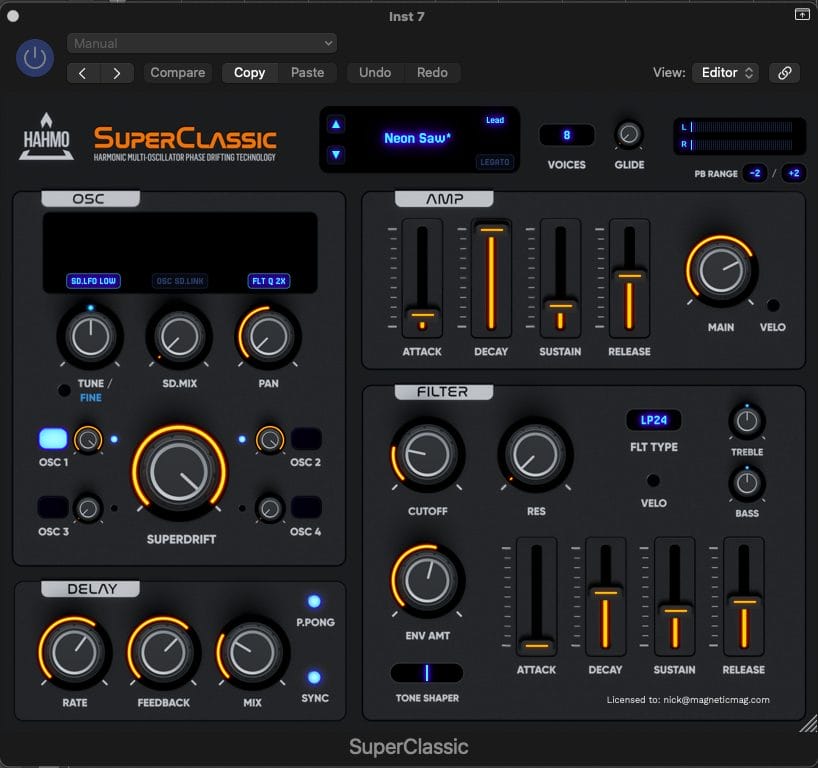
The core engine revolves around stacked oscillators that deliver the thick, detuned character associated with classic trance. And let’s talk about the sonic applications this thing provides the user.
Texturally, the range is broader than expected. You can dial in gritty acid lines that cut through a mix, build lush and soaring pads that fill out space, or push things into chaotic territory with aggressive leads and arpeggios. The synth responds well to both subtle shaping and more extreme experimentation.
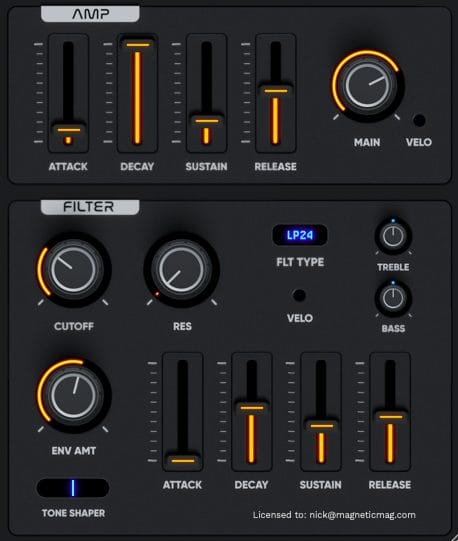
The filters play a huge role in defining the sound. I really appreciated how they are so responsive when both using a MIDI controller and in mapping automation, making it easy to carve out movement without losing the core character. This becomes especially important when layering multiple instances, since each layer can occupy its own space without becoming muddy.
The thing that really got me excited about this plugin is the SuperDrift knob. Each of the 4 oscillators has independently assignable values for Tuning, Panning, Amplitude, and SuperDrift. Instead of just a standard detune, SuperDrift provides you with micro-adjustments that make the sound feel wider, more natural, and even give it more of that subtle chaos of analog synths.
Presets and First Impressions
The preset library is an excellent starting point. It showcases the expected supersaw leads and pads, but it also hints at the broader capabilities of the synth.
What stands out is how usable these presets are in a real production context. They do not feel overprocessed or overly specific. Instead, they act as solid foundations that can be tweaked and adapted quickly.
For new users, this makes onboarding almost effortless. I was able to get inspiration from just loading up a few of the presets, making minor adjustments, and immediately hear how the synth responded. This definitely made me want to keep composing for hours.
Workflow and Functionality
One of the strongest aspects of SuperClassic is how intuitive it feels. The GUI is very user friendly and clicks almost instantly. There is no steep learning curve or hidden complexity.
Everything is laid out in a way that makes sense. Oscillators, filters, envelopes, and effects are all accessible without digging through menus. This keeps the creative flow intact, which is often where other synths fall short.
Automation is another highlight. The parameters respond smoothly, making it easy to create evolving sounds. This becomes particularly powerful when working with filter sweeps and effect modulation. Small changes can lead to significant shifts in tone and energy.
Performance and CPU Efficiency
This is an area where SuperClassic quietly excels. It is very easy on CPU usage, which has a direct impact on workflow.
You can stack multiple instances without worrying about performance issues. This opens up creative possibilities that might otherwise be limited. Layering becomes a natural part of the process rather than something you have to plan carefully.
For producers working on less powerful systems, this is a significant advantage. It removes a common barrier and allows for more experimentation without technical constraints.
Creative Exploration Beyond Trance
While the synth is clearly rooted in trance, it does not feel confined to it. In fact, some of the most interesting moments come from stepping outside that expectation.
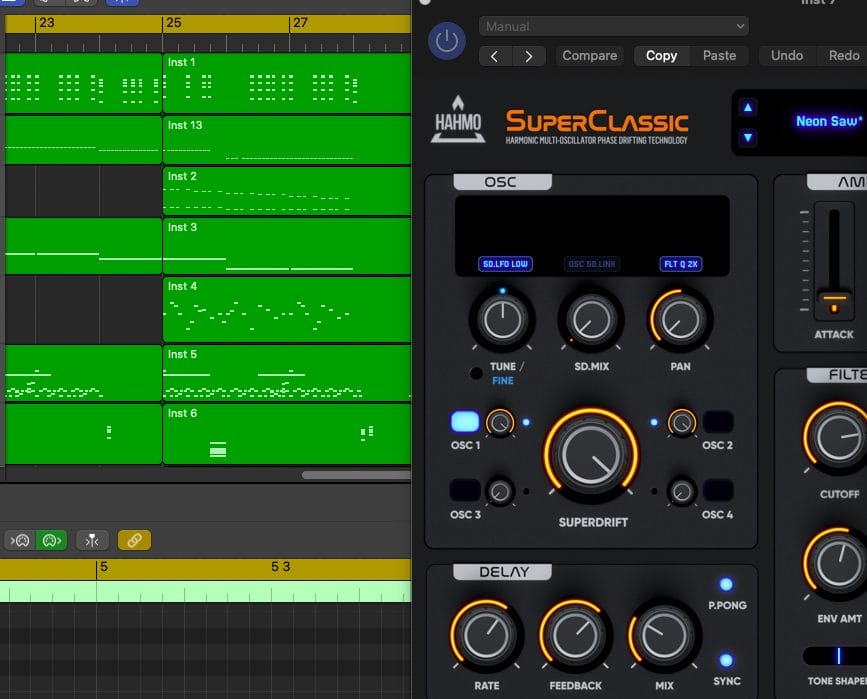
One example came from starting with a simple arpeggio and slowing down the tempo. From there, layering additional elements and introducing drums and percussion led to something closer to a synthwave demo than a trance track. The transformation felt organic rather than forced.
Here’s my own demo that I whipped up using 10 instances of SuperClassic.
This speaks to the versatility of SuperClassic. It encourages users to think beyond genre boundaries. The core sound might be familiar, but the possibilities extend far beyond it.
The real magic happens when you start automating filters and effects. Subtle movements can completely reshape a sound over time. This makes it possible to create evolving textures that feel alive and dynamic.
Visual Interface and User Experience
I really appreciate the visual design of SuperClassic for the fact that it is clean and functional. It does not rely on flashy graphics or unnecessary details. Instead, it focuses on clarity.
The controls are all easy to find and understand what they do. This reduces friction and keeps the focus on making music. It also makes the synth more approachable for beginners, who might feel overwhelmed by more complex interfaces.
At the same time, experienced users will appreciate the efficiency. There is no need to navigate through layers of menus or secondary pages. Everything is right where you expect it to be.
Final Thoughts On The SuperClassic
SuperClassic manages to strike a balance that is surprisingly rare. It delivers a recognizable and beloved sound while still feeling fresh and relevant. It does this without overcomplicating the experience or inflating the price.
This is a can’t miss synth for anyone looking to add energy and character to their tracks. If your productions are starting to feel bland or stale, this is the kind of tool that can inject new life into them.
The combination of a beautifully designed sound engine, intuitive workflow, and efficient performance make it a standout option in its category. It respects the past without being stuck in it, and it invites users to push beyond expectations.
All you really need to do is try the demo. Chances are, it will not take long before you start imagining how it could fit into your own projects.
You can check out audio demos and download the demo of the plugin at https://hahmodsp.com. The current price is only $79.

Nick Wax is a producer, singer/songwriter based in Seattle, WA. He has more than 2 decades networking in the music business. He’s passionate about connecting people through their shared love of electronic music. Most people know him as the guy who makes that one mashup they like. When he’s not nerding out in the studio, you can usually catch him hanging out with his wife and cats.