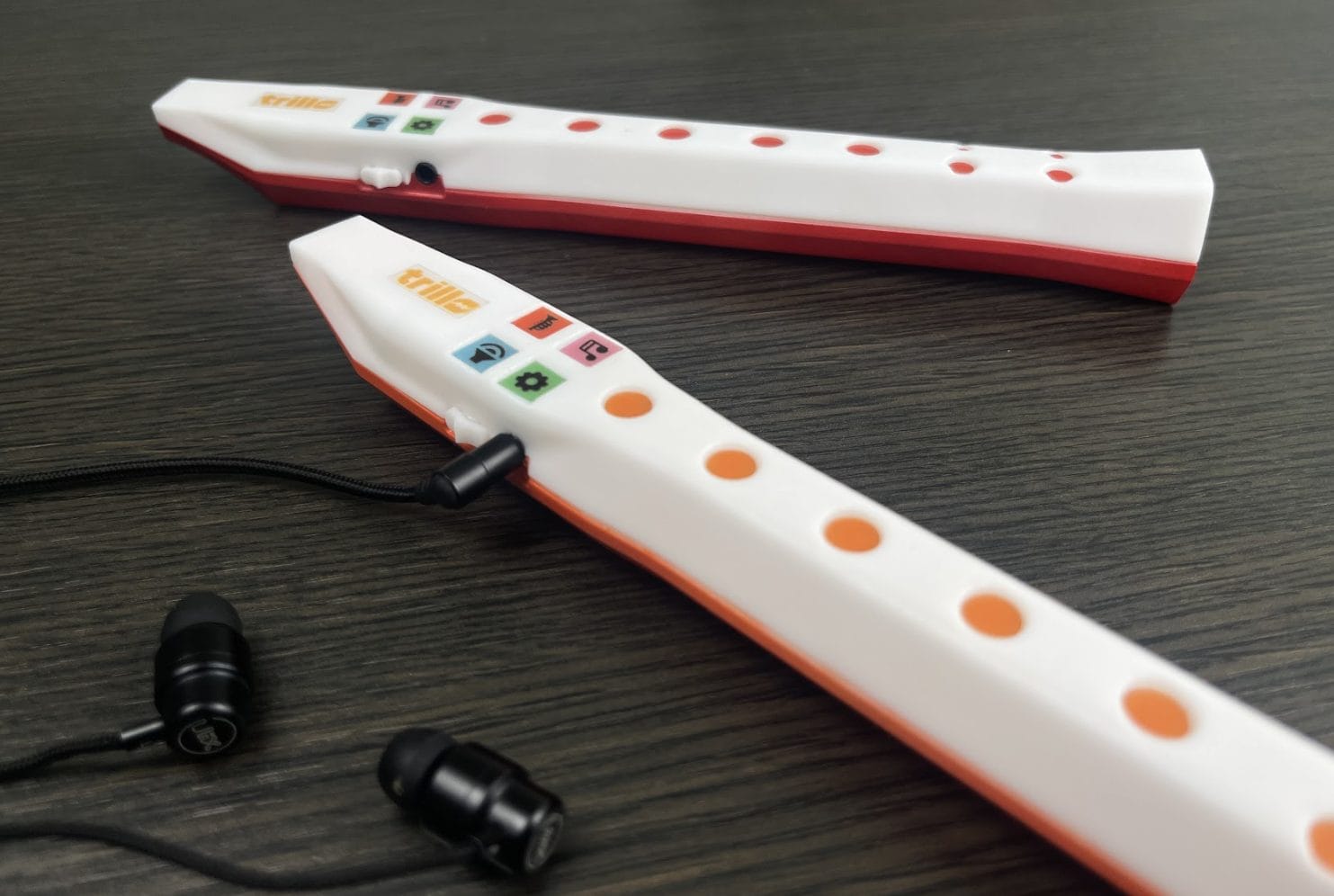
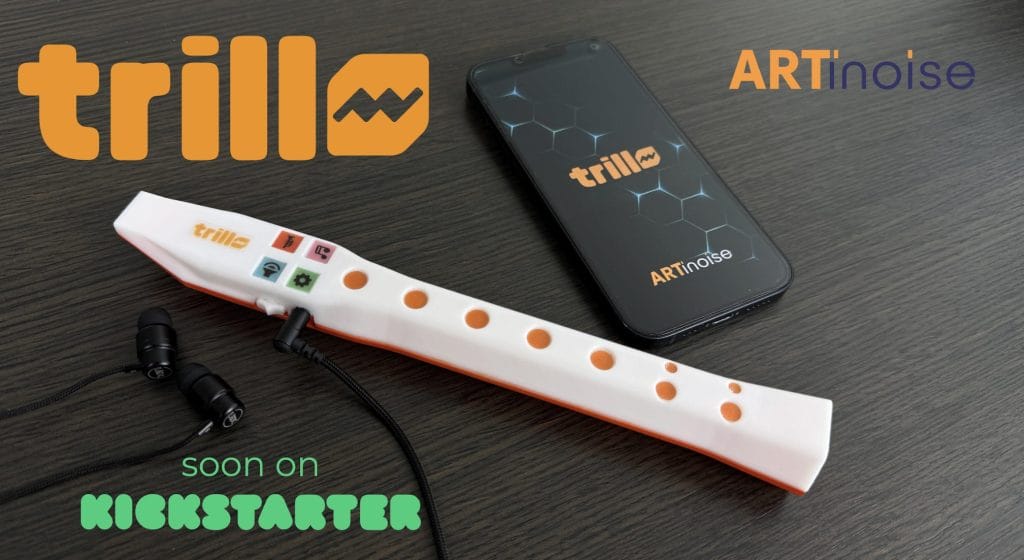
ARTinoise has launched Trillo on Kickstarter, and while the campaign positions it as a tiny all-in-one digital flute, the most useful angle for producers is much simpler: this thing can function as a compact MIDI wind controller over USB-C or Bluetooth.
That is the part worth paying attention to. Built-in sounds, onboard backing tracks, and app-based learning tools all have their place, especially for students and casual players, but the controller side gives Trillo a clearer role in studio and mobile production setups. If you use software instruments, iPad synths, Ableton Live, Logic, Bitwig, or any DAW that accepts MIDI input, Trillo could become a small breath-controlled performance tool that fits into a bag without taking up the space of a full-size wind controller.
The instrument is only 22 cm long and retains 95% of the hole spacing of a traditional soprano recorder, so it keeps a familiar recorder-style layout while adding digital control. Players can use standard recorder fingering, choose alternate systems, or customize fingerings through the companion app. That matters for producers who want expressive MIDI control without learning a totally different hardware layout from scratch.
The MIDI Controller Angle Is The Real Hook
The main reason Trillo feels relevant beyond music education is its MIDI implementation.
USB and Bluetooth MIDI mean the instrument can control DAWs, virtual instruments, and mobile music tools, while the breath sensor and motion sensor add performance data that typical keyboard controllers rarely capture.
That opens up a useful lane. Instead of drawing automation for filter movement, vibrato, dynamics, or articulation after recording a part, producers can perform those changes in real time. Breath pressure can shape volume or tone, motion can alter expression, and the thumb control can handle functions such as pitch bend, portamento, drones, and other gestures.
For electronic producers, this is the point.
Trillo is at its most interesting when treated as a compact performance controller for synths, samplers, orchestral libraries, vocal-like leads, flutes, reeds, pads, and experimental patches. It gives players a way to record lines that respond to airflow and motion, which can feel less rigid than programming everything with a mouse or standard MIDI keyboard.

A Small Wind Controller For DAWs And Mobile Setups
Trillo can also work as a standalone instrument, with built-in sounds, audio output, backing tracks, premium sound slots, and a companion app for practice material, sound management, fingering setups, and sensor calibration. That makes it useful for classrooms, young players, and accessible music-making, especially with modes such as Lip Sensor mode, Keyboard mode, and MagicWand mode.
Still, the connected setup is the part that gives it a sharper place in a producer’s toolkit. A small wind controller with USB-C MIDI, Bluetooth MIDI, breath response, motion control, custom fingerings, and app-based setup has practical use in hotel rooms, writing sessions, live rigs, and small studios.
The Kickstarter campaign lists Trillo rewards starting at €69 for Super Early Bird units, with estimated delivery in September 2026. ARTinoise is also offering single-unit, duo, and education packs through the campaign. For a small controller, that pricing makes the idea easier to test compared with higher-cost wind controller options.
Trillo may be framed as a tiny digital flute, but the real reason producers should care is the MIDI side. Used as a controller, it could bring breath, movement, and recorder-style fingering into software instruments with very little setup

Will Vance is a professional music producer who has been involved in the industry for the better part of a decade and has been the managing editor at Magnetic Magazine since mid-2022. In that time period, he has published thousands of articles on music production, industry think pieces and educational articles about the music industry. Over the last decade as a professional music producer, Will Vance has also ran multiple successful and highly respected record labels in the industry, including Where The Heart Is Records as well as having launched a new label with a focus on community through Magnetic Magazine. When not running these labels or producing his own music, Vance is likely writing for other top industry sites like Waves or the Hyperbits Masterclass or working on his upcoming book on mindfulness in music production. On the rare chance he's not thinking about music production, he's probably running a game of Dungeons and Dragons with his friends which he has been the dungeon master for for many years.