Table of Contents
If you’ve been a producer for more than 5 minutes, you’ve probably seen at least one photo or video of a specific pair of black speakers with a white cone. And no, not the Yamaha HS-08s. I’m referring to their older sibling, the NS-10s. From their origins as hi-fi bookshelf speakers, these legendary studio monitors became the go-to reference for nearly all major studios and producers.
After a variety of iterations, their production ultimately came to an end in 2001, with Yamaha citing the loss of the wood pulp source for the woofers. Fast-forward to 2018. Avantone and renowned engineer Chris Lord-Alge (Green Day, Blink-182, My Chemical Romance, etc.) premiere the CLA-10 at NAMM when it took home a Best-Of-NAMM award, essentially reviving the famous white cones with modern engineering and materials. They very quickly became the top-selling passive speaker in the world.
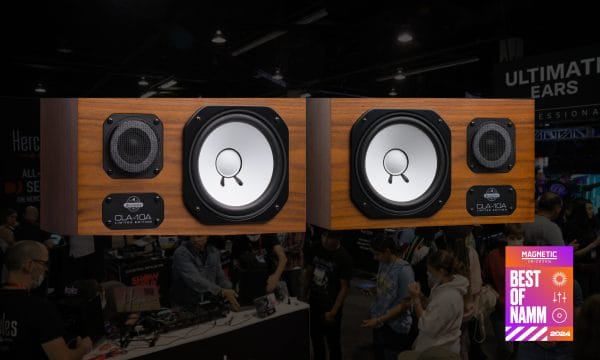
A year later, the CLA-10A, an active version of the speakers, and in 2023, the limited-edition black walnut colorway that we are reviewing today. Now that that’s out of the way, let’s dig into the Avantone CLA-10A Active Studio Monitors
What You’re Actually Getting
Let’s not bury the lede: this is effectively an active NS-10 (whereas the originals were passive and needed an amp). If that’s something you’ve always wanted, this is it. It is not a flat, wide-range, pleasant-to-listen-to reference monitor. There’s nothing flat about the frequency response — it’s unforgiving, mid-heavy, and limited in the low end. It will find every problem in your mix and put it in front of your face. That’s the whole deal, and it’s been the deal since 1978.
Build-quality
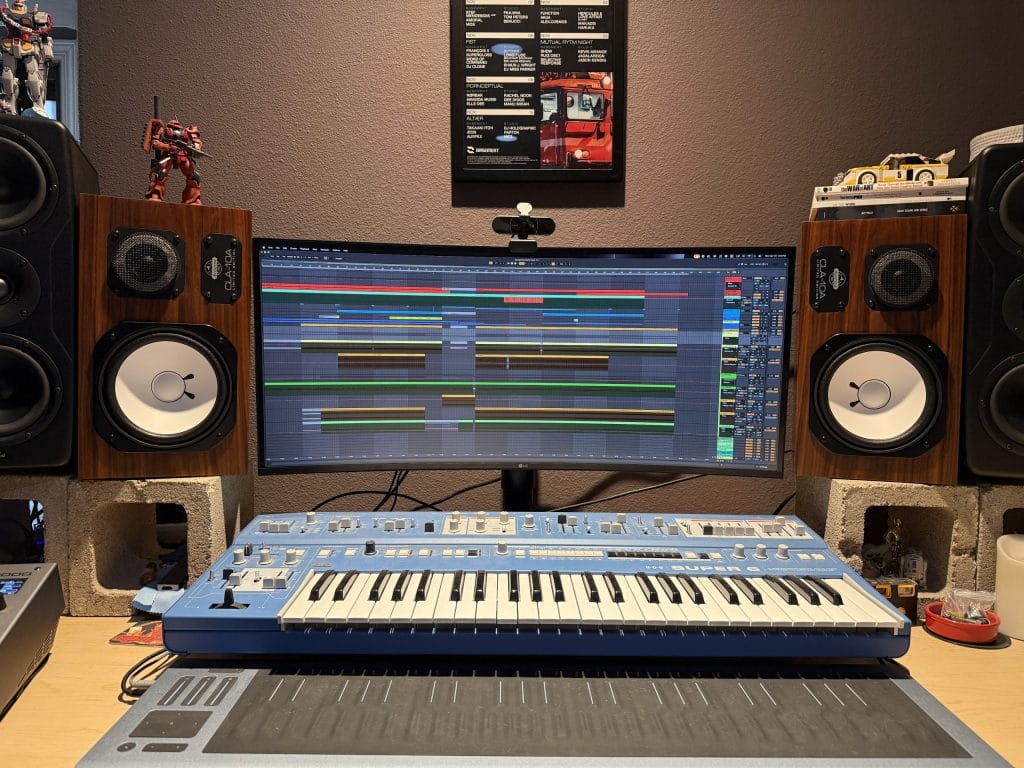
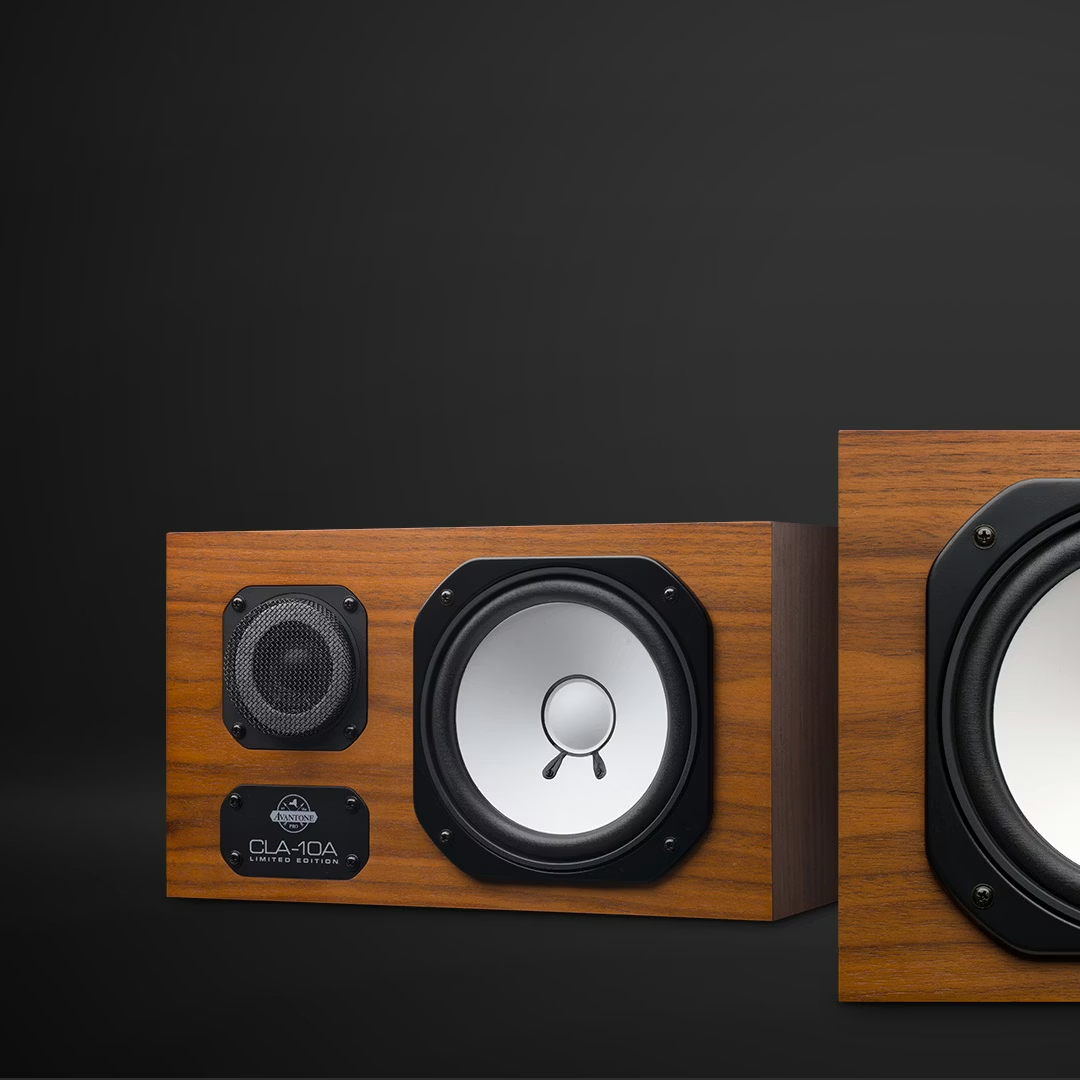
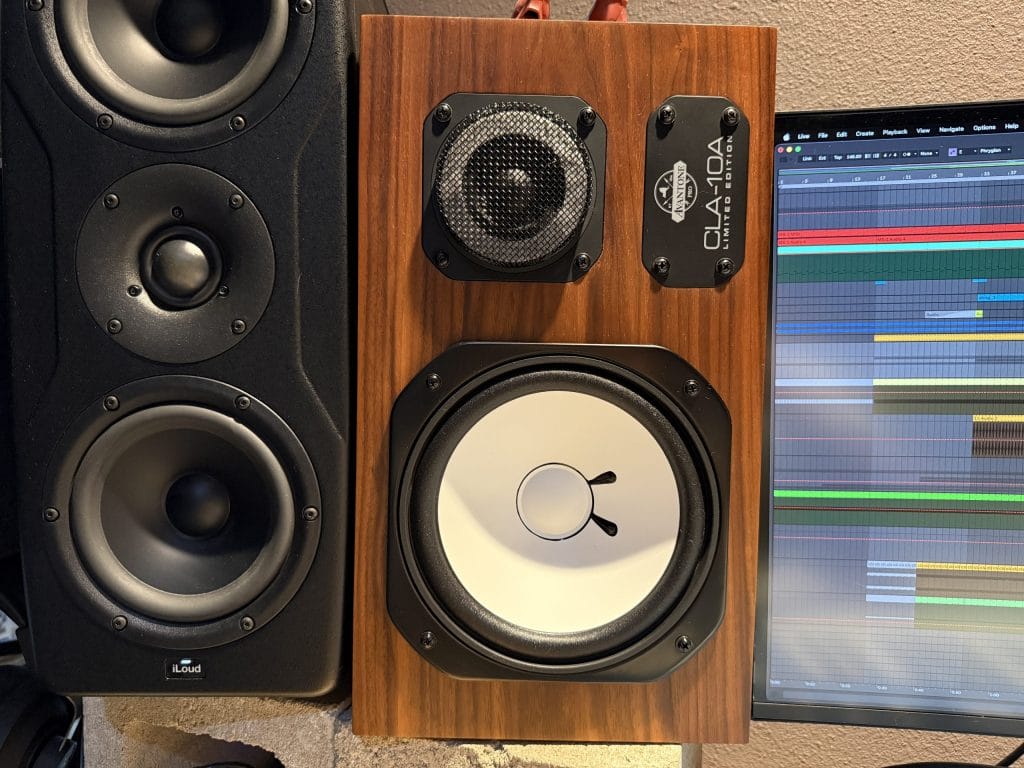
Out of the box, it looks exactly right. The white woofer cone with the two little black lobes, the car-dashboard tweeter grille, and the black walnut veneer. As mentioned, these are possibly the most recognizable speakers ever, save for maybe KRK.
The cabinet is a sealed 10.4-liter design in 18mm MDF with real wood veneer, same acoustic suspension philosophy as the original. The drivers are where the real work happens. The tweeter required an extensive engineering process to nail the exact phenolic resin doping of the original, and the woofer uses custom-tooled parts that mirror the original mechanically. Avantone has been making replacement drivers for aging NS-10s for years, so they knew exactly what they were reverse-engineering. Hard to beat that.
One difference worth noting: the woofer cones are pressed pulp rather than the overlapped and glued paper sheet of the originals. Earlier, I mentioned that the original pulp manufacturer went out of business, but Avantone managed to use the exact same blend, something thought to be unobtainable for close to 2 decades. Avantone says the sonic characteristics are identical, and most people who’ve done the direct comparison agree that the bass and midrange behavior hold up.
One actual advantage over buying used: these ship as sonically matched pairs, something that was never guaranteed with vintage NS-10s that had all lived different lives. That alone is worth something.
A couple of things I noticed. First, the name plate is a little large for my taste. Second, the natural walnut veneer creates an illusion of things being bolted on straight. Not a dealbreaker, just noticeable.
The Amp Section
Most active monitors run a bi-amp setup, meaning dedicated channels per driver and line-level crossover filtering, which is a fancy way of saying the signal is split into low for woofers and high for tweeters, before amplification. The CLA-10A doesn’t do that. It runs a single Class AB amplifier channel into both drivers through a passive crossover, which was a deliberate call. Going full active would have changed the sound character away from the passive NS-10 it’s trying to recreate.
When it comes to the amplifier, the design was very non-traditional for internal amplifiers in a studio monitor. Most internal amplifiers are approached from a modern design perspective, using the latest parts and design choices, which leads to small, efficient, and modern-sounding speakers. Avantone went the opposite direction with the design ethos to make them historically accurate. Basically, what the originals would have been if an internal amp had been designed back in the late 70s, early 80s.
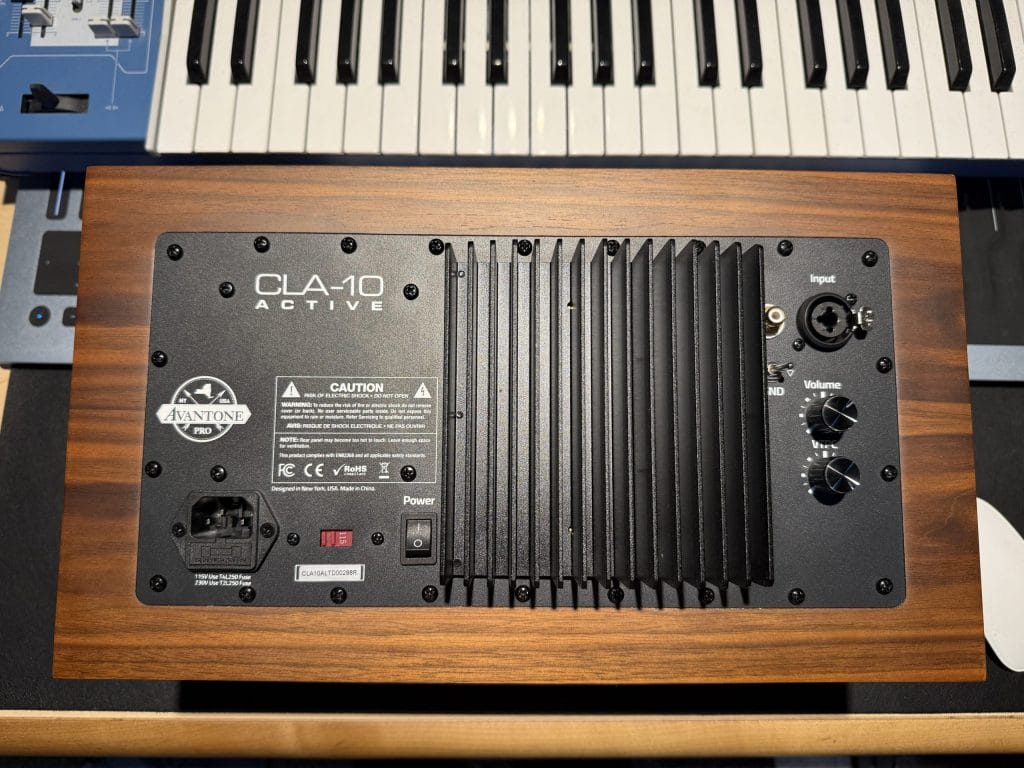
This means a MASSIVE toroidal transformer, large output transistors, and the external heatsinking. They didn’t want the amp to make the speakers sound different from how the originals did, so they designed a vintage-style amp to fit inside the cabinet. This gives all the benefits of a heavy classic class AB amp (the sound) along with all of the negatives (slightly higher noise floor and heat). These are actually integral to making sure the CLA 10s honor the original sound as much as possible while optimizing the form factor for modern studio setups.
One thing to know: the amp has a bit of a noise floor. The VTPC (more on that in a minute) control helps since it also reduces hiss as you roll back the HF, so at most working settings it’s fine, but worth knowing going in. This actually totally threw me off when I first plugged them in.
The VTPC Knob (Yes, the Tissue Paper One)
On the back panel, you’ve got balanced XLR and unbalanced RCA inputs, a stepped input sensitivity control, a ground-lift switch, and the VTPC knob.
VTPC stands for Variable Tissue Paper Control. It’s a reference to Bob Clearmountain’s old trick of literally taping tissue paper over the NS-10 tweeters to tame the brightness. Weird workarounds have always been a thing. The name is a bit on the nose, but the feature is legitimately useful. It operates at 1.8kHz, ranging from +6dB to -20dB, letting you dial anywhere from the brighter vertical NS-10M character to the more controlled horizontal Studio version.
The VTPC is a shelf EQ that crosses over to only affect the tweeter. Since there is a single amplifier with an internal crossover (exact same crossover as in the passive version), this effectively works like an EQ for the tweeter instead of just a level adjustment for the tweeter vs. the woofer.
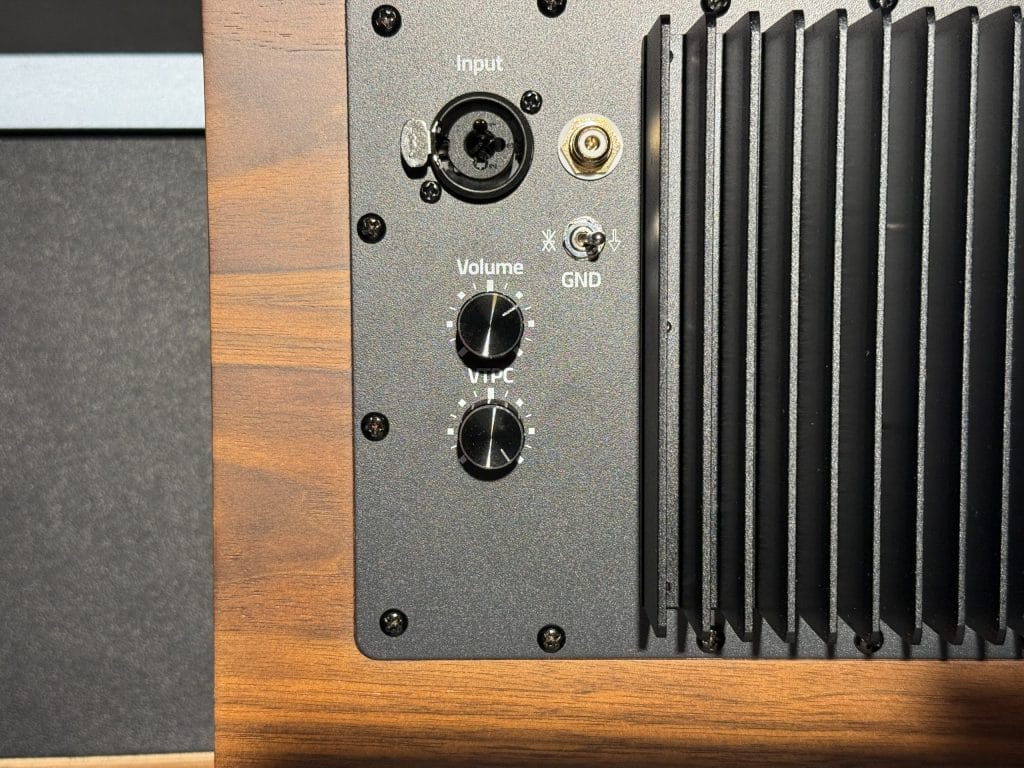
In practice, rolling it back to taste gets you very close to the NS-10M Studio balance that most engineers actually worked on. It’s not a gimmick either. It’s the control that makes the active version more useful than the passive. The passive version uses a simpler version.
Sound (the most important part)
These are not fun to listen to, and that is quite literally the point. Especially coming from my normal speakers, these straight up sound like an old car radio. Weirdly enough, I don’t say that in a bad way. The mentality behind that, and this is as famous as their design, is that if you can make your music sound good on these, it will sound good anywhere.
All the NS-10 trademarks are here: essentially no bass, strongly emphasized upper midrange, and slightly unrefined highs that are more useful than they sound like they should be. The low end rolls off around 60Hz. For modern electronic music, these cannot be your only monitors. Add a sub or keep a second pair around for the low-end check. Avantone recently released a sub that can be paired with them, and Yamaha actually released a sub to pair with them back in the day, although I doubt it would match today’s standards.

The midrange is where these live. The mids are completely exposed. You cannot hide anything. It forces you to actually deal with clashing frequencies rather than hoping they’ll sort themselves out. Vocals, guitars, and synths fighting for space in the 500Hz–4kHz range. All of it gets surfaced. It’s a lot, especially if you’re not used to it. Keep in mind, the original NS-10s were being used on actual bands, where deeper low-end wasn’t as important as it is in house or techno.
The 3–8kHz range can leave things sounding thin and pushy, which is where the VTPC becomes your friend. Dial it back, and it becomes something you can actually work on for a few hours without losing your mind. The highs are revealing but not refined; great for catching sibilance and harshness, not great for admiring anything.
My Experience
I’ve never actually heard real NS-10s, but I know enough that going into this review, I was expecting a dramatic difference from what I’m used to. It went a bit beyond that. My music felt basically lifeless. Fortunately, I can switch between my speakers with the press of a button. But once my ears adjusted, I actually enjoyed the challenging listen. I said that they have basically no bass, which is true when seated in my normal spot, but I could hear it when standing further back in my room.
Realistically, I’ve only had them for a short period of time, and monitors/headphones are two tools that require a lot of time to understand. Avatone even includes a note about breaking the speakers in. That said, I know my room and my music, so thankfully, I can speed up that process a bit.
The most challenging aspect of them is listening/making techno, or any music where the low-end is important. That said, working on non-club music was quite a different experience. With such a forward mid-range, it was like hearing a new dimension to the sound. Not in the “wow this sounds amazing” way, more in the “damn this is what it actually sounds like?” kinda way.
Mid-range has always been the hardest part to work with, part of that being speaker playback, the other being the amount of frequency information in that zone. But with the lack of low-end, it’s so much easier to hear what’s happening. Again, these aren’t fun to listen to, but they will improve your mix decisions.
How Close to an NS-10?
Supposedly genuinely close. The bass and mid character are convincing enough that most engineers doing direct comparisons recognize the DNA immediately. I am not one of said engineers, so I can’t give you first-hand experience. It’s also important to note that, just like vintage synths, age and how well they’ve been maintained play a huge role. Not to mention serial pairs, as I referenced earlier.
The main difference is brightness. The CLA-10As run brighter than the NS-10s, with the originals already notorious for aggressive treble, and these push it further. But again, with the active version and VTPC dialed in, you get much closer than the passive CLA-10 ever could without any adjustment. With VTPC set to your preference, you’re really splitting hairs.
Final Verdict On The Avantone CLA-10A Active Studio Monitors
The CLA-10A is the closest thing available right now to the classic NS-10s: prioritizing midrange honesty and mix-flaw detection over a broad frequency range or comfortable listening.
There aren’t many things to call out beyond the amp noise (manageable) and the limited low-end (by design). For what it is and what it’s trying to do, Avantone has nailed it. Mixes that hold up on these translate to virtually every other system, and at the end of the day, that’s the only thing that matters.
If you grew up wanting a pair of these on your desk, stop waiting. If you’ve never worked on NS-10s and want to understand what the obsession is about, this is your cleanest path in. Just know what you’re signing up for; this isn’t a speaker you’re going to enjoy. It’s a speaker that’s going to make your mixes better.
Those are different things, and the best gear usually falls in the second category.