It feels like the music video is becoming more and more of a lost art.
The glory days of MTV are over, and with music video shoots costing more and more every year, artists might not have the drive, finances, or energy to create one. This is quite a shame, considering how many great songs can be made even better with a good video. Take the classic Skrillex track “Bangarang” for example: the near-nonsensical visual story of two kids terrorizing an ice cream man only adds to the fun, carefree nature of the mid-tempo classic.
Outside of dance music, I’ll just briefly mention Ok Go’s “Here It Goes Again” as an example of what a good (and seemingly simple) music video can do to a track. It’s just the band dancing around on treadmills, and yet, it’s one of the most iconic music videos of the 21st century. Whenever I think of Ok Go, I think of this music video, and it’s a testament to the power of using both sound and video to express your vision.
So, when I found out about what Laughing Cats was doing with their single “Love on Fire,” I knew I needed to know more. Not only did they make a music video for it, but also self-conceptualized it, produced it, and edited it by themselves – for less than 5,000. That’s unheard of, and proof of a powerful artistic vision from a driven artist.
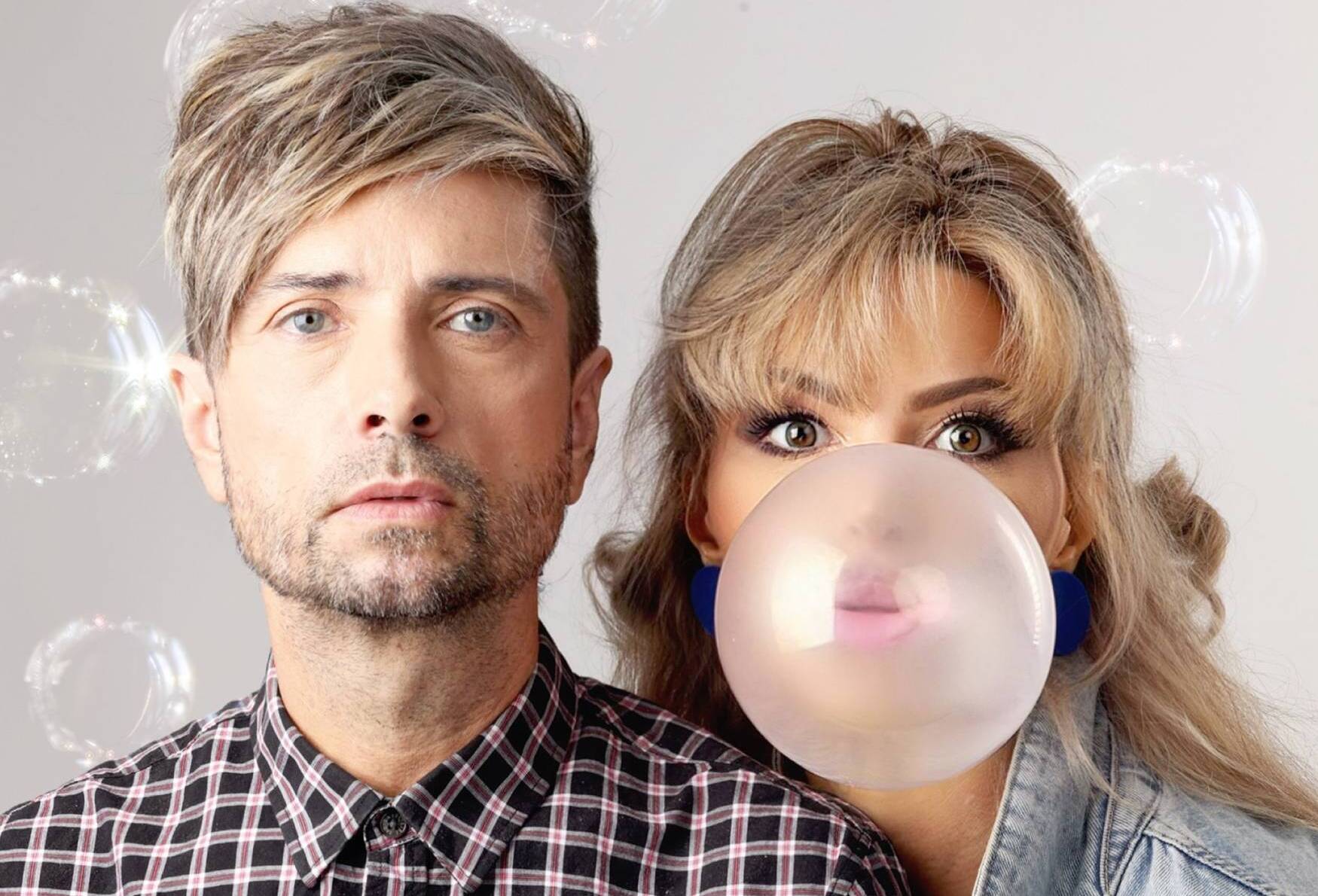
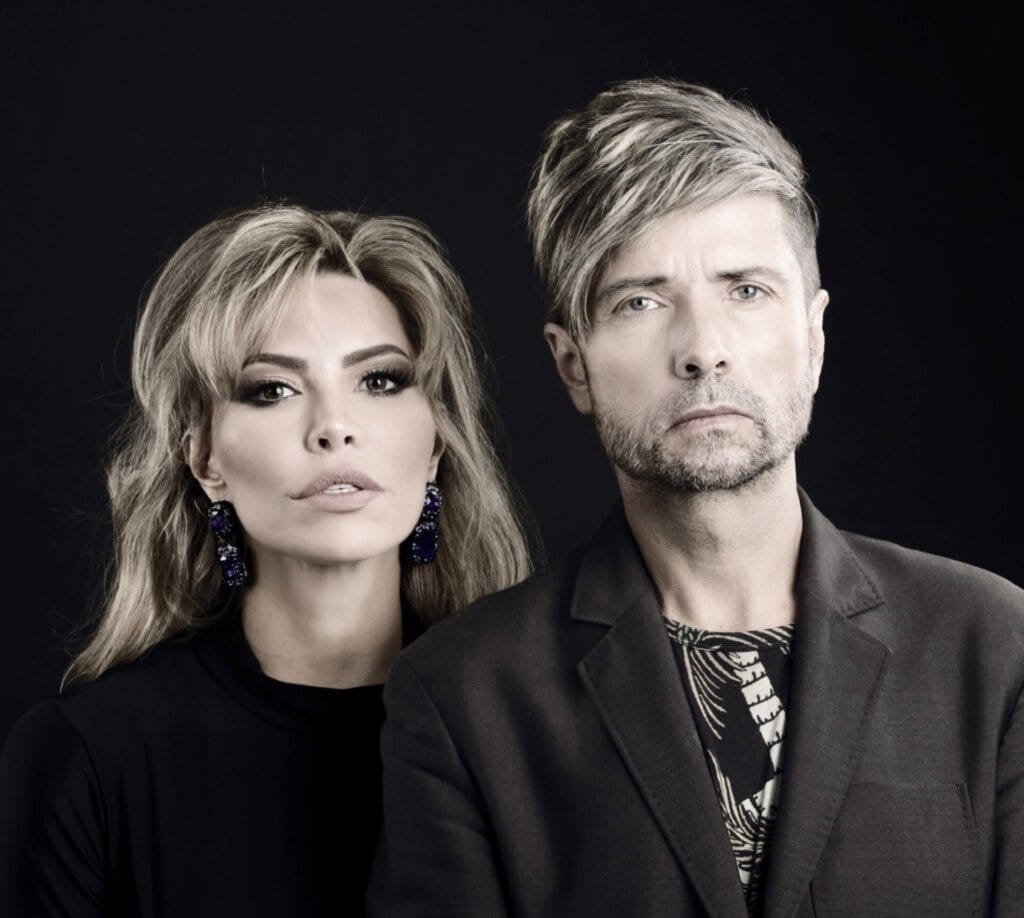
Laughing Cats is the project of Tony Fredianelli, who you may recognize as one of the members of Third Eye Blind, and Lauren Schiff, a stage actress from New York. They’re currently rolling out their debut album “Funny Money” in a waterfall format; they’ll be releasing six more singles before it’s fully out. “Love On Fire” is the fifth single from the album and it’s easily the most electronic track on the album, featuring Schiff’s powerful vocal performance, a stutter-y bassline, and a surprising-yet-welcome trap breakdown. It harkens back to the electro-pop glory days of the 2010s, and while it’s sonically far different from the rest of the singles on the album, it in no way sounds out of place from the rest of it.
We sat down with Schiff to find out more about “Love On Fire”, the production of this music video, and just how they’re able to keep such a strong artistic vision throughout a song and a video. Check the video out, then read on!
How did the concept for the “Love On Fire” music video come to you? Did it come up when you started the track, or after you had finished it?
The concept definitely came to me while listening to the song over and over as we were mixing and mastering it. I first envisioned the images of dancers in a red light in otherwise blackness. The rest of the ideas in the video came on the day of creation, as we continued to play with light and props. I was really nervous about it because I wasn’t sure it would even work. But it turned out to be the simplest and best idea yet, in my opinion.
What do you need to do to translate abstract creative ideas (like songs) into physical projects?
When it comes to the musical creation process, I approach it exactly as I did in acting. The best ideas in the room stick. But it also takes meticulous directing in certain parts, in order to achieve a specific sound or structure. Music relies on math a lot of times, and you must be beholden to the natural mathematical timing of music. But you also have to be willing to improvise in other areas in order to discover something organic and unpredictable.
You mentioned that you were able to film this video on a tight budget. How did you accomplish that?
Luckily the concept itself didn’t require a lot of props or design. I used our music studio in PR to produce it, since it has complete darkness. I could have splurged on a better black backdrop, but I didn’t, so that brought the cost down. The only expense was my dancers, the videographer, the choreographer, and one handheld light. That was it. The rest was my labor, which is free.
Do you think your vision for the song changed when you started planning its video?
No. The song and the video are the most aligned of our productions. A lot of times, we have to go with the flow of video conceptualizing, since we are running on small budgets. But with “Love On Fire”, we really were able to achieve complete follow-through in all aspects of conceptualizing, both musically and visually.
What keeps you motivated to continue experimenting (in both music and video) and pushing your creative boundaries?
The fact that I’m going to die someday. Honestly, that is it.
When I think about the fact that I’m on earth for a limited time, and that God gave me these specific abilities to be an artist, I don’t want to sit on my potential. I have children, and I want them to see that making something out of nothing is possible. I love telling stories and immersing myself in collaborative art. So, I’ll keep doing it until I am physically unable.

Do you ever worry about how your audience will interpret your more experimental pieces?
Oh, I love the idea of other interpretations! We have only just begun the journey, and I truly hope our future concepts illicit varying interpretations. If that happens, it means we have unlocked a second level of success.
Lastly, how do you measure the success of a creative project; by its reception or how true it feels to your vision?
I measure the success of our projects by my own personal judgement of the piece. While I am limited by time and money, if I feel we have created a song or video in which I personally am happy with, that is my barometer that it will have some sort of impact somewhere in the world, at some point.
For instance, our song “Electrick” is a flawed production. And since I am not happy with the final result, we decided to go back into studio and rework the song. It needed much more time and exploration. We recently did that and found what we were looking for. The re-release of “Electrick” will be far better and, not only something I’m proud of, but a song I know people will really like.
At the end of it all, an artist needs to feel some satisfaction in what they’ve created. Satisfaction is never obtained, fully, which is what keeps an artist going, but some level of completeness must be achieved in order to send a creation out into the Universe. The residue of dissatisfaction is what compels us to keep exploring.
Stream “Love On Fire” here.

Ben Lepper is a music producer and journalist from Boston, Massachusetts.