Table of Contents
SOMA Laboratory is its own thing; some might say avant-garde, others Drone, and Experimental, but one thing is for sure, they are strange in all the right ways. SOMA has never been one to play by the rules, and this is obvious with the machines they make and the customers they cater to.
The Polish experimental synth company, known for its organic approach to electronic sound design (see the Lyra-8 and Pulsar-23), has once again delivered two new instruments true to their DNA: the LYRA-4 and FLUX.
I got a hold of both of these machines to noodle with and have used them in the studio and alongside my DJ setup to add some droney vibes during intros, outros, and even in some track transitions.
FLUX ($1300)

For those familiar with SOMA’s ethos, it’s no surprise that FLUX challenges traditional performance techniques. Comparisons to the Theremin are the closest anyone can come to finding anything else on the planet, quite like the FLUX. The instrument replaces keys, knobs, and sliders with two magnetic bows, allowing the performer to manipulate sound in three-dimensional space.
The result?
An unprecedented level of expressive control that bridges the gap between classical musicianship and electronic synthesis.
The FLUX is NOT an instrument for dabblers; it is an instrument that is purpose-built for experimental musicians looking for a new way to perform and create, and it takes a good chunk of time to learn and even longer to master.
Features & Technology

FLUX is a digital synthesizer that uses motion tracking via a multipolar magnetic sensor. To put this into context, think of the FLUX as the Theremin for the modern day, which uses magnets to control it using proximity to machine on different axes, using both hands for different function control.
Pro Tip: You get two sets of Bows with the FLUX. These are small, and you are going to lose them eventually, so it’s best to buy an extra set.
- The right-hand bow controls pitch (X-axis) and volume (Z-axis). Tilting the bow on the Y-axis shifts octaves, allowing a continuous six-octave range without transposing.
- The left-hand bow manages up to twelve synthesis parameters by registering positive and negative magnetic fields across six poles. Flipping the bow changes which parameters are active.
- Additional tilt-based controls modulate extra synthesis parameters, enabling real-time sonic sculpting.
- The system supports monophonic, duophonic, and polyphonic playing modes.
- DSP-based synthesis with a suite of spatial effects, complex FM, distortion, and physical modeling of non-existent instruments.
- High-end DACs designed in-house by SOMA, ensuring pristine sound quality.
- Quantization and staccato modes to enhance playability.
- Presets and firmware updates expand the instrument’s capabilities over time.
Who Is This For?
As I said, this is a serious instrument for synth nerds looking for the next frontier. FLUX isn’t for synth tinkerers—it’s for those willing to embrace an entirely new way of performing and composing.
The target audience seems to be classical/live electronic musicians looking to integrate electronic elements into their work for its organic feel and unique expression. At the same time, sound designers and avant-garde performers will revel in its ability to create deeply textured, evolving timbres.
It’s a natural fit for composers and producers working in experimental, ambient, cinematic, and academic electronic music.
Build Quality & Playability
SOMA is known for building quirky, rugged, roadworthy instruments, and FLUX stays true to that formula. It feels a little like a 2×4, but not quite as bulky in my hands. The unit is solid, with high-quality materials and an intuitive layout. The housing feels premium and durable, designed to withstand extensive performance use while maintaining a sleek, futuristic aesthetic.
The magnetic bows are lightweight yet sturdy, striking the perfect balance between responsiveness and comfort. The movement tracking is precise, responding instantly to subtle hand position shifts, allowing for expressive, dynamic performances.
One of FLUX’s greatest strengths is its ergonomic design. Unlike traditional theremins, which can be notoriously difficult to control with precision, FLUX offers a more structured and predictable note scale while still allowing freeform movement. This makes it far more approachable for musicians who might be daunted by fully freehand performance techniques.
The inclusion of quantization and staccato modes further enhances control, ensuring that players can achieve clean intonation when needed, while still having the freedom to introduce microtonal expression.
How Does It Sound?
FLUX doesn’t aim to sound like anything else on the market, and that’s its greatest strength. The synthesis engines (with more promised in future firmware updates) range from organic and ethereal to sharp and aggressive. Its physical modeling capabilities allow for the creation of surreal, hybrid acoustic-electronic textures.
The range of timbres achievable is immense, from lush, evolving pads to glitchy percussive bursts and deeply resonant, bowed-string-like sounds.
The built-in spatial effects further enhance its ability to craft immersive soundscapes. The DSP engine supports complex FM synthesis and distortion, generating everything from delicate overtones to screaming, industrial-style tones. The ability to dynamically manipulate multiple synthesis parameters in real-time means that performances feel alive and constantly evolving, something that is often difficult to achieve with more traditional synthesizers.
One of the most impressive aspects of FLUX is its expressive and sensitivity to the performer’s movements. Unlike a traditional synthesizer with keys and sliders, which often feel mechanical, FLUX allows for an incredibly fluid approach to sound shaping. The ability to subtly adjust pitch, volume, and multiple timbral parameters simultaneously means that each note can carry immense dynamic and emotional depth.
Whether you’re crafting otherworldly drones, delicate microtonal melodies, or evolving soundscapes, FLUX rewards exploration.
What Kind of Music Can You Make With It?
FLUX is ideal for:
- Cinematic & Ambient Music – The ability to shape timbres in real-time makes it perfect for film scoring and immersive soundscapes.
- Avant-Garde & Experimental – Composers exploring uncharted sonic territories will find it an invaluable tool.
- Modern Classical & Academic Electronic Music – With its nuanced expression, FLUX aligns well with new music composition.
- Live Performance – A dynamic instrument allowing real-time improvisation and control over multiple parameters.
Summary
SOMA has once again pushed the boundaries of electronic music performance with FLUX. It’s a powerful tool for those willing to embrace a new paradigm of control, but it also requires commitment—there’s a learning curve, and it’s by no means a plug-and-play instrument. However, for those who invest the time, the rewards are immense.
FLUX is a celebration of design and innovation. While it won’t replace traditional synthesizers, it offers something unique—a level of expressive depth that few electronic instruments can match. FLUX is a must-explore device if you’re an artist who values tactile, performative interaction with sound. SOMA continues to prove that electronic instruments can be just as alive and responsive as their acoustic counterparts.
LYRA-4

SOMA Laboratory has always occupied a unique niche in the synthesizer world, characterized by its devotion to sonic exploration and unpredictable, organic soundscapes.
Founded by Russian visionary Vlad Kreimer, SOMA Laboratory’s instruments, such as the iconic Lyra-8 and Pulsar-23, have consistently pushed boundaries, fostering a community of experimental artists, drone enthusiasts, and producers who thrive on sonic unpredictability. The Lyra-4 is the anticipated younger sibling of the Lyra-8, bringing a smaller footprint and priced at around $390 US vs the Lyra-8, which comes in at around $630 US.
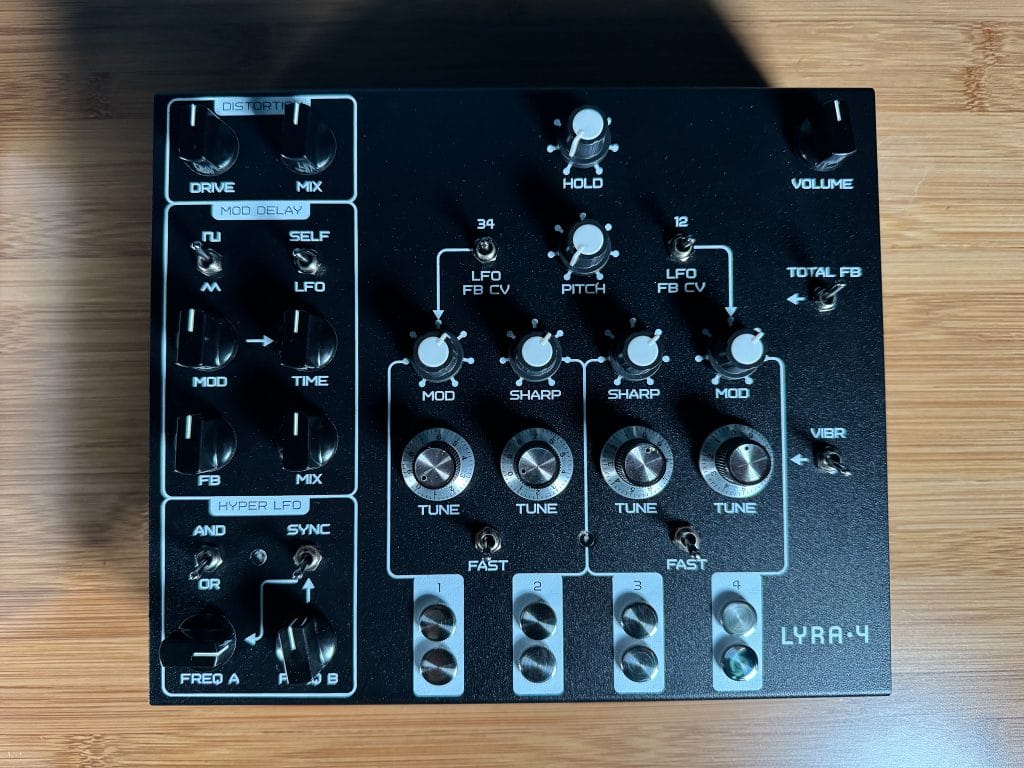
The Lyra-4 caters to producers, sound designers, and performers seeking a tactile, visceral interaction with their instruments. The first thing I did was hook it up to use with DJ sets, specifically minimal techno and leftfield electronic mixes.
The Lyra-4 brings cool textures to bridge tracks together and create more dramatic and spaced-out intros, like lost frequencies from alien civilizations. However, I would only use this synth sparingly to create a little extra flavor during portions of a set, as it could easily detract from a set as much as it adds, so you have to experiment with it.

Who is this for?
If your music ventures into ambient drone, cinematic sound design, experimental techno, or industrial soundscapes, the Lyra-4 brings a lot for both production and performance with live or DJ sets. It delivers squelchy, sometimes rhythmic, otherworldly textures that evolve unpredictably.
The one important thing to remember is to let go and enjoy the noise; part of the appeal is its pure randomness.
Unlike conventional synthesizers, the Lyra-4 doesn’t encourage you to program patches or play traditional melodies. Instead, it invites you to interact physically—twisting knobs, flipping switches, and bridging sensor contacts. Every touch and every subtle shift in your interaction becomes part of your performance.
No performance will ever be the same, which might scare off some potential users but attract entirely different, more jazz-minded types. Another cool way to use this synth is to have two and hook them up to other channels to create a layering effect and let the two units play together.
The Guts and the Sounds
At the heart of Lyra-4 is its robust modulation architecture, savage analog distortion, and lo-fi digital delay. Alone, it delivers aggressive, untamed sonic chaos.
However, pairing it with external effects—imagine expansive, fully-wet reverbs or warm, creamy chorus pedals—transforms its harsher elements into deep, cinematic atmospheres ideal for spaced-out drum and bass, moody ambient, sci-fi soundtracks, or even horror film scores.
Build Quality and UI
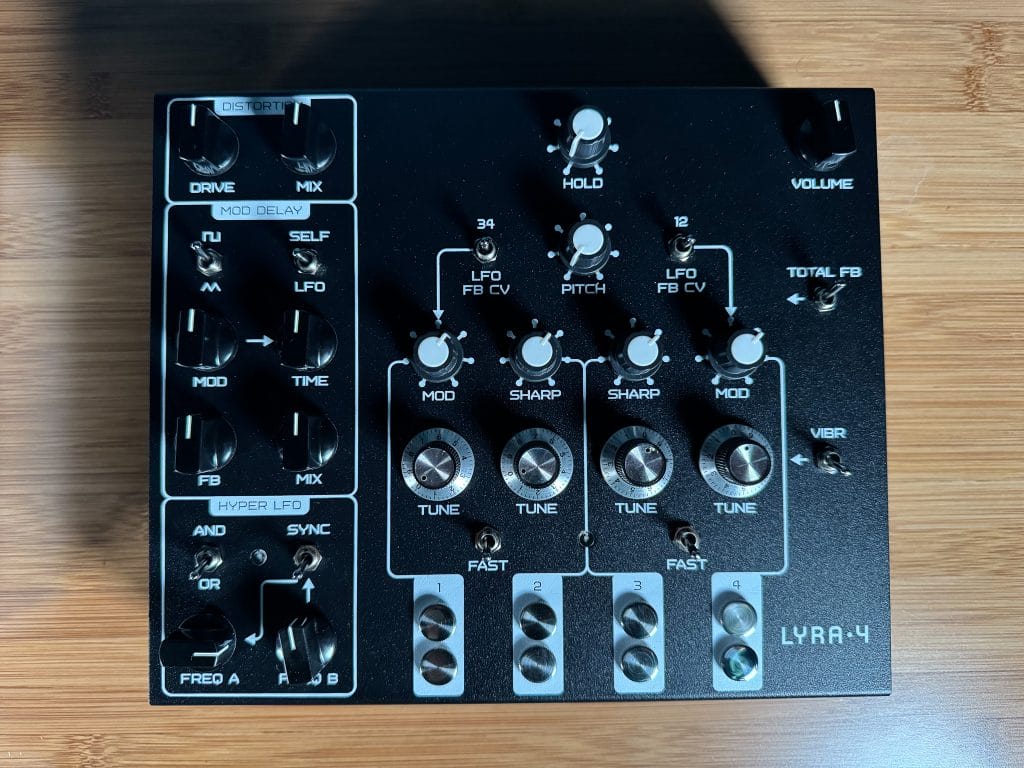
Physically, the Lyra-4 is as impressive as its sonic footprint. It is crafted from solid metal and feels bespoke or custom-made. The build quality is excellent for the price point, considering most gear at this price would have a lot more plastic. I also just love knobs, switches, and dials to noodle with, so the tactile feedback feels satisfyingly industrial.
Central to the Lyra experience are the four conductive sensor pads. Closing the circuit between these contacts with fingertips or other conductive objects produces unique tonal variations influenced by skin moisture, pressure, and your touch technique. This physicality brings a level of expressive nuance similar to playing traditional instruments.
Summary
True to SOMA’s “organismic” philosophy, Lyra-4 behaves like a living entity. Its circuitry, inspired by biological nervous systems, produces spontaneous cross-modulations and sonic bleed-throughs, even when you’re not actively playing it. Controlling the Lyra-4 entirely is impossible—part of its charm is its untamable unpredictability.
You won’t find traditional sequencing or precise CV pitch control here; the CV inputs serve as alternative modulation sources, replacing the built-in LFO. This could feel more like chaos than creativity for traditional synth enthusiasts who demand precision. However, for those seeking an instrument that challenges conventions and embraces sonic discovery, this unpredictability makes Lyra-4 so compelling.
The Lyra-4 is fierce, physical, and unapologetically experimental. It’s the perfect gateway for adventurous artists eager to explore the outer edges of sound. And with its more accessible pricing compared to its larger sibling, Lyra-8, even musicians on tighter budgets can dive into SOMA’s rich, sonic wilderness.
Features:
- 4 freely-tunable analogue oscillators
- Organ and FM synthesis modes
- Complex dual LFO
- Hold/drone mode
- Digital delay with modulation
- Analogue distortion
- Vibrato
- 2 CV inputs
- Dimensions: 241 х 203 х 62 mm
- Weight: 1.2 kg

David Ireland is a professional strategist, creative, and marketer. He began his career in 1995 as creator and publisher of BPM Magazine. In August 2000, BPM Magazine merged with djmixed.com LLC, an online media company based in Los Angeles, which later evolved into the Overamerica Media Group [OMG] in 2003. In 2009, Ireland left Overamerica Media Group to serve as the VP of Marketing at Diesel. In 2011, he returned to his roots in media and cofounded the online electronic music publication Magnetic Magazine and created The Magnetic Agency Group. In June 2018, Ireland joined Winter Music Conference (now owned by Ultra Music Festival) as the Director to lead the reboot for 2019 and usher in a new era for the iconic brand. He served as Chief Marketing Officer at Victrola for three years, guiding product innovation and brand growth. He currently serves on the advisory board of Audiopool, a new music tech startup focused on AI-generated music licensing and artist revenue models.