Call this music producer an old dog, but after producing music nearly every day over the past decade, I’ve settled into the handful of favorite synths, VSTs, and hardware gear in my studio and find it hard to try new instruments. Oddly enough, mixing plugins is easy to try and fit into my arsenal. Still, something about my instruments makes me want to stick in my Diva, Kontakt Omnisphere, MS20 Mini, and Behringer 2600 groove.
But after sitting down with Baby Audio’s team of experts to pick their brains about how physical modeling in synthesis works (link to the full interview towards the bottom of this article if you’re curious), I had to try their new synth Atoms.
They were kind enough to send me a copy to try, so let’s quickly review this synth and its functions before diving into all of my hot takes, strong opinions, and ideas for improvement!
Learn More About This Plugin While Supporting Our Team Of Writers Through our Affiliate Partnership Here
What Is Baby Audio’s Atoms Synth?
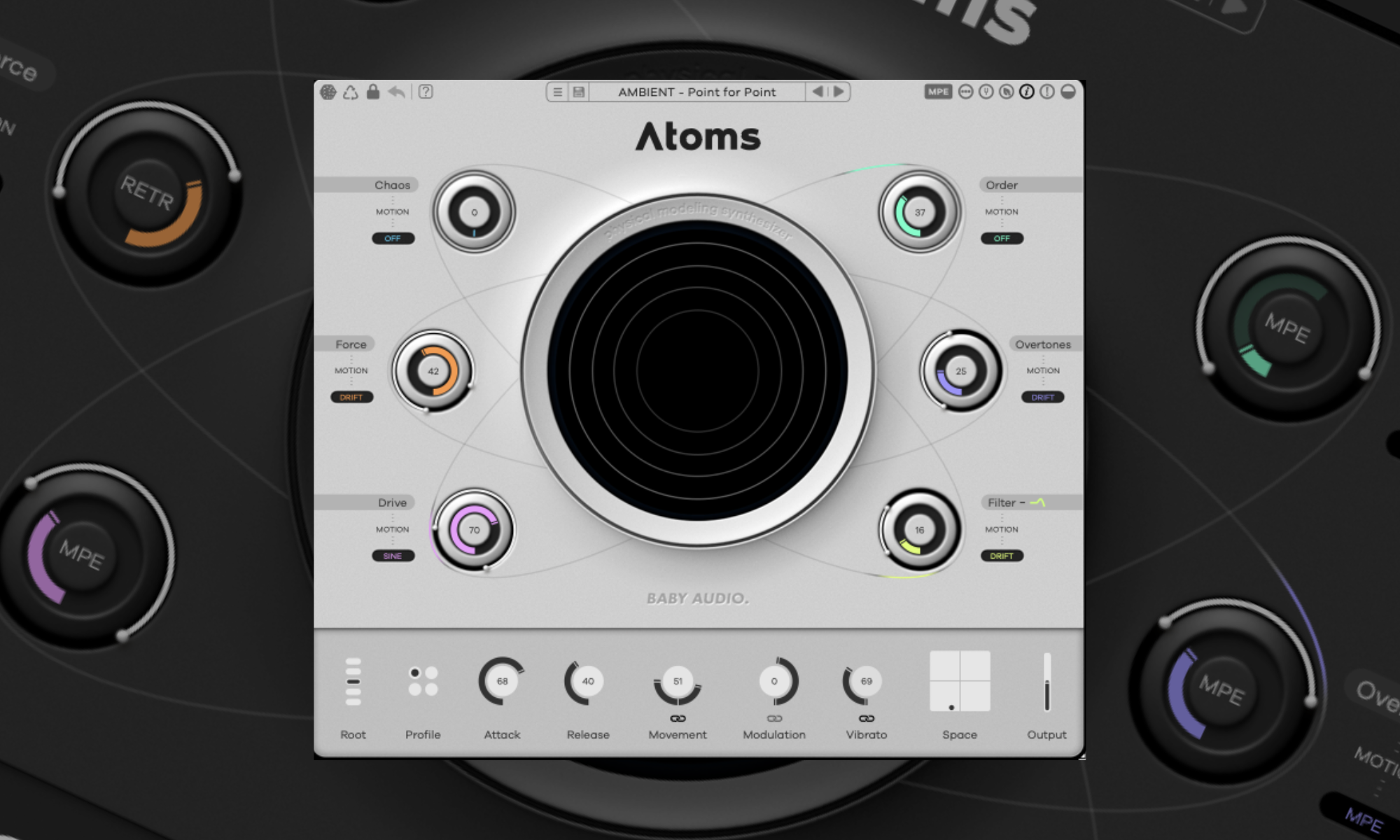
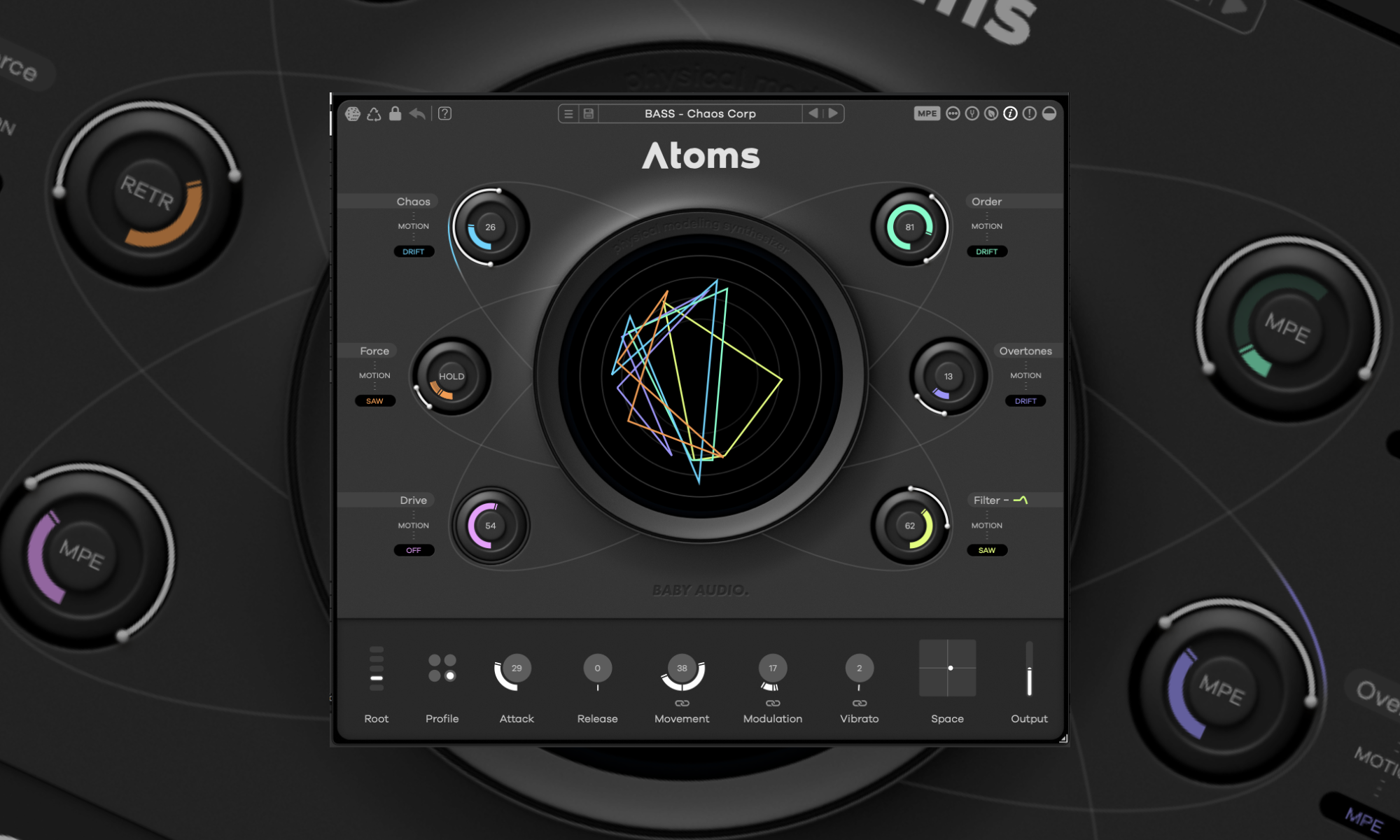
Atoms is a software synthesizer that utilizes physical modeling to simulate the sounds of real-life instruments, presenting a level of depth that allows for exploration beyond traditional sound boundaries. The software achieves this by emulating interconnected masses and springs with tweakable properties, which respond to a virtual bowing action to generate sound. It aims to produce organic fluctuations like those found in acoustic instruments, with six main parameters for users to manipulate. Atoms are positioned as evolving tools that, when interacted with, resemble natural organisms due to their shifting and regenerative sonic capabilities.
Users can choose between different sonic profiles to further sculpt the sound. These effects and profiles are integrated directly into the physical model to create more innate and cohesive modulations than would be achievable with separate effects chains. The physical modeling nature of the software is further accentuated by a visualizer that graphically represents the simulated mass-spring network, offering real-time visual feedback of the sound synthesis process.
Atoms feature a powerful randomization engine to foster exploration and creativity. Users can generate new patches with a single click. The randomization can be refined through selective parameter adjustment or by locking certain ones to maintain specific sound characteristics.
The ‘Recycle’ button acts as a secondary randomizer, creating variations of the current patch for additional sound exploration. This encourages users to engage with the plugin’s features to fully appreciate the capabilities of Atoms, including its library of presets crafted by sound designers and an expansion pack, which presents a diverse range of the software’s sonic possibilities.
What I Liked About Atoms
It’s ALIVE!!!!
All jokes aside with the name of this section, I will admit that this synth is incredibly lifelike and also alive with movement and expression. The presets especially boast a ton of modulation and evolution in their timbres as notes are held and played, so none of its 100+ presets sounds overly “pre-setty.”
Whether it’s something simple like a basic vibrato up to the wild-and-crazy ‘Chaos” parameters, every sound can be injected with a ton of life and movement, which is the secret sauce for making your music engaging and boring.
Which is the perfect segue to my next point!
It’s At Its Best For Ambient Stuff
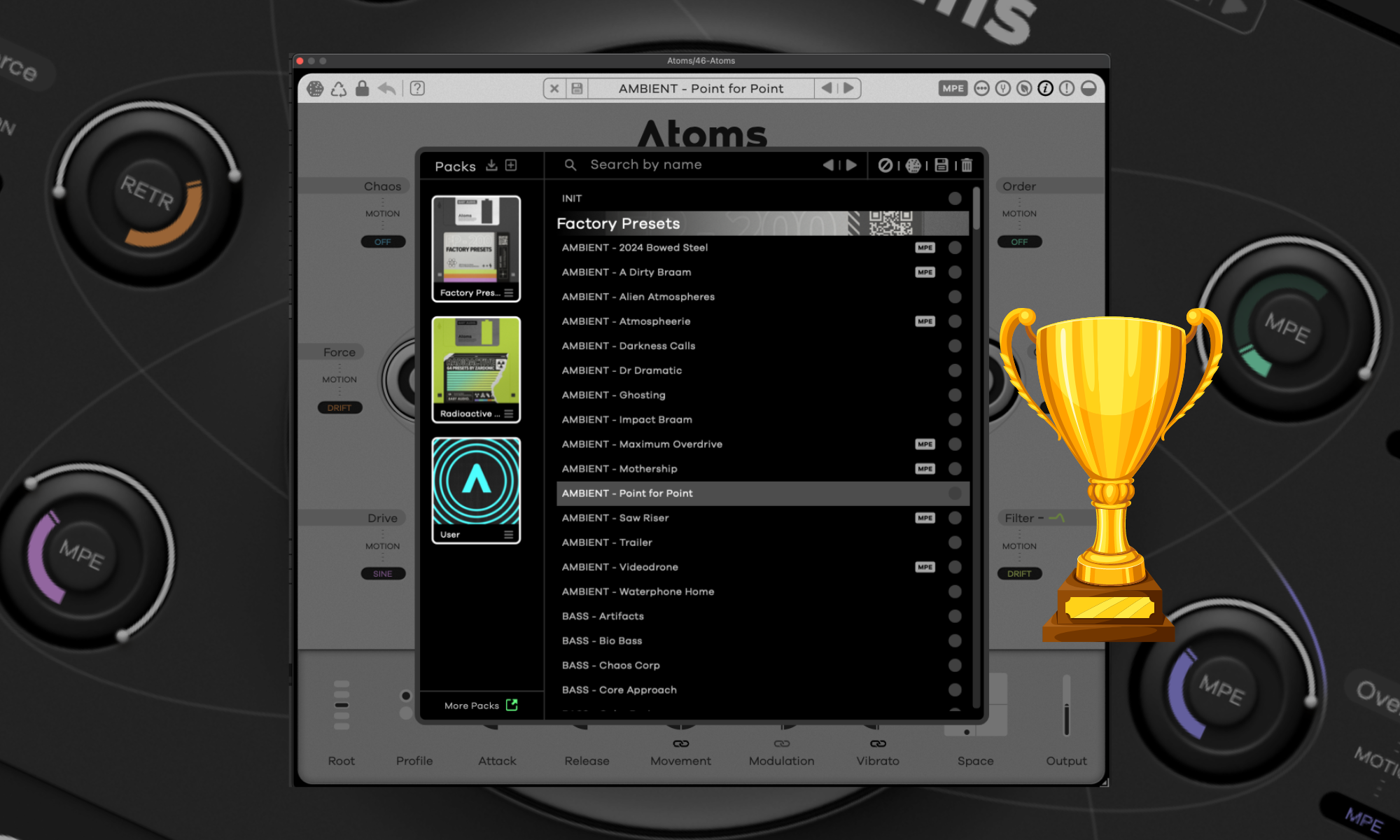
When I first opened this plugin, I jumped right into the string section, as that’s the primary instrument people often associate with physical modeling synthesis. And I’ll admit the strings were pretty good! I know I’ll be be using these strings to layer underneath the Omnisphere strings I’ve been using for years to create a sort of hyper-realistic dystopian ambiance and not so much relying on Atoms for my primary string sound (and that’s perfectly okay in my mind!). Examples of this below by the way…
But where this synth comes into its own is in the ambient soundscapes and subtle, playable textures it produces, which are genuinely next-level impressive. The entire section of “Ambient” presets was inspiring, and the ” Pulsing ” presets introduced otherworldly textures into the backdrops of even my most minimal compositions.
Hear The Ambience And Movement In One Of My Favorite Presets!
Check Out How Inspiring This Pulsing Preset Is Too!
I’ve used Omnisphere for these textures for decades, but the rompler-esque nature that I always attribute Omnisphere to often gives me little control over the samples playing. But the fact that the physical modeling was playing this texture means that I could mess around with parameters, change automation points, and more to keep a singular sound constantly changing and evolving until the end of time.
Amazing stuff!
Hear Me Slowly Fade In Atoms Underneath A String Patch And Notice How Much Color and Movement It Brings.
Its Streamlined UI Makes For Meaningful Changes
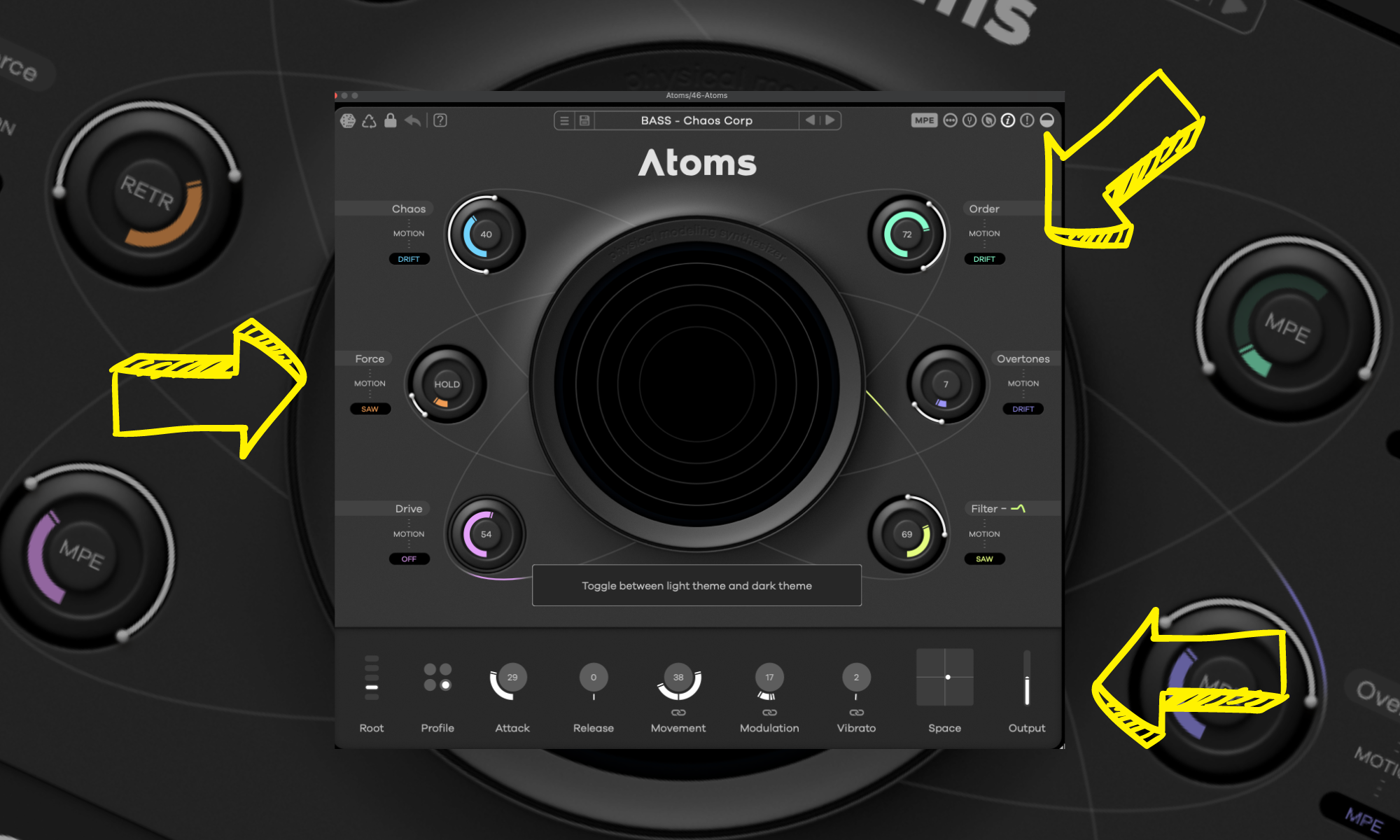
In my opinion, physical modeling is a type of synthesis that can be overly complex if the instrument’s developers lose touch with the core demographics of those using the plugin. Complex parameters and, almost exclusively, otherworldly and alien sounds are all that could be expected from this niche sound design style when most producers want a synth that makes sounds their fans LIKE to listen to. Still, Baby Audio flipped that script on its head.
The GUI is straightforward. There are only a handful of parameters to affect, and each one changes the sound in a meaningful way. This makes experimentation fun and modulation exciting, as adjusting a few parameters throughout a 16-bar loop can alter the sound and flip it into something entirely new right before your eyes (…ears?).
It’s a plugin that’s far from complete and focuses on making sounds you and your fans may want to listen to instead of being an overly niche sound design tool that makes interesting yet unusable tones.
What I Wasn’t Crazy About
It’s Hit Or Miss On Leads
Okay, the taste is incredibly subjective, so take this comment with a grain of salt, but as much as I love using the pulsing, string, and ambient presets, when it comes to some of the lead sounds that this synth tries to produce, I found them to be incredibly hit or miss.
As expected, the flute presets (the Atomic Flute and Flutegaze presets specifically) were incredible, and all of the woodwind-style presets performed as well as you would expect from a physical modeling synth. But some of the other wonky ones, like ‘THX-ish’ and ‘Flies Everywhere,’ sounded alright in isolation, but I couldn’t get them to mesh with any other sounds and textures I tried pairing them within a few basic compositions.
But again, all subjective, and the presets I did love FAR outweigh the lead sounds I wasn’t crazy about.
THX-ish Preset Sounds Alright, But Far From Useable
INLINE
What Is Physical Modeling Anyways?!
Physical modeling synthesis is a digital sound production technique that simulates musical instruments’ physical properties to generate sound. Unlike sample-based synthesis, which plays back pre-recorded sounds, physical modeling uses mathematical models to recreate the behavior of an instrument’s components, such as strings, air columns, or membranes. This approach allows detailed control over the sound by manipulating parameters representing physical characteristics, including mass, tension, and material properties. The result is a highly dynamic and responsive sound that can change in real-time with player interaction, offering depth and realism not typically found in sample-based instruments.
The distinction between physical modeling and sample-based synthesis lies in their core principles. Sample-based synthesis relies on a static library of recorded sounds, which limits flexibility and expressiveness since the sounds cannot change beyond their initial recording parameters. Physical modeling, however, dynamically generates sound through real-time calculations, enabling nuanced adjustments that mimic the intricate variations of live instrument performance. This makes physical modeling uniquely suited for creating organic, lifelike sounds and allows exploring sounds that do not exist in the natural world, expanding creative boundaries beyond traditional acoustic instrument capabilities.
While physical modeling provides unparalleled control and realism, it also challenges users to think differently about sound design. The complexity of controlling a sound through physical parameters requires a deeper understanding of how instruments produce sound in the real world.
However, this complexity also unlocks new creative possibilities, allowing for the creation of unique, expressive, and highly detailed sounds. Tools like Baby Audio’s Atoms exemplify the potential of physical modeling synthesis, offering users the ability to craft deeply organic and entirely new sounds, underscoring the innovative power of this synthesis method in modern music production.
Final Thoughts
After a decade entrenched in my production habits, accustomed to my selection of synths and VSTs, Atoms from Baby Audio has genuinely piqued my interest.
Atoms’ power lies in their ability to navigate between the realms of hyper-realistic simulations and create sounds that border on the fantastic. The tactile nature of its interface encourages a hands-on approach to crafting sound, making each twist and turn of a knob an exploration of the possibilities of acoustic alchemy.
Despite my initial hesitance, Atoms has proven its worth in the studio. It’s more than a supplement to my existing setup—it’s a catalyst for auditory innovation. Even with its occasional misses, the hits are nothing short of revelatory. Physical modeling may not be familiar, but Atoms translates this complex concept into a visceral audio experience, and I commend Baby Audio for that!
Learn More About This Plugin While Supporting Our Team Of Writers Through our Affiliate Partnership Here

Will Vance is a professional music producer who has been involved in the industry for the better part of a decade and has been the managing editor at Magnetic Magazine since mid-2022. In that time period, he has published thousands of articles on music production, industry think pieces and educational articles about the music industry. Over the last decade as a professional music producer, Will Vance has also ran multiple successful and highly respected record labels in the industry, including Where The Heart Is Records as well as having launched a new label with a focus on community through Magnetic Magazine. When not running these labels or producing his own music, Vance is likely writing for other top industry sites like Waves or the Hyperbits Masterclass or working on his upcoming book on mindfulness in music production. On the rare chance he's not thinking about music production, he's probably running a game of Dungeons and Dragons with his friends which he has been the dungeon master for for many years.