
Table of Contents
Image C/O Warner Music UK
Griff’s “Last Night’s Mascara” is a great excuse to dig into some literary comparisons and see what poetry and classic literature can reveal about her lyrics. Griff’s songwriting hits on the raw, sometimes messy emotional residue that lingers after someone leaves our lives. She takes something as small as leftover mascara—a detail we might normally brush off—and turns it into a powerful symbol of emotional attachment and the struggle to let go.
Since her days of recording in her bedroom, Griff’s journey has taken her to major stages with Taylor Swift and Coldplay. But even as her platform has grown, she’s kept that deeply personal, almost confessional style that makes her music resonate.
Using my background in English lit and creative writing, I want to give these lyrics a more poetic analysis, pulling in writers like Langston Hughes, John Donne, and Elizabeth Bishop, who all wrestled with similar themes of love, loss, and resilience. These are just my own opinions and takeaways, of course, but I hope that by looking at the song through this literary lens, we’ll unpack a new layer of meaning in “Last Night’s Mascara.” In pairing Griff’s modern lyrics with timeless poetry, we can see just how universal—and timeless—the need to process, and sometimes simply survive, heartbreak can be.
Griff Last Night’s Mascara Lyrics
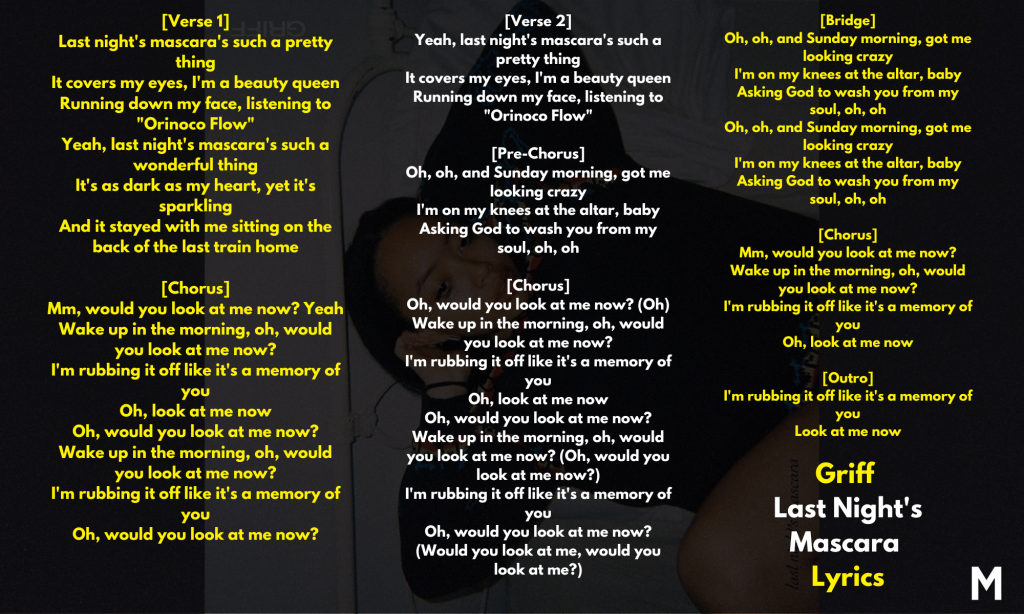
Griff Last Night’s Mascara Meaning
“Last night’s mascara’s such a pretty thing / It covers my eyes, I’m a beauty queen”
In this line, the speaker is describing their mascara from last night. It’s still there, almost like a leftover reminder of something or someone. Normally, we think of mascara as something that enhances beauty. Here, though, it’s covering the speaker’s eyes in a way that feels heavy. It suggests there’s something emotional and even sad that the speaker can’t quite wipe away. The mascara becomes more than just makeup—it’s a sign of leftover feelings that are hard to remove.
This idea connects with Langston Hughes’ poem “Life is Fine.” In his poem, Hughes writes about feeling deeply hurt but pushing through, with lines like “Though you may hear me holler, / And you may see me cry.” Just like Hughes’ speaker feels the weight of sadness but doesn’t give up, the song’s speaker also feels pain yet keeps going. The mascara is a mark of what they went through, much like Hughes’ speaker carries the weight of their pain openly.
Calling the mascara “a pretty thing” while knowing it’s smudged and messy shows the speaker is in conflict. They’re stuck between wanting to look fine on the outside and feeling hurt on the inside. Much like Hughes’ speaker finds strength in facing their pain, the song’s speaker is also confronting their emotions, even if they feel raw and exposed.
“Would you look at me now? / Wake up in the morning, oh, would you look at me now? / I’m rubbing it off like it’s a memory of you”
Here, the speaker is trying to clean away the mascara, almost as if wiping away the memory of this person. Each morning, they wake up and go through this routine of “rubbing it off,” suggesting they’re trying to move on from the past. The mascara is a reminder of someone they’ve lost or left behind, and rubbing it off feels like an effort to erase those feelings. This repetition of rubbing it away shows us that moving on isn’t simple—it’s a daily effort that the speaker has to repeat.
John Donne’s poem “A Valediction: Forbidding Mourning” also explores the difficulty of parting from someone important. Donne writes, “If they be two, they are two so / As stiff twin compasses are two.” He’s describing love as something that stays connected even when people are apart. Similarly, the song’s speaker is trying to rub away the memory, but it doesn’t disappear easily. Just as Donne describes love as a strong force that stretches but doesn’t break, the speaker here can’t fully separate from the memories and feelings left behind.
The fact that the speaker repeats “would you look at me now?” suggests they’re seeking some kind of validation or acknowledgment, maybe even from the person they’re trying to forget. It’s almost like they’re saying, “Look at how I’m trying to move on,” even though it’s not easy. This attempt to let go, like in Donne’s poem, shows that true separation from someone emotionally close can feel like a tug-of-war.
“And Sunday morning, got me looking crazy / I’m on my knees at the altar, baby / Asking God to wash you from my soul”
In this line, the speaker goes from trying to wipe away the mascara to asking for something deeper: a release from their soul. By mentioning “Sunday morning” and “the altar,” we get the sense that the speaker is looking for more than just a physical cleansing. They’re looking for spiritual help to fully let go of this person. This plea to God shows how hard it is to move on—they feel like they need more than their own willpower to finally feel free.
This connects with Elizabeth Bishop’s poem “One Art,” where Bishop writes, “The art of losing isn’t hard to master.” In her poem, Bishop talks about how losing things, especially people, is something we all experience. Even though she tries to convince herself that loss is easy, she admits it can feel like “disaster.” Just like the speaker in Bishop’s poem, the song’s speaker is trying to master the art of letting go, but it’s a struggle. The mascara in the song is like Bishop’s repeated line about “losing,” showing that loss is something that doesn’t fade instantly.
When the speaker says they’re “asking God to wash you from my soul,” it shows that this is more than just a memory they’re trying to erase. It’s something deep and spiritual. The line reflects a real struggle with moving on from something that’s affected them on a soul level. The need for divine help suggests that, like Bishop’s speaker, they’re realizing that losing someone close can be much harder than they expected.
“I’m rubbing it off like it’s a memory of you”
In this final line, the speaker returns to the act of “rubbing it off” again, repeating it like a daily ritual. The fact that this line comes back at the end shows us that the process isn’t complete. Even after asking for help, the speaker is still working through these feelings every day. The mascara remains a constant reminder, and even though they’re rubbing it away each morning, the memory of the person isn’t fading quickly.
This ongoing struggle is also reflected in Bishop’s “One Art.” In her poem, Bishop repeats that line, “The art of losing isn’t hard to master,” but each time she says it, we sense that she’s trying to convince herself. Both the song and the poem show us that losing someone leaves traces that are hard to erase, even with repeated effort. The speaker in the song keeps wiping away, just like Bishop’s speaker keeps talking about loss—both are caught in a cycle of trying to let go but still feeling attached.
This final attempt at wiping off the mascara shows that moving on can be a slow, ongoing process. Much like Hughes’ speaker in “Life is Fine” who faces their pain with resilience, the song’s speaker is showing their own kind of strength. Even though they’re still dealing with feelings, they keep trying, day after day, to let go. It’s a powerful reminder that healing and moving forward isn’t always instant but can be a gradual journey.
Main Takeaways and Poetic Throughlines
At its core, “Last Night’s Mascara” digs into themes of heartbreak, memory, and resilience—the emotional “aftertaste” that doesn’t quite fade, even when we want it to. Griff takes something as everyday as leftover mascara and builds it into a symbol of emotional residue. This detail of smudged mascara might seem small, but it mirrors how memories from past relationships often linger, whether we like it or not. Griff’s lyrical line, “rubbing it off like it’s a memory of you,” shows how she’s facing that lingering pain every day, making the song feel deeply relatable and universal.
This is something Langston Hughes also explores in “Life is Fine,” where his speaker, after facing his own emotional turmoil, ultimately finds a reason to keep going. Hughes’ words—“Though you may hear me holler, / And you may see me cry”—reveal the power in openly acknowledging pain, much like Griff’s speaker confronting her feelings in “Last Night’s Mascara.” For both Hughes and Griff, survival is an everyday act of resilience.
There’s also a strong spiritual side to the song that gives us more insight into Griff’s perspective. Raised in the Hillsong megachurch, Griff has spoken about how faith and music intertwined for her growing up, and this influence shows here in lines like “Sunday morning, got me looking crazy / I’m on my knees at the altar.” The speaker’s plea to God to “wash you from my soul” reveals the depth of her struggle.
For her, letting go isn’t just a surface-level act—it’s a plea for spiritual release, for help in removing something she’s finding impossible to scrub away on her own. This idea of enduring emotional connection echoes John Donne’s “A Valediction: Forbidding Mourning,” where Donne writes about a bond that doesn’t break easily, no matter the distance. His line, “If they be two, they are two so / As stiff twin compasses are two,” captures this attachment. Like Donne’s speaker, Griff’s character can’t fully separate from the past, even if she’s trying to cleanse herself of it.
Finally, “Last Night’s Mascara” draws out the slow, repetitive nature of loss—a process that often doesn’t just “fade away” overnight. Griff, known for her raw and vulnerable lyrics, taps into this gradual struggle in lines about trying, each morning, to erase the evidence of a past love. Elizabeth Bishop captures this same feeling in her poem “One Art.” Bishop’s line, “The art of losing isn’t hard to master,” highlights the tension between wanting to let go and the stubborn way that memories linger. Griff’s speaker “rubbing it off” again and again shows that moving on can take small, steady efforts, not one dramatic moment.
Both Bishop’s and Griff’s works reflect the difficult truth that emotional healing isn’t immediate—it’s a repeated act of resilience, where even the smallest daily rituals can become steps toward closure. For Griff, a singer who’s faced performance nerves and the challenge of “moving people” night after night on stage, this song itself may even be part of her own process of working through and ultimately letting go.

Will Vance is a professional music producer who has been involved in the industry for the better part of a decade and has been the managing editor at Magnetic Magazine since mid-2022. In that time period, he has published thousands of articles on music production, industry think pieces and educational articles about the music industry. Over the last decade as a professional music producer, Will Vance has also ran multiple successful and highly respected record labels in the industry, including Where The Heart Is Records as well as having launched a new label with a focus on community through Magnetic Magazine. When not running these labels or producing his own music, Vance is likely writing for other top industry sites like Waves or the Hyperbits Masterclass or working on his upcoming book on mindfulness in music production. On the rare chance he's not thinking about music production, he's probably running a game of Dungeons and Dragons with his friends which he has been the dungeon master for for many years.