Table of Contents
Music production is easier to start than ever, but the blank piano roll is still brutal.
That is where MIDI plugins and generators can help. They can write chords, build basslines, create arps, generate melodic ideas, shape rhythmic patterns, and give you something to react to when the first move feels too vague. The best ones do not write the track for you. They give you a starting point worth editing.
After producing music for more than a decade, running labels, and trying a fairly ridiculous number of music theory plugins, MIDI sequencers, arpeggiators, and generative writing aids, I still think these are some of the best options for producers who want help getting from silence to a usable musical idea.
Quick answer: The best MIDI plugins and generators in 2026 are Scaler 3, Melody Sauce 3, Phrasebox 2, Captain Plugins Epic, BLEASS Arpeggiator, Harvest, Forager, HY-RPE2, Stepic, Chordjam, Riffer, and Cthulhu. Start with Scaler 3 for chords, Melody Sauce 3 for fast ideas, and Phrasebox 2 for playable phrase sequencing.
What Changed In This 2026 Update?
A lot changed since the original version of this article.
Scaler 2 has been replaced by Scaler 3 for most new buyers. Melody Sauce 2 has been replaced by Melody Sauce 3, which now generates melodies, chord progressions, and basslines. Phrasebox has moved to Phrasebox 2, which adds deeper phrase generation, CC automation, row rules, multi-channel output, and more timing control.
Captain Plugins Epic is also the version to look at now, especially if you want one writing system for chords, melody, bass, drums, and keyboard-style performance. BLEASS Arpeggiator, Harvest, Forager, HY-RPE2, and MIDI Madness 3 still have a place, but they need clearer buyer notes because the category has gotten stronger.
I also added newer picks that now deserve space in the conversation: Stepic, Chordjam, Riffer, and Cthulhu. Some are newer. Some are older but still relevant. The point of this update is not to chase novelty. It is to help you pick the right MIDI plugin for the part of the writing process that keeps slowing you down.
Who Is This Article For?
This is for producers who can usually make sounds, mix drums, and arrange loops, but sometimes freeze when it is time to write notes.
It is also for producers who know music theory but want faster routes into variation. A good MIDI plugin is not only for beginners. Even if you know your way around chords and scales, a phrase generator or sequencer can push you away from the habits your fingers repeat every time you sit down.
That point comes up a lot when I revisit older production articles after artist interviews. In TEED’s interview on taste, trends, and building a creative process that lasts, the lesson I kept thinking about was that taste grows from repeated decisions. MIDI generators are at their best when they speed up those decisions, then leave enough room for you to edit, reject, and reshape the idea.
Quick Picks: What Is The Best MIDI Plugin For Each Job?
| Need | Best Pick | Current Price | Why It Works |
|---|---|---|---|
| Best overall music theory plugin | Scaler 3 | Around $99, upgrade $39 | Chords, performance, detection, standalone mode, and deep composition help |
| Fastest melody starter | Melody Sauce 3 | $79 sale, $99 regular | Generates melodies, chords, and basslines quickly |
| Best phrase arpeggiator | Phrasebox 2 | Around $94 regular, often lower on sale | Turns chords into editable phrases with piano-roll logic |
| Best full writing suite | Captain Plugins Epic | Price varies by sale and bundle | Chords, melody, bass, drums, and play mode in one system |
| Best simple arp plugin | BLEASS Arpeggiator | $39 | Polyrhythmic arps, randomization, desktop and iOS support |
| Best rhythm-first generator | Harvest | Price varies | Tap a rhythm first, then generate notes around it |
| Best chord-exploration plugin | Forager | Price varies | Good for finding less obvious progressions |
| Best Euclidean sequencer | HY-RPE2 | About €42.95 or $48 | Grid and Euclidean sequencing with modulation options |
| Best modulation sequencer | Stepic | €39 | Step sequencing plus MIDI CC modulation |
| Best random chord generator | Chordjam | €49 | Chord progressions with guided randomization and MPE |
| Best riff generator | Riffer | €49 | Generates riffs from pitch, duration, velocity, and density |
| Best older budget arp/chord pick | Cthulhu | $39 | Still great for chord triggering and pattern arps |
BLEASS Arpeggiator
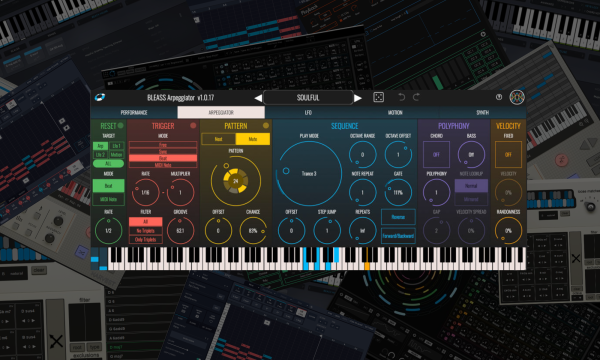
BLEASS, a company we’ve been loving and recently lauded in our roundup of the best softsynths in the game, has an arpeggiator that sneaks under the radar for far too many producers these days, and it’s a real shame because it’s an incredibly powerful MIDI arpeggiator with a duel functionality as a cheeky little FM synth. Granted, the FM synth wasn’t one of my favorite parts of the plugin by any means, but it can be great, and I can see it being useful as a simple sound generator when dialing in ARP patches and such.
But the BLEASS arp really shines when it comes to the arp. Its ability to add randomization to parameters and touch points like velocity is a great way to add a human element where most arps often feel robotic, even when swing is introduced.
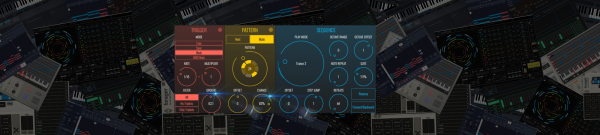
And that’s the real magic that I’ve discovered here; where most arpeggiators and MIDI generators are good at creating complex sequences or intricate polyrhythms in their MIDI, the majority lack the simple functionality of making them sound human, but BLEASS’ arp breaks the mold with tons of options and parameters to dial in the randomness and imperfections that make it sound like you wrote and played its melodies by hand!
Learn More About This Plugin While Supporting Our Team Of Writers Here
Melody Sauce 2

Melody Sauce first came on my radar years ago when it was just as simple as a Max4Live device, but it’s come a long way with its second official iteration. Where Melody Sauce 2 really shines is just how easy it is to operate without sacrificing too much functionality. The added benefit of saving different sketches in the bank feature means you don’t have to commit to an idea before trying out what MS2 will generate next for you.
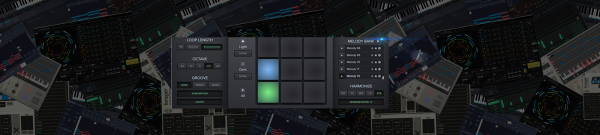
This allows you to really cycle through ideas quickly without feeling the need to commit, which makes Melody Sauce 2 one of my favorite tools when I hit writer’s block to crank out a couple of different melodies with different timings and syncopations to see what kickstarts my creative juices again.
I almost think it does this by design because so many other AI-driven MIDI generators go so deep into the creative process that they write you into a corner without any room to expand upon the melody they give you. In contrast, MS2 provides amazing foundational melodies and rhythms that are inspiring in their own right but leave plenty of room to elaborate on by hand, by you.
Learn More About This Plugin While Supporting Our Team Of Writers Here
Phrasebox
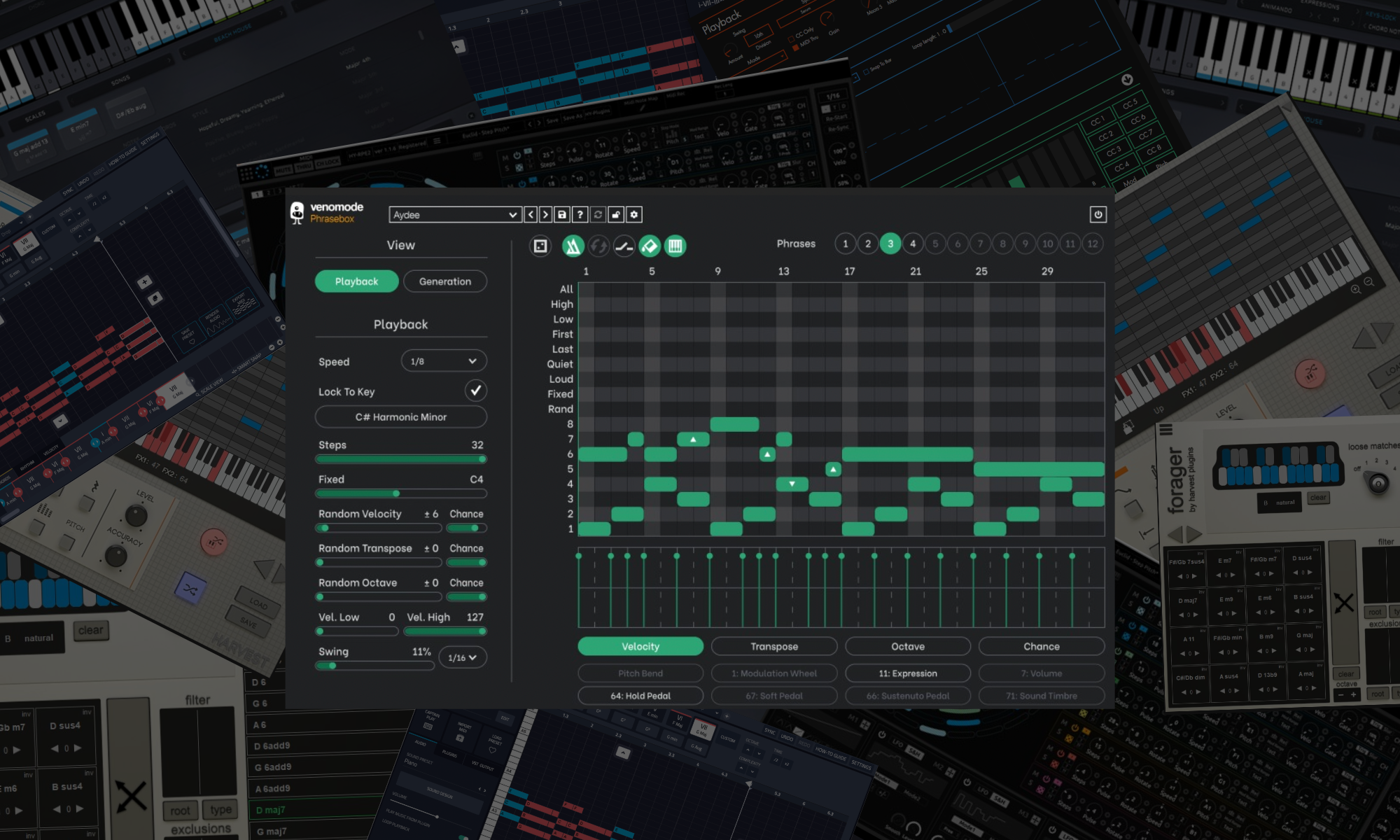
Anyone familiar with a DAW that has a piano roll, which I assume is pretty much everyone, will be able to pick up and start using Phrasebox almost instantly.
At the core of its interface is the generator window, which is fashioned after a classic piano roll, which makes editing notes in the MIDI it generates easy as you can change the note length, timing, and sequencing all directly in the window instead of having to do it by “ear” while adjusting parameters and probability chances.
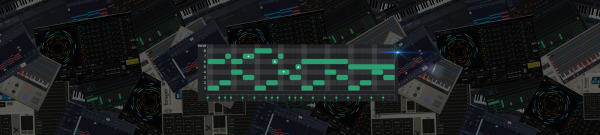
That said, you can use many randomization features to create new and inspiring results once you have a foundational riff you’re happy with. Options like note probability and randomizer integration add human-like changes to velocity, timing, and even note transposition.
The real X-factor with Phrasebox is, and I don’t mean to belabor the point, the piano rolls at the center of its sequencing. Having the visual feedback not only makes editing the notes incredibly easy but also doubles as an educational tool for those who want to make music but don’t know the complex theory (at least, yet). It allows you to learn while you do, which isn’t always as easy as it sounds.
Learn More About This Plugin While Supporting Our Team Of Writers Here
Captain Plugins
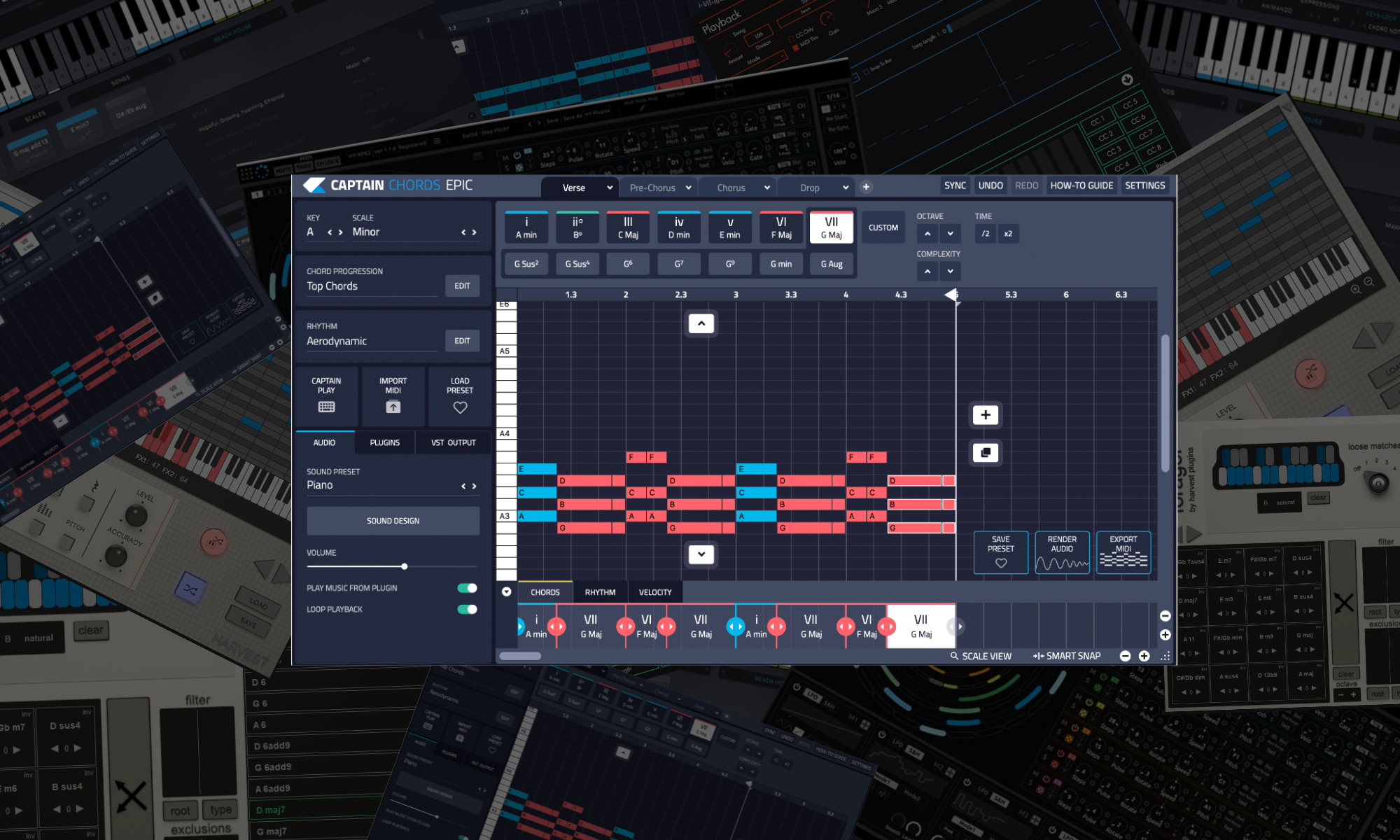
The Captain bundle of plugins, which we reviewed in a massive deep dive, is a powerhouse suite of tools that helps you write everything from chords to melodies and even bass lines. While this is certainly a MIDI generator plugin, I’ve always found it easier to describe it more as a production assistant and not in the clickbaity AI way. It has a massive bank of chords with smart suggestions recommending various chords you could include next.
So, say you want to write a track in the most vanilla key, C major. Well, you start with a Cmaj chord, and it will naturally recommend that you go to the next most popular chord in the progression, the Fmaj chord. But it will also give you other recommendations, like the 5th chord (Gmaj), the 7th chord, or even the suspended 4th chord (Fsus4). Better yet, you can cycle through these different recommendations until you find one you dig the most.

The real bell-of-the-ball feature here is that all the different plugins in the suite, from Captain Chords to the melody plugin, can speak to each other. So even if you have an instance of the chord plugin open and feeding MIDI that it’s generated to a pad preset on Omnisphere, the Captain Melody EPIC plugin can be referencing the chord plugin even though the melody plugin is feeding MIDI into an entirely different channel like your lead synth.
It’s pretty bonkers if you ask me!
Learn More About This Plugin While Supporting Our Team Of Writers Here
Harvest
It’s no secret that MIDI generators are fraught with problems that usually require a couple of different workarounds. Usually, these workarounds are far from dealbreakers; if it generates great-sounding MIDI, then I’m down to use it!
One of the biggest hurdles I encounter is that the melodies MIDI generators give me sound good in isolation, but their cadence and timing almost work against the track’s established rhythm and groove I’ve spent hours writing.
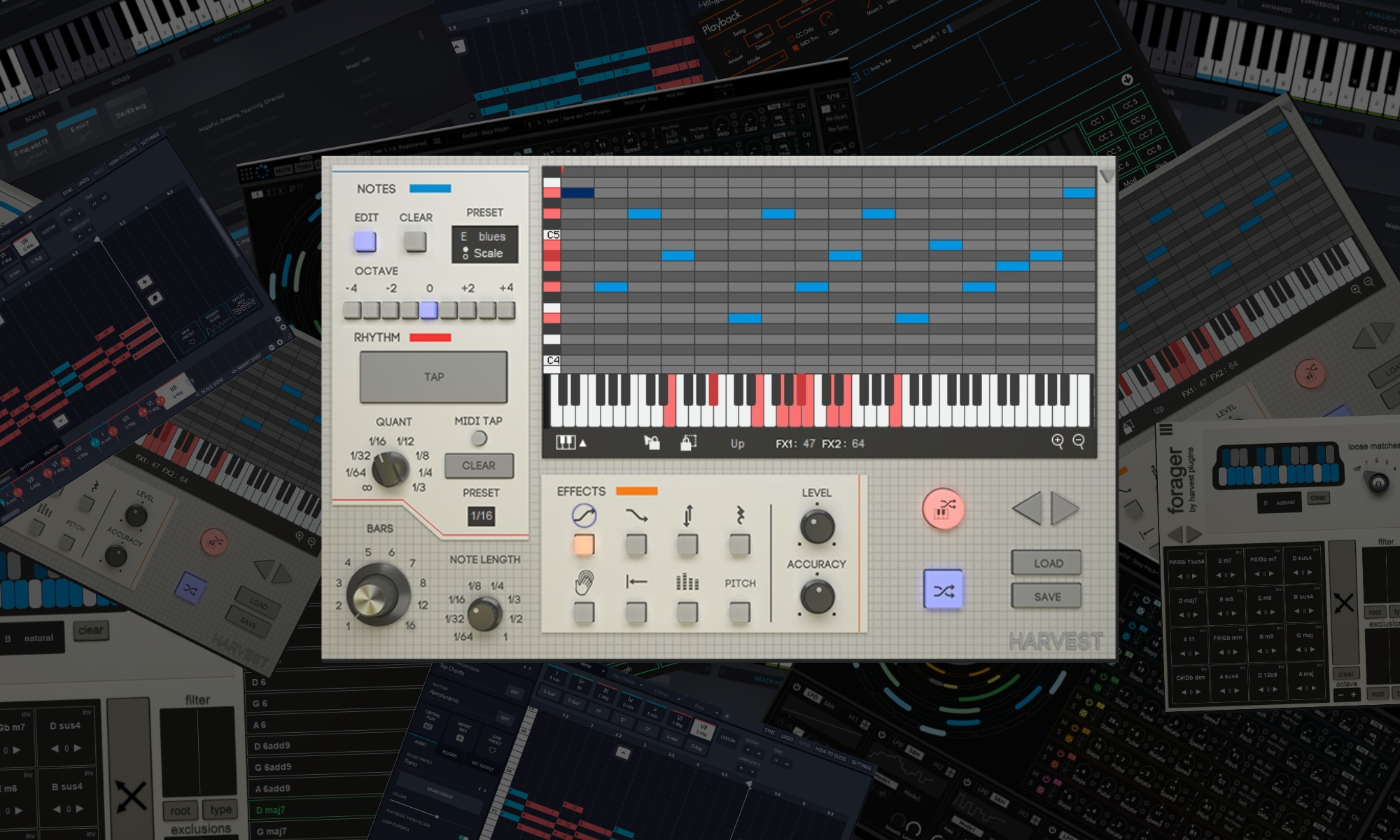
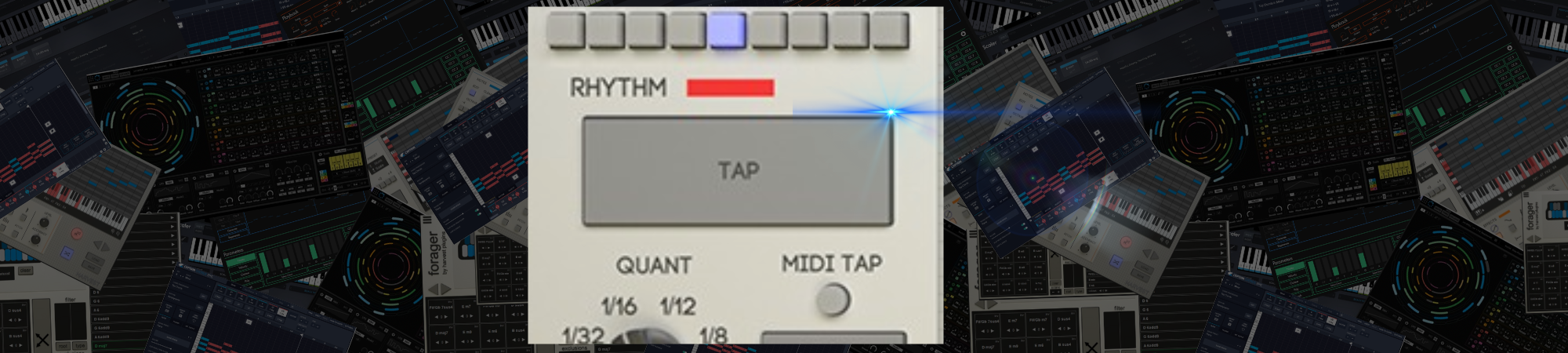
But Harvest’s ability to tap out a rhythm and confine the notes it generates only to the rhythm you’ve given it instantly rectifies that problem. Honestly, this is an incredibly unique quality I don’t think I’ve ever seen in such a plugin. Now that I know it exists, I wonder why every MIDI generator doesn’t include a similar feature!
This function, coupled with the ability to freeze specific chunks of the MIDI sequence it generates, means you can slowly but surely chip away at a melody you know has potential, freezing the chunks that sound great and regenerating the bits that aren’t up to snuff until you have something you love. All this, coupled with a semi-old school aesthetic, offers this plugin a ton of value and bang for its>$30 price tag.
Learn More About This Plugin While Supporting Our Team Of Writers Here
Midi Madness 3

One clever feature of Midi Madness 3 is the fact that it comes with several Macro knobs located at the top of the plugin, allowing you to change and morph your sounds and sequences in real-time.
All too often, MIDI generators and arps spit out a relatively static bundle of notes, but having the option to modulate and reshape the notes in the sequence as the track evolves is a real magic bullet to help it not sound robotic (arguably more so than having more minor features like velocity randomness and note modulations).
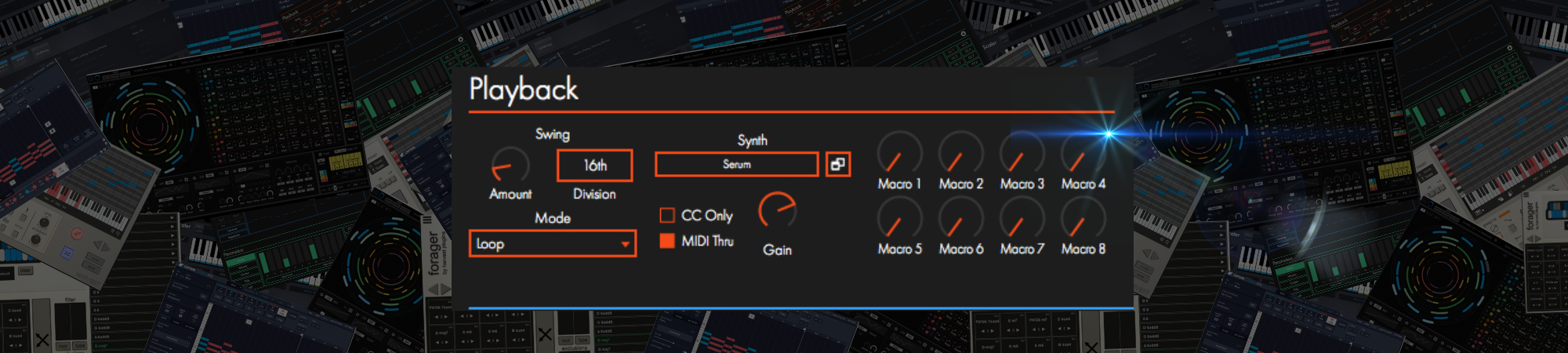
But it stands out because it can respond to incoming MIDI data, making it a powerful tool for systematic composition and live performance. Personally, I almost always write the chords of a track first, which is why I found a ton of value in the aforementioned Captain Plugin bundle. But still, I don’t want to be confined to their ecosystem every time. When I sit down to write chords on a piano, the MIDI Madness 3 is the perfect next step in the workflow, as I can feed those chords into it and have it start generating new melodies, sequences, or textures based on the chords.
Learn More About This Plugin While Supporting Our Team Of Writers Here
Forager

Forage is the chord-driven cousin of the Harvest plugin we chatted about above. And where many other MIDI generators, even some on this list, are incredibly formulaic if not entirely systematized, the Forager plugin takes a more spontaneous route when suggesting and generating its chords.
While this might seem a little frustrating for those who want to bang out ideas quickly and move on to the next stage of the process, those who do a bit of digging and scraping for some unique combinations of chords that Forager can give you will be rewarded with far more complex and nuanced progressions that sound anything but plugin-generated.
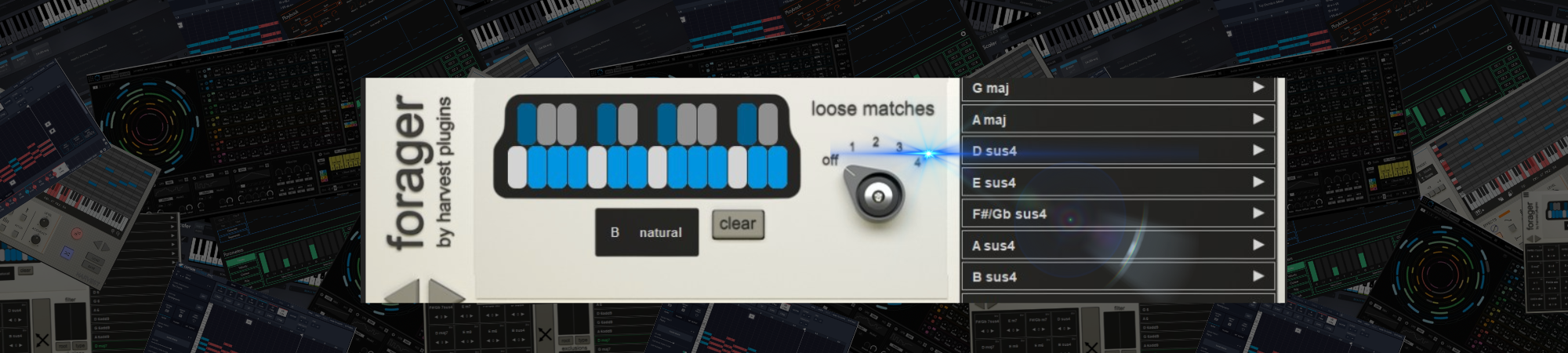
Perhaps those making conventional EDM or more commercial genres won’t need this level of nuance, no offense, of course, as I produce predominantly dance music as well, but for those looking to have more odd-ball chords in genres like Jazz, Hip-hop, and others, you will find a constant companion and production partner with Forager.
Learn More About This Plugin While Supporting Our Team Of Writers Here
HY-RPE2
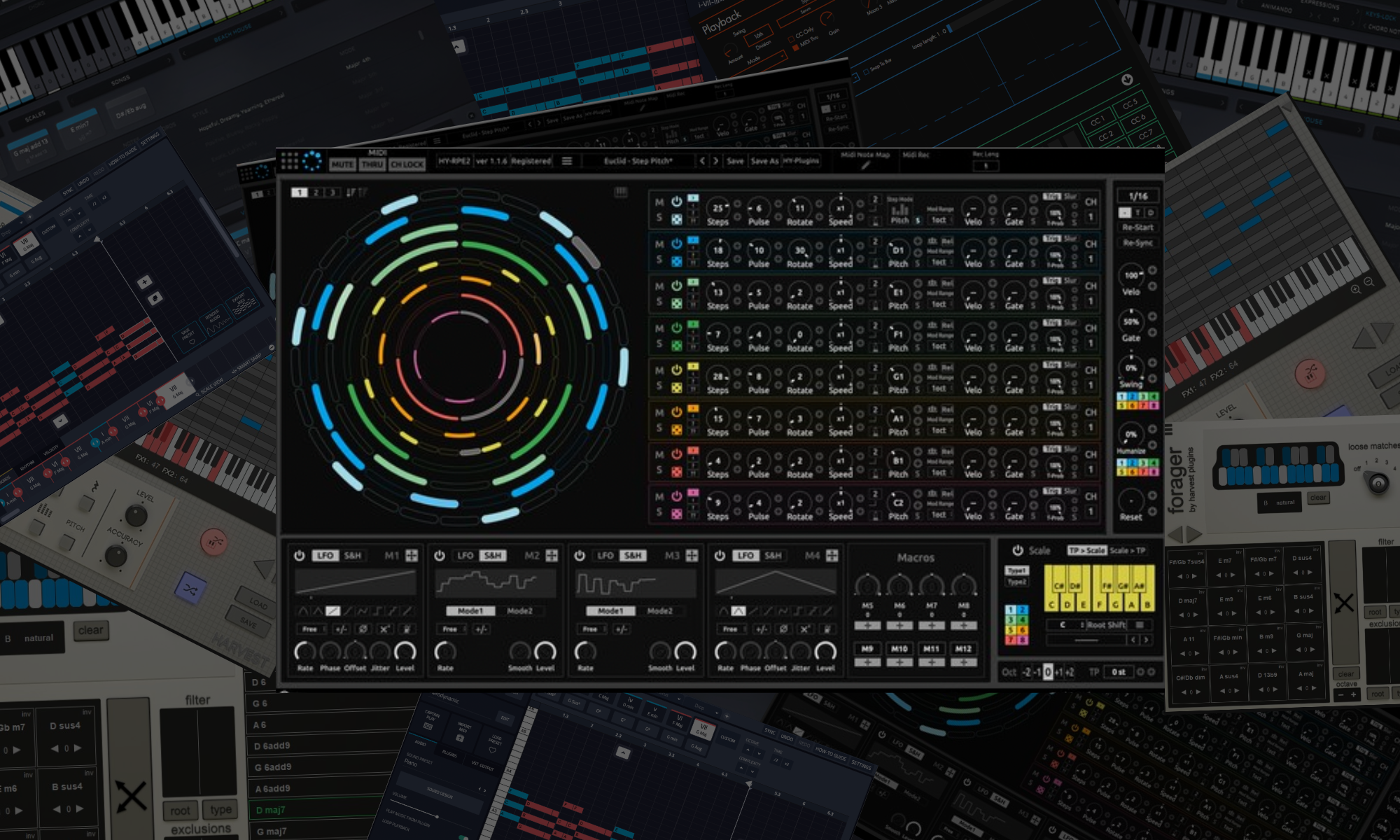
Ahh, the hypnotic magic of Euchlydian sequencing, the type of songwriting and note formation that sounds cool but that few can do just by ear or hand. But that’s where plugins like this one come into the mix, helping create numerical sequencing that mathematically aligns to create some truly unique interactions between rhythms and note lengths.
Now listen, there are a ton of different sequencers like this, but few can give as much control and, arguably more importantly, make as much sense as HY-RPE2 does.

It makes complex rhythms seem digestible because of the circular sequencer window on the left side of the screen, which is color-coded so you know what channel and layer is interacting with what and when. So much Western music follows a fairly rigid formula centered around standard time signatures. This is the ideal MIDI generator plugin to break out of that mold.
You’d be shocked to hear how much having just a single layer or two in your track that don’t follow the conventional eight-bar grid pattern can add a sense of mysticism and wonder to a track and make it far less predictable. Check out my track ‘Algebra of Contentedness’ below, whose lead is in an unconventional 12-bar loop (probably the most basic of polyrhythmic compositions, at least in dance music).
Learn More About This Plugin While Supporting Our Team Of Writers Here
Scaler 3
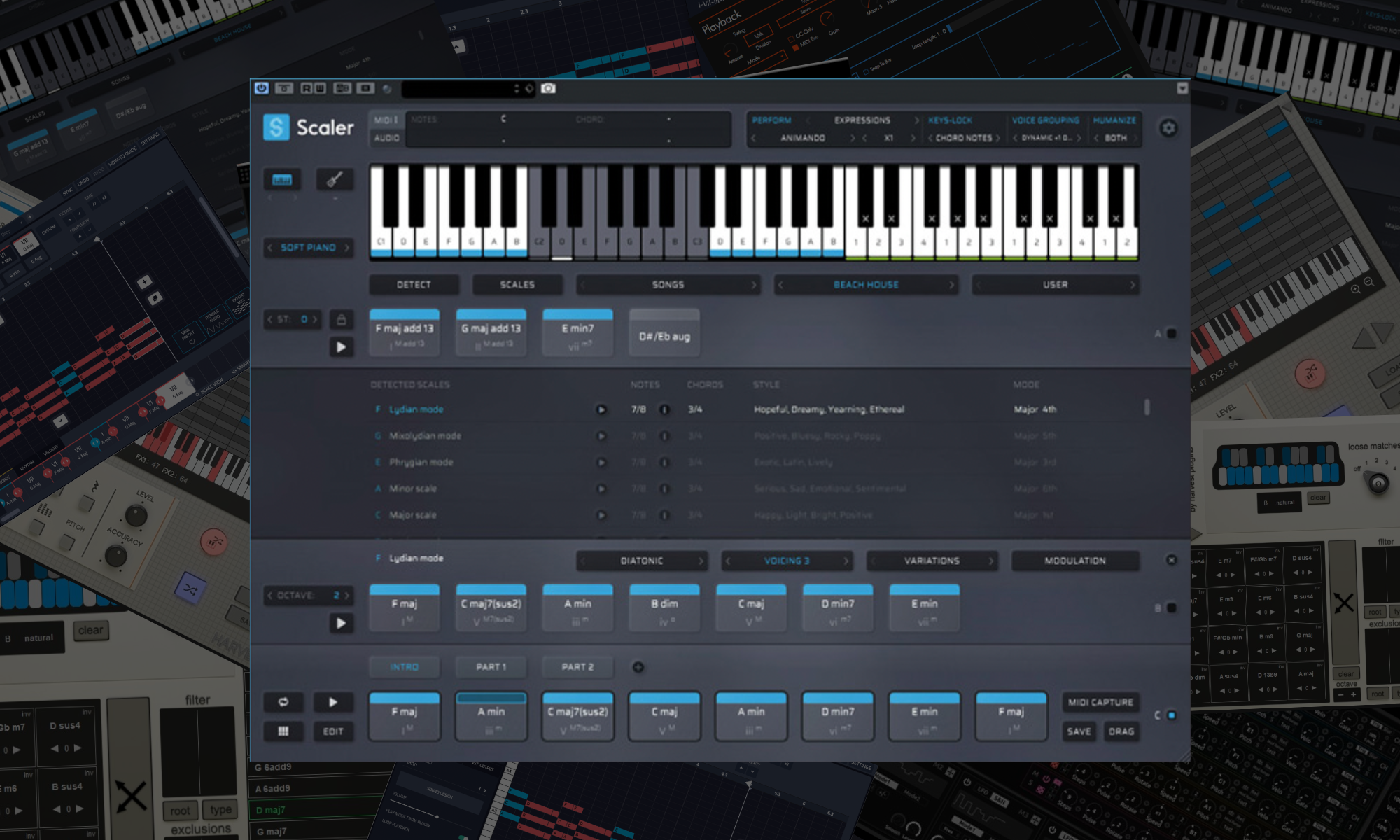
MIDI generators and note-creation plugins are powerful tools to generate initial ideas, much like we’ve discussed with many of the tools in this list, but most stop there. A plugin might be great for writing chords, or another plugin might be great at arpeggiating chords once you’ve written. But a few plugins can create an initial idea and then repurpose it in numerous ways, giving you enough melodic content and layers to write nearly an entire song.
But Scaler 2 does exactly that, and most of the heavy lifting here comes from its performance tab, which transforms simple chords into intricate performances through its arpeggio, strumming, and other expressive articulations, adding depth and realism to all of your productions. It has the potential to single-handedly be the secret sauce that turns your loop into a track (or at least give you enough music ideas to turn a 16-second idea into a fully drawn-out story).
This feature goes hand in hand with the plugin drag-n-drop functionality as well, meaning a fast workflow would look something like this:
- Create an initial chord loop in Scale 2
- Drag that melody into a piano preset or synth pad on another VST
- Then, create a melody
- Repeat step #2, but drag it into a lead synth channel
- They create a strumming texture with the chords for texture
- Repeat step #2, dropping it into an ear-candy-style synth
- Create a few extra tonal pads and atmospheres to fill the space, and you’re armed with enough material to start the arrangement!
This workflow makes Scaler 2 one of the most powerful tools in the industry for MIDI generator and music theory tools and can help you write fantastic music quickly and efficiently. Certainly not one to sleep on!
Learn More About This Plugin While Supporting Our Team Of Writers Here
FAQ
How Do MIDI Plugins Fit With Mixing And Finishing?
MIDI plugins help start songs. They do not finish them.
That sounds obvious, but it is the trap. A generated chord progression can sound impressive at the start of a session and still fall apart once the arrangement, mix, vocal, or bassline enters. A generated melody can feel exciting for ten minutes and then become the part you eventually mute.
That is normal. Treat MIDI output like raw material.
Once the idea is working, the track still needs arrangement decisions, sound choices, gain staging, dynamics, tonal balance, and mix discipline. That is where something like the Massive 50 Off Musik Hack Plugins Master Plan And Fuel Are Now Half Price article fits the larger workflow. Master Plan and Fuel are not MIDI generators, but they sit on the other side of the same production chain: after you have an idea, you still need to make it hit and translate.
MIDI plugins can start the conversation. Your arrangement and mix still need to answer it.
When Should You Wait For A Sale?
Software pricing moves constantly, so patience can save money.
Scaler, Plugin Boutique products, Audiomodern plugins, Mixed In Key products, Native Instruments software, iZotope products, and many smaller developers all cycle through seasonal discounts. Black Friday, summer sales, anniversary sales, and holiday sales can make a major difference.
That is why the Native Instruments And iZotope Holiday Sale With Free Plugins And Storewide Savings piece is worth keeping in mind even when shopping outside NI. The broader plugin market runs on discount cycles. If you do not need the plugin today, waiting can make sense.
The exception is cheap workhorse plugins. BLEASS Arpeggiator at $39, Cthulhu at $39, Stepic at €39, and Riffer or Chordjam at €49 are already in impulse-buy territory for a lot of producers. For bigger suites, I would watch sale pricing.
What Are The Common Mistakes With MIDI Generators?
The first mistake is using the first generated idea without editing it. That almost always sounds like the plugin did the writing.
The second mistake is generating chords, melodies, and basslines from separate plugins without checking whether they actually speak to each other. A track can be harmonically correct and still feel disconnected.
The third mistake is ignoring rhythm. A melody with the wrong cadence can feel dead even if the notes are right.
The fourth mistake is using MIDI generators to avoid learning theory entirely. These plugins can help you learn faster if you pay attention to what they create.
The fifth mistake is using too many at once. Pick one generator, get the idea out, then edit.
The sixth mistake is keeping every output. Most generated ideas should be deleted. That is part of the process.
What Are The Best MIDI Plugins For Beginners?
Scaler 3, Melody Sauce 3, Captain Plugins Epic, and Chordjam are the best beginner-friendly picks.
Scaler 3 is best if you want to understand chords and scales while writing. Melody Sauce 3 is best if you want quick results. Captain Plugins Epic is best if you want one connected system for several parts of a track. Chordjam is best if you want chord variation without a heavy learning curve.
Beginners should avoid starting with the most abstract sequencers unless that is what excites them. HY-RPE2 and Stepic are great, but they make more sense once you know what kind of motion you want.
What Are The Best MIDI Plugins For House And Techno?
Phrasebox 2, BLEASS Arpeggiator, Stepic, HY-RPE2, Riffer, and Scaler 3 are the strongest choices for house and techno.
Phrasebox 2 is great for plucks, arps, and chord-driven movement. BLEASS Arpeggiator is fast and musical. Stepic and HY-RPE2 are better for sequences, modulation, and polyrhythms. Riffer is good for evolving riffs. Scaler 3 is still valuable for building harmonic ideas before the sequencing begins.
If you want hardware-focused house production, the article on Hardware Synths For House Music Production is a good next read because MIDI plugins get even more interesting when they start driving external synths.
What Are The Best MIDI Plugins For Ambient Music?
Scaler 3, Stepic, Riffer, HY-RPE2, Cthulhu, and Chordjam are the best picks for ambient.
Ambient music benefits from slow movement, evolving patterns, and harmonic material that can stretch without becoming boring. Stepic is especially good because it can sequence notes and MIDI CC. Riffer and HY-RPE2 can create less predictable motion. Scaler 3 and Chordjam help with chord color.
For ambient producers deciding between plugins and hardware, my article on Hardware Synthesizers And Drum Machines For Ambient Music Production covers the physical side of the same problem.
What Are The Best MIDI Plugins For Producers Who Already Know Theory?
Phrasebox 2, Stepic, HY-RPE2, Riffer, and Cthulhu are probably the better picks.
If you already write chords quickly, you may not need a full theory assistant. You may need a plugin that turns your ideas into motion. Phrasebox 2 is great for that because it starts from chords and builds phrases. Stepic and HY-RPE2 are good when rhythm and modulation matter. Riffer is good when you want controlled melodic unpredictability.
Theory knowledge does not make these plugins pointless. It makes them easier to steer.
Can MIDI Generators Replace Music Theory?
No. MIDI generators can help you work without knowing every theory concept, but they do not replace your ears.
The best outcome is that you use the plugin, then learn from what it gives you. Look at the chords. Look at the notes. Ask why one progression works and another does not. Notice which inversions feel smoother. Notice which rhythms sit with the drums.
Over time, that turns a plugin from a crutch into a teacher.
Can You Release Music Made With MIDI Generators?
Yes, but read each plugin’s license.
Most MIDI generator plugins are designed for commercial music production, and many state that their output can be used royalty-free. Melody Sauce 3, for example, states that its musical output can be used in your productions, including commercial releases, while also making clear that the user remains responsible for avoiding infringement.
That is the practical rule: use the output as part of your own work, edit it, shape it, and do not redistribute raw MIDI as a competing loop pack or content library unless the license explicitly allows that.
Do MIDI Plugins Work In Every DAW?
No. Always check MIDI routing support before buying.
Some DAWs handle MIDI FX better than others. Ableton Live, Logic, Cubase, Bitwig, Studio One, Reaper, and FL Studio all have workable routes, but the exact setup can vary. Reason is often more difficult for VST MIDI-out plugins. Logic users may need AU MIDI FX versions. Pro Tools users should check AAX support.
This is especially important if you plan to route a MIDI generator into another plugin or out to hardware. Check compatibility first, especially on Apple Silicon Macs and newer Windows systems.
Final Thoughts: Which MIDI Plugin Should You Buy In 2026?
For most producers, Scaler 3 is the best first buy. It covers the widest range of writing needs and can grow with you.
If speed is the whole point, buy Melody Sauce 3. If you already write chords and want phrases, buy Phrasebox 2. If you want a complete writing system, buy Captain Plugins Epic. If you want arps, buy BLEASS Arpeggiator or Cthulhu. If you want sequenced movement, buy Stepic, HY-RPE2, or Riffer. If you want chord randomness, buy Chordjam. If rhythm-first melody writing is your issue, try Harvest.
The most important thing is to avoid treating any of these plugins like a songwriter you outsource to. Use them as idea machines. Generate, edit, delete, drag the MIDI out, change notes, change rhythms, and make the part feel like something you would have written on your best day.
That is where these plugins earn their place. They do not replace taste. They help you reach the moment where taste can take over.

Will Vance is a professional music producer who has been involved in the industry for the better part of a decade and has been the managing editor at Magnetic Magazine since mid-2022. In that time period, he has published thousands of articles on music production, industry think pieces and educational articles about the music industry. Over the last decade as a professional music producer, Will Vance has also ran multiple successful and highly respected record labels in the industry, including Where The Heart Is Records as well as having launched a new label with a focus on community through Magnetic Magazine. When not running these labels or producing his own music, Vance is likely writing for other top industry sites like Waves or the Hyperbits Masterclass or working on his upcoming book on mindfulness in music production. On the rare chance he's not thinking about music production, he's probably running a game of Dungeons and Dragons with his friends which he has been the dungeon master for for many years.