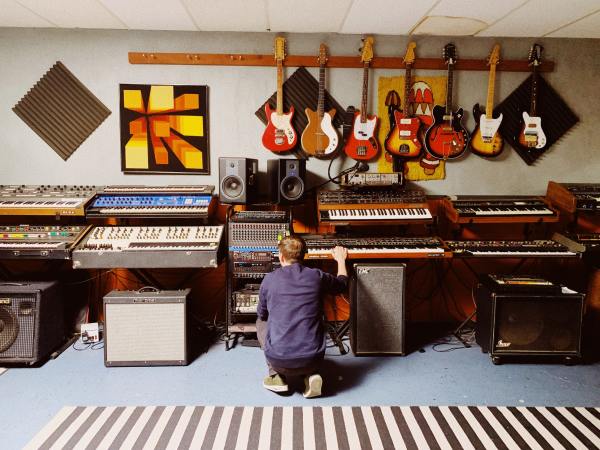
In 2023, budget-friendly and affordable synths have democratized the sound of electronic music, allowing everyone from bedroom producers to Grammy-winning artists to tap into the feeling and sound of hardware synthesizers. But this was only sometimes the case, and throughout the 70s and 80s, when hardware synths were first breaking ground, companies had to be much more selective about which instruments they brought to market.
But the released ones had a massive impact on the sounds and genres of entire generations, undoubtedly paving the way to the bright, modern, and synth-heavy styles of music popular in today’s culture.
So let’s step back and walk down memory lane to unpack the ten most iconic and classic hardware synthesizers of all times and share some music that heavily features the synths in question.
Sequential Circuits Prophet-5

The Prophet-5, developed by Sequential Circuits, quickly became a favorite among musicians and industry professionals due to its ease of use and portability. It was a polyphonic synthesizer that offered a patch memory, a game-changer at the time. This feature allowed users to save their custom sounds, making it far more convenient than relying on preset settings or physically writing down the positions of each switch and knob. Compared to its direct competitor, the Yamaha CS-80, the Prophet-5 was preferred due to this crucial feature.
While the Prophet-5 was a massive success, its bigger brother, the Prophet-10, was less reliable due to overheating issues that would cause it to conk out mid-session. However, the Pro-One, the Prophet-5’s little brother, was trendy and well-received.
Sequential Circuits, unfortunately, closed down in the late 1980s as digital synthesizers started to take over the market. Nevertheless, the Prophet-5 continued to gain legendary status among musicians and music producers. In 2002, Dave Smith established Dave Smith Instruments and brought the Prophet-5 back to life. He celebrated the synth’s 30th anniversary in 2007 with a new and highly acclaimed version called the Prophet ’08.
The Prophet-5’s unique analog textures made it a popular choice among film composers, particularly for horror and sci-fi films, due to its ability to create unsettling and eerie chords. It was also a standard fixture in pop music, featuring in iconic songs such as Michael Jackson’s “Thriller” and Madonna’s self-titled debut album and its follow-up, “Like a Virgin.” The Prophet-5’s prevalence in recording studios led to its inclusion in early West Coast rap records, with Dr. Dre and Too $hort utilizing the synthesizer in their respective music.
The Prophet-5’s popularity was not limited to film scores. Despite its hefty price tag, it was a market leader and widely used in pop music. Michael Jackson’s Thriller album, Madonna’s self-titled debut, and follow-up Like A Virgin featured the Prophet-5 heavily. This synth became a studio staple that it also entered early West Coast rap records. Dr. Dre and Too $hort used the Prophet-5 (along with a Roland TR-808 drum machine) to create their influential music.
YAMAHA DX7
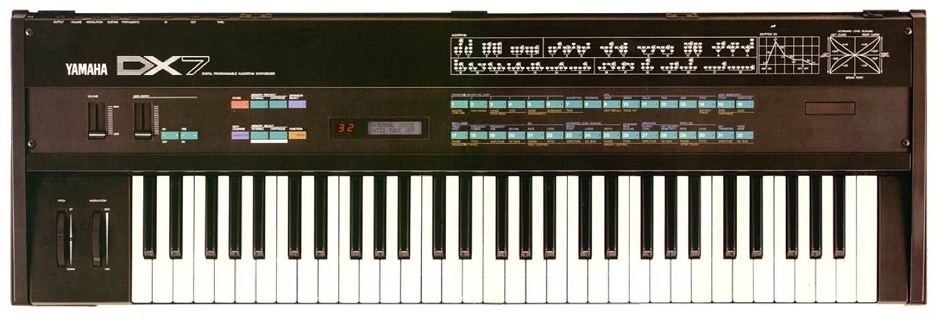
In the early 1980s, analog synthesizers had been the go-to for over a decade, and musicians were starting to look for something new. Yamaha was ready to deliver the Next Big Thing in the form of the DX7, which was released in 1983 and became a game-changer in the music world.
One of the most significant features of the DX7 was its 16 voices of polyphony, making it a powerful instrument that could produce complex and layered sounds. The full-sized keyboard was also velocity and aftertouch capable, which gave musicians a new level of expression and control.
But what set the DX7 apart was its use of frequency modulation (FM) synthesis. This new technique was devised by John Chowning at Stanford and licensed by Yamaha. Unlike analog-style FM, which was used as an effect, Yamaha’s FM synthesis was the core of the DX7’s architecture.
FM synthesis was initially seen as challenging to program, which led to the birth of a third-party sound design industry. However, those who took the time to understand it discovered a wealth of new and exciting timbres. The DX7 could produce a range of sounds, from crisp percussive tones to hard-hitting basslines. Real-time controllers, such as breath control input, added to the expressiveness of the instrument.
Despite the complexity of FM synthesis, the DX7 was a commercial success, and its presets became instantly recognizable in popular music.
Some of the most famous songs to feature the DX7 include:
- “Jump” by Van Halen
- “Take on Me” by A-ha
- “Careless Whisper” by George Michael
- “Africa” by Toto
- “Beat It” by Michael Jackson
The DX7’s success revitalized the synthesizer industry, and its impact can still be felt today. While it may have been a breath of fresh air in 1983, the DX7 remains a popular and sought-after instrument among musicians and collectors.
ARP 2600
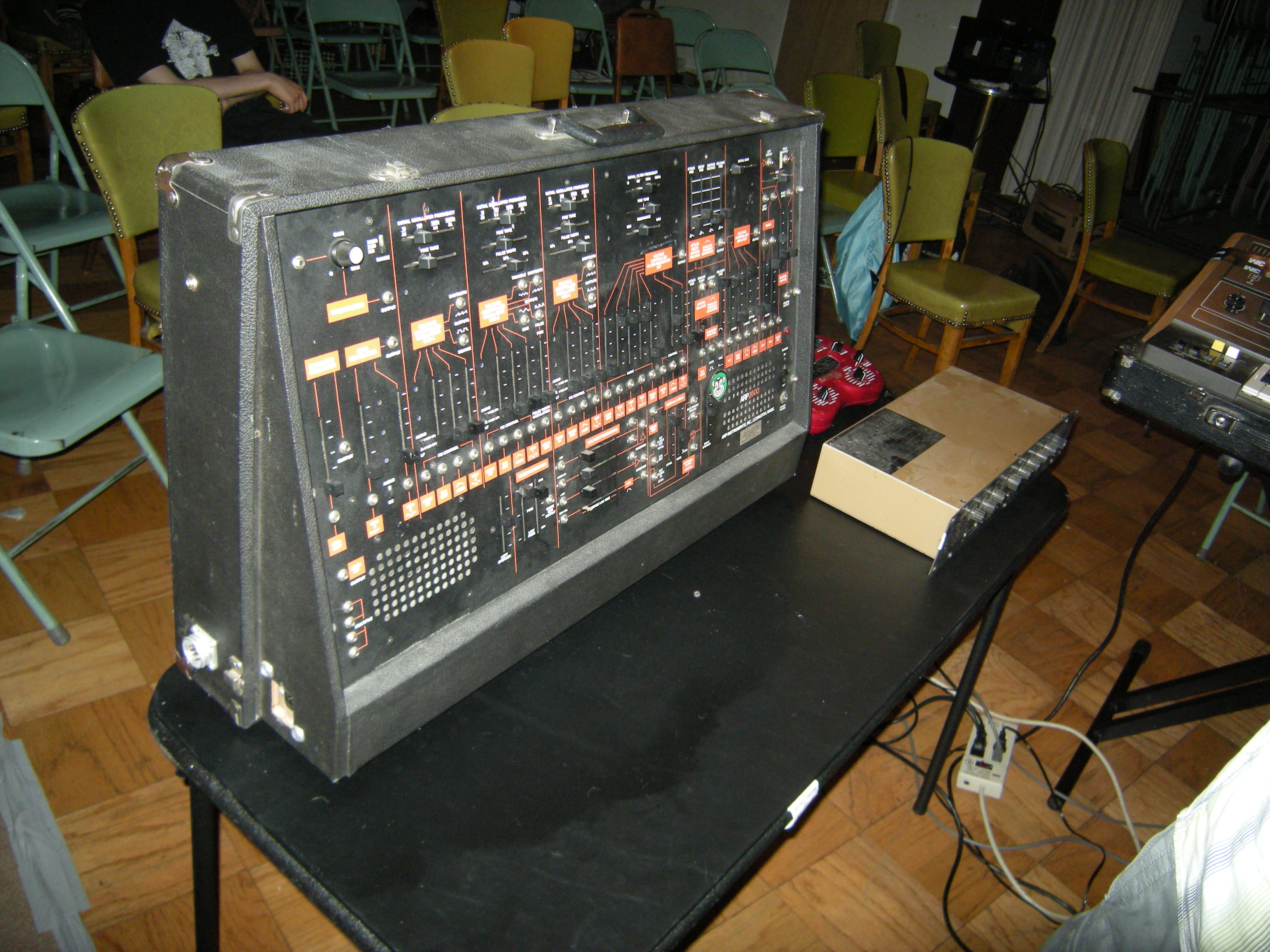
The ARP 2600 was designed to be a modular synthesizer that could be used by performing musicians, offering a fully patchable instrument in a compact package. It was created to bring the full range of modular synthesis to a more accessible level without limiting options by a written-in-stone signal path like the Minimoog.
The synthesizer had three oscillators, noise, filter, ring mod, and reverb. Its fixed signal path could be overridden by patching cables into any point in the instrument’s architecture. This provided a vast amount of flexibility in terms of complexity and customization. Although patches could be created without cables, the possibilities for experimentation and sound design were endless once the cables were plugged in. The ARP 2600 produced everything from pseudo-sequences to full drum beats with a swing.
The ARP 2600’s stable oscillators and early models’ filter, similar to Moog’s filter (at least according to Moog’s lawyers), gave it an edge in the market. The synthesizer underwent a few iterations, starting with its blue metal body, then the tolex-encased units, and finally, the elaborate black and orange models of the early 1980s.
Today, ARP 2600s are trading at high prices in the used market. Units previously given away for pennies are now selling for thousands of dollars. However, buyers should be cautious when purchasing early models as they can be difficult to repair due to ARP’s habit of encasing circuits in epoxy.
The ARP 2600 can be heard on many popular songs, such as “Baba O’Riley” by The Who, “Papa Was a Rollin’ Stone” by The Temptations, and “Frankenstein” by Edgar Winter. It was also used by many other notable musicians and bands, including David Bowie, Herbie Hancock, Joy Division, and Depeche Mode.
If you’re looking for synths that sound as good as the Arp 2600 but cost a lot less, here is our top list of alternatives you can snag without breaking the bank
Fairlight CMI
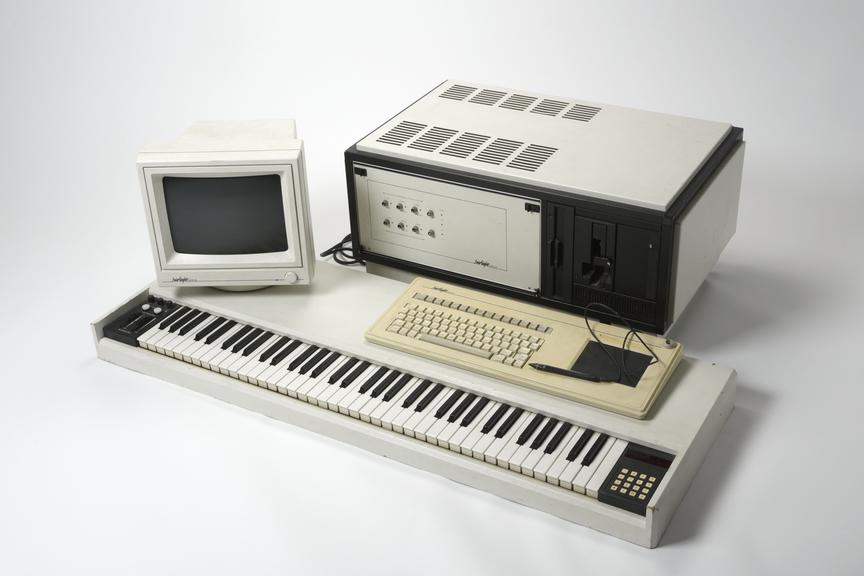
The Fairlight CMI is a legendary synthesizer released in 1979 and costs as much as a detached house. Developed in Australia by Peter Vogel and Kim Ryrie as a development of their early experimental synthesizer, the Qasar M8, the CMI was the first sampling synthesizer. It could take recorded sounds and map them across the keyboard, making it a revolutionary instrument in electronic music.
The CMI was bundled with a sequencer and a light pen that allowed touch-screen style control back in 1979, which was an incredible feat for its time.
While it was technically capable of sounding like anything, due to its short sampling memory (8 bit at 16khz on the CMI Series I) and not exceptionally high quality, it tended to excel at small, crunchy staccato sounds. It also could draw waveforms into the computer and edit previously saved waveforms, which was groundbreaking.
Peter Gabriel was the first customer to purchase a CMI and used it to synthesize the smashing of a TV screen, showcasing the instrument’s capabilities. Led Zeppelin’s John Paul Jones was the second customer, and the word soon spread across the Atlantic. Herbie Hancock famously demonstrated the synth on an episode of Sesame Street and used it to craft his anthemic ‘Rockit,’ while Stevie Wonder was also an early adopter.
The CMI was probably most widely recognized for being used by Jan Hammer in creating the Miami Vice theme tune. Kate Bush was another early devotee, and she was the first musician to play the CMI on an album, making it a centerpiece of her 1980 full-length Never For Ever. With 1985’s Hounds of Love, Bush used the CMI, allowing it to influence the album’s conceptual and experimental sound.
Here are a few more popular songs that feature the Fairlight CMI:
- Art of Noise – “Close (To the Edit)”
- Tears for Fears – “Shout”
- Pet Shop Boys – “West End Girls”
- Michael Jackson – “Wanna Be Startin’ Somethin’”
- Duran Duran – “The Reflex”
ARP Odyssey
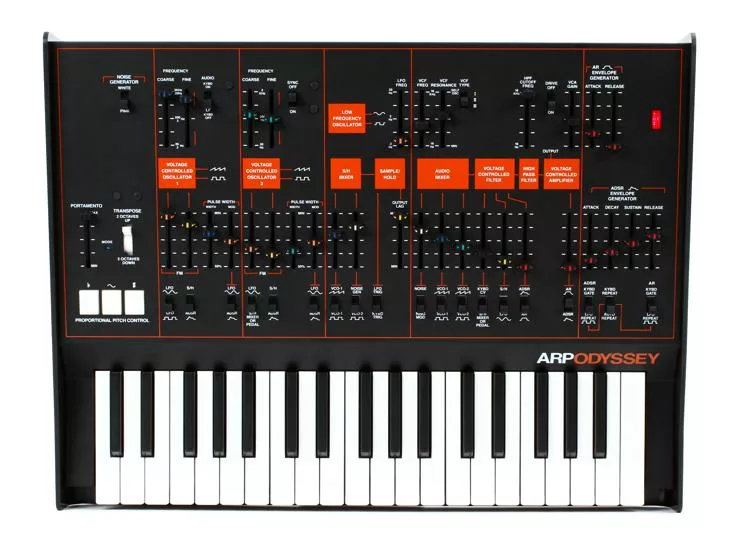
In the early 1970s, Moog revolutionized the synthesizer market by introducing the Minimoog, a portable, user-friendly synthesizer that was easy to play. It quickly became popular among musicians, and Moog dominated the market for years. However, American manufacturer ARP was also interested in getting a piece of the portable synthesizer market, so they released the Odyssey in 1972.
While the Odyssey was similar to Moog’s synthesizers in many ways, it had a few key differences that made it stand out. For one, it was much smaller and more portable than the 2500 and 2600 modular units that ARP was known for. It was also more affordable, which made it more accessible to musicians who couldn’t afford Moog’s high-end synthesizers.
Find The Availability Of This Synth On Sweetwater Here
The Odyssey’s sound was also unique. While it had fewer oscillators and a smaller filter than the Minimoog, it was the world’s first duo-phonic synthesizer, meaning it could play two notes simultaneously. This made it ideal for creating lead sounds and other types of music that required multiple notes to be played simultaneously.
The Odyssey’s sound was favored by many musicians, including German electronic outfit Tangerine Dream, who used it on several early recordings and 1981’s “Exit.” Jazz musician Herbie Hancock also used it on his track “Chameleon,” which features the synthesizer’s characteristic pulse. ABBA’s 1979 hit “Gimme Gimme Gimme” features a melody played on the Odyssey, and it was also a favorite of Ultravox man John Foxx, who used it extensively on his 1980 album “Metamatic.”
Thanks to its popularity, the Odyssey was inexpensive and often used by up-and-coming musicians who couldn’t afford Moog’s more expensive synthesizers. This included Richard Davis and Juan Atkins, who used the Odyssey on early Cybotron recordings. These recordings would influence the development of electro and techno music, which would become popular in the 1980s and beyond.
Korg MS-20
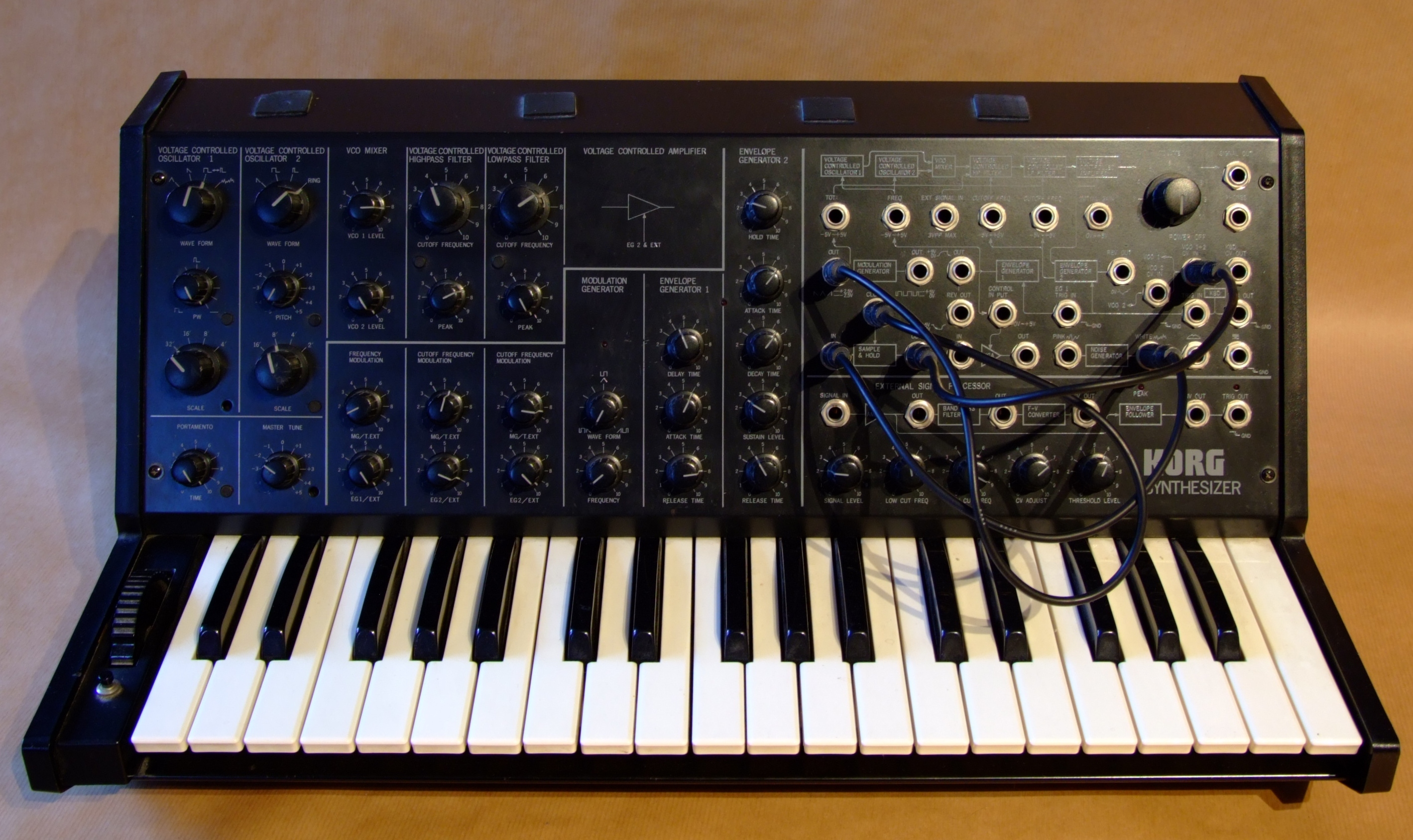
Korg’s MS-20 synthesizer was first released in 1978 and quickly became a popular choice for electronic musicians due to its unique blend of hardwired and patchable connections. The MS-20 was part of Korg’s second generation of mono synths and its smaller sibling, the MS-10. While the MS-20’s imposing appearance attracted many users, its sound was quite different from that of the popular Minimoog, which disappointed some musicians.
The MS-20 was equipped with two oscillators and two filters, which gave it its distinctive, resonant squeal and powerful low-end. It also had a unique external signal processor that allowed for the control of the synthesizer from an external sound source or the manipulation of external sounds through the MS-20’s filters. This provided a wide range of creative options for musicians, making the synth popular with modular synth enthusiasts and experimental musicians.
Initially, the MS-20 was not widely used and was mainly found in budget electro recordings or the more experimental end of the private press scene. However, in the 1990s, the synth experienced a resurgence in popularity, especially in France. Daft Punk famously used the MS-20 to craft the iconic bassline in their breakout hit “Da Funk,” while Air used it to manipulate their vocals on “Sexy Boy.” Mr. Oizo famously used the synth to create the bassline on Levi’s advert soundtrack “Flat Beat.” Alison Goldfrapp was also known to use the MS-20, controlling it with her vocals, and it remained at the center of Add N to (X)’s setup for many years.
Despite its initial lack of popularity, the MS-20’s unique sound and flexible control options have made it a popular choice among electronic musicians, leading to a software rework and a proper analog remake of the synth. The MS-20’s impact on electronic music is undeniable, and it continues to be used in a wide range of genres, from experimental to mainstream.
If you’re looking for synths that sound as good as the Korg MS-20 but cost a lot less, here is our top list of alternatives you can snag without breaking the bank
Korg Wavestation

The Wavestation was first released in 1990 and was designed by a team of former Sequential Circuits engineers with vector synthesis experience. The synth was immediately popular among electronic and experimental musicians looking for new sounds and ways to manipulate them.
One of the unique features of the Wavestation was its ability to use wave sequencing. This allowed users to string together individual waveforms in a sequence, with control over pitch, volume, and crossfade time. This made it easy to create complex, evolving sounds and rhythmic patterns that could change over time.
The Wavestation also had a powerful effects section, including reverb, delay, chorus, flanger, and more. These effects could be used on individual layers or applied to the entire sound. In addition, the synth had a joystick that could blend and crossfade between different layers of sounds, giving users even more control over their patches.
In terms of popular songs that feature the Korg Wavestation, here are a few notable examples:
- Massive Attack’s “Teardrop” prominently features a Wavestation patch called “Orbiting Glass.” This sound can be heard throughout the song, particularly in the intro and outro.
- Nine Inch Nails’ “Closer” uses a Wavestation patch called “Warm Pad” for the song’s signature pad sound.
- The Orb’s “Little Fluffy Clouds” features a Wavestation patch called “Crystal Clear” that can be heard in the song’s opening.
- Radiohead’s “Paranoid Android” uses a Wavestation patch called “Choral Waves” for the choir-like sound during the song’s climax.
These are just a few examples, but countless musicians across many different genres have used the Korg Wavestation. Its unique sound and capabilities continue to make it a sought-after synth among synth enthusiasts and collectors today.
Yamaha CS-80

The Yamaha CS-80 was a groundbreaking synthesizer that helped put Japan on the map in the synthesizer industry. It was known for its deep and unusual sound, as well as its large size and high price tag. Despite its luxurious sound and features, the CS-80 had difficulty competing with newer, more affordable synths that offered larger banks of sounds and programmable presets.
One of the CS-80’s standout features was its ability to play chords without issue, making it one of the first “true” polysynths. It also offered a velocity-sensitive keyboard and introduced polyphonic aftertouch. However, its most unique feature was its sizeable ribbon controller on the front panel, which allowed for long, smooth pitch bends and gigantic filter sweeps, giving it a versatility that few competitors could match.
Although its high price tag meant that the CS-80 was mainly found in larger studios, it was still beloved by many well-known musicians. Stevie Wonder was a fan and reportedly used it so much that he broke the ribbon controller. Vangelis was also a massive devotee and used it on many of his albums, including his influential Blade Runner soundtrack. The BBC Radiophonic Workshop even had a CS-80 in their collection, which was used to create the iconic ring-modulated sting sound that opened the Doctor Who theme music.
The Yamaha CS-80 has been used on various iconic songs across different genres. Stevie Wonder used it on his 1976 album “Songs in the Key of Life,” including the hit “Sir Duke,” while Vangelis employed it heavily on the soundtrack to “Blade Runner” in 1982. The CS-80 can also be heard on Kate Bush’s “Wuthering Heights,” Toto’s “Rosanna,” and on songs by Jean-Michel Jarre, Journey, and Yes, among others. The synth’s unique sound and capabilities made it popular for artists seeking a rich, textured sound.
OBERHEIM OB-XA

The introduction of Sequential Circuits’ Prophet-5 shook the synthesizer industry and brought the era of mono synths to an abrupt end. If your synth couldn’t store sounds, it was deemed obsolete. Manufacturers began to produce their competitive products to keep up with the demand for programmable polyphonic synthesizers.
Oberheim, which had already offered polyphony in its OB Four and Eight Voice instruments, decided to rethink its designs and develop something new. They combined the best of their previous designs and created the OB-X, an instant hit. It was followed by several other models, each with its specific qualities and refinements, but the OB-Xa is the one that stands out the most. The OB-Xa featured a simplified dual oscillator signal path, but what set it apart was its 24 dB filter, which created a huge, phat sound.
It could also create layered sounds by combining both filters for an even more complex and engaging sound. The OB-Xa could be lashed with a DMX or DX drum machine and a DSX sequencer to form a complete Oberheim ‘System. The OB-Xa was popular with musicians of the time and continues to be highly regarded by music producers and synthesizer enthusiasts.
The Oberheim OB-Xa can be heard on many classic tracks from the 1980s, particularly in the synthpop and new wave genres. Some of the most popular songs featuring the OB-Xa include “Jump” by Van Halen, “Beat It” and “Thriller” by Michael Jackson, “Sweet Dreams (Are Made of This)” by Eurythmics, and “Jump (For My Love)” by The Pointer Sisters. The instrument’s distinctive, thick sound was particularly well-suited to creating powerful, soaring leads and lush pads, and it remains a favorite of many synth enthusiasts to this day.
MOOG MINIMOOG

The Minimoog is one of the most iconic vintage synthesizers ever created, and it’s still highly sought after today. The synth’s design has become a synthesis template many standard manufacturers still use. With its trio of oscillators, noise generator, and an exceptional filter, the Minimoog made synthesizers accessible to the performing musician, and its impact on electronic music cannot be overstated. Musicians were able to introduce electronic sounds into the mainstream and create new genres of music.
Bill Hemsath, a Moog employee, created the first Minimoog in his attic during lunch hours. He just wanted a portable instrument he could take home, but he created a legend.
What makes the Mini so great? First, its limited number of parameters makes it easy to use while offering enough flexibility to create a wide range of sounds. Second, the Minimoog has a genuinely unique sound. The oscillators are rich, the envelopes are snappy, and the highs are piercing and crystal clear. The bass is legendary, big, and ballsy, and making the synth sound bad is nearly impossible.
The Minimoog can be heard in many classic songs, including “Lucky Man” by Emerson, Lake & Palmer, “Space Oddity” by David Bowie, “Shine On You Crazy Diamond” by Pink Floyd, and “Whip It” by Devo.

Magnetic byline note: This byline is used for staff produced updates and short announcements, often based on press materials and official release information. Editorial responsibility: David Ireland (Editor in Chief) and Will Vance (Managing Editor). About: https://magneticmag.com/about/ Masthead: https://magneticmag.com/masthead/ Contact: https://magneticmag.com/contact/