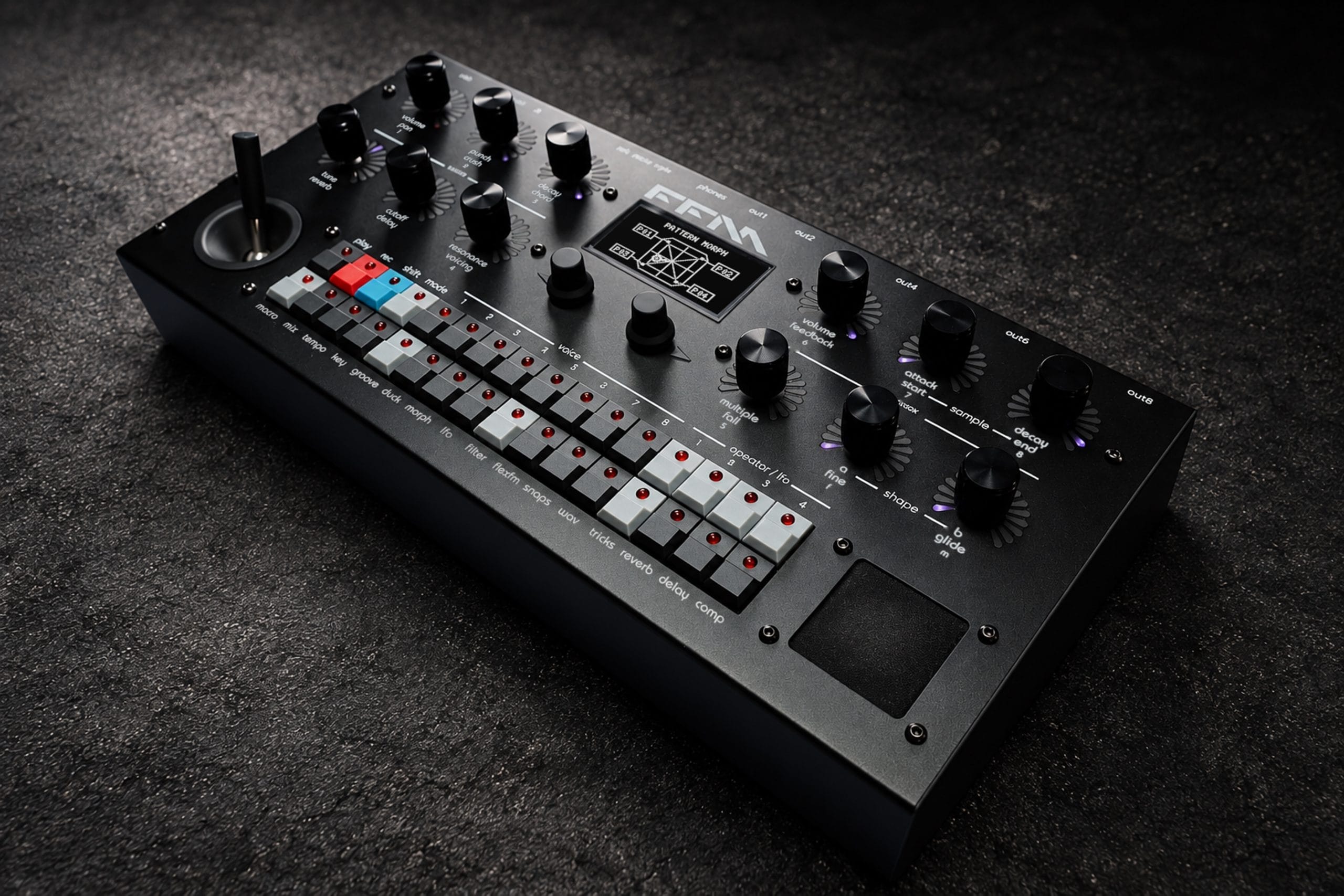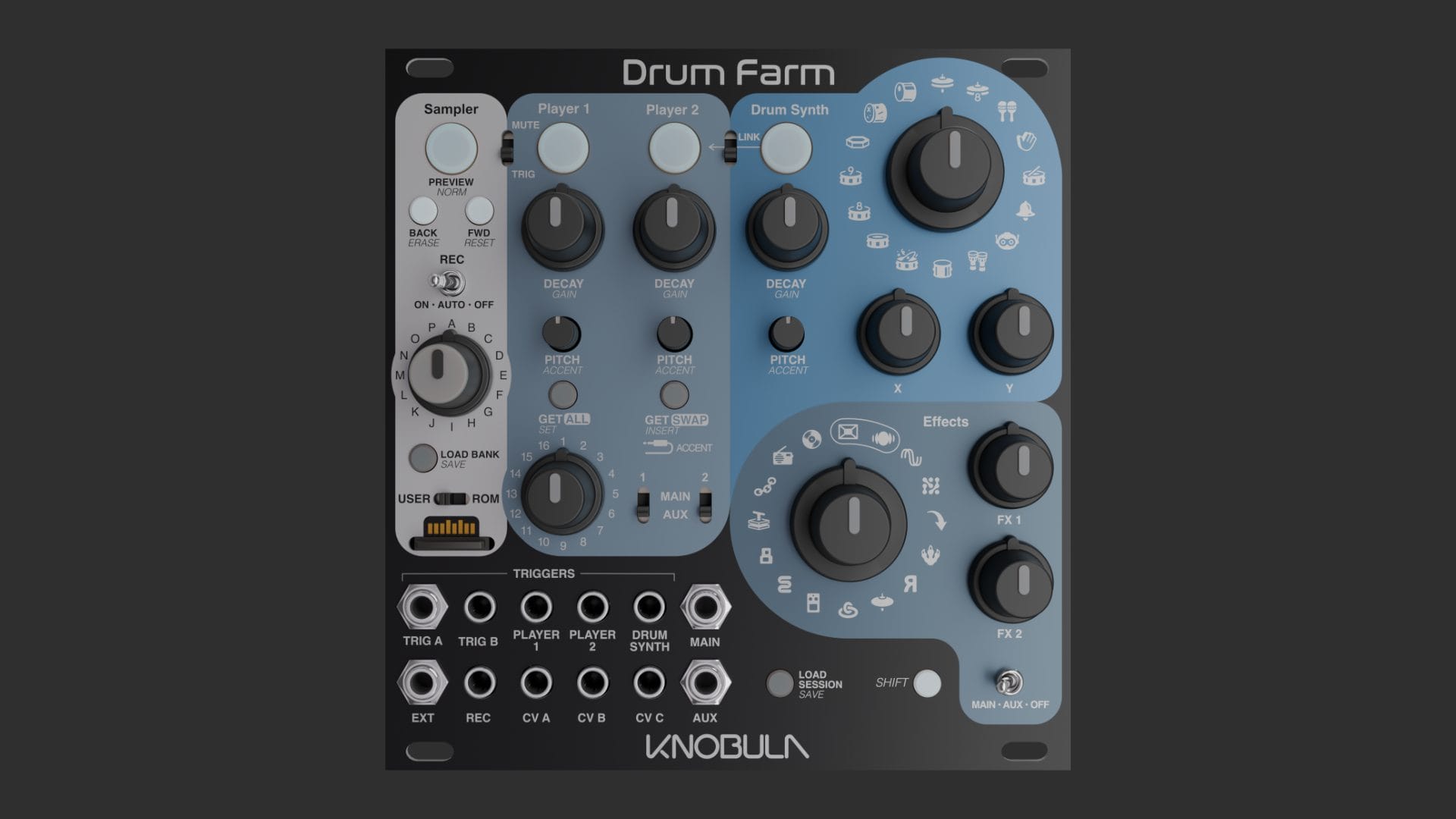
Knobula’s new Drum Farm looks like a module built by someone who understands where percussion workflows usually slow down in Eurorack. You patch a drum voice, add processing, maybe sample it elsewhere, then start rebuilding the chain when you want variation. Drum Farm tightens all of that into one place. It combines a drum synth section, an effects engine, and a digital sampler inside a 24HP module built around live manipulation and quick iteration.
That broader design is what gives the module real appeal. Drum Farm is not trying to be another single-purpose drum voice with a few extra tricks attached. It is trying to function as a small percussion environment, one where you can create a hit, reshape it, capture it, then fold it back into a new layer without leaving the module. Knobula is drawing from 16 virtual analogue and physically modelled drum algorithms, 16 realtime effects, and a sampler that can play back up to three voices, which gives users a lot of ground to cover before they ever need to look elsewhere in the rack.
A module built around iteration, not menu diving
What makes Drum Farm feel useful is that the workflow stays immediate. Knobula has stuck to its no-screen, no-preset philosophy here, which means the module is designed to be handled rather than navigated. You choose a drum model, shape it, run it through the effects, sample the result, and keep building from there. That sounds simple, but in Eurorack simplicity at the workflow level usually ends up being the difference between a module that stays central in a patch and one that gets used once, appreciated, then ignored.
The onboard sampler is a big part of that.
It can run in the background and record into 16 sequential audio buffers, which opens the door to self-building drum kits, evolving loops, or more layered percussive structures without needing external recording hardware. There is also an external input, so the module can capture audio from field recordings or from elsewhere in the rack, then pull that material into the same processing cycle.
Five CV and gate inputs keep the module open from a control perspective too. Users can assign them to switch between drum algorithms, effect types, or samples on the fly, making Drum Farm much more than a static sound source. It can behave like a performance instrument, a resampling engine, or a generative percussion tool depending on the patch.
Drum Farm fits Knobula’s larger design language
This release also makes sense within Knobula’s broader identity.
Jason Mayo’s modules have consistently leaned toward direct physical interaction, and Drum Farm continues that approach in a way that feels well judged. The emphasis is on tactile control, quick experimentation, and the kind of accidental discoveries that modular users actually value. That is a better fit for this format than over-structured recall-first design.
That said, recall is still part of the picture. Drum Farm can save full sessions to microSD, including buffers, knob positions, samples, and settings, with up to 32 sessions per card. That gives it enough memory for studio work and live use without changing the immediate, performance-led feel of the module itself.
Shipping is scheduled for June 2026, with pricing set at £449 including VAT and two faceplate color options available. More importantly, Drum Farm looks like a module built around momentum. It keeps percussion design moving, and that alone gives it a clear place in a crowded Eurorack field.

Will Vance is a professional music producer who has been involved in the industry for the better part of a decade and has been the managing editor at Magnetic Magazine since mid-2022. In that time period, he has published thousands of articles on music production, industry think pieces and educational articles about the music industry. Over the last decade as a professional music producer, Will Vance has also ran multiple successful and highly respected record labels in the industry, including Where The Heart Is Records as well as having launched a new label with a focus on community through Magnetic Magazine. When not running these labels or producing his own music, Vance is likely writing for other top industry sites like Waves or the Hyperbits Masterclass or working on his upcoming book on mindfulness in music production. On the rare chance he's not thinking about music production, he's probably running a game of Dungeons and Dragons with his friends which he has been the dungeon master for for many years.