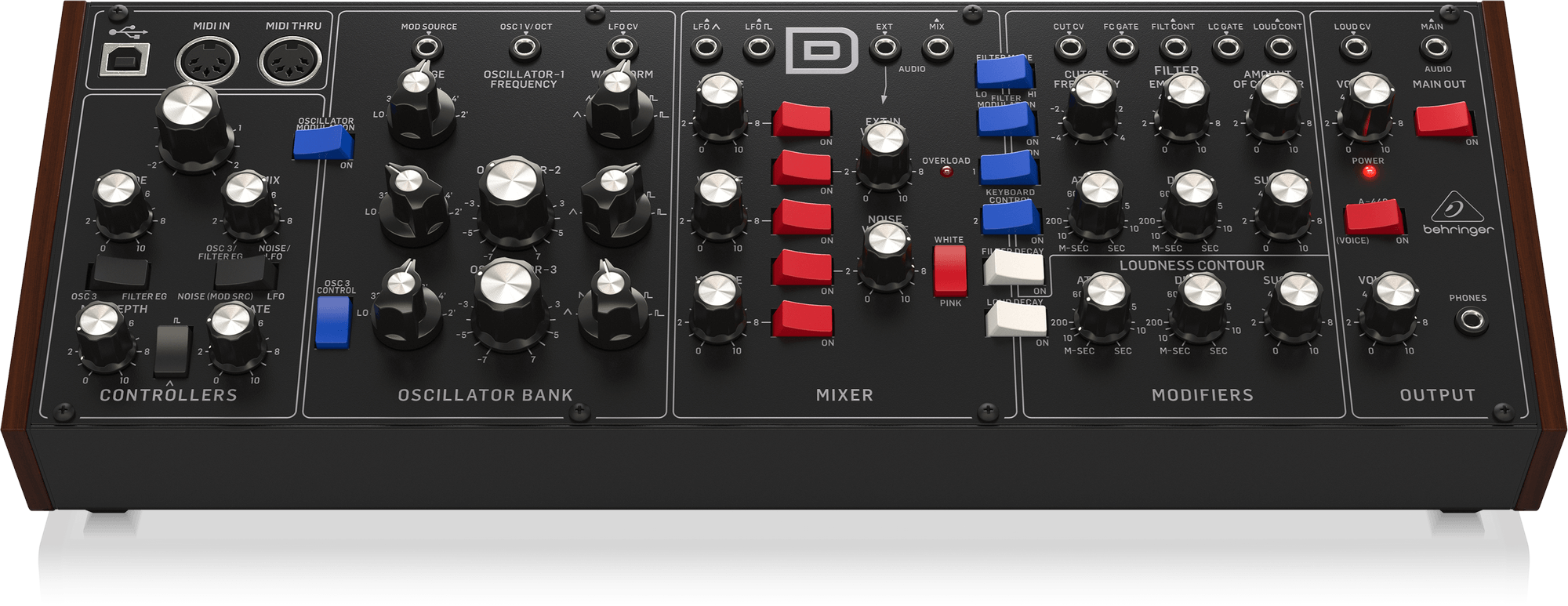
We’re kicking off the new year by diving headfirst into another review of an iconic emulation. With more and more producers beginning to implement a couple of pieces of hardware into their mostly-digital workflows, there has never been a higher demand for desktop-friendly and great-sounding instruments. And while those expectations might seem lofty in such a small piece of gear, many companies have been able to deliver in spades.
Behringer is one such company that has been on a hot streak lately, releasing compact versions of some of the most popular hardware synthesizers of the 70s, 80s, and 90s. And with the recent rerelease of Moog’s pricey Model D synth, Behringer thought there was no better time than now for us to see how their emulation measures up. So they sent us a Behringer Model D to review, and we’re about to break down what we thought about it in this review.
So let’s dive in…
Or You Can Check Out More About This Synth While Supporting Our Small Team Of Writers Through Our Partnership With Sweetwater Here
What Is The Behringer Model D?
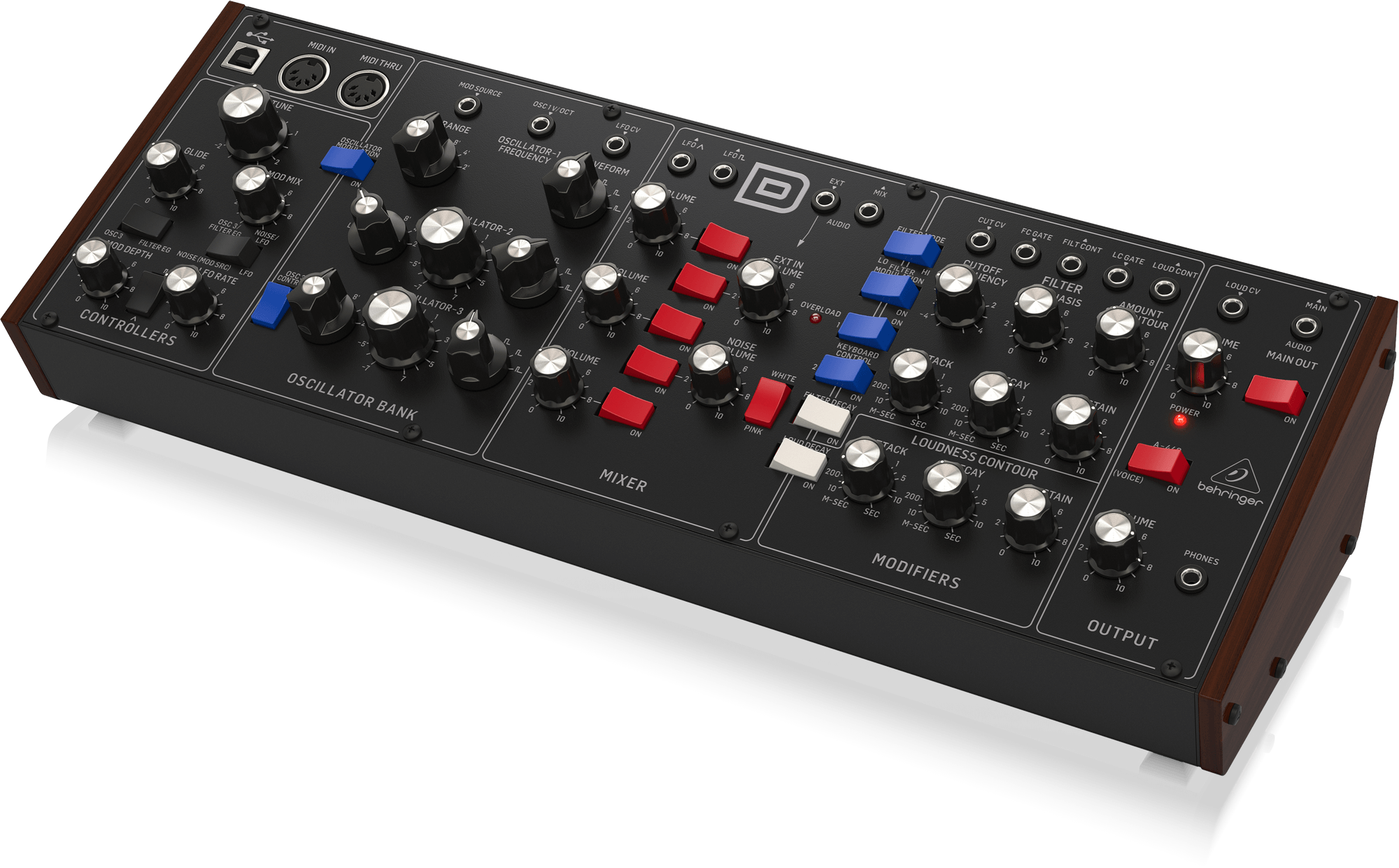
The Behringer Model D synth is another of Behringer’s attempts at recreating and emulating some of the most iconic synths of the past decades. Falling right in step with other remakes like the Behringer Arp 2600, the Model D offers almost all of the features most producers and artists would need from Moog’s original but at a fraction of the price.
Better yet, the Behringer Model D comes in a compact, Eurorack-compatible build, making it even more customizable than its namesake!
Outside of that, the core of its sound comes from its three warm-sounding VC oscillators; all feature the most commonly-used waveforms. Dial in your upper harmonics with Pulse and Square waves and round out your low-end weight with a tasteful amount of sub with a triangle wave from the third oscillator.
Further shape the sound with the Model D’s other classic parameters like its 24dB VCF with a signature biting resonance, the option to toggle between lowpass and highpass filtration, overdrive functionality, portamento, and more. Overall, the synth offers just enough to shape familiar-yet-unique sounds without overwhelming you with possibilities and patching options.
What I Liked Most About The Behringer Model D
We could write a short novella about all the different features and usage situations you could get from this budget-friendly desktop synth. Instead, to save the synth’s technical jargon and niche applications, let’s dive into my three favorite features about the device that stood out to me within just a few hours of unboxing this synth and firing it up in Ableton.
It’s Small
We’ve owned a fair amount of synthesizers in our time producing, and the biggest gripe about most is how much space they take up in the confined spaces we’re working in. The first many years of a career as a producer often have you produce in bedroom studios or small corners of the house, where space is minimal.
But the desktop nature of the Behringer Model D means that it takes up less real estate on your desk than a keyboard might and has slotted in quickly into a couple of different desk configurations we’ve tried it with.
Couple this with the Behringer Model D being at a reasonably comfortable price, and you’ve got a recipe for a fantastic synth for beginners that you can use consistently over an entire career. Don’t believe us? Look at the video below from one of my favorite producers, who used this synth in his remix on Lane 8’s in late 2022.
It’s Easy To Use
We touched upon this briefly in the point above, but this synth is a complete breeze to use and is one of the best hardware units we recommend to newer artists and students we’ve worked with. If you’ve ever used a hardware emulation plugin like Arturia’s Mini-V, you will instantly be able to use this synth without skipping a beat.
The signal flows intuitively between the modules from left to right, and the labeling of each module is clear and free of semi-modular jargon many producers might not know (terms like S/H Clock, KYBD CV, and others you might encounter on Behringer’s other emulations).
It is Sound
The synth has its own sound, just like other hardware gear, that cannot be replicated even with the most faithful emulations. And that’s precisely what you want in a piece of gear. The warm and crunchy tones that even the most basic waveforms the Model D produces jump out of the speakers, and while it might take a bit of extra EQ work to tame its output, the work is worth it.
I hate to keep returning to the price, but for only a few hundred dollars, this is an excellent quality to have in a piece of gear with only a $350 price tag.
What You Might Not Be Crazy About
Finding a piece of studio gear that checks every box without any gripes is scarce, and the Model D is no different. And while I rarely approach any piece of hardware that we are reviewing with expectations, there was one thing that did make us pause…
It Might Require Some Firmware
We booted up the synth and plugged it into Ableton, which it instantly recognized, but I struggled to get sound from it but got frustrated expecting this synth to be plug-and-play, just like the Korg Ms-20 and Arp 2600.
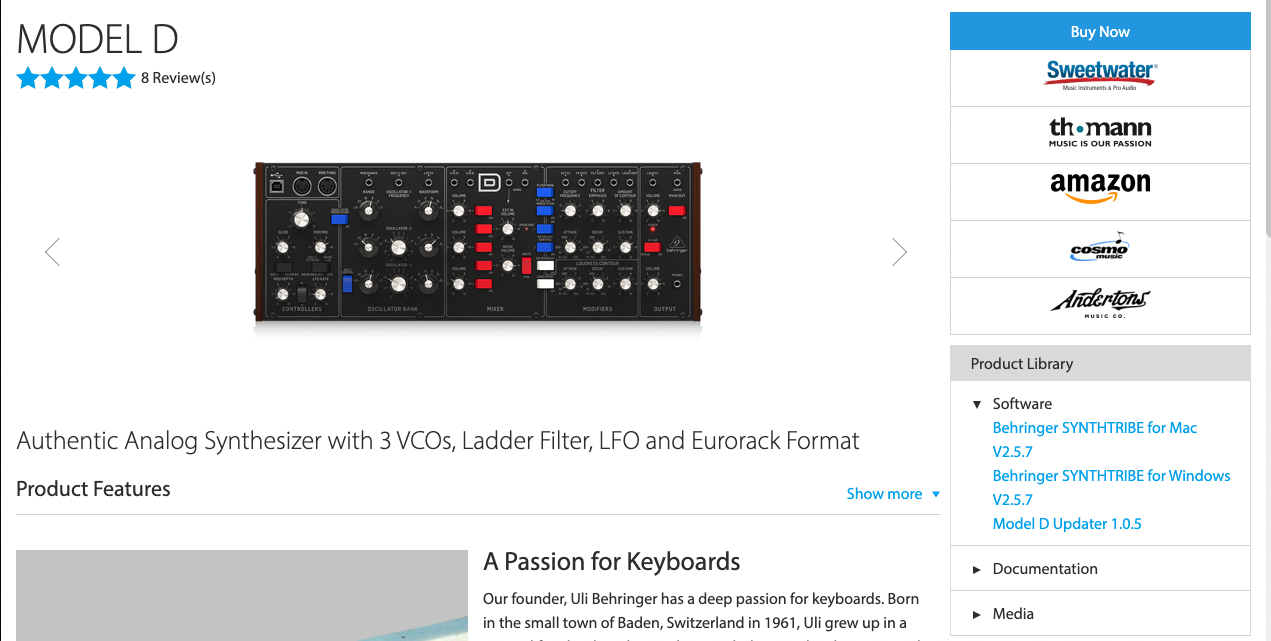
But after doing some digging, we learned that the Behringer Model D might need a potential firmware update accessed through a client-service app that can be downloaded on Behringer’s website. The firmware is tucked away in a collapsable menu on the Model D’s landing page on the site, so don’t forget to make sure your unit is up to date once it arrives at your door.
It Isn’t Polyphonic (…Duh)
We will preface this gripe by saying it is not a gripe of our team, and we knew full well that the Model D is a mono synth. But in doing our research and looking at the analytics, it turns out that this is a fairly common question the producer community is wondering.
So let us clarify this all in case you are one of the many producers inquiring about its voicing.
The Behringer Model D is a Eurorack-sized Analog Monosynth Module, which is to say that it only has a single voice and can only play one note at a time. It’s a monosynth, and if you’re looking for something that can play chords, you might be better served to keep an eye out for this synth on the horizon.
Is The Behringer Model D Worth It?
Only you can answer this question for yourself. Still, we can only say amazing things about it after messing around extensively with this budget-friendly piece of hardware. Here’s why:
- It’s small and compact, meaning it slots well into confined workstations that most producers looking for a synth at this price point would need.
- Its unique sound jumps out of the speakers and can easily set a user apart from many producers relying only on software emulations.
- It’s easy to use and doesn’t bog you down with complicated signal pathing and modular jargon that might confuse producers unfamiliar with its terms and abbreviations.
Check Out More About This Synth While Supporting Our Small Team Of Writers Through Our Partnership With Sweetwater Here
Specs On The Behringer Model D
- Type: Desktop Synthesizer
- Analog/Digital: Analog
- Polyphony: Mono
- Oscillators: 3 x VCO
- Waveforms: Triangle, Sawtooth, Tri-sawtooth, Square, Wide Pulse, Narrow Pulse, Reverse Sawtooth (OSC 3)
- Noise Generator: White, Pink
- Envelope Generator: 2 x EG (attack, decay, sustain)
- LFO: Triangle, Square wave
- Filter: 24dB Ladder Filter, low-pass/high-pass
- Effects Types: Overdrive circuit
- Analog Inputs: 1 x 1/8″ (external audio)
- Analog Outputs: 2 x 1/4″ (main out low, high), 1 x 1/8″ (main out), 1 x 1/8″ (mix audio out), 1 x 1/8″ (headphones)
- MIDI I/O: In/Thru/USB
- Other I/O: Mod Source, OSC 1V/OCT, LFO CV, LFO square, LFO sawtooth, Cut CV, FC Gate, Filter, LC Gate, Loud contour, Loud CV
- USB: 1 x Type B
- Power Supply: 12V DC power supply (included)
- HP Size: 70HP
- Height: 3.5″
- Width: 14.7″
- Depth: 5.4″

Will Vance is a professional music producer who has been involved in the industry for the better part of a decade and has been the managing editor at Magnetic Magazine since mid-2022. In that time period, he has published thousands of articles on music production, industry think pieces and educational articles about the music industry. Over the last decade as a professional music producer, Will Vance has also ran multiple successful and highly respected record labels in the industry, including Where The Heart Is Records as well as having launched a new label with a focus on community through Magnetic Magazine. When not running these labels or producing his own music, Vance is likely writing for other top industry sites like Waves or the Hyperbits Masterclass or working on his upcoming book on mindfulness in music production. On the rare chance he's not thinking about music production, he's probably running a game of Dungeons and Dragons with his friends which he has been the dungeon master for for many years.