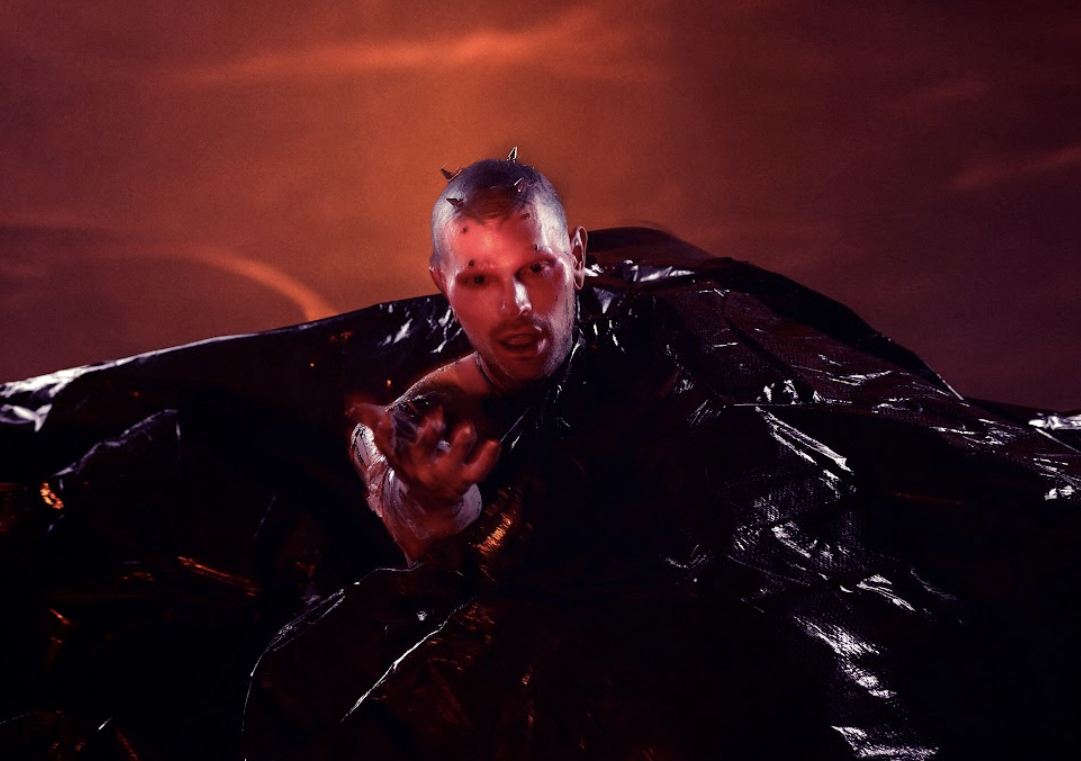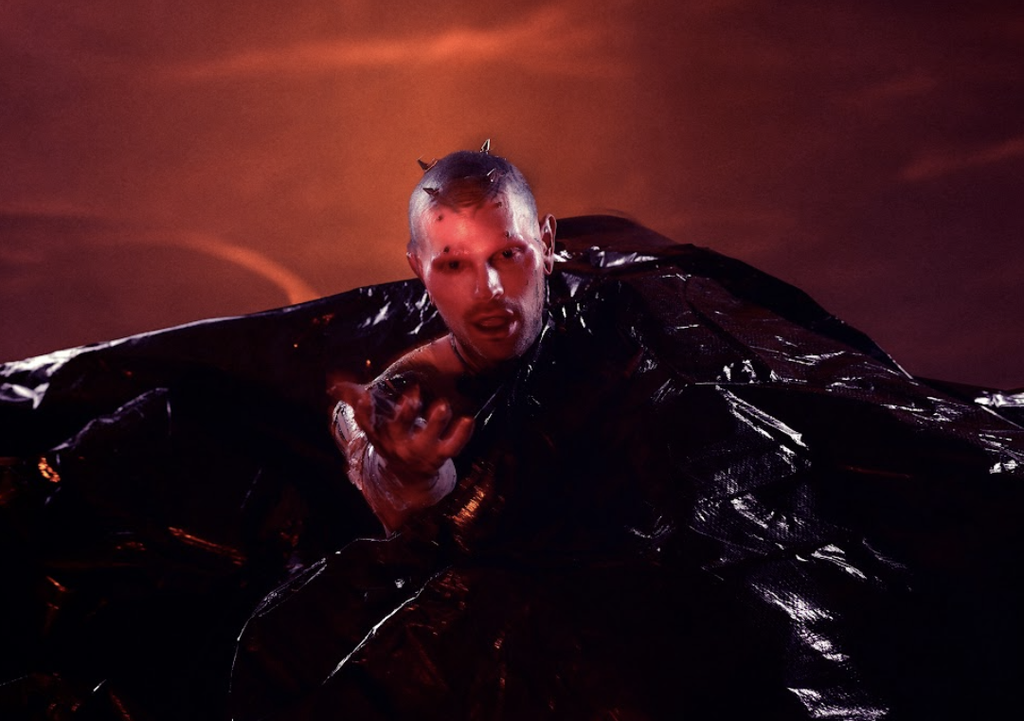
Red does a lot of work in Wendy Bevan’s “Sirens” video before the song even explains itself. It is beauty, warning, romance, blood, theatre, danger, and the kind of glamour that feels a little too perfect to trust. Bevan pulls from the surreal beauty imagery around Sayoko Yamaguchi, Shiseido, and Serge Lutens, but the video does not play like an archival moodboard.
It takes the charge of those images and turns it psychological: a face becoming a mask, a body becoming part of the image, and the viewer being pulled closer even as the whole thing starts to feel less safe.
That is where “Sirens” gets interesting. The song is not only about seduction in the obvious sense; it is about leaving for the final time and turning the myth back on whoever used it first. Bevan frames the track as a woman standing between land and water, hearing something that the men in the story never really understood. The ocean is not a place where she disappears. It is where she changes form, finds force, and lets the lies and old myths fall behind her.
The video opens the world of Alone With The Unknown in the same way the song does.
It gives the album its first threshold: beauty with a warning inside it, desire with danger moving underneath it, love as something you enter without full control over where it will take you.
In the interview below, Bevan talks about Sayoko Yamaguchi, Shiseido, Serge Lutens, red as a siren, distorted electric violin, oceanic transformation, and why the video needed to feel like a spell before it explained itself.
Interview With Wendy Bevan
The “Sirens” video draws inspiration from the surreal beauty imagery of Sayoko Yamaguchi and Shiseido campaigns from the late ’70s and ’80s, particularly the work of Serge Lutens. What drew you to these references, and how did they shape the visual world you created for the song?
The bold simplicity of vibrant red, the elegance, and the hyper-modern juxtaposition of such a graphic image against the song’s lyrics, sonic textures, and storytelling felt so powerful to me. I was really drawn to the way those images are incredibly beautiful, surreal, and glamorous, while through the use of wide, odd angles they feel slightly strange, artificial, and unsettling, like you are looking inward and finding something bolder and bigger than imagined.
The power of the face becoming a mask, and the model becoming part of the image rather than simply being the subject of it, really interested me. I didn’t want to recreate those references literally, but the feeling of being drawn toward something hypnotizing and mesmerizing, so you become unsure whether it’s safe or whether you should let it lead you astray, into “Sirens.”
Heightened color, theatricality, and surreal beauty allowed it to find a language of its own within the context of the video. The red became psychological for me, a signal: sensual, dangerous, romantic, visceral. Red is a siren itself. It can mean so many things.
“Sirens” has a dark, cinematic, and almost otherworldly sound, balancing seduction with a sense of unease. How did you approach the song’s production and sonic textures to capture that atmosphere, and were there any particular sounds or musical influences you drew from?
The starting point was the idea of the siren itself, an ancient female voice calling to you from somewhere you are still yet to discover, alluring you into the waters of time.
So I wanted the music to have that same pull as the vocal, like waves crashing, seductive voices calling, not knowing whether what you’re hearing is in your mind or coming from the tides.
“Sirens” is ultimately a song about leaving, for the final time. Conceptually and visually, it moves between the land and the ocean. It begins on the earth, with a woman being drawn away by something more beautiful. She has been taken, “lost in divine” myths of men and their stories, their lies, but she begins to see and hear the sirens in a way he was never able to.
In resenting the curses and myths of men, she joins the sirens herself. In leaving, she finds a new strength in the tides and within these sirens, so the ocean becomes a place of transformation. There is some resistance as she leaves the land, but eventually she gives herself over to the waters. When she “hears the stars sing,” she is taken into the depths, in a trance, into cathedrals and caves beneath the water, carried in by song. The men, their lies and myths, become nothing more than memories.
I wanted that transformation to be felt in the music. The crashing and swelling of the instrumental section is almost the physical moment of entering the water, where the waves become bigger, the world becomes less stable, and then something stronger emerges from it. There is a sense of surrender in the crashing, but also deep liberation. She isn’t being swallowed by the ocean. She is finding power within it.
The power of the lyrics starts immediately with the first line: “This time it’s goodbye, be lonely again darling.” It gives you a storyline straight away. Someone is leaving for the final time, and then there’s stillness, standing between the land and the water, looking out at the emptiness, while something more powerful is calling you toward it. There’s anger in that departure too, particularly in the idea of being told these divine myths by men, and then, in revenge, twisting those myths into something of your own.
Musically, I was interested in creating a feeling rather than making the production overly literal. We wanted the sound to feel spacious, dark, and immersive, with moments that almost feel like they’re emerging from another world. There’s a lot of atmosphere and tension in the track, and I love the idea that not everything needs to be immediately understood.
The violin solo in the instrumental section is important, as I used an organ pedal, one of my favorites alongside some of the other EarthQuaker Devices I use, to distort and color the violin. The ebb and flow of the solo feels haunting and sensual, something moving beneath the surface.
I’ve always been very inspired by cinema and by music that creates a sense of place. With “Sirens,” I wanted the production to feel like a landscape that becomes the ocean, somewhere you enter, that takes you with it, rather than just a song you listen to. There’s beauty in this, but there’s always a shadow underneath.
Your album Alone With The Unknown explores connection, commitment, love, and the uncertain spaces between desire and certainty. How does “Sirens” fit into the larger world of the album, and what did creating its accompanying video allow you to express that the music alone couldn’t?
“Sirens” is the opening track of Alone With The Unknown, and it creates the perfect introduction to the world because the song itself is about being pulled toward something when you don’t necessarily know where it’s going to lead you. There’s desire, surrender, and fascination, but also a sense of danger and uncertainty, and in “Sirens” this is very dramatic as an intro. Visually, it brings me the land and the ocean, but the video insists on an ultra-modern red visual that glows like a burning flame for the pathway to the rest of the album to open up.
Something that runs consistently through Alone With The Unknown is the idea that love and connection can be incredibly beautiful and powerful, but they also require you to step into something you can’t completely control or predict. You have to accept a certain amount of mystery.
While music can create a landscape of feelings, matching this visually allowed me to play with color, stillness, movement, glamour, and artifice, and make that inner world tangible, modern, and simple. I want the video to leave some questions unanswered. Rather than explaining the song, it creates another layer to it. It also harks back to some of those ’90s alternative pop videos too, and who doesn’t love a dose of that? Hopefully you feel something from the image before you understand what you’re looking at and being taken in toward, much like the album itself.Bevan released her debut album Rose and Thorn through Kwaidan Records in 2016, produced by Marc Collin, before later collaborating with Nick Rhodes of Duran Duran on ASTRONOMIA, a four-part contemporary classical and cinematic soundtrack project released across the solstices and equinoxes of 2021. Alone With The Unknown, produced by Nick Rhodes, continues her interest in myth, memory, longing, desire, and the unseen emotional forces that shape human connection.
Closing Thoughts
What works about “Sirens” is that Bevan doesn’t treat the video as an accessory to the song. It feels like the same spell in visual form. The red is not just styling, the face is not just beauty, and the glamour is not there to soften the danger. Everything is pulling in the same direction: toward something beautiful enough to make you ignore the warning inside it.
That framing gives the production more shape.
The distorted violin, swelling instrumental passage, dark space, and sense of instability all become part of the same leaving. You can hear the track move away from land. That is why the song’s first line lands with such force: “This time it’s goodbye, be lonely again darling.” It places the whole thing after the decision has already been made.
There is another useful connection with Lana Crow’s synth-pop framing around “Japrisot”.
That piece was about how bright, stylized synth-pop can still carry something uneasy underneath. “Sirens” works from the opposite side of the palette, darker and more theatrical from the start, but the same principle applies. The surface is part of the emotion, not a distraction from it.
The ’90s alternative pop video reference also matters. Bevan’s work does not feel nostalgic in a simple way, but it understands the era when a music video could be strange, seductive, slow, and image-led without explaining itself every few seconds. The “Sirens” video seems to want that kind of permission: feel the image first, understand it later, and maybe never completely.
That sits beside Rework’s interview on exlove and stripping things back to raw emotion, where post-punk, synthwave, and indie electronic references became a way to talk about emotional pressure rather than genre purity. Bevan’s album has a different scale and theatricality, but she uses similar freedom to move between eras, images, and sonic languages without flattening the feeling.
The broader takeaway is that “Sirens” gives Alone With The Unknown a fitting threshold. It does not explain the album; it opens the door with a warning attached. Love, desire, commitment, and surrender may be beautiful, but they are also unstable forces.
Bevan understands that, and “Sirens” turns that instability into a red-lit room, a distorted violin, a mask-like face, and a woman walking into the water on her own terms.

Magnetic byline note: This byline is used for staff produced updates and short announcements, often based on press materials and official release information. Editorial responsibility: David Ireland (Editor in Chief) and Will Vance (Managing Editor). About: https://magneticmag.com/about/ Masthead: https://magneticmag.com/masthead/ Contact: https://magneticmag.com/contact/