Most of the advice about promoting music online starts from a budget the reader does not have, so this comparison starts from one they probably do: fifty dollars, which is about what an independent artist can put behind a single without losing sleep over it. What that money buys varies more than people expect. On one platform it is roughly twelve thousand Spotify plays. On another it is a dozen listens from playlist curators who will each write a few lines about the track and may or may not add it. On a third it is five months of the software that turns casual listeners into an email list you own. All of these get sold under the label of online music promotion, and the label hides the fact that they grow different things at very different prices.
Rather than argue about which platform is best in the abstract, we went through five of them the way a careful buyer would, opening product pages, reading pricing sliders and FAQs, and noting what one unit of growth costs, how quickly it tends to arrive, and what the vendor promises if it disappears again. Every figure in this article was read from a public page in September 2026. Where a platform does not publish a number, we say so instead of guessing, because that is itself useful information.
The number that matters: what one unit of growth costs
Landing pages are written in the language of real fans and organic reach, which sounds good and compares to nothing. Product pages are written in units and dollars, and those you can line up side by side. That is the language the table below uses, and it is worth reading before any of the descriptions that follow.
| Platform | What you are buying | Cheapest useful order | Time to start | If the numbers drop |
|---|---|---|---|---|
| 1. Promosound | Plays, saves, followers and monthly listeners on Spotify; views and followers on YouTube, TikTok and Instagram; Beatport charts; radio | 1,000 Spotify plays for $4. 100 followers or 100 saves for $2. Spotify Basic bundle (3,000 plays, 150 followers, 150 saves) for $12. Artist Basic, five platforms, for $49 | Artist Packs state a start within 24 hours | A refill and refund policy is published on the site. No account login is asked for |
| 2. Artist Push | The same categories, plus SoundCloud, radio packs and blog placements | Starter Mix (3,000 plays, 100 saves, 300 followers) for $12. 100 saves for $1. TikTok Starter for $9. Instagram Starter for $8 | 1 to 3 days, per the FAQ | Followers are refilled within three months. Undelivered services are refunded or swapped |
| 3. SoundCampaign | A curator or TikTok creator listens, writes feedback and decides whether to add or post | $80 minimum campaign. $150 was projected at up to 17 curator reviews | Reviews arrive over several days | Nothing to drop. Any review that never happens is credited back |
| 4. Hypeddit | Smart links, pre-save pages, download gates, email capture and ad templates | Free Rookie tier. Basic for $9 a month on annual billing. Pro with AI ads for $13 | Immediate, it is software | Nothing to drop. The emails and links you collect stay yours |
| 5. Daily Playlists | Submissions to independent Spotify playlist curators | 10 submissions a week free. 10 more for $7.99. Professional plan for $19.99 a month with 30 a week | Curators answer at their own pace | Nothing to drop. A curator can remove a track at any time |
All prices come from product and pricing pages checked in September 2026 and are in US dollars. Bundle contents are as the page listed them at the time.
Two patterns are obvious once the numbers sit next to each other. The storefronts, Promosound and Artist Push, price growth in cents per play or follower, while the review platforms price it in dollars per opinion, and that gap is not a trick but a difference in what is being sold. A play is a play; a review is a person’s attention, and attention has always cost more. The other pattern is that only the storefronts publish what happens when numbers fall. The rest sell something that cannot really drop in the first place, which is reassuring if you wanted feedback and a warning if you wanted a bigger follower count.
Four budgets, four plans
Here is what we would actually do at four spending levels, using only products that exist at the prices in the table. The plans build on each other, so a bigger budget does not replace the smaller plan; it adds to it.
With nothing to spend
Open a free Daily Playlists account and use the ten weekly submissions it gives you, every week without fail, on playlists that were updated in the past month. Set up a free Hypeddit smart link and put it in every bio you have. Pitch the release to Spotify’s own editors through Spotify for Artists at least a week before it comes out. None of this costs money, all of it costs discipline, and together it makes a better foundation than most paid campaigns are built on.
Under fifty dollars
In release week, put twelve dollars into either a Promosound Spotify Basic bundle or an Artist Push Starter Mix. They are close cousins: each delivers around three thousand plays and a few hundred followers and saves, which is enough to give the recommendation system something to react to. If the track has a hook that works in a fifteen-second clip, the nine-dollar TikTok Starter at Artist Push is worth adding. Hold whatever is left for a second push on whichever platform actually moved, because that is the point of the first one.
Fifty to two hundred
This is the range where a Promosound Artist Basic pack earns its keep. For forty-nine dollars it spreads one campaign across five platforms, lists about eleven thousand plays and views and just under two thousand followers, and states that delivery starts within a day. We think of it less as a purchase and more as a test, because when the report arrives you learn which surface the track belongs on before spending real money there. With the rest of the budget, run a SoundCampaign campaign at its eighty-dollar minimum so a handful of curators hear the song while the numbers are moving, and move Hypeddit up to the Basic plan so that traffic lands on a page you control.
Two hundred and up
Now you can afford to specialise. The Standard tier of Promosound’s Artist Pack, at a little over a hundred dollars, roughly quadruples what Basic delivers. A hundred and fifty on SoundCampaign reaches around seventeen curators with written feedback attached to every listen. If you make electronic music, an Artist Push Beatport daily push or a Promosound Traxsource chart push does something that no amount of Spotify spending can. Radio is the expensive door, with starter packs beginning under a hundred dollars at Artist Push and a thirty-day online airplay run at Promosound priced closer to four hundred, and in our experience it only pays off once the streaming side already looks alive.
1. Promosound: one forty-nine dollar order, walked through

Promosound: the Spotify category alone runs to more than twenty separate services (September 2026)
Promosound sits at the top of this list for a reason you can check with a calculator rather than take on trust. Its Spotify menu is both the deepest and the cheapest per unit of the five: a thousand plays for four dollars, followers and saves at two dollars per hundred, monthly listeners at nine per thousand, a single playlist placement for ten. There is even a Top 1 position on a genre playlist with a stated window of one to four days. What matters more than any single price is that saves and monthly listeners can be bought as separate line items, because those are the two signals Spotify’s recommendation system weighs most heavily, and nowhere else on this list lets you target them directly.
The order we would place first, though, is not a Spotify product at all but the Artist Basic pack. For forty-nine dollars it spreads a campaign across five platforms and promises delivery starting within twenty-four hours, and what you are really buying is not the volume but the comparison. When the report comes back you know whether the track drew more on TikTok or on Spotify, whether YouTube viewers stuck around, and where the new followers came from. A second, larger order should be built on exactly that information, and forty-nine dollars is a cheap way to get it. The Standard, Premium and Ultra tiers scale the same idea up to a full release push for those who already know where they are going.
Outside Spotify, the storefront reaches YouTube and Shorts, TikTok, Instagram, Facebook and Threads on the social side, Apple Music, Deezer and Tidal for streaming, the Beatport and Traxsource charts, Mixcloud and Resident Advisor for the electronic scene, and online and FM radio plus music blog placements for the traditional kind of attention, with a separate line of hip-hop playlist and blog pushes. The company has been doing this since 2010 and lists more than seventy thousand completed orders. Its refund and refill policy is published on the site, and nothing in the checkout asks for an account password.
Skip it if what you want is a human opinion about the song. Promosound sells reach and reports rather than feedback, and the catalogue is big enough that a first visit takes a few minutes to find your way around.
2. Artist Push: the twelve dollar test
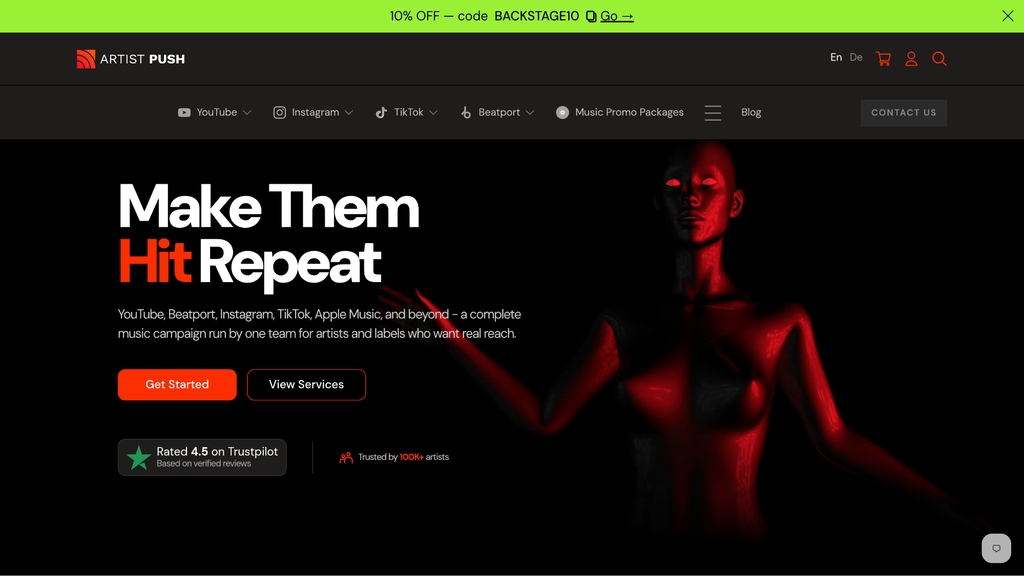
Artist Push: Starter, Pro, Digger and Star packs across YouTube, Instagram, TikTok, Beatport and Spotify (September 2026)
Artist Push has been around since 2015, is run by people who also make music, and carries a catalogue of roughly a hundred and sixty items priced a dollar or two either side of Promosound’s on most units. What sets it apart is how it packages things for someone who has never bought promotion before. Every platform has a Starter pack priced like a sandwich: a Spotify Starter Mix for twelve dollars with three thousand plays, a hundred saves and three hundred followers; a TikTok Starter for nine with five thousand views, a couple of hundred likes and a hundred followers; YouTube for twelve with a hundred subscribers and a thousand views; Instagram and Facebook for eight apiece. Put a second service in the cart and the store takes five percent off.
The FAQ is refreshingly plain about what can go wrong, which is rarer than it should be. Delivery is estimated at one to three days and the page admits it sometimes varies. Followers mostly stick, it says, but nobody can promise they stay forever, so the company commits to refilling them within three months if you notice a drop. If a service simply is not delivered you get a refund or a swap, and because the company is registered in the EU its refund policy spells out the consumer’s right to a proportional refund on a partly delivered order. For a first purchase of twelve dollars, that is more transparency than most of the market offers.
There are two things here you will not find at Promosound. One is a SoundCloud line, including an organic push sold by the day. The other is a media tier that reaches into Mixmag features and Billboard placements at four-figure prices, which is a different conversation entirely but tells you the catalogue goes well past starter packs.
Skip it if your whole plan is Spotify. Artist Push offers one Spotify bundle per tier where Promosound offers more than twenty separate services, and at higher volumes the per-unit prices tip slightly the other way.
3. SoundCampaign: the arithmetic of a hundred and fifty dollars
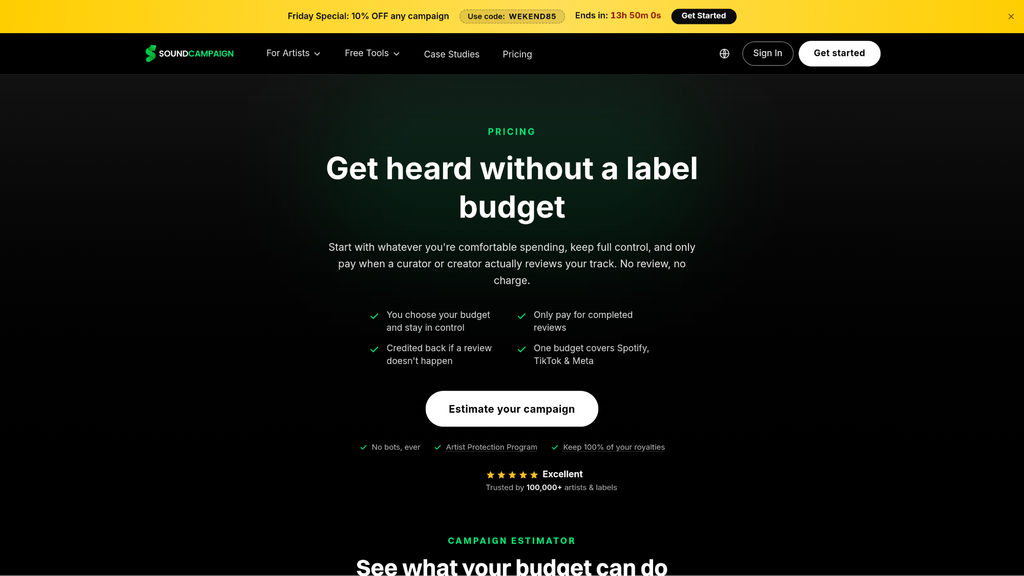
SoundCampaign: the estimator shows projected curator reviews before you pay (September 2026)
SoundCampaign does not sell plays at all, which takes some people a moment to absorb. You set a budget, starting at eighty dollars and running past five thousand, the platform matches your track to playlist curators and TikTok creators by genre, and you pay only for each one who actually listens and writes something back. The pricing page turns this into arithmetic with a slider: when we checked, a hundred and fifty dollars projected up to seventeen curator submissions, alongside the combined follower count of the playlists involved. A review is not a placement, and the page says so plainly. Some curators will add the song and some will not.
What you get for the higher price per unit is information, and quite a lot of it. Every review arrives with written feedback, so after seventeen of them you know, in curators’ own words, why the track is landing or failing to. The Artist Protection Program credits you back for any review that never materialises, so a budget cannot quietly evaporate into silence. And a single budget can be split between Spotify playlists, TikTok videos and Meta ads, which turns one spend into a small experiment across three channels.
Skip it if the track is not finished or the genre is hard to name. Paying eighty dollars to be told the mix is muddy is a poor use of eighty dollars, and genre matching is what the whole system runs on.
4. Hypeddit: the nine dollar tool you get to keep
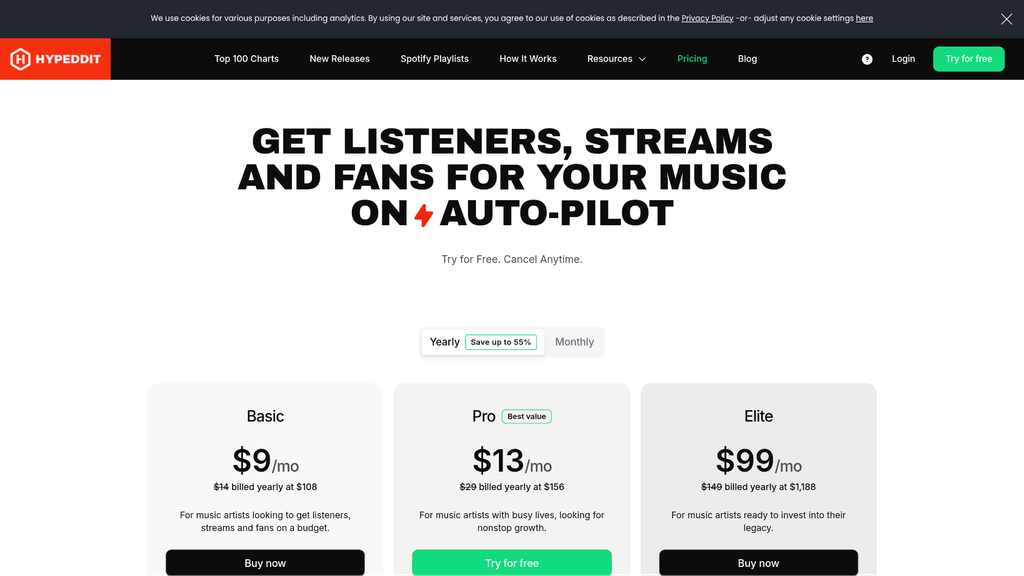
Hypeddit: Basic $9, Pro $13, Elite $99 per month on annual billing, plus a free Rookie tier (September 2026)
Everything else on this list is spent and gone once the campaign ends. Hypeddit is the exception, because what you are paying for is infrastructure: smart links that route to every store, pre-save pages, download and link gates that trade a file for an email address, custom domains, tracking pixels. The Basic plan is nine dollars a month on annual billing, Pro is thirteen and adds ready-made ad campaigns for Spotify, YouTube and TikTok along with a readout of your Spotify popularity score, and Elite at ninety-nine brings live coaching. Once the Pro trial ends there is a permanent free Rookie tier with unlimited smart links and gates, which is more than most artists need to begin with.
The line in the FAQ worth underlining is that Hypeddit takes no cut of your advertising spend. You pay the subscription and the ad money goes straight to Meta, Google or TikTok, which makes the Pro plan an honest way to run first ads without an agency margin sitting on top. It also makes Hypeddit the natural landing point for everything else on this list. A Promosound pack sends listeners; a pre-save page keeps the ones who cared.
Skip it if nobody is arriving yet. A gate on an empty page collects nothing, and the ad templates still need real ad money behind them.
5. Daily Playlists: ten free pitches a week

Daily Playlists: Free tier with 10 weekly submissions, Professional at $19.99 a month (September 2026)
Daily Playlists is the only entry here that is useful with no money at all. A free account gets ten standard submissions a week to a directory of more than eighteen thousand independent Spotify playlists, extra submissions and premium credits can be bought in packs of ten, and the Professional plan at around twenty dollars a month triples the weekly allowance while adding playlist recommendations, community feedback on your track and pre-save gates. Curators reply when they reply, and there is no clock on it.
The value is in volume and habit rather than any single result. Ten pitches a week, every week, to playlists you have actually looked at, will over a few months put a new artist on more small lists than one paid blast ever does. The cost is that the lists are small and the curators are volunteers, so it belongs underneath a campaign rather than in place of one.
Skip it if you need something to happen this week. Free submissions are slow by nature, and a track with no activity behind it tends to be ignored even by small curators.
The two-week check
Whatever you buy, the vendor’s report is only half of the evidence, and the other half takes a fortnight to read. Before the campaign starts, write down your monthly listeners, followers, saves per play and profile visits from Spotify for Artists or YouTube Studio. Write them down again the day it finishes. Then wait two weeks and write them down a third time. A campaign whose numbers held is a campaign that worked; one that slid back to the first line was a rental. This matters for more than pride. Under Spotify’s artificial streaming policy, streams the platform later judges to be artificial can be removed, and repeated removals put the release itself at risk, so a vendor that publishes refill terms is at least telling you it expects to be measured.
Five ways to waste the money
The most common one is buying plays for a track whose profile has no artwork, no bio and no other songs on it. Listeners arrive, find nothing to follow, and leave, and the only number that moves is the one you paid for. Close behind it is ordering the biggest package first: a five-hundred-dollar pack on a song that has never been tested is a five-hundred-dollar guess, and the whole reason the twelve and forty-nine dollar orders exist is to make the big one an informed decision.
Paying curators to review a demo is the third. SoundCampaign and Daily Playlists put your song in front of people whose job is mostly to say no, so give them the finished version. The fourth is sending all that traffic to a Spotify link rather than to a page you own; every platform here can drive listeners, but only Hypeddit keeps their email, and without it the next release starts from zero again. The fifth is handing over a password. None of these five platforms needs one, and anyone who asks is telling you how they intend to deliver.
FAQ
Which online music promotion platform gives the most for fifty dollars?
Promosound, in our reading of the prices. Its forty-nine dollar Artist Basic pack covers five platforms with around eleven thousand plays and views and close to two thousand followers, starting within a day, and nothing else here reaches five surfaces for that money. Artist Push comes second with its eight to twelve dollar Starter packs if one platform is all you need.
What is a fair price for a thousand Spotify plays in 2026?
Between four and six dollars on the storefronts we checked, with Promosound at the lower end and Artist Push at the upper. A vendor charging far less deserves a hard look, and one charging far more should be selling something extra, such as targeting or curator attention.
Is it worth paying for curator reviews when submissions can be free?
If you want speed and written feedback, yes: SoundCampaign guarantees both and credits you back for silence. If you have time and no budget, the free tier at Daily Playlists will get you in front of small curators for nothing. Plenty of artists use both.
Do bought followers stay?
Some leave, as some followers always do. The difference between vendors is what they promise to do about it. Artist Push commits to refilling followers within three months, and Promosound publishes a refill policy of its own. Ask any other vendor the same question before paying.
Can these platforms get a track removed from Spotify?
Spotify removes streams it judges artificial and can act against repeat offenders. The safeguards are the same across all five: real listener activity, no password, no guaranteed play counts, and your own two-week check on the numbers.
What should be ready before spending anything?
A finished master, artwork, a profile with a bio and at least one other track on it, a pre-save or smart link, and a note of your current numbers so you can tell afterwards whether anything actually changed.
Verdict
Priced per unit of growth rather than by the promises on the landing page, Promosound is the platform to start on: the widest catalogue, the cheapest Spotify plays, saves and listeners of the five, and a forty-nine dollar pack that answers the question every later purchase depends on. Artist Push is the nearest alternative and the gentlest first order for someone who has never bought promotion. SoundCampaign is what you buy when you want a curator’s opinion and are willing to pay per opinion. Hypeddit is the only spend on this list you get to keep. Daily Playlists is the free habit that sits under all of it. Pick the budget line that matches yours, run it for two weeks, and let your own dashboard decide what comes next.

Magnetic byline note: This byline is used for staff produced updates and short announcements, often based on press materials and official release information. Editorial responsibility: David Ireland (Editor in Chief) and Will Vance (Managing Editor). About: https://magneticmag.com/about/ Masthead: https://magneticmag.com/masthead/ Contact: https://magneticmag.com/contact/