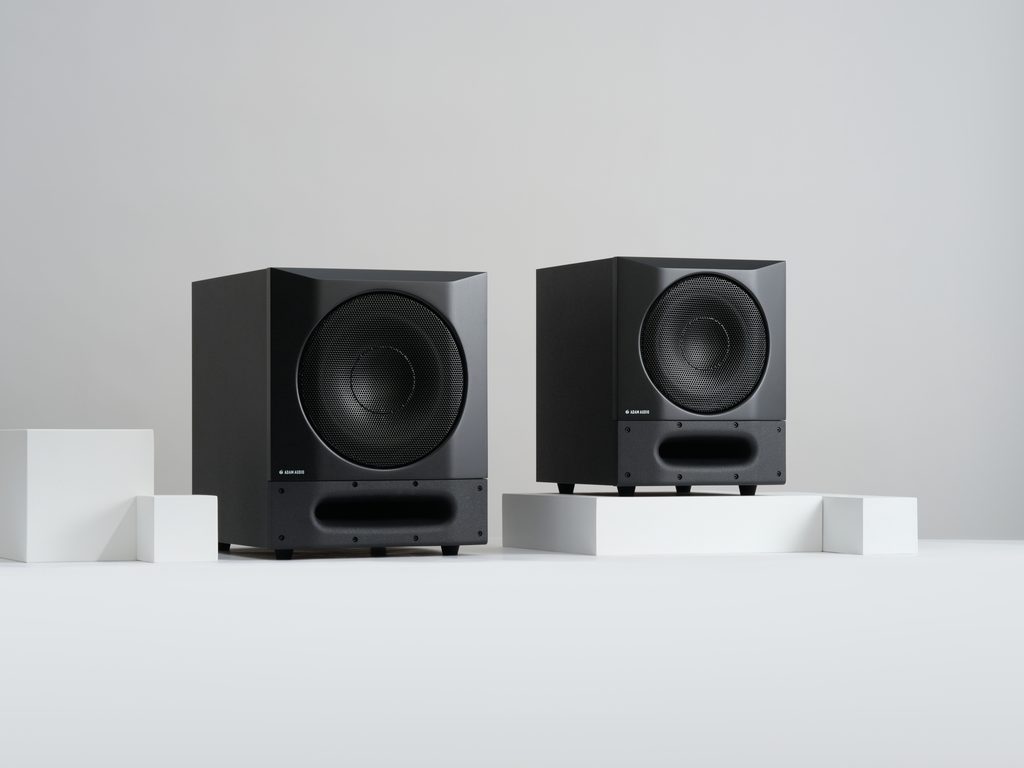
ADAM Audio’s Sub8 PRO is aimed at a very specific studio problem: compact monitoring setups often need low-end extension, but they do not always need a giant subwoofer taking over the room.
The Sub8 PRO is built as a smaller, networked studio sub that can sit under a desk, connect into modern monitor setups, and handle more than simple low-frequency reinforcement. It uses a high-excursion 8-inch woofer, a powerful class D amplifier, DSP-based processing, and an FEA-optimised bass reflex port. That combination puts it closer to a calibration-ready studio component than a basic bass box.
That distinction is important. In smaller rooms, adding a sub can either help the monitoring system feel more honest or make the low end harder to judge. The difference usually comes down to integration. Level, crossover, phase, delay, and room behavior all need attention, or else the sub becomes a distraction.
ADAM seems to understand that.
The Sub8 PRO includes phase and crossover control, AES3 digital audio, balanced XLR and TRS connections, a footswitch connection for bass management bypass, Ethernet control, ADAM Control software, and Sonarworks profile upload.
That makes it a natural fit beside the company’s smaller monitor options. I covered ADAM’s compact D3V monitors in my ADAM Audio D3V review, and Sub8 PRO feels like the more serious expansion point for producers who want a compact system to reach lower without losing control of the room.
The Networked Side Is the Real Advantage
The most interesting part of Sub8 PRO is the fact that the sub is part of ADAM Audio’s modern networked speaker ecosystem.
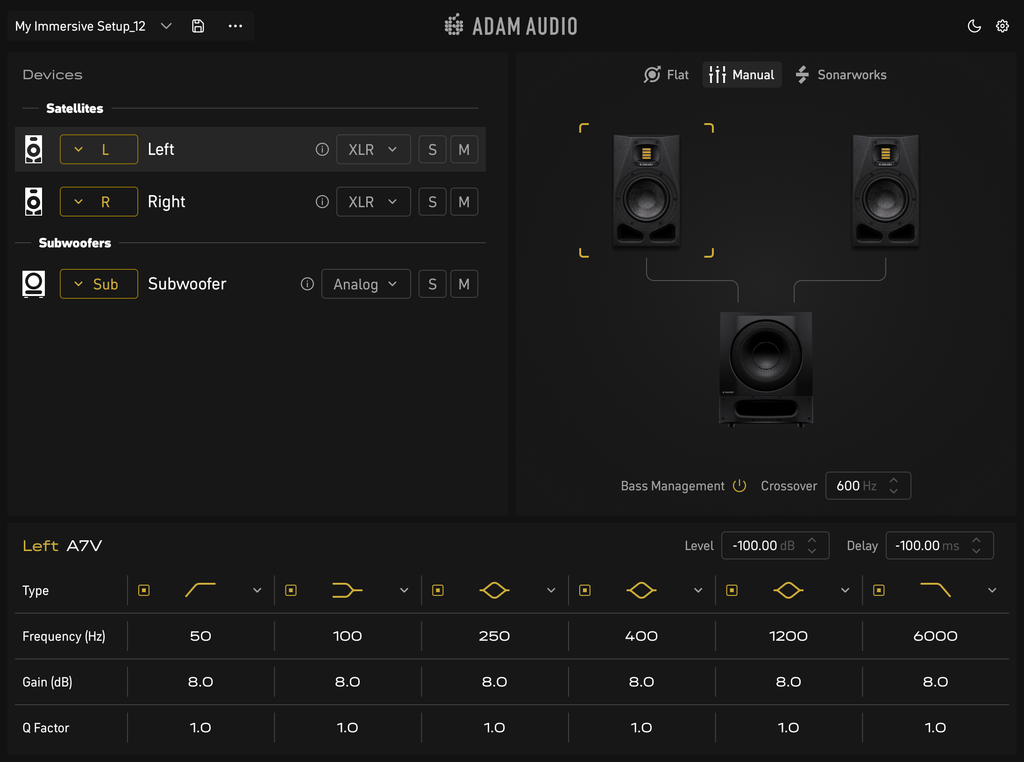
ADAM Control lets users adjust tuning and phase settings remotely over Ethernet, in real time, from Windows or macOS. Once the sub is connected, multiple subwoofers and A Series monitors can be managed at once. You can adjust equalization and delay from different listening positions, and firmware updates can add new features over time.
Nobody wants to crawl behind a subwoofer every time the crossover or phase needs a small adjustment. In a tight studio, the backplate may be against a wall, under a desk, or buried in cabling. Network control lets you adjust the sub from the listening position, where you can actually judge the results.
Sub8 PRO also includes four bands of parametric EQ for room adaptation. That gives producers a direct way to deal with problem areas in the room without relying only on physical placement. Placement still matters, of course, but small rooms rarely behave perfectly. A few dB in the wrong place can make the low end feel exaggerated, hollow, or inconsistent.
That is why software-controlled calibration is becoming less of a luxury and more of a normal studio expectation. IK Multimedia made a similar argument with its newer monitor systems, which I covered in my article on the iLoud Precision MKII and ARC X System. ADAM’s approach here is different, but the larger point is the same: modern monitoring needs to account for the room, not pretend the room is invisible.
Sonarworks Support Makes It Easier to Trust
Sub8 PRO is built to work with Sonarworks-created filters from SoundID Reference, which can be uploaded directly to the subwoofer’s DSP platform. The product pack specifically positions the sub as a match for ADAM’s Sonarworks-ready A Series monitors.
That matters because subs can be difficult to trust in smaller rooms. You might feel more bass, but that does not mean you are hearing it accurately. Room modes can trick you into under-mixing or over-mixing the low end, and that mistake may not show itself until the track is played in a car, club, headphones, or another studio.
Sonarworks integration gives the Sub8 PRO a more complete role inside a calibrated monitoring system. With a measurement mic and SoundID Reference, users can build calibration profiles for stereo and multichannel setups, then host the correction directly on the sub’s DSP.
That workflow is a good fit for producers who want to keep the computer session cleaner too. Instead of relying only on a plugin across the mix bus, correction can be handled in the speaker system itself. That can be especially helpful when bouncing, switching DAWs, checking references, or using multiple audio sources.
I covered a neighboring studio problem in my article on Audient ORIA Mini bringing hardware room correction to smaller studios. Sub8 PRO is not trying to be the same product, but it belongs to the same movement: better monitoring depends on making calibration less fragile and more integrated.
Built for Stereo and Immersive Workflows
Sub8 PRO has three operating modes: Stereo, LFE, and Wide.
Stereo mode covers conventional two-channel use. LFE mode is designed for immersive mixing, with a 120 Hz cutoff that follows Dolby’s advice for LFE channels in Atmos systems. Wide mode lets the subwoofer play full range, which gives users more flexibility when bass management is handled elsewhere in the chain.
The AES3 digital connections also matter here.
The Sub8 PRO can receive and pass two channels of digital audio at up to 24-bit resolution and 96 kHz sample rates. Staying digital can reduce conversion stages and help longer cable runs stay cleaner in professional setups.
The analog side is still covered too, with two XLR/TRS combo connections and two XLR analog outputs. That gives the sub room to sit in different studio layouts without forcing one connection type.
The Woofer and Port Are Doing Heavy Work
The Sub8 PRO’s woofer uses a fibre-reinforced paper cone with an elastic rubber surround, designed for considerable excursion while maintaining mechanical behavior. ADAM also mentions a ferrite magnet system with demodulation rings to stabilize voice coil inductance, along with advanced ventilation of moving parts to reduce unwanted noise.
The port design gets similar attention. ADAM used Finite Element Analysis to model airflow across the bass port, calculating curvature, flaring, and effective length to keep air speed more consistent across the port. The aim is reduced turbulence and higher SPL capability.
That is the sort of technical detail that may sound dry until a subwoofer is pushed.
Port noise, mechanical strain, and limiter behavior all become audible when the low end is asked to work hard. ADAM’s product pack points to the Sub8 PRO being designed for output without turning the enclosure into the weak point.
The specs support that role in a compact format. Frequency response is listed at 30 to 228 Hz at -3 dB, and 26 to 300 Hz at -6 dB. Maximum SPL figures include 105 dB in half space at 1 meter from 50 to 100 Hz at 3 percent THD, plus a 113 dB max peak SPL in half space with IEC-weighted noise in Stereo mode.
That is a lot of output for a sub that weighs 15.3 kg and measures 385 x 300 x 365 mm.
The cabinet is front-firing and front-ported, built from vinyl-wrapped MDF with a painted MDF front panel, and the woofer is protected by a steel grille.
Who Sub8 PRO Makes Sense For
Sub8 PRO makes the most sense for producers, mixers, composers, editors, and small studio owners who already understand that low-end extension is only helpful when it can be managed.
If the goal is simply to shake the room, there are cheaper and less precise ways to do that. The Sub8 PRO is more interesting for people who want the sub to become part of the monitoring system rather than a loose add-on.
It fits best with compact monitoring systems that need deeper reach, A Series-based rooms using ADAM Control, studios already working with SoundID Reference, and smaller immersive setups where LFE and Wide modes add flexibility. It also makes sense for producers working on bass-heavy music who need to make better decisions below the range where small monitors start to fade.
The tagline in the product pack is “Complete Your System,” and that is probably the right way to read it. Sub8 PRO is not about turning a studio into a club. It is about extending a monitoring chain in a way that can be controlled, calibrated, bypassed, updated, and folded into a more serious room setup over time.

Will Vance is a professional music producer who has been involved in the industry for the better part of a decade and has been the managing editor at Magnetic Magazine since mid-2022. In that time period, he has published thousands of articles on music production, industry think pieces and educational articles about the music industry. Over the last decade as a professional music producer, Will Vance has also ran multiple successful and highly respected record labels in the industry, including Where The Heart Is Records as well as having launched a new label with a focus on community through Magnetic Magazine. When not running these labels or producing his own music, Vance is likely writing for other top industry sites like Waves or the Hyperbits Masterclass or working on his upcoming book on mindfulness in music production. On the rare chance he's not thinking about music production, he's probably running a game of Dungeons and Dragons with his friends which he has been the dungeon master for for many years.





![Baby Audio HyperWarp Review: Why Less [Processing] Is More](https://magneticmag.com/wp-content/uploads/2026/10/Untitled-Design-88.png)



![Baby Audio HyperWarp Review: Why Less [Processing] Is More](https://magneticmag.com/wp-content/uploads/2026/10/Untitled-Design-88-1024x683.png)
![How It Was Made: Lang Father i(Junkyard Dog) [Welofi]](https://magneticmag.com/wp-content/uploads/2026/10/Press-Pic_2-1024x576.jpg)