Every DJ has some version of the same nightmare.
The booth is dark, the room is full, the first track needs to load, and suddenly the thing that worked perfectly at home refuses to cooperate in public. Maybe the USB is not recognized, maybe the mixer is different from the rider, maybe a firmware detail nobody checked is now the only thing anyone can think about, and maybe the person who knows the answer is nowhere near the booth.
Save My Gig is built for that moment, but the smarter part of the project is that it does not want DJs discovering it only once the night is already sideways.
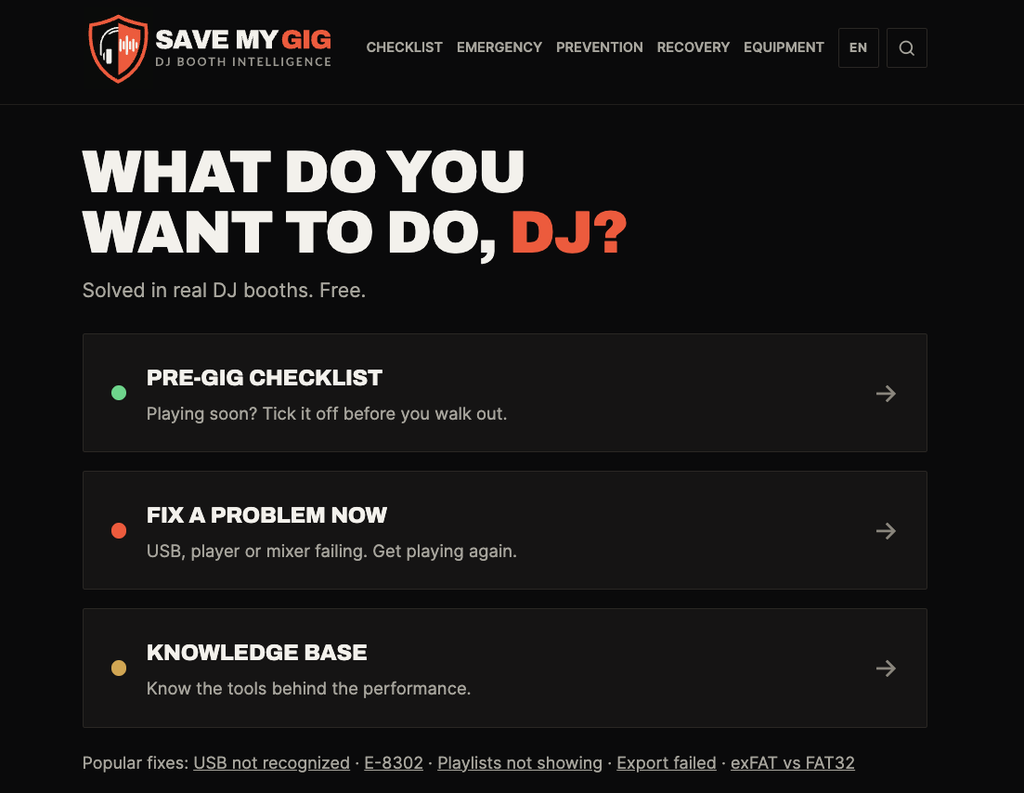
The platform positions itself as DJ Booth Intelligence: a free technical reference for live DJ performance, designed to help artists and booth teams prepare before a show, respond during a technical failure, and learn afterward so the same problem does not keep repeating itself under pressure.
That makes the project more practical than most DJ-tech conversations, because it deals with the unglamorous stuff that can actually decide a night: backup USBs, file formats, firmware changes, equipment differences, missing adapters, weak signal, unfamiliar mixers, and the slow panic of trying random fixes while people are waiting.
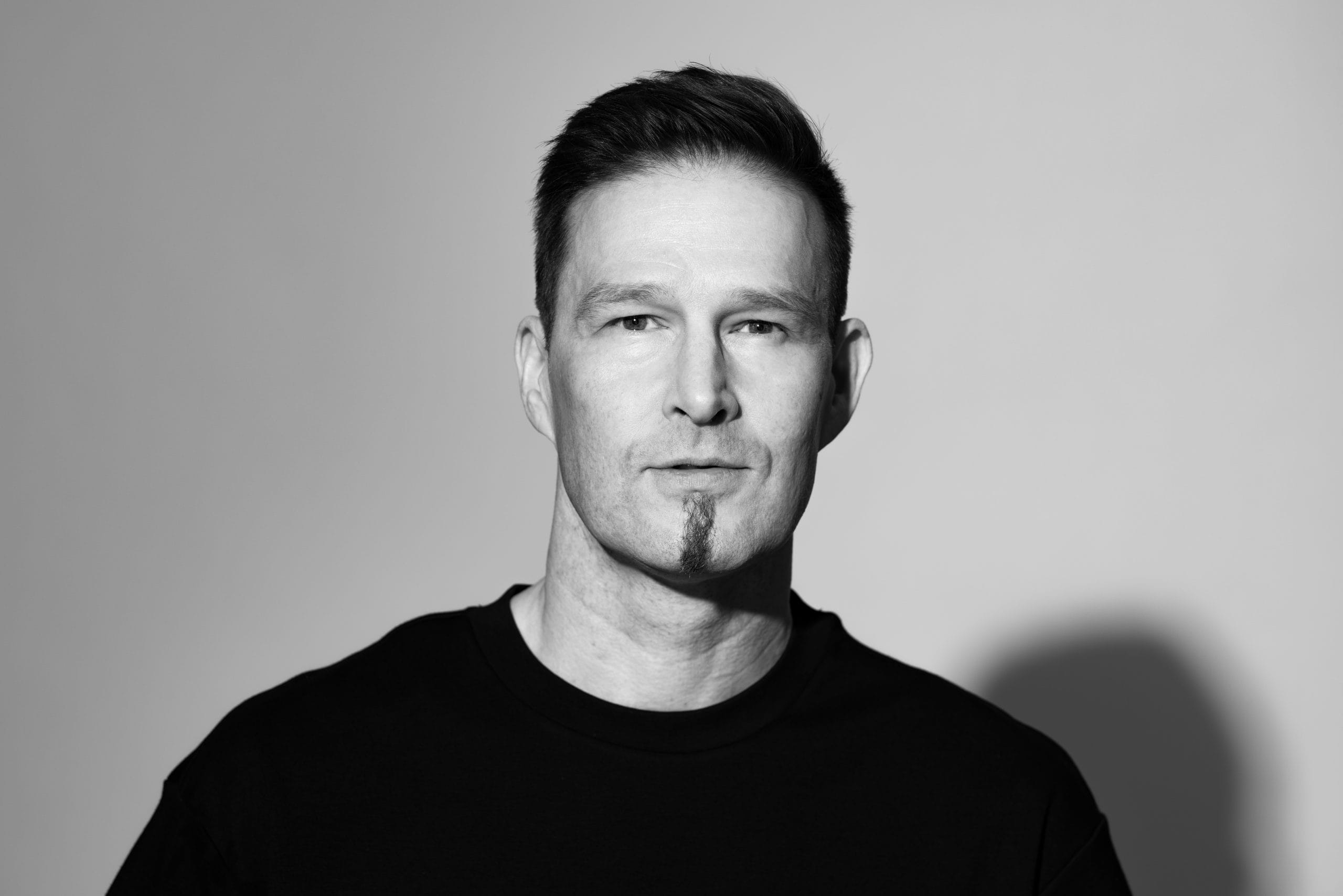
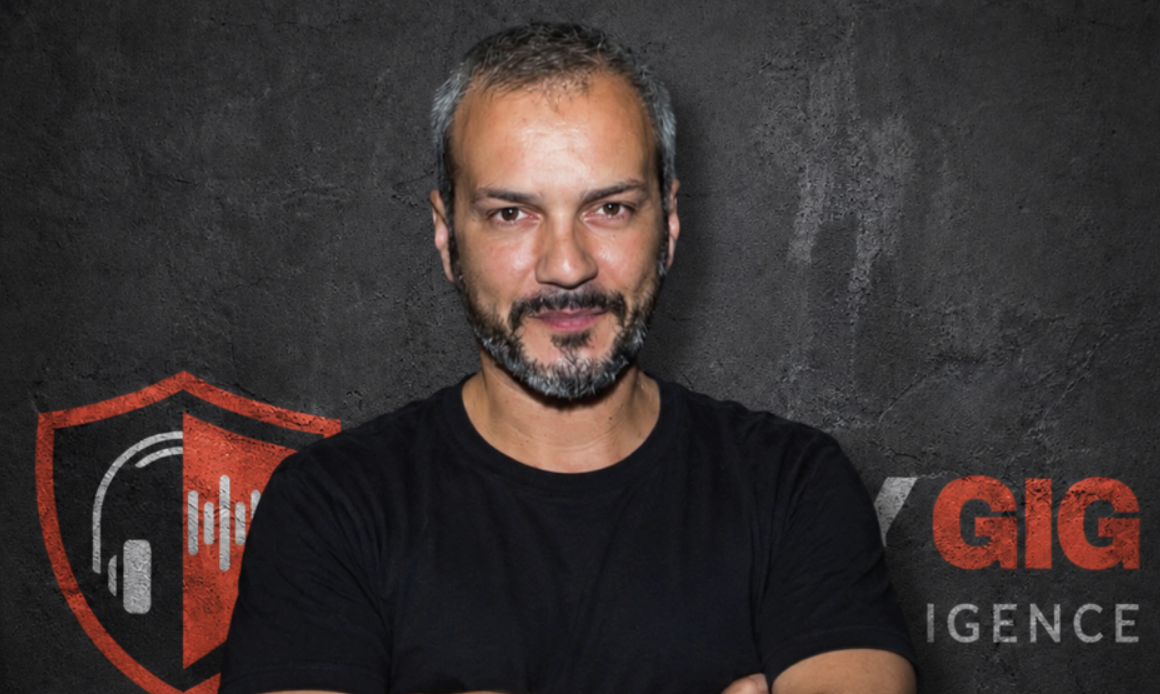
In the interview below, Antonio Afonso of Save My Gig (pictured above) breaks down why the platform was built as a collective project, why offline access had to be part of it from the beginning, and why emergency information should never be treated as a place to sell someone something.
Interview With Antonio Afonso of Save My Gig
Save My Gig draws on almost four decades of experience in electronic music. Which roles gave you the closest view of technical failure in DJ booths?
Mostly by accident, I ended up standing in a lot of different places when things went wrong.
I started as a DJ in the late 1980s. Over time, my work expanded into product management, product development and product specialisation, alongside roughly two decades working with some of the leading DJ equipment brands. There were also the trade fairs and conferences that come with that world, both on panels and in the audience. Along the way, there was DJ education, equipment distribution and rental, an online MP3 store, and more than 350 events produced around the world, from club nights to international tours and festivals. For the past decade, I have also been involved in international management for an award-winning, 10,000-capacity hyperclub that hosts more than 100 international DJs every year.
Still, no single one of those roles teaches you very much on its own. Together, they show you the same failure from several different sides, and that turned out to be the practical lesson.
Behind the decks, you experience failure directly. As the person responsible for the equipment, as part of the technical team, or as the person answering to the artist, promoter or production, you experience the consequences differently. Equipment fails. The setup is not what the rider said it would be. The music itself refuses to cooperate, or the DJ simply forgot something essential for the performance.
And it is never only the DJ who pays for it. Technicians, touring crews, promoters, artists and everyone around the performance face the same reality: inside a booth, under the pressure of a live performance, a relatively small technical issue can become a major problem very quickly. And of course, we cannot forget the public.
Save My Gig came out of watching that happen for years, from all of those different positions. The idea was simple: take that accumulated experience and turn it into something usable, so the next person facing the same problem does not have to solve it from scratch at the worst possible moment. The DJ booth community needed a fast, practical place to prevent problems, save the gig when they happen anyway, and be better prepared for the next one.
That experience is not one person’s alone. The team behind Save My Gig comes from different parts of the industry, and several contributors have chosen to remain anonymous. They would rather contribute what they know than put themselves at the centre of the project, and we have deliberately kept it that way. It is not about faces or a founder story. It is about collective experience and a shared desire to help. Made by DJs, for DJs.
Nobody involved claims to have all the answers. The goal is narrower than that: share what we have learned and help stop a small technical problem from ruining an important gig.
Before Save My Gig, how were working DJs usually finding answers when equipment failed during a set?
Through a combination of experience, improvisation, faith and whoever happened to be standing nearby. The information usually exists somewhere.
Most equipment ships with a manual. But almost nobody reads 100 pages from front to back the way you would study for an exam. DJs learn the essentials they need to perform, and then they move on. That is not laziness, it is simply how busy professionals actually work.
The problem arrives the moment something unexpected happens, because that is when the part you skipped suddenly becomes the only part that matters. At that point, the options are Google, a YouTube video, a forum thread that may be five years old, a phone call to another DJ or technician, or simply changing things at random and hoping. Sometimes that works. Sometimes it does not, and there may be hundreds or thousands of people watching.
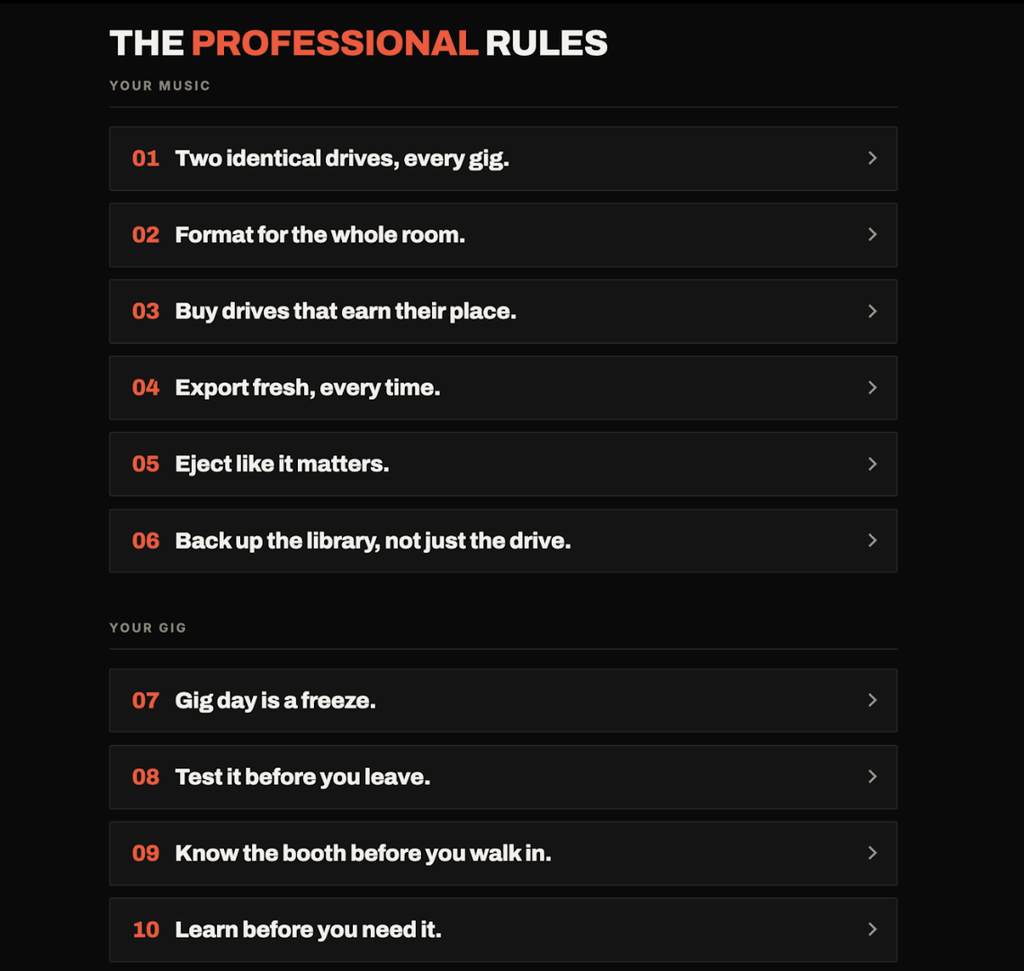
Save My Gig exists partly to remove that scramble. We know most DJs are not going to read an entire manufacturer manual from A to Z. Manuals can be long, highly detailed and full of information that, while important in certain situations, may never be relevant to their normal workflow. So we created the Equipment Field Manuals: practical, digestible resources focused on the essential things you really need to understand about a specific piece of equipment or situation.
And then we go one step further with the Fast Lane. Right at the beginning of each equipment page, it highlights the five things that can potentially decide your gig on that particular unit. In around 20 seconds of reading, you can understand the most important things you need to know before using it.
This is particularly valuable when you are about to play on unfamiliar equipment, but it can also help experienced users catch something that has changed, for example after a firmware update.
Ideally, you discover these things before you press play, of course.
But there is a point we make constantly, and it matters more than the platform itself: Save My Gig should not be discovered during an emergency.
It can help in real time, and it is built to work under pressure. But if you are standing in a booth with seconds to react, no resource on earth is going to teach you how to use a machine from zero. It is a little like reading the emergency manual while the plane is already going down.
So our position is always the same: prepare before the gig. Learn the equipment you are going to play on. Understand its limits and compatibility traps. Know the emergency procedures before you need them.
Save My Gig is an extra layer of preparation. Ideally, you never need to open it in an emergency. But if you do, you already know where to look and have a better idea of what to do.

Why did offline access need to be available from the beginning?
Because if you are building something meant to help when technology fails, you cannot assume the internet connection will be available when you need it most.
The emergency case is the obvious one. A festival site, a backstage area, a basement venue with no Wi-Fi or poor mobile data coverage. If something goes wrong and you still have time to investigate, our Interactive Troubleshooting walks you through the symptoms, almost like medical triage, narrowing the possibilities until you reach a likely cause.
But offline access turned out to matter far beyond the emergency.
Touring DJs spend a significant part of their lives in airports, hotels, cars and planes. That dead time can actually be some of the best preparation time available. You can read up on the equipment waiting for you at the venue, check compatibility or simply explore the technical information available on the platform and know more about your working tools.
That is why we made Save My Gig deliberately lightweight from day one. No heavy graphics, no decorative effects, nothing that slows it down. It loads quickly, can store information through the browser, and can also be installed as a PWA, or Progressive Web App, on a phone or laptop. Essentially, it is a website that can behave much like an installed app while remaining accessible without an active internet connection.
We initially focused on making the emergency resources available offline. But it became clear quite quickly that the entire platform needed to be.
Take a real scenario. You are boarding a flight and discover that the equipment specified in your technical rider will not be available. You are going to play on something else. Suddenly, you have a few hours in the air to prepare, but no internet connection. That is exactly where offline access earns its place.
A common example is a generational change in equipment. A DJ expects a CDJ-3000 and discovers a CDJ-3000X setup instead. That might sound like an upgrade, but depending on how the music library was prepared and exported, it can introduce compatibility considerations that need to be understood before arriving at the booth.
Knowing that at 30,000 feet rather than discovering it in front of a crowd can be the difference between making a correction and facing a serious problem.
So offline access has become something we did not fully anticipate at the beginning: a portable technical library for DJs and booth professionals.
Ultimately, offline access serves two purposes: finding help when something goes wrong and having knowledge available while you still have time to prevent the problem from happening.
The second one may actually be the bigger piece.
The SURU.Music workshop placed DJ Booth Intelligence in front of working artists. Which question or reaction from that event affected the platform afterward?
Interestingly, the biggest effect of the SURU.Music workshop happened before the workshop itself.
Preparing the presentation forced us to step back and look at Save My Gig from a different perspective. Until then, it was very easy to describe the platform primarily as an emergency resource: something designed to help DJs when technology fails and they need answers quickly. But while preparing the workshop, we realised that this was only one part of a much bigger picture.
We structured the entire presentation around three moments: before, during and after the gig. Suddenly, Save My Gig started to make much more sense as a complete cycle rather than simply an emergency platform.
Before the gig, you prepare, check and prevent. During the gig, if something goes wrong, you diagnose, troubleshoot and make decisions under pressure. After the gig, you learn from what happened, improve your knowledge and prepare better for the next one.
That simple exercise changed how we see the platform itself. Emergency Mode is important, of course, but ideally it should not be the first reason someone discovers Save My Gig. The more you know before arriving at the DJ booth, the better your chances of avoiding an emergency altogether.
The interaction with the SURU community, its members and the masters involved in the workshop also had a direct effect on the platform. Their experience and feedback helped us look more carefully at the preparation process and identify additional things that DJs and technical teams should consider before a performance.
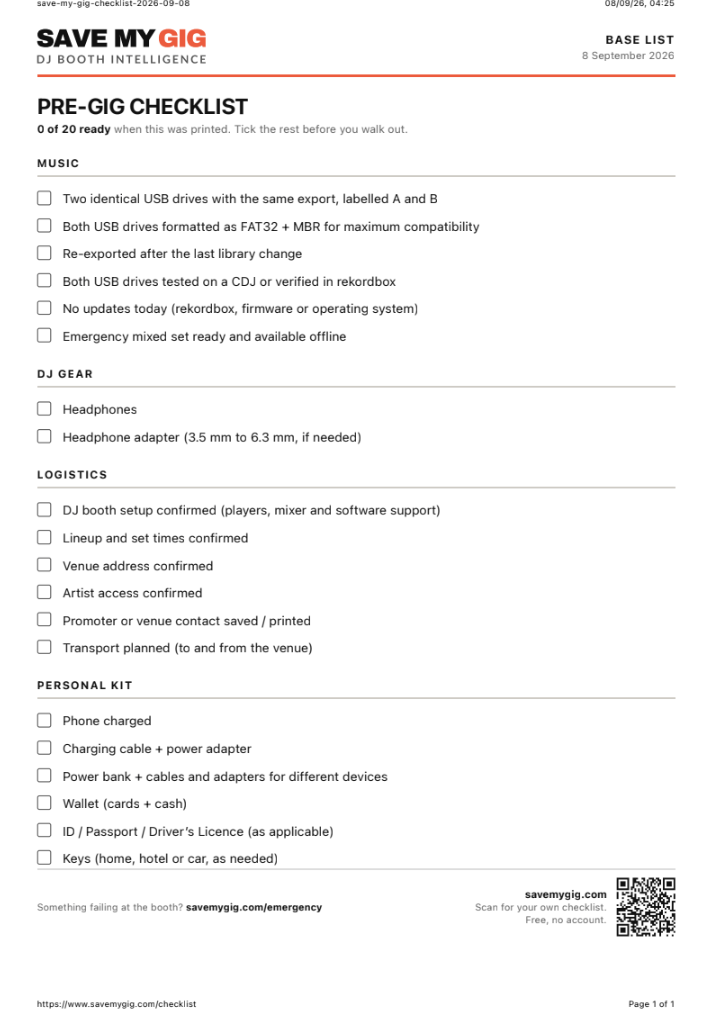
As a result, the Advanced Pre-Gig Checklist evolved from 48 to 50 items. It is designed as a practical tool to help DJs and technical teams systematically check the things that can easily be forgotten before a gig. Of course, every professional works differently, which is why there is also a Custom Mode that allows users to adapt the checklist to their own needs.
It may sound like a simple feature, but forgetting one small item can sometimes create a much bigger problem later. A missing adapter, the wrong cable, an unprepared backup USB or something that was simply assumed would be available can quickly become a problem when you are already at the venue.
That was probably the most important lesson from the SURU.Music experience: DJ Booth Intelligence does not begin when something goes wrong. It begins long before the first track.
The workshop helped us redefine Save My Gig as something much broader than an emergency platform. It is about preparing better, reducing avoidable risks, knowing how to react when problems happen and learning from every experience afterwards.
You cannot prevent every technical problem in a DJ booth. But you can remove a surprising number of variables before they ever have the opportunity to become one.
Save My Gig is free and keeps sales content outside Emergency Mode. What funding model can support ongoing maintenance without influencing the recommendations?
First, I think it is important to clarify what we mean when we say that commercial content stays outside Emergency Mode. Save My Gig does not currently have advertising, promotional content or paid recommendations anywhere on the platform, and it is completely free.
But we have already established an important principle for the future: if commercial elements are ever introduced, Emergency Mode is not the place for them.
Imagine a DJ standing in a booth with a serious technical problem and trying to understand what to do. That is not a moment when we should be showing advertisements, promotional messages or trying to sell them something. Emergency Mode exists for one reason: to help solve the problem.
As for the wider platform, we are still at a very early stage. Save My Gig began as a free project for the DJ community and has grown considerably beyond its original concept. We intend to keep the platform free, but as it grows, maintaining and developing it will naturally require resources. That may eventually lead to sponsorships, partnerships or other ways of generating revenue. We are open to finding sustainable solutions, but they have to make sense within the nature and principles of the project.
The important thing is that we cannot allow a future business model to compromise what Save My Gig is about. The platform needs to remain independent. Our responsibility is to the person facing the technical problem, not to a manufacturer, sponsor or commercial partner.
If we identify a genuine issue with a piece of equipment, a firmware update or a particular configuration, we need to be able to explain it honestly. Equally, we are not here to attack brands. If the information gathered through Save My Gig can help manufacturers understand real problems and ultimately improve their products, that is a positive outcome.
So the honest answer is that we are still discovering what a sustainable future might look like. But we already know the boundaries. Any commercial activity around Save My Gig must and will respect the independence, purpose and seriousness of the platform.
The mission comes first. Any business built around it has to respect that.
Company Spotlight: What Save My Gig Does
Save My Gig is a free DJ Booth Intelligence platform built for the real conditions around live DJ performance. It is not only a troubleshooting page for when something breaks, and it is not only a preparation checklist for DJs who want to feel more organized before a show. It is designed as a full cycle: before, during and after the gig.
Before the gig, the platform helps DJs prepare, check and prevent issues using Pre-Gig Checklists, equipment information, firmware notes and compatibility guidance. That may sound basic until you look at the kinds of things that often cause real booth problems: the wrong USB format, an untested export, a missing adapter, an unfamiliar setup, an unexpected firmware change, or a venue rig that is not quite what the rider promised.
During the gig, Save My Gig shifts into Emergency Mode and Interactive Troubleshooting. The idea is to give DJs and booth teams a structured diagnostic path instead of a pile of guesses. When pressure is high, random changes can make the situation worse, so the platform pushes users toward one-variable-at-a-time thinking: diagnose, eliminate possibilities, recover.
After the gig, Save My Gig turns the incident into knowledge. Its Knowledge Base, Dictionary, FAQs, Facts & Fixes, Equipment Field Manuals and post-gig learning approach are meant to help DJs understand what happened, what they learned and what should change before the next performance.
Each equipment page also includes the Fast Lane, which highlights the five things that can potentially decide a gig on that specific unit. The platform is available 24 hours a day in English, Spanish and Portuguese, works offline, and can be installed as a PWA on a phone or laptop, which means the information can stay accessible in a bad-signal booth, backstage, at a festival site, or on a flight.
The Advanced Pre-Gig Checklist shows how practical the platform is trying to be. It covers two identical USB drives, FAT32 and MBR formatting for compatibility, re-exporting after library changes, testing on CDJs or in rekordbox, emergency mixed sets, a third copy of the music, adapters, USB cables, Ethernet, RCA, headphones, a laptop and charger, booth confirmation, artist access, transport, accommodation, ID, earplugs, medicine, snacks, and the kind of small items that rarely feel urgent until they are suddenly the only thing missing.
The project is built by DJs, product specialists and technical professionals from across the industry, with several contributors choosing to remain anonymous. That collective framing is central to the idea. Save My Gig is less interested in turning one person into the face of the project and more interested in turning years of booth experience into something any working DJ can reach before a small problem becomes a public failure.
Website: https://www.savemygig.com
Closing Thoughts
The strongest thing about Save My Gig is that it treats DJ preparation like part of the craft rather than an admin chore. Plenty of artists will spend hours searching for records, tweaking playlists and thinking about the arc of a set, then walk into a booth with one USB, no tested backup, no adapter, no clue what firmware is running and a quiet belief that everything will probably be fine. Sometimes it is.
Sometimes the night starts teaching lessons in front of a full room.
That connects naturally with my interview with Malcolm Zeller on preparing sets around city, room and slot time. Zeller was talking about musical preparation, but Save My Gig lives on the technical side of the same conversation. A good set depends on taste and timing, but it also depends on whether the artist can actually access the music, understand the setup and keep the booth from turning into a guessing game.
The platform’s before-during-after model is the part that makes it work editorially. If Save My Gig were only an emergency page, it would be easy to file it under “nice to have.” But the stronger idea is prevention. Learn the equipment before the gig. Check the compatibility traps. Build backups. Know where the emergency information lives before the emergency happens. Then, after something goes wrong, close the loop instead of pretending it was just bad luck.
The offline piece is also more serious than it may sound at first.
A DJ tool built for emergencies cannot assume clean Wi-Fi, usable cell service or a calm backstage environment. A flight to the gig may become preparation time. A basement venue may have no signal. A festival site may be overloaded. The information has to be reachable when the conditions are already imperfect, because imperfect conditions are often when people need it.
There is another smart boundary in the commercial answer.
Save My Gig is free now, and the team is clear that if sponsorships or partnerships appear later, Emergency Mode cannot become a sales surface. That line is not cosmetic. A DJ dealing with a booth failure does not need an ad, a paid recommendation or a manufacturer-friendly answer. They need the most direct path to understanding the problem.
That also puts responsibility on the platform as it grows.
If Save My Gig starts documenting real issues with equipment, firmware or configurations, it will need to stay direct without turning into a complaint board. The project’s best version sits in that middle lane: clear enough to help DJs avoid problems, serious enough to help manufacturers see recurring issues, and independent enough that the person in the booth still feels like the priority.
The checklist might be the simplest proof of concept. Two identical USB drives. FAT32 and MBR formatting. No updates on the day of the gig. Emergency mixed sets. Cables. Adapters. Booth setup confirmed. Promoter contact saved. Earplugs. Medicine. Snacks. None of that is glamorous, but a lot of professional life is built from unglamorous details done before they become urgent.
The broader takeaway is that Save My Gig is trying to make booth intelligence feel normal. Not heroic. Not paranoid. Normal. DJs cannot prevent everything, and live performance will always find new ways to break clean plans, but preparation changes the scale of the problem. A bad moment does not have to become a wrecked set. A small failure does not have to become the story of the night.
Sometimes the most professional thing a DJ can do happens long before anyone sees them press play.

Will Vance is a professional music producer who has been involved in the industry for the better part of a decade and has been the managing editor at Magnetic Magazine since mid-2022. In that time period, he has published thousands of articles on music production, industry think pieces and educational articles about the music industry. Over the last decade as a professional music producer, Will Vance has also ran multiple successful and highly respected record labels in the industry, including Where The Heart Is Records as well as having launched a new label with a focus on community through Magnetic Magazine. When not running these labels or producing his own music, Vance is likely writing for other top industry sites like Waves or the Hyperbits Masterclass or working on his upcoming book on mindfulness in music production. On the rare chance he's not thinking about music production, he's probably running a game of Dungeons and Dragons with his friends which he has been the dungeon master for for many years.