Most people who quit guitar do not quit because they hate music.
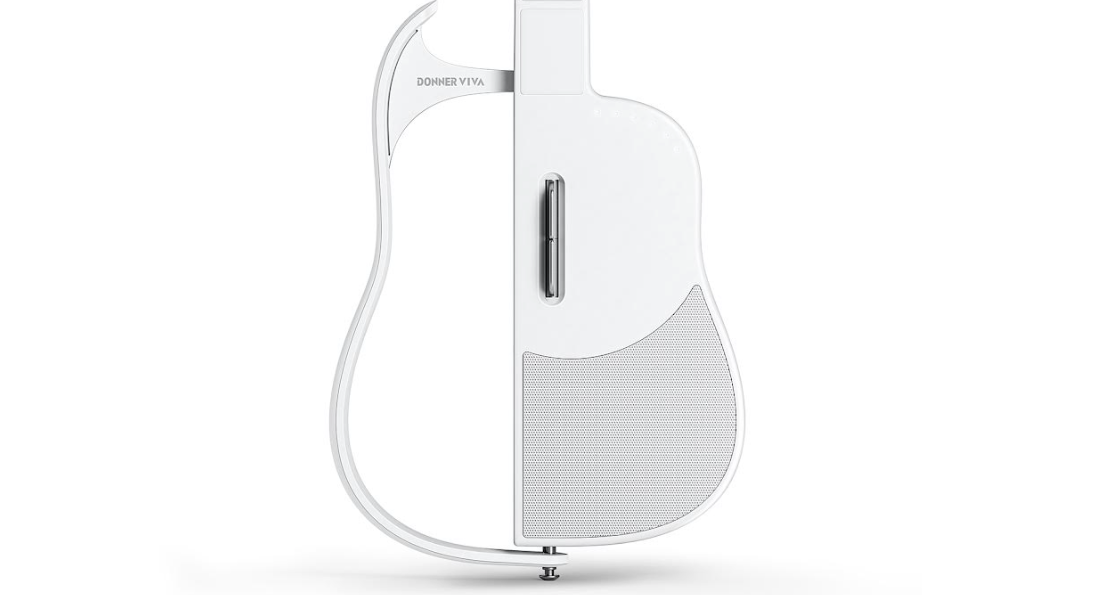
They quit because the first month can feel like a wall. Sore fingertips. Buzzing notes. chord shapes that feel impossible. Strumming patterns that fall apart the second singing enters the picture. That is the gap Donner is trying to address with VIVA, a stringless guitar built to let someone pick up an instrument and play a full song almost immediately.
The idea is not subtle. VIVA removes the steel strings and replaces them with a silicone-and-carbon-film touch fretboard, then adds a 7×7 RGB LED grid that shows where to place your hand. Pair it with the free Donner Play app, and the app supplies drums, bass, piano, and ambient backing parts in sync.
That makes VIVA less like a traditional guitar replacement and more like a song-starting instrument shaped like a guitar.
That distinction is important. Anyone expecting VIVA to behave like a normal electric guitar may be asking the wrong question. The better question is whether it helps people get past the friction that stops them from making music in the first place.
The Backing Band Is the Real Hook
The built-in “backing band” idea is the reason VIVA works as a product story.
A beginner does not only need help finding the right fret. They need context. They need to hear how a chord sits with drums, bass, and harmony underneath it. They need the feeling of playing inside a song before technique has fully caught up.
Donner Play’s Band Mode provides VIVA with up to 12 MIDI tracks arranged by Donner’s in-house team, turning the instrument into a small performance system. Free Play mode adds A/B tone switching and more than 50 rhythm presets, so the player can move away from guided playing once they start getting comfortable.
That is where VIVA feels connected to Donner’s larger smart-instrument run. We covered some of that direction in our earlier article on Donner’s smart guitar and Music China 2025 lineup, where the company was already pushing into instruments that lower the first barrier without abandoning the idea of performance.
VIVA takes that further by turning the support system into part of the instrument itself.
The Sound Engine Keeps It Away From Toy Territory
The danger with any stringless guitar is that it can start to feel like a novelty.
Donner is clearly trying to avoid that by giving VIVA a deeper sound side than the toy-guitar premise might suggest. The instrument uses a Dream DSP and MCU with IR-sampled tones, seven instrument voices, six drum kits, and low-millisecond latency.
The seven sampled voices cover acoustic guitar, nylon-string classical, distorted rock electric, modern clean electric, vintage clean electric, acoustic grand piano, and ambient piano. The drum kits cover pop, rock, R&B, metal, and vaporwave. Style packs for pop, folk, britpop, rock, emo, and punk change the feel of the same song, while off the app the player can set chords, styles, and arpeggios manually.
That gives VIVA a wider role than “easy guitar for beginners.”
It can become a sketchpad for singers, a couch instrument for people who want to write without opening a laptop, or a portable idea machine for producers who think better when harmony is under their hands. It is not meant to replace a Strat, a nylon string, or a serious MIDI guitar setup. It is meant to remove the part of guitar that intimidates people before they ever reach the fun part.
That same beginner-friendly technology thread came up in our review of Donner’s MEDO sampler, where the appeal was not raw power. It was immediacy, portability, and giving people a faster way into making something.
This Is Still a Guitar Question
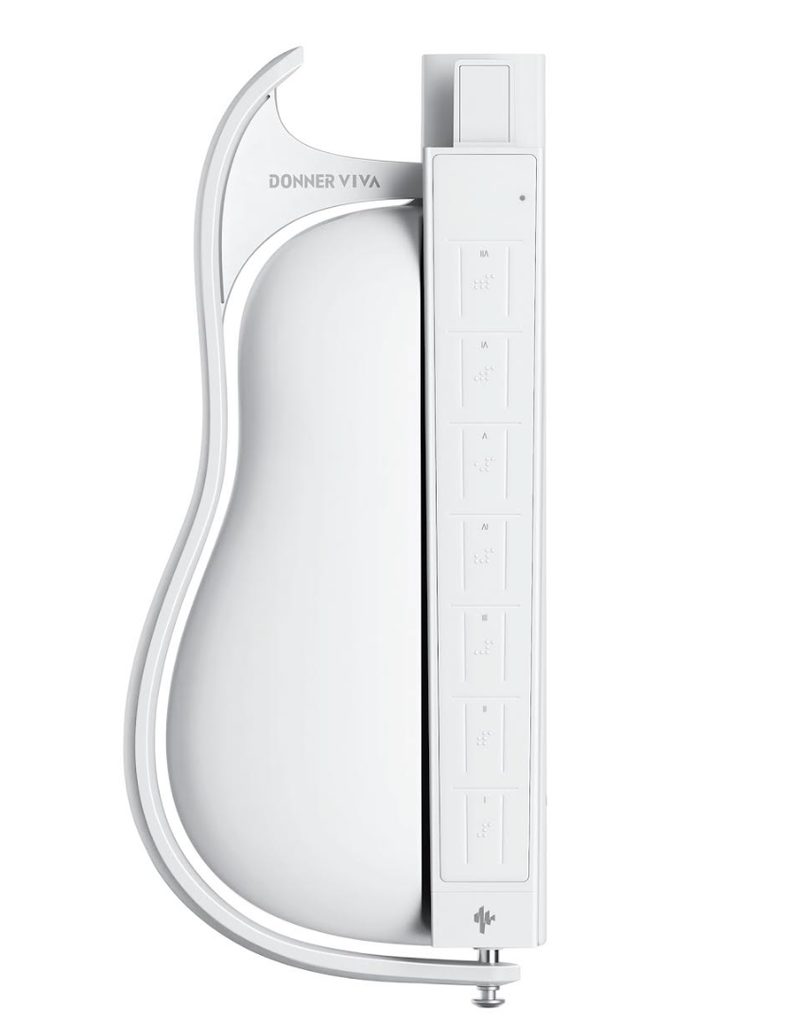
The most interesting tension around VIVA is whether guitar needs strings to teach the feeling of guitar.
For traditionalists, the answer will probably be yes. Strings teach pressure, touch, bend, buzz, pick attack, hand strength, and all the small physical details that make a guitar feel alive.
But VIVA is not really trying to teach that version first.
It is trying to let someone experience song form, harmony, rhythm, tone switching, and arrangement before their fingers have paid the usual entrance fee. That might make it valuable for people who always wanted to play but bounced off the mechanics early. It could also help singers who want accompaniment without years of chord work, or producers who want guitar-like harmonic control without tracking a real instrument.
There is a music-education angle here too. Our piece on the benefits of music education touched on how access and early confidence can change someone’s relationship with music. VIVA sits in that same zone, but from a product angle: make the first win happen sooner, then let the player decide how far they want to go.
Donner VIVA Is Shipping Now
Donner VIVA is shipping now in Ivory White for $399.99 in the United States.
It is available direct from Donner and on Amazon. Review units are also available on request.
The instrument follows Donner’s REVO smart guitar and MEDO handheld synth as part of the company’s smart-instrument line, but VIVA may be the most direct version of Donner’s current thinking. Use technology to remove the first barrier, give the player a full musical result quickly, and make the object light enough to live outside a formal studio setup.
That is the cleanest read on VIVA.
It is not a replacement for guitar in the old sense. It is a different entry point into playing songs, writing ideas, and getting over the part where the instrument feels like a test before it feels like music.

Magnetic byline note: This byline is used for staff produced updates and short announcements, often based on press materials and official release information. Editorial responsibility: David Ireland (Editor in Chief) and Will Vance (Managing Editor). About: https://magneticmag.com/about/ Masthead: https://magneticmag.com/masthead/ Contact: https://magneticmag.com/contact/





![Baby Audio HyperWarp Review: Why Less [Processing] Is More](https://magneticmag.com/wp-content/uploads/2026/10/Untitled-Design-88.png)


![Baby Audio HyperWarp Review: Why Less [Processing] Is More](https://magneticmag.com/wp-content/uploads/2026/10/Untitled-Design-88-1024x683.png)
![How It Was Made: Lang Father i(Junkyard Dog) [Welofi]](https://magneticmag.com/wp-content/uploads/2026/10/Press-Pic_2-1024x576.jpg)