PolyFreq has launched Phonon, its debut plug-in, and the cleanest angle here is control. Granular tools often lean into chance, drift, and loose texture generation, while Phonon is built around repeatable sample reconstruction, playable pitch behavior, and a modulation system that keeps the process hands-on inside a DAW.
That gives the plug-in a useful place for producers who like granular synthesis, yet want something that can behave like an instrument rather than a random audio mangler.
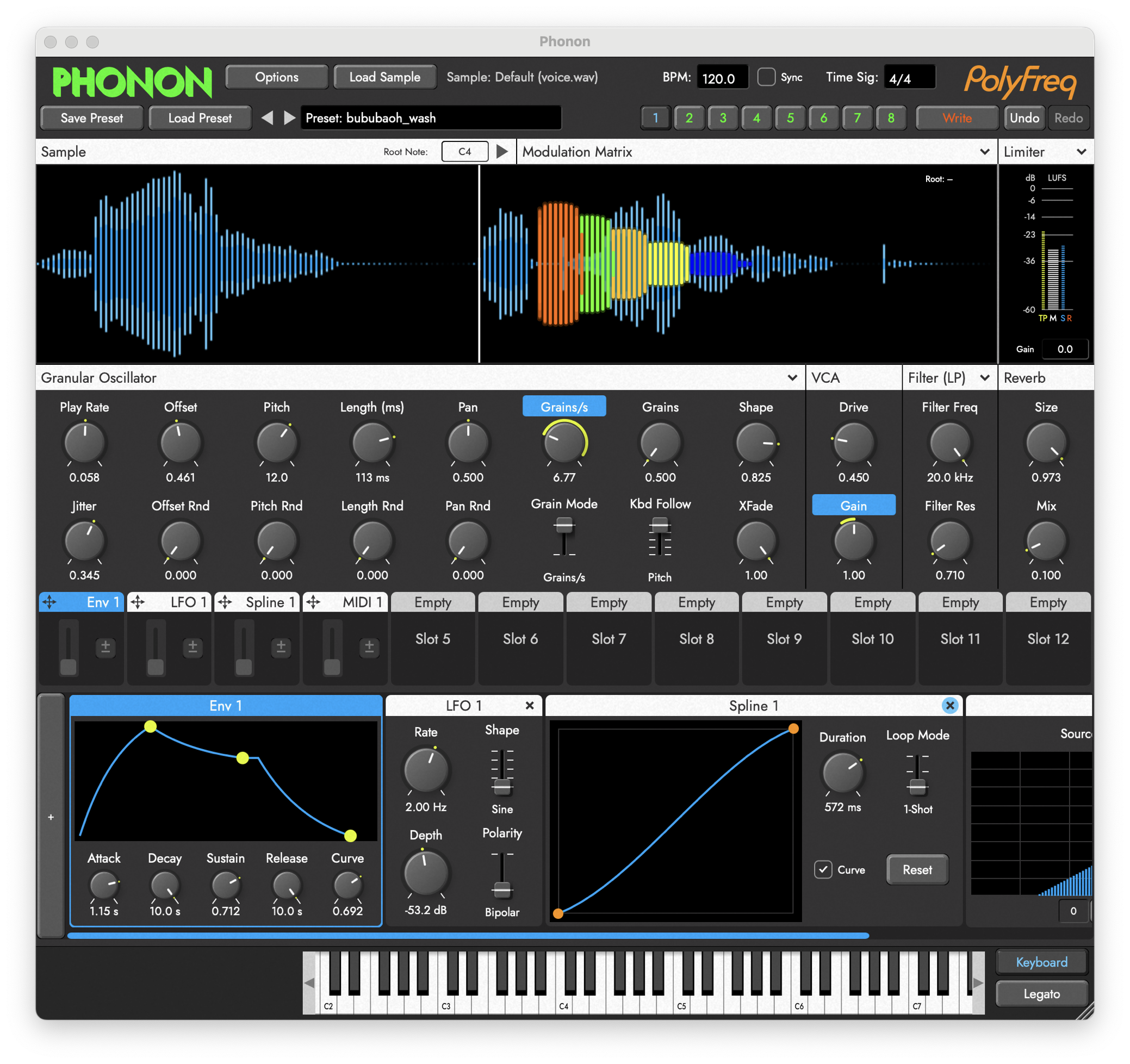
Phonon uses a sample-granulation engine with root-note detection, four keyboard-follow modes, and legato, so users can drag in a sample and play it with a level of pitch control that feels closer to a synth workflow.
Founder Nick Mariette comes from a technical background spanning spatial audio, audio augmented reality, Dante, Dolby Atmos, and Lake Technology, which helps explain why Phonon feels so focused on precision. The plug-in is built around synchronous granular, also described as graintable synthesis, with sub-sample grain scheduling, separate grain rate and density controls, and enough structure to move between texture design and tuned instrument parts.
Phonon is available to buy as a standalone or VST3 plug-in for macOS (10.13 or later) and Windows (10 or later) at a 33% launch discount — duly rising thereafter to its full price of $89.00 USD (excluding tax)/€76.00 EUR (including tax)/£68.00 GBP (including tax) — directly from PolyFreq here: https://www.polyfreq.com/products
Granular Synthesis With Actual Pitch Control
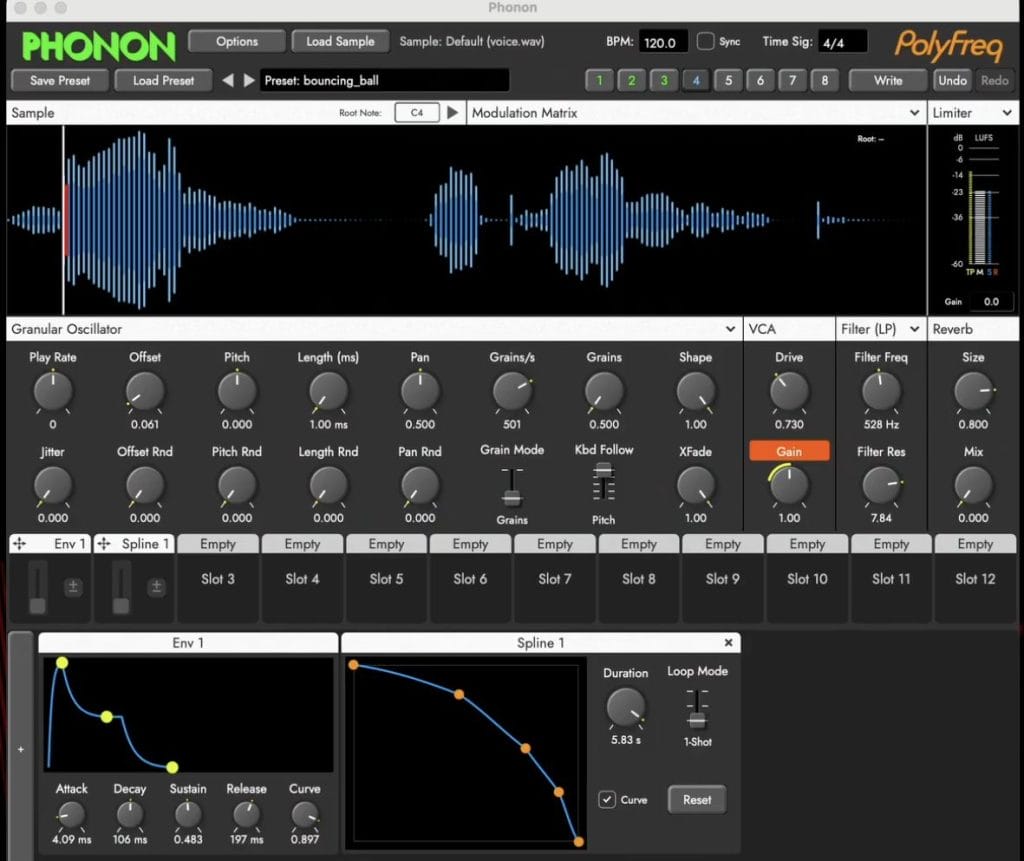
The main reason Phonon feels worth covering is its playable design. Root note detection, keyboard follow modes, and legato give producers a way to turn almost any sample into a controlled instrument. That could be useful for vocal chops, field recordings, synth snippets, guitar notes, foley, noise layers, or any short audio source that has enough character to be rebuilt through grains.
The engine supports eight voices of polyphony and up to 256 grains per voice, which gives users a wide range of density without forcing every patch into haze. Grain rate and density are separated, so tempo, tone, movement, and texture can be adjusted with more intention. That detail should appeal to sound designers who want repeatable results rather than a plug-in that gives them a different answer each time they move one control.
The modulation system also looks practical. Phonon includes drag-and-drop modulation, with sources such as LFOs, envelopes, sample metadata, sequencers, MIDI control data, and noise types. Most features are visible in the interface, with minimal hidden menus, which should make the plug-in easier to learn than many granular tools in this category.
Phonon Plug-In For Producers And Sound Designers
Phonon can run as a standalone instrument or as a VST3 plug-in for macOS 10.13 or later and Windows 10 or later.
The effects section includes drive, resonant filtering, and utility reverb, giving users enough tone shaping inside the plug-in before routing audio elsewhere.
The preset system also deserves attention. Users can capture, export, develop, and share patches with sample embedding and eight-way snapshots, which makes Phonon better suited for repeatable production work. That is useful when a patch needs to survive across sessions, systems, or collaborations.
Phonon is available now at a 33 percent launch discount before moving to its full price of $89 USD, €76 EUR, or £68 GBP. PolyFreq is also presenting the plug-in at SUPERBOOTH26 in Berlin from May 7-9 at Booth H116.
For producers, the key point is simple: Phonon brings granular synthesis into a format that feels playable, controlled, and useful for actual parts. It can still handle stretched textures and fractured sample work, though its sharper value comes from turning audio into an expressive instrument with pitch-aware control and fast modulation routing.

Will Vance is a professional music producer who has been involved in the industry for the better part of a decade and has been the managing editor at Magnetic Magazine since mid-2022. In that time period, he has published thousands of articles on music production, industry think pieces and educational articles about the music industry. Over the last decade as a professional music producer, Will Vance has also ran multiple successful and highly respected record labels in the industry, including Where The Heart Is Records as well as having launched a new label with a focus on community through Magnetic Magazine. When not running these labels or producing his own music, Vance is likely writing for other top industry sites like Waves or the Hyperbits Masterclass or working on his upcoming book on mindfulness in music production. On the rare chance he's not thinking about music production, he's probably running a game of Dungeons and Dragons with his friends which he has been the dungeon master for for many years.