
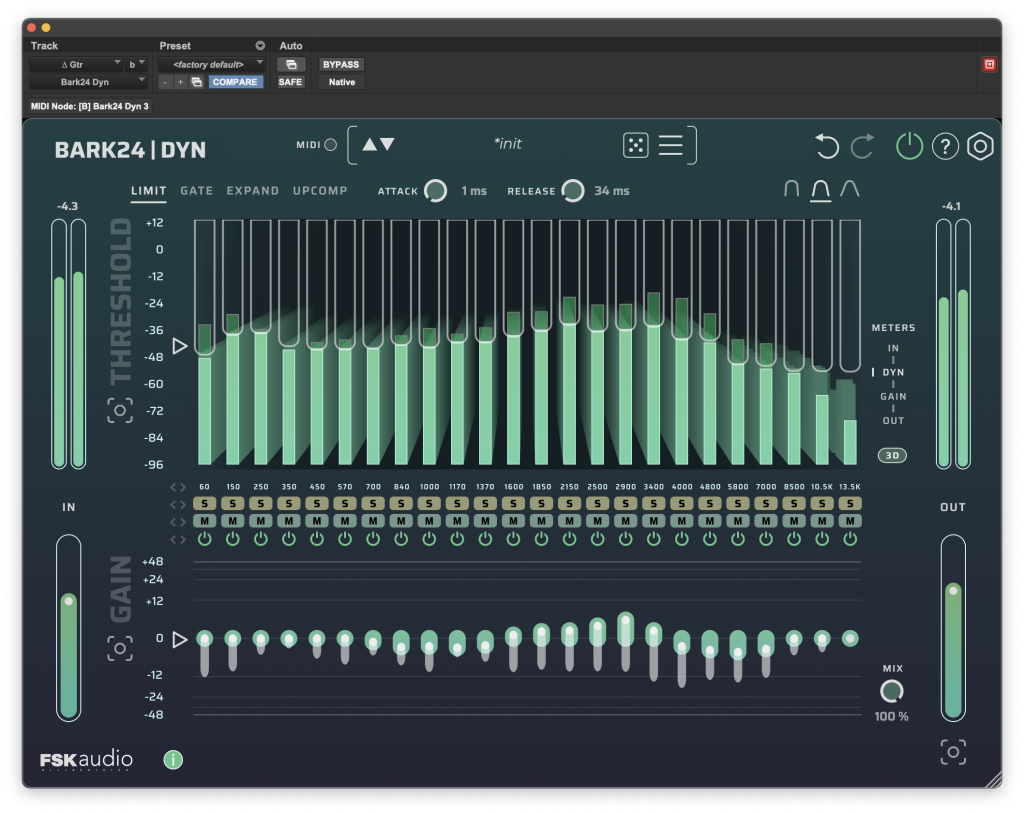
FSK Audio has released Bark24 | Dyn v1.1, an update that makes the complex processor faster to use in real sessions. The plug-in is built around a 24-band structure based on the Bark scale, which organizes frequency ranges according to how people actually perceive sound instead of using evenly spaced bands.
That central idea stays the same, but version 1.1 improves how quickly you can get results once the plug-in is on a track.
This update matters because Bark24 | Dyn already sits in a category that blends dynamic EQ, multiband compression, expansion, and gating into a single system. The challenge with tools like this usually comes down to speed. If it takes too long to dial in, it slows down the mix process. Version 1.1 addresses this directly with automation and grouped controls, reducing the amount of manual adjustment required across all 24 bands.
A perception-based approach to multiband dynamics
Bark24 | Dyn divides incoming audio into 24 perceptual bands, which allows each part of the frequency spectrum to respond independently. Instead of applying a single gain change to the full signal, the plug-in processes each band independently, giving more control over how different elements behave under compression or expansion.
This approach makes it easier to manage issues like harsh upper mids, uneven low-end energy, or masked details in dense mixes. Because the bands follow the Bark scale, adjustments line up more closely with how changes are actually heard, which helps reduce guesswork when shaping tone and dynamics.
The plug-in also includes linear-phase filters with selectable slopes, per-band gain control up to ±48 dB, and detailed visual feedback across multiple metering modes. These features position it as a full-spectrum processor rather than a single-purpose tool.
Workflow updates that reduce manual work
Version 1.1 introduces several changes aimed at speed and usability. Auto-threshold, gain, and output adaptation respond to incoming signal levels and processing intensity, which helps maintain consistent levels without constant manual compensation.
Group editing is another key addition. Users can adjust multiple bands at once, which is useful for shaping broader tonal areas rather than working band-by-band. Updated solo and mute workflows, along with drag-based control for shifting those states, make it easier to audition specific parts of the spectrum during a mix.
An output limiter has also been added, giving users a way to control peaks at the end of the processing chain without needing a separate plug-in.
At $99 during the intro period, Bark24 | Dyn v1.1 sits in a competitive range for a processor with this level of control. The feature set targets mixing engineers and sound designers who want detailed control over dynamics while keeping the workflow efficient.

Will Vance is a professional music producer who has been involved in the industry for the better part of a decade and has been the managing editor at Magnetic Magazine since mid-2022. In that time period, he has published thousands of articles on music production, industry think pieces and educational articles about the music industry. Over the last decade as a professional music producer, Will Vance has also ran multiple successful and highly respected record labels in the industry, including Where The Heart Is Records as well as having launched a new label with a focus on community through Magnetic Magazine. When not running these labels or producing his own music, Vance is likely writing for other top industry sites like Waves or the Hyperbits Masterclass or working on his upcoming book on mindfulness in music production. On the rare chance he's not thinking about music production, he's probably running a game of Dungeons and Dragons with his friends which he has been the dungeon master for for many years.