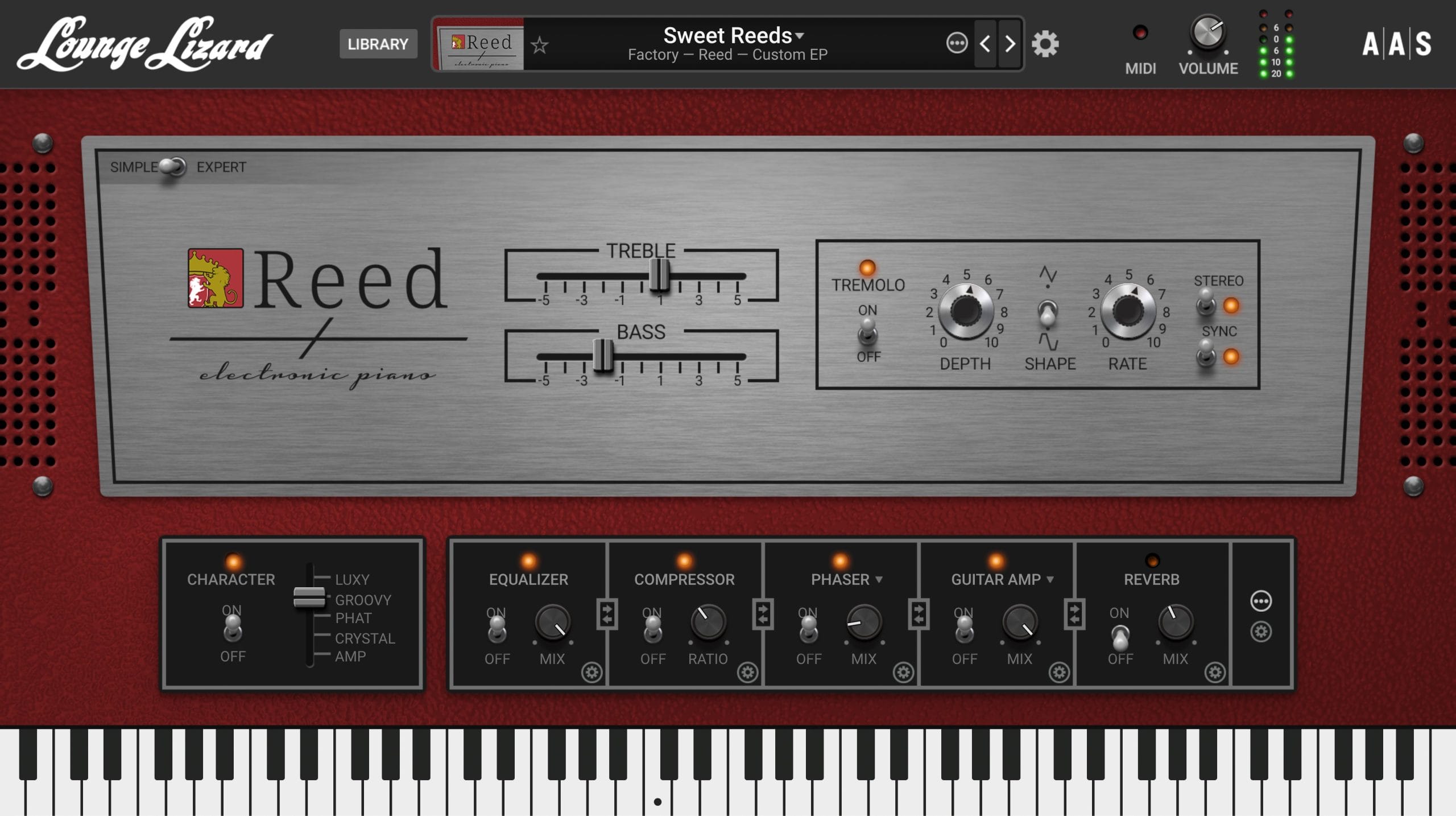
Load up Montreal-based plugin company Applied Acoustics Systems’ Lounge Lizard EP-5, and you’ll be shocked that you’re not playing a real electric piano.
With both reed and tine engines, true-to-life sound and warmth, and the ability to literally go under the hood and tinker with your sound, the fifth version of the Lounge Lizard is one-of-a-kind in its authenticity. It’s one of the most popular electric piano VSTs out there today’s and for good reason: it looks, sounds, and feels like a real one. Warm rhodes chords, jazzy piano solos, and even wild sound design are possible with this plugin.
When looking at this synth, you can tell that designing it was a meticulous labor of love, with every last thing accounted for. This begged the question: why do all of this for an electric piano? That is, what about the electric piano is so special to them that they had to pull out all the stops on this VST? And, what keeps making them come back and improve it even after 20 years on the market?
We sat down with the AAS team to learn more. Check out this quick intro video, and read on to learn just how they pulled this one off (hint: a lot of it is thanks to physical modeling).
First, why an electric piano? Out of all the instruments to emulate, why this one?
The idea of creating a synthesizer dedicated to the electric piano came about somewhat by chance. AAS’s very first product was Tassman, a modular software synthesizer based on physical modeling, whose first version was released in 2000. Our goal with Tassman was to provide a library of traditional analog modules as well as modules simulating acoustic objects such as strings, bars, plates, hammers, and so on.
One of our team members had the idea to create a patch simulating the mechanics of an electric piano, and it turned out to be one of the best in the library. That gave us the idea to create a dedicated synthesizer for the electric piano, inspired by this patch. By making it a standalone product, we could go much further in modeling this type of instrument and also design a dedicated interface.
We rented real instruments to take measurements, which we then used as the basis for our modeling work. Lounge Lizard EP-1 was released in January 2002.
What were some of the major improvements that went into V5?
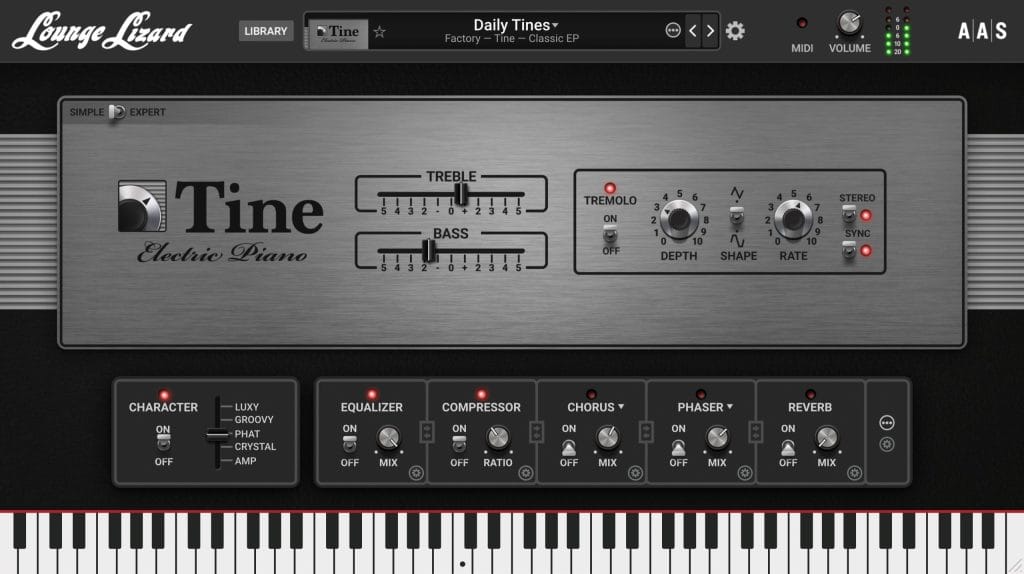
Lounge Lizard EP-5 is not just an incremental upgrade, it’s a complete rewrite of the synthesis engine. In previous versions, while we offered both tine and reed piano presets, the core model was primarily based on tine pianos, which could be adjusted to approximate reed-like tones.
With EP-5, we went much further in modeling the fork components of tine-based pianos and their interactions, resulting in richer behavior and more authentic tones. We also developed an entirely new model dedicated to reed-based pianos, enabling a truly faithful reproduction of this type of instrument.
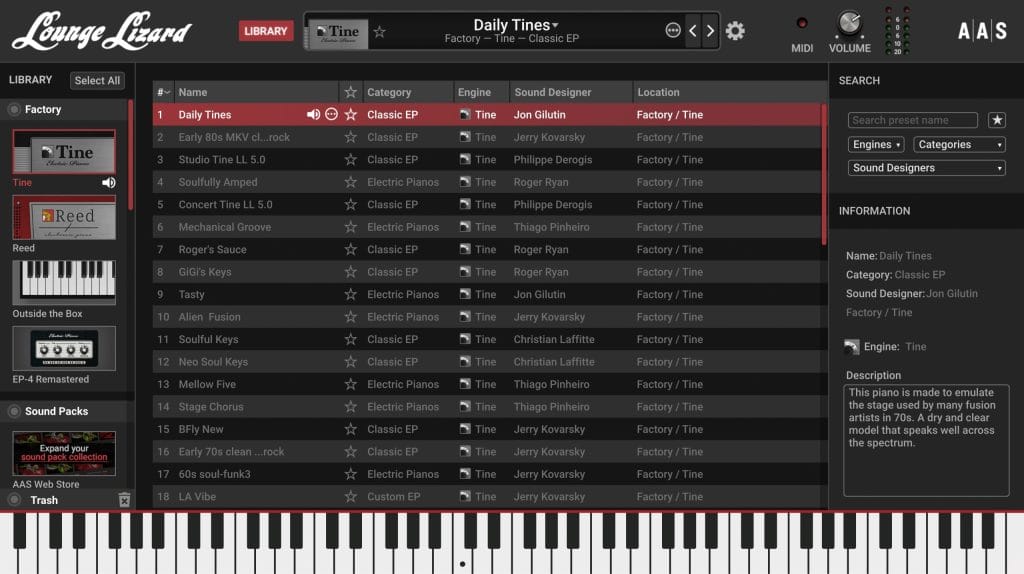
Each piano type now has its own dedicated interface to enhance the playing experience. Other notable improvements include a completely redesigned preset browser and a brand-new library of over 150 classic
and custom piano sounds, along with a remastered version of the Lounge Lizard EP-4 library.
Could you elaborate on the difference between the tine and reed engines?
The sound-producing mechanism of an electric piano is relatively simple. In tine-based pianos, pressing a key releases a damper and triggers a felt-tipped hammer that strikes a metal bar shaped like a tuning fork. The struck portion, called the tine, is made of stiff steel wire, while the other, parallel section is the tone bar. The tone bar acts as a resonator, adding sustain to the sound. Vibrations from the tine are captured by an electromagnetic pickup and sent to an amplifier—much like the process in an electric guitar.
In reed-based pianos, the mechanism is similar, but instead of striking a metal fork, the hammer hits a metal reed. These reeds are positioned close to pickup plates. Together, the reed and pickup plate form a variable capacitor, or electrostatic pickup system. When a reed vibrates after being struck, the distance between it and the pickup plate changes, which in turn changes the capacitance. This variation generates a small alternating current that is amplified and played through loudspeakers.
Both the unique vibrating elements and the distinct pickup systems have been modeled in our tine and reed engines allowing for the faithful reproduction of the tone and feel of these instruments.
How did you ensure that this plugin “felt” real?
That realism comes naturally from physical modeling. A physical model is like a black box that receives control signals (MIDI) and produces sound. When the control input changes, the model reacts based on its
current state, so the sound is always evolving in both tone and dynamics. This mirrors how real instruments behave and is why physical modeling can sound so natural and alive.
Sampling, by contrast, is more static—like a photograph. For example, if you strike a note and then strike the same note again, the sound will differ each time. The first strike hits a tine, reed, or string (in the case of an acoustic piano) at rest, while the second hits it already vibrating, subtly altering the tone. Our ears pick up on these
small differences, yet they are difficult to reproduce with samples.
Of course, this realism depends on the quality of the model itself, and each instrument requires its own approach because the underlying physics are different. Electric pianos are especially well-suited to physical modeling, and in Lounge Lizard, our engine benefits from over twenty years of refinement and improvement.
When looking at the inclusion of an effects chain, what kind of effects were you looking for, and how did you decide on what to include?
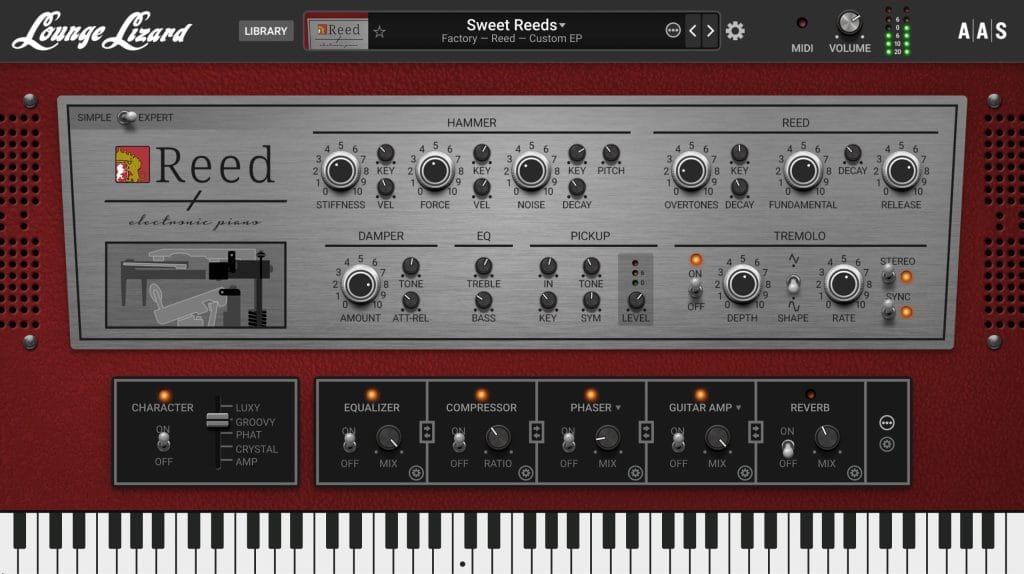
Many vintage electric pianos had built-in tremolo and EQ, so we made sure to include these directly on Lounge Lizard EP-5’s main interface.
As with all our products, Lounge Lizard also features a full multi-effect rack, offering a wide range of sound-shaping
possibilities. In designing the factory library, we showcased effects that have been historically paired with electric pianos, such as distortion, chorus, and wah-wah, to capture their classic character. We also added a guitar amplifier module, which was not present in previous versions of Lounge Lizard, making it an especially nice addition for crafting authentic and expressive tones.
What are some creative ways that you’ve seen producers using the Lounge Lizard – ways that maybe you didn’t expect when making it?
With physical modeling, the usual goal is to develop a model that reproduces an instrument as faithfully as possible. That’s what we did with Lounge Lizard. However, once the model is built, nothing prevents you from using parameter values that don’t correspond to any real-world instrument. That’s where physical modeling becomes really exciting from a creative perspective. Very quickly, the sound designers we worked with began pushing these boundaries, experimenting with extreme parameter values and unusual effect combinations. This led to some truly fascinating sounds—completely different from a traditional electric piano, yet still carrying the inherent quality of a musical instrument. Think bell-like tones, mysterious organs, tuned percussion, and more. This path proved so inspiring that we eventually created three dedicated expansion sound packs of otherworldly sounds for Lounge Lizard.
Lastly, what’s one thing about electric pianos that everyone should know?
One historical fact that I find interesting about electric pianos is that Harold Rhodes created his first pianos from scrapped airplane parts when he was in the Army Air Corps in the 1940s. These were originally used as therapy for recovering soldiers.
Another fact that I find amazing, given their immense musical influence, as well as high vintage prices and popularity, is that these iconic instruments almost disappeared in the 1980s before being rediscovered.
Purchase the Lounge Lizard EP-5 here.

Magnetic byline note: This byline is used for staff produced updates and short announcements, often based on press materials and official release information. Editorial responsibility: David Ireland (Editor in Chief) and Will Vance (Managing Editor). About: https://magneticmag.com/about/ Masthead: https://magneticmag.com/masthead/ Contact: https://magneticmag.com/contact/