Table of Contents
The first thing that caught my attention about The Viaim RecDot was right in the name, “AI Earbuds.” With this technology entering our lives faster than anything in recent history, this functionality piqued my interest, and I reached out to the PR team, so here we are.
The value proposition wasn’t so much the buds themselves but the software and app that accompany them. On their own, the RecDot’s are a great pair of earbuds that check all the boxes and sound quite good with the Japanese HiRes Audio Society (Wireless) stamp of approval to boot, which is not easy to get.
So the sound is great, but you don’t buy buds like this for the sound alone, and for $250, most people will buy a brand they know, like Apple’s AirPod Pro 2s. So why drop your cash on an unknown brand?
Suppose you’ve ever fumbled through a voice memo after a meeting, or scrambled to transcribe an interview with half-decent accuracy. In that case, the Viaim RecDot AI earbuds may very well be your unicorn. These buds aren’t just about delivering decent sound—they’re about giving your ears and your calendar a boost of futuristic intelligence and efficiency.

Yes, you can get some of this functionality with a paid subscription to ChatGPT and a pair of normal buds with a good mic, but what’s going to make the Viaim RecDot stand out is the app functionality so you can get some great features on the go and there is no fee for the app that I can find anyway.
Viaim is taking a specific approach with this set of buds, and they are solving a problem for busy professionals. While most wireless earbuds are locked in a specs arms race—chasing better ANC, better bass, or shinier fidelity—the Viaim RecDot has created earbuds that are purpose-built for people who need to record meetings and transcribe them, not just how they sound. Imagine AirPods met Otter.ai, and their lovechild was good-looking, multilingual, and knew exactly who said what in your last conference call.

The Design
Let’s start with the physical form factor. At a glance, RecDot resembles your typical long-stemmed true wireless earbud, reminiscent of AirPods Pro 2, albeit with a slightly more substantial design. That added heft makes sense once you realize they’ve packed in dual mics, sensors for AI transcription, and enough memory and processing power to run on-board speech recognition. Unfortunately, the fit never was quite right for me with any of the tips, and this might be due to the extra weight. They stayed in fine when seated, but would not work well for a quick stroll down a busy subway platform or any type of workout.
Fit can be very subjective, so they might fit other people just fine, but I wanted to mention this as I’ve not had this issue with many buds before. With the various sizes, Small, Medium, and Large, you can most likely find something that suits you, as this is a standard sizing for most buds. I was able to get a decent seal, and the app provides a test to let you know as well, which is a nice feature.
If you’ve read any of my headphone reviews, you know I’m not a big fan of touch controls, as they often are wonky and misfire when you accidentally touch your headphones in the wrong place. However, the reality with buds is that there is no room for tactile controls on tiny inears, so that leaves touch controls. Oh well.
The stem Viaim RedDot sensor lets you swipe and tap to control volume, skip tracks, or engage voice assistants. These interactions can feel a little finicky, but they work ok enough, so not a huge deal breaker for most people.
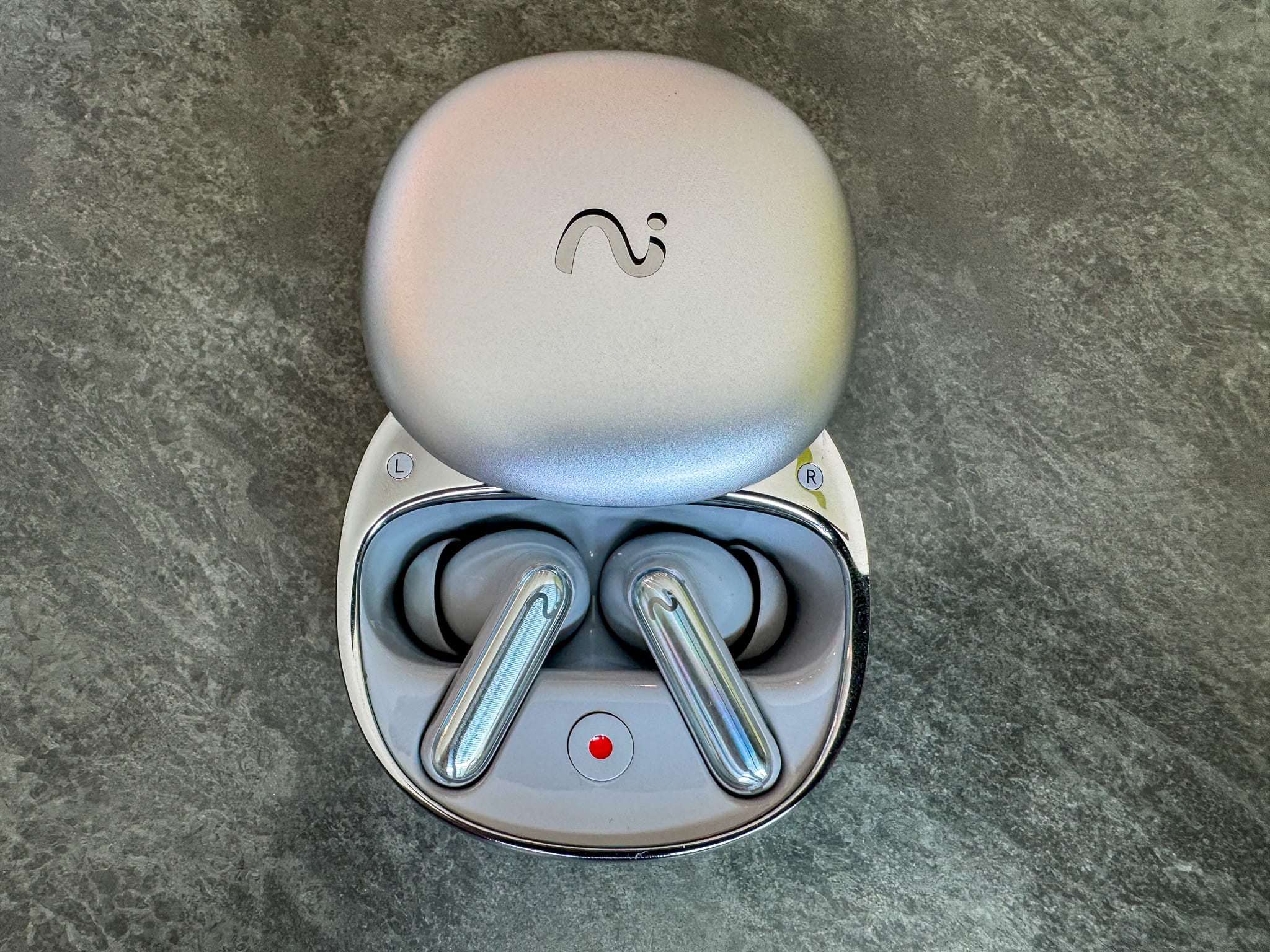
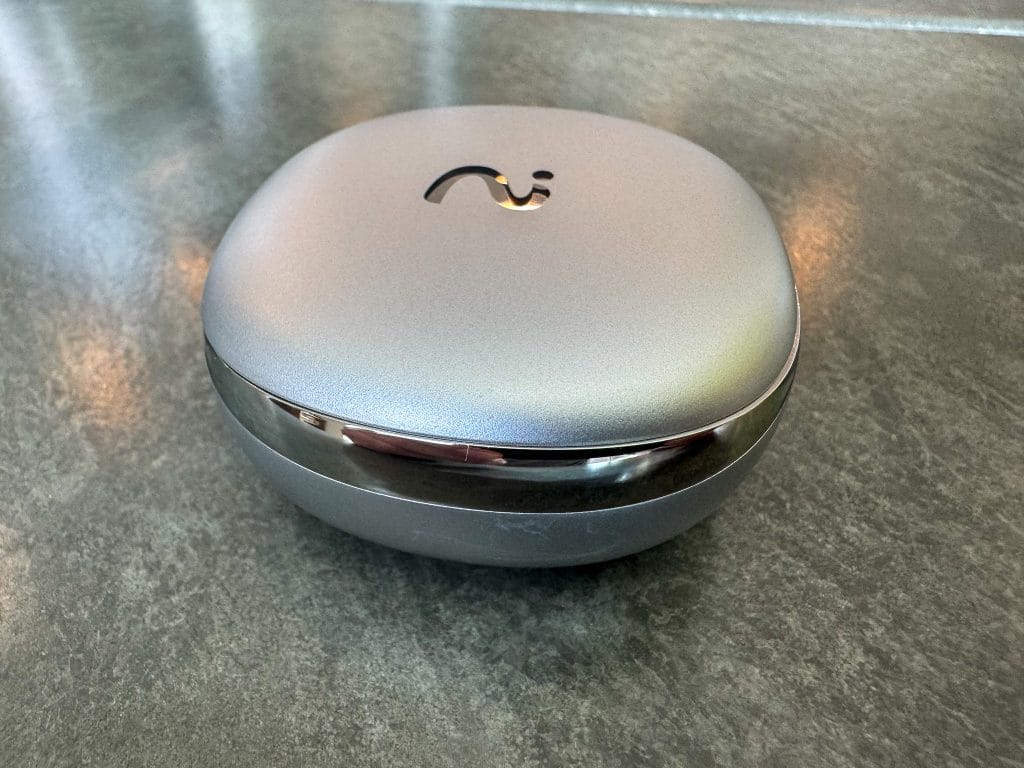
The charging case is clean and looks like a shiny little oyster from outer space. Simple, compact, and efficient. A satisfying magnetic click confirms when the buds are docked. USB-C charging is here, as expected, and Viaim squeezes out 9 hours on a single charge (36 hours total with the case).
Bonus: there’s a physical record button on the case, love that bit! Pop an earbud in, press the button, and you’re rolling—no app required. It’s subtle and practical for on-the-fly recording.
Sound Quality:
Let’s not pretend the RecDot is a rival to Campfire Audio or Focal. But for a set of earbuds where AI is the star, the audio is surprisingly tight. There’s real clarity here—vocal-forward mixes like Agnes Obel’s The Curse or the layered instrumentation of one of my favorite go tos, Miles Davis Kind of Blue, sounded quite good.
Bass has decent presence, mids are neutral enough not to fatigue you on long sessions, and highs don’t veer into shrill territory. Again, these bear the standard of the Japanese HiRes Audio Society (Wireless), which is very legit and not easy to achieve. The companion app offers EQ presets (such as Pop and Bass Boost), but most users will find the “Balanced” setting to be the most suitable across various genres.
The AI Functionality
This is where things get interesting, and this is why most people lean in on this unknown brand. The RecDot buds are equipped with AI transcription and translation tools that deliver. I ran them through a few meetings, casual calls, and even a podcast-style sit-down—and they kept up. It’s not perfect, but the transcriptions were accurate enough to significantly speed up my productivity after the meeting.
Real-time transcription works across three scenarios: system calls, live face-to-face chats, and audio/video playback. The transcripts are organized, searchable, and speaker-separated. Viaim even tosses in post-meeting to-do lists and summaries. And yes—it’s shockingly good at figuring out who’s responsible for what.
Translation? Oh yes, an impressive 14 languages are supported. Meeting assistant that extracts action items? Yup. It’s like having a note-taking assistant in your ears, allowing you to focus on what’s being said, rather than scribbling down notes and bobbing in and out of the conversation.
There are some limitations. If you or someone else pauses too long, the AI inserts a period and treats it as a new sentence. It’s not a dealbreaker, just something to keep in mind if you speak with a jazz-like sense of timing. It’s essential to remember to speak clearly, enunciate, and maintain a consistent cadence for optimal results.
The actual audio recordings of the calls, however, were not great, and certainly not suitable for use in a podcast, etc. So what you are paying for is the transcription functions that can speed up your life on the go.
Pros & Cons Of The Viaim RecDot
Pros
- Truly useful AI transcription & meeting assistant features
- Excellent speaker separation and clear transcriptions
- Sound quality that punches above its weight
- Smart case with physical record button
- 9 hours per charge + 36 hours with case
- 14-language translation support
Cons
- Truly useful AI transcription & meeting assistant features
- A bit bulky for workouts
- Premium price tag ($249.99)
Who Should Buy the Viaim RecDot?
Great for:
- Knowledge workers, journalists, content creators who need transcription, meeting notes, or interviews organized
- Remote teams or bilingual collaborators
- Music lovers who want solid audio with next-level productivity features
Keep on shopping:
Audiophile purists — you’re still better off with a wired setup
Workout junkies — look elsewhere for better fit and sweat resistance
Learn More at Viaim’s Website

David Ireland is a professional strategist, creative, and marketer. He began his career in 1995 as creator and publisher of BPM Magazine. In August 2000, BPM Magazine merged with djmixed.com LLC, an online media company based in Los Angeles, which later evolved into the Overamerica Media Group [OMG] in 2003. In 2009, Ireland left Overamerica Media Group to serve as the VP of Marketing at Diesel. In 2011, he returned to his roots in media and cofounded the online electronic music publication Magnetic Magazine and created The Magnetic Agency Group. In June 2018, Ireland joined Winter Music Conference (now owned by Ultra Music Festival) as the Director to lead the reboot for 2019 and usher in a new era for the iconic brand. He served as Chief Marketing Officer at Victrola for three years, guiding product innovation and brand growth. He currently serves on the advisory board of Audiopool, a new music tech startup focused on AI-generated music licensing and artist revenue models.