Table of Contents
Image Credit: Tears For Fears And Phonogram, Mercury and Vertigo Records. Used For Creative Commentary And Educational Purposes
There’s a certain kind of song that keeps coming back around—not because it’s tied to one specific era, but because it keeps making sense in new ones. Everybody Wants to Rule the World has that kind of staying power. It’s the track people remember from the first minute of hearing it, even if they can’t quite say why. And even though it came out in 1985, with all the soft-synth shimmer and radio polish you’d expect from that decade, it somehow manages to cut deeper than its surface lets on.
I think that’s part of what makes it worth revisiting—especially now, when power still feels like the most unstable currency there is. Tears for Fears once said this song at the tail end of the Songs from the Big Chair sessions.
It came together quickly—too quickly, according to them. Roland Orzabal once joked that it was written in less than two weeks because they were tired, ready to go home, and didn’t take it too seriously. But that looseness is part of the magic.
Everybody Wants to Rule the World, at a glance
- It was written quickly, almost offhandedly, near the end of Songs from the Big Chair, but ended up defining the band.
- The title was changed from Everybody Wants to Go to War—which tells you everything you need to know about the tone they were trying to strike.
- The chorus sounds soft, but the song quietly confronts the cost of control, and how easily people trade comfort for authority.
The band was only in their mid-twenties at the time. They were writing songs about personal disintegration on one side and global anxiety on the other, and somehow making it all sound like prime-time radio. This track ended up being their biggest hit—topping charts across eight countries, going platinum a dozen times, and even soundtracking a few political misunderstandings along the way.
American politicians have tried to claim it as an anthem, completely missing the sarcasm threaded through the verses. “Say that you’ll never, never, never, never need it”—Curt Smith once said that line was the real core of the song. It’s not a celebration of power. It’s a quiet shrug at what people are willing to give up to chase it.
This lyric analysis is just me pulling from my background in creative writing and literature to look at the song a little more like a piece of poetry. I’ve spent years reading fiction and studying classic texts, and when I hear this track, I hear something timeless under the surface. These are just my takeaways—not the final word—but I think it’s worth asking what we can learn when we treat a pop song like a piece of writing.
And honestly, it’s also a great excuse to stretch a few literary comparisons and see where they land.
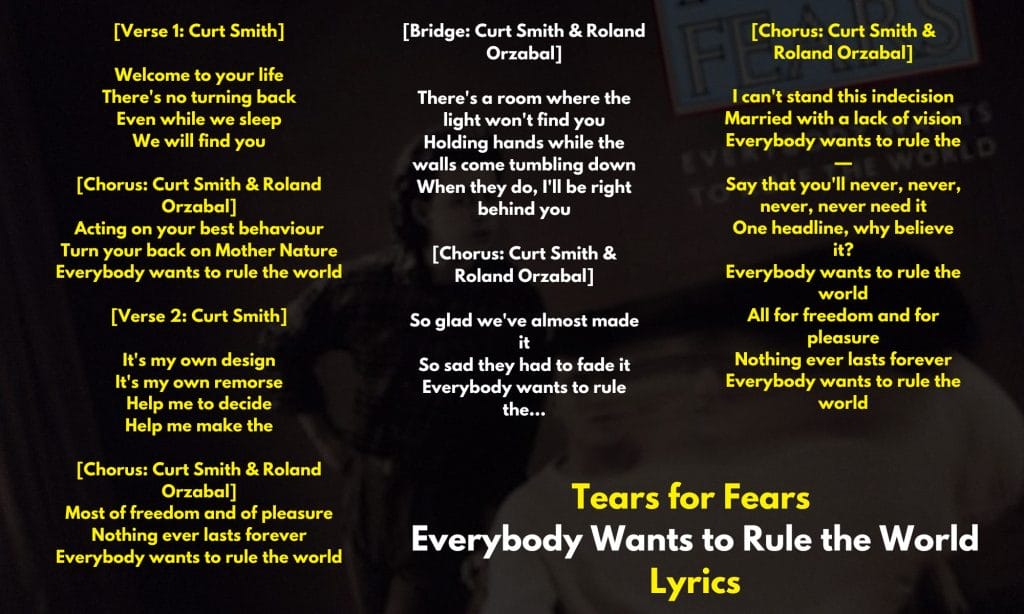
Everybody Wants to Rule the World Lyrics
Let’s Unpack The Song’s Meaning…
Welcome to your life / There’s no turning back
When those lines arrive, they feel like a door closing behind you. I believe the artist was pointing out that once you walk into this world—once you take those steps—there is no rewind. Curt Smith described the band as presenting therapy sessions wrapped in pop melodies. That tells me they invite listeners into a space that feels personal, even when the lyrics carry global ideas.
In an interview which has since escaped me or else I would link it (sorry! I’ll update the article with the link if I can find it), Roland Orzabal explained that the band found their voice by blending the political with the personal. That comes through in this line. It sounds universal, but it lands with personal weight. Once you’re in your life, you keep moving forward. You do not get to step back or undo what brought you here.
This opening line sets the tone for the rest of the song. You’re being told you are already in motion. The path is laid. And the tension that follows—the need to control, the fear of collapse—begins here.
Even while we sleep / We will find you
This line feels watchful. It puts power in the room, even when you try to rest. That’s what makes it so effective. It suggests a force that does not turn off. Even sleep is not protected. Curt Smith has been known to say that the themes behind the song included power, war, and misery. This lyric is one of the places where you can hear that seriousness come through clearly.
To me, this is a quiet picture of control. There is no loud demand. Just presence. Just pressure. That’s what gives the lyric weight. It’s not dramatic. It’s steady.
Auden writes in The Shield of Achilles, “A plain without a feature, bare and brown, / No blade of grass, no sign of neighborhood.” That same mood shows up here. A space watched over but not cared for. It exists to be managed. These lyrics make clear that authority, once set in motion, reaches into every space—including the ones you think are yours.
Acting on your best behaviour / Turn your back on Mother Nature
This lyric brings things closer to the personal. It highlights how control shapes your habits. You start trying to be the version of yourself that fits. And over time, you start stepping away from what feels real. The band has said they used psychology in their songwriting. You can hear that here—how the need to conform quietly reshapes your sense of self.
The line about Mother Nature hits hard. It’s not just about the environment. It is pointing to instincts. To internal truths. And to what gets lost when survival asks you to be polite rather than honest.
Auden’s poem paints a similar picture. He writes of “an artificial wilderness / And a sky like lead.” That image of man-made emptiness supports the idea in this line—that systems ask you to fake peace while stripping away connection. The song is showing that when we perform safety, we lose the part of us that can actually feel it.
Everybody wants to rule the world
This is the core line. It repeats like a quiet fact. No cheering, no blame. Just recognition. That’s part of what makes it effective. The line does not need to raise its voice to be true. Roland Orzabal shared that the original idea had been to write about going to war, but that they shifted the title to “rule the world” to make the emotion clearer. I believe that shift changed everything. It made the song less direct, but more revealing.
It’s not limited to countries or governments. People want control—in jobs, relationships, homes. That line captures the scale of it. And because it comes back again and again, it starts to feel inescapable. Not as a threat, but as a condition.
Adrienne Rich captures that cost in her poem Power. She writes, “She died a famous woman denying / her wounds came from the same source as her power.” That idea—that ambition brings harm we refuse to name—sits directly in the center of this chorus. The want to rule carries a cost, even if we keep trying anyway.
It’s my own design / It’s my own remorse
Here, the voice shifts. It moves from “everybody” to “my own.” That change matters. The speaker is not talking about the world anymore. They are talking about what they built. And they’re not proud. They’re tired. That honesty cuts through. The lyric owns the decision. It says: I built this path. And now I live with what came from it.
The band has mentioned that some of their writing came from processing grief and personal change. That makes this section feel lived-in. It is not a theory. It is something someone felt firsthand. That gives the lyric shape.
Rich’s poem works here again. The idea that the very thing that gives you strength can also bring you harm shows up in both works. This lyric reflects the moment where you stop blaming and start facing your own part in the loss.
Help me make the most of freedom and of pleasure / Nothing ever lasts forever
Now the speaker is reaching out. They want help. They want to hold something good before it goes away. The awareness that time moves—that joy slips—that hits right after the remorse. There is a desire for change here, but it comes with no guarantee. And I think that makes the lyric sharper. The hope is small, but real.
This shift opens up space for softness. The line invites someone else into the moment. That matters. The song begins with pressure. This part opens into vulnerability. Wanting to enjoy something becomes a form of resistance against the parts of life that feel designed to wear you down.
Miłosz writes in A Song on the End of the World, “A bee circles a clover, / A fisherman mends a glimmering net.” That calm continues even as endings rise. The lyric reflects the same thought. Pleasure might vanish, but while it is here, you reach for it.
There’s a room where the light won’t find you / Holding hands while the walls come tumbling down
This moment opens a kind of shelter. Everything might collapse. But in that collapse, people still hold hands. That image carries weight. It shows that even if the system breaks, you can still choose connection. That does not reverse anything. But it matters anyway.
The band spoke often about balancing the personal and political. You can hear that balance in this line. The larger world is unstable. But in the middle of that, people are still human. They still care. That’s not resistance in the way of protest. That’s resistance in the way of staying close.
Miłosz returns here. He shows how normal life continues during deep crisis. His poem reminds us that not all power is loud. Some of it is quiet. Some of it is the choice to stay with someone else when the lights go out.
So glad we’ve almost made it / So sad they had to fade it
There is tension in this pair of lines. The speaker nearly reaches something—maybe peace, maybe freedom—and then it fades. That sadness does not come from confusion. It comes from understanding. The speaker knows what they lost. And they know someone else pulled it away.
The band’s own history with pressure and control adds context here. They talked about how success made things harder, not easier. I hear that reflected in this lyric. Making it to the edge and not getting to cross feels familiar.
Auden’s poem describes a place where the people “who never were and never will be” stand waiting. That kind of emptiness shows up here too. The speaker got close to something real. But someone or something took it away before it could last.
I can’t stand this indecision / Married with a lack of vision
This final moment returns to frustration. The speaker is no longer hopeful. They see clearly now: there are no plans. No leadership. No direction. And that realization ends the song in a place of deep clarity, but no resolution.
The band spoke openly about how creative choices were shaped by external pressure. That feeling of being stuck between what you want to make and what you’re told to make shows up here. The system does not guide. It delays. It avoids.
This lyric closes the arc. It begins with a person stepping into the world. It ends with that person seeing that the world they stepped into has no clear way forward. What remains is awareness. The speaker may not know the solution. But they are wide awake to the problem.
My Biggest Takeaways
I keep coming back to the idea that Everybody Wants to Rule the World doesn’t try to convince you of anything. It just kind of presents what’s already there. It’s one of those songs that’s easy to hear passively—driving, shopping, standing in line—but if you listen closely, it’s saying something pretty bleak, and saying it without raising its voice. You’ve got lyrics like “There’s no turning back” and “Acting on your best behaviour” landing with this clean, polished sound, but the world they describe is already in motion, already decided.
The final version might sound more universal or radio-friendly, but the feeling underneath is still about conflict—just not always the kind with weapons.
That tension—between the calm delivery and the pressure underneath—makes me think of Miłosz’s A Song on the End of the World. That poem builds a scene where everything seems normal: bees flying, shops open, no panic in the air. But the world is ending anyway.
That’s the exact feeling I get from the verses in this track. You’ve got this soft, steady groove, and over it the lyrics are quietly describing systems falling apart—people giving up their instincts, watching things crumble in slow motion. And the band wasn’t imagining some abstract future. They were in the middle of Cold War uncertainty, getting booked on tours they didn’t ask for, being pushed to play Live Aid during their only week off. They were exhausted. That kind of pressure seeps into the writing. It’s not staged—it’s lived-in.
When the song hits lines like “It’s my own design / It’s my own remorse,” it slips into something more personal. That’s where Adrienne Rich’s Power starts to echo through. Rich writes about Marie Curie ignoring the damage that came with her work—literally dying from the very thing that made her a legend. That same idea shows up here: the moment where someone admits they built the thing that’s now breaking them.
And when Auden writes about “an artificial wilderness” and “a sky like lead” in The Shield of Achilles, he’s describing a kind of moral emptiness created by systems that were supposed to protect us. That’s the same landscape you hear in this song—one where freedom feels hollow, pleasure fades fast, and ambition quietly strips everything human out of the frame. The chorus sounds clean, but it’s pointing at something messy.
And the more I sit with it, the more it feels like they were saying, you already live here—you might as well know what it costs.

Will Vance is a professional music producer who has been involved in the industry for the better part of a decade and has been the managing editor at Magnetic Magazine since mid-2022. In that time period, he has published thousands of articles on music production, industry think pieces and educational articles about the music industry. Over the last decade as a professional music producer, Will Vance has also ran multiple successful and highly respected record labels in the industry, including Where The Heart Is Records as well as having launched a new label with a focus on community through Magnetic Magazine. When not running these labels or producing his own music, Vance is likely writing for other top industry sites like Waves or the Hyperbits Masterclass or working on his upcoming book on mindfulness in music production. On the rare chance he's not thinking about music production, he's probably running a game of Dungeons and Dragons with his friends which he has been the dungeon master for for many years.