
Table of Contents
Image Cred: Rca Records/Lloud Co
LISA’s “Moonlit Floor (Kiss Me)” is more than just a dreamy, danceable track—it’s a story of romance, intimacy, and cultural fascination, all set against the iconic magic of Paris. With its evocative lyrics about twilight kisses and irresistible French accents, this song blends modern pop sensibility with timeless themes of love and desire. The melody itself borrows from Sixpence None the Richer’s 1997 classic, “Kiss Me,” but LISA transforms it into something uniquely her own, layering in emotional depth and sensory imagery that feel fresh and personal.
In this article, I’ll use my background in English literature and creative writing to explore the deeper meanings behind LISA’s lyrics. These are my own interpretations, but I’ll also connect the song to poetry and classic literature to show how themes like cultural romanticism and fleeting love have been explored across time.
Poets like Paul Éluard, Sara Teasdale, and Arthur Symons have written about love and connection in ways that echo LISA’s storytelling. By weaving their works into this analysis, I hope to give you a more nuanced perspective on how “Moonlit Floor (Kiss Me)” fits into the broader tapestry of romantic art. Let’s unpack it together.
“Moonlit Floor (Kiss Me)” at a Glance
- Love in the details: This song is all about those small, electric moments—like a glance or a perfectly timed kiss—that make infatuation feel so intense and personal.
- Paris as a vibe: The Paris setting isn’t just a backdrop; it’s a whole mood. Twilight kisses and moonlit floors create a dreamlike space where romance feels bigger than life.
- Falling when you least expect it: The lyrics nail the feeling of being totally caught off guard by someone who completely disarms you—one French accent, and it’s game over.
LISA Moonlit Floor (Kiss Me) Lyrics
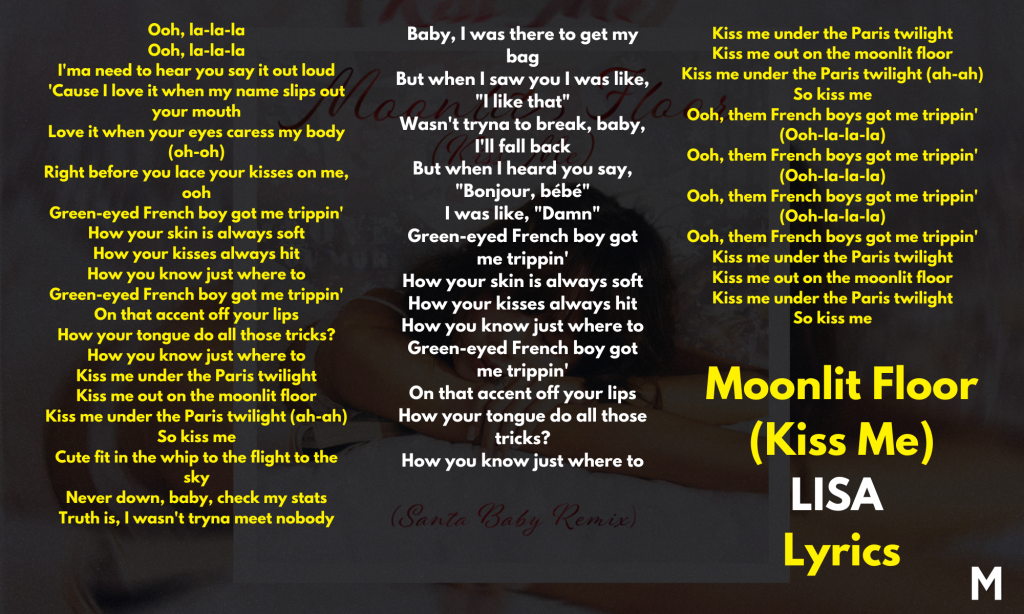
LISA Moonlit Floor (Kiss Me) Meaning
“Ooh, la-la-la / I’m gonna need to hear you say it out loud”
The song opens with these light, playful lines that instantly pull you into a mood of flirtation and excitement. The repetition of “Ooh, la-la-la” gives the song a carefree rhythm, like the speaker is caught up in a wave of romantic feelings. When they say, “I’m gonna need to hear you say it out loud,” it’s not just about words—it’s about wanting validation and connection. Hearing their name spoken by someone they care about makes the experience feel real and meaningful.
This focus on how words can build intimacy reminds me of Paul Éluard’s poetry, especially in “Capitale de la Douleur.“ In one poem, he writes, “Your voice, in which my soul rests, becomes my world.” The way Éluard elevates a voice to something almost sacred matches what the song is doing here. Both works show how love isn’t just about physical moments—it’s about what’s said, how it’s said, and the emotion behind it.
When the speaker says, “‘Cause I love it when my name slips out your mouth,” it feels deeply personal. There’s a vulnerability in admitting that hearing their name from their lover gives them joy. This echoes Éluard’s idea that even the smallest gestures in love—like speaking someone’s name—can hold great power.
“Love it when your eyes caress my body”
This line uses powerful imagery to describe a moment of connection. Eyes don’t literally touch, but the way the speaker describes it makes it feel like their lover’s gaze is as intimate as a physical caress. This kind of imagery focuses on how attraction isn’t just about touch—it’s about the way someone looks at you and makes you feel seen.
In Sara Teasdale’s poem “Paris in Spring,” she writes, “The streets are filled with beauty; the air is sweet with love.” Teasdale connects a setting with emotion, much like how the song connects a glance to physical intimacy. Both works show how sensory experiences—like a gaze or a beautiful street—can heighten the feeling of love.
The lyrics go further, though, with, “Right before you lace your kisses on me.” The word “lace” suggests something gentle and deliberate, showing that these moments are full of care. Together, these lyrics paint love as something that exists in looks, touches, and thoughtful gestures, much like Teasdale’s romantic view of Paris.
“Green-eyed French boy got me trippin’”
Here, the speaker brings us right into the heart of their infatuation. The repetition of “trippin’” shows how overwhelming their feelings are. The details about “soft skin” and “kisses always hit” focus on the physical side of attraction, but there’s more to it. By naming the boy’s green eyes, the speaker highlights a specific feature, making the romance feel unique and personal.
Paul Éluard often focused on specific physical details in his love poems to make them vivid. In one, he writes, “Your eyes hold a thousand tomorrows.” Like Éluard, the song ties physical beauty to something deeper—admiration and longing. It’s not just about how the French boy looks but how he makes the speaker feel.
The mention of the French accent—“On that accent off your lips”—adds a layer of cultural fascination. The speaker is drawn to more than just the boy’s appearance; they’re also captivated by what makes him different. This reminds me of Teasdale’s Paris poems, where the city’s unique charm amplifies love. Just like Paris, the French boy’s accent makes the romance feel special and out of the ordinary.
“Truth is, I wasn’t tryna meet nobody”
This line shifts the tone of the song, giving us a glimpse into the speaker’s original intentions. They weren’t looking for love; they were focused on their goals. But then, the unexpected happens. The line, “But when I heard you say, ‘Bonjour, bébé,’ / I was like, ‘Damn,’” captures that exact moment when everything changes.
Arthur Symons’ “Prologue to ‘The Symbolist Movement in Literature'” talks about these fleeting, life-altering moments. He writes, “A single word may unlock the soul, drawing it out of its dream.” Just like in the song, Symons shows how a small moment—hearing someone speak, seeing a gesture—can open up a flood of emotions.
For me, this part of the song is all about spontaneity. The speaker wasn’t expecting to fall for anyone, but love doesn’t wait for plans or permission. This kind of surprise makes the feelings even more intense, like they’re caught up in something bigger than themselves.
“Kiss me under the Paris twilight”
This is where the song leans into fantasy, using Paris as a symbol for love and magic. The image of twilight adds a dreamy quality, suggesting that this romance exists outside of ordinary life. The repetition of “kiss me” feels almost like a plea, as if the speaker wants to hold onto this moment forever.
Sara Teasdale captures a similar feeling in “Paris in Spring,” where she describes the city as a place that makes love feel more alive. Her line, “In Paris, spring unfolds like a lover’s arms,” shows how a place can amplify emotions. Like in the song, the setting of Paris becomes a part of the romance itself.
The repeated imagery of kissing emphasizes how the speaker wants to stay present in this perfect moment. The lyrics remind us that love can make even something as simple as a kiss feel monumental, just like how Teasdale and Symons use small details to symbolize big emotions.
“Ooh, them French boys got me trippin’”
As the song closes, the refrain brings everything full circle. The repetition of “trippin’” reflects how love can feel disorienting and all-consuming. It’s clear the speaker is swept up in their emotions, fully embracing the magic of the connection.
Paul Éluard’s line, “Love is the dawn of all things,” feels fitting here. Both the song and the poem highlight how love can make everything feel new and exciting. The French boy isn’t just a romantic partner—he’s a symbol of possibility and wonder.
By ending with the repeated call to “kiss me under the Paris twilight,” the song leaves us with a feeling of longing and beauty. It’s about cherishing those moments that feel perfect, even if they’re fleeting. For me, this is what makes the song so powerful—it reminds us to live fully in the present, especially when love takes us by surprise.
Main Throughlines For Me
“Moonlit Floor (Kiss Me)” captures the kind of romance that sneaks up on you and completely changes the way you see the world. LISA leans into small, intimate details—how a gaze feels like a touch or the way an accent can linger in your mind—showing how love lives in these moments. Lines like, “Love it when your eyes caress my body,” remind me of Paul Éluard’s idea that love transforms everyday gestures into something extraordinary.
In “Capitale de la Douleur,” Éluard writes, “Your eyes, in which I travel, have given me the world.” That same sentiment runs through LISA’s lyrics—she’s talking about a love that’s as physical as it is emotional, where a glance says everything.
The setting of Paris adds another layer to this. It’s not just a location—it’s the heartbeat of the story. Paris is tied to ideas of romance and magic, and LISA uses that to amplify the mood. When she sings, “Kiss me under the Paris twilight,” she’s not just describing a place; she’s pulling us into a dream where love feels endless. Sara Teasdale captures this same feeling in “Paris in Spring,” describing the Seine as “flowing like a song.”
Both Teasdale and LISA use Paris to show how love can feel bigger than life, as if the city itself is part of the connection. Even the emphasis on the lover’s French accent ties into this—LISA isn’t just falling for the person; she’s falling for the whole atmosphere, the way everything about this moment feels perfectly Parisian.
What makes the song stick, though, is how it captures the unexpected nature of it all. The speaker admits, “Truth is, I wasn’t tryna meet nobody,” showing how they weren’t looking for love—it just happened. That surprise makes the feelings hit even harder, as if the romance is a rare and fleeting gift. Arthur Symons wrote about moments like this in “Prologue to ‘The Symbolist Movement in Literature,’” describing how beauty can freeze time, making everything else fade away. LISA’s imagery of twilight kisses and moonlit floors taps into this same idea.
She’s showing us a love that feels perfect, but also temporary—something you hold onto for as long as you can, knowing it won’t last forever. That’s what gives the song its emotional weight: it’s about savoring the magic of a connection, even if it’s just for a moment.

Will Vance is a professional music producer who has been involved in the industry for the better part of a decade and has been the managing editor at Magnetic Magazine since mid-2022. In that time period, he has published thousands of articles on music production, industry think pieces and educational articles about the music industry. Over the last decade as a professional music producer, Will Vance has also ran multiple successful and highly respected record labels in the industry, including Where The Heart Is Records as well as having launched a new label with a focus on community through Magnetic Magazine. When not running these labels or producing his own music, Vance is likely writing for other top industry sites like Waves or the Hyperbits Masterclass or working on his upcoming book on mindfulness in music production. On the rare chance he's not thinking about music production, he's probably running a game of Dungeons and Dragons with his friends which he has been the dungeon master for for many years.









![How It Was Made: Lang Father i(Junkyard Dog) [Welofi]](https://magneticmag.com/wp-content/uploads/2026/10/Press-Pic_2-1024x576.jpg)