Table of Contents
To stay at the top of their game, DJs must ride the waves of current DJ technology. This industry is constantly undergoing rapid evolution, and it’s easy to get left in the dust.
With technology undergoing incredible change in recent times, music and DJing tech is an area that is seeing a large amount of growth. From cloud DJing to VR integration, countless new pieces of technology are available to DJs today, designed to make their lives easier.
This review highlights recent and upcoming DJ technology trends that deserve serious attention.
Overview: Key Themes in DJ Technology Trends

- Affordability and accessibility – DJ gear is cheaper and easier to use than ever in history.
- Artificial Intelligence – From track discovery and mix production to self-promotion, AI is transforming the nature of DJing.
- Cloud DJing – Integrated streaming services are more viable, giving DJs spontaneous access to huge libraries – whether experimenting, planning, or performing.
- Hybrid Workflow – DJs can amplify their productivity and output by leveraging both ‘live’ and ‘studio’ software.
- Promo Powers – Say goodbye to your agent and take advantage of a wealth of tools for self-promotion.
- Standalone Controllers – Many high-quality all-in-one controllers are coming to market, mobilizing DJs.
- Gesture Control – Cutting-edge technologies like VR, AR, and computer vision are opening new dimensions of expression and control.
6 Top Trends in DJ Technology for 2024
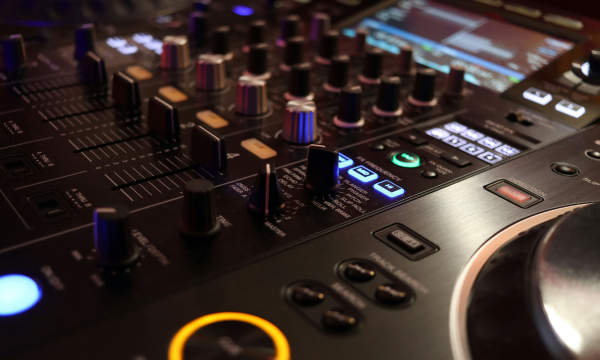
The DJing industry is undergoing vast developments in every corner of its existence. The following trends are set to have the highest impact going forward and cover some of the most exciting areas of emerging DJ tech.
1) Sync or Swim: Artificial Intelligence for DJs
No discussion of modern technology would be complete without talking about artificial intelligence (AI). Arguably the zeitgeist of today, AI is widely regarded as the defining force for the next era of humanity and technology – and it’s certainly going to have repercussions on the DJ industry.
AI will impact many areas of DJ technology and opens several doors to new concepts, tools, and techniques.
One recent example of AI being used in DJing is DJ.Studio, which helps to suggest harmonic mixes, create auto-transitions, and rapidly generate new mix ideas on their powerful editing timeline.
Stem separation technology is another AI-dependent tool, which is becoming even cleaner and more accurate. This helps DJs to be craftier and more expressive with their mixing, enabling them to create more unique live remixes and mashups on the fly. Soon the technology will be powerful enough to precisely split out stems, with minimal bleed-through and imperfections.
In terms of music discovery, AI algorithms are becoming more powerful at collecting DJs’ listening data and delivering personalized track suggestions. This can help DJs find new music quicker, but they need to be cautious that they are still delivering unique sets, and aren’t becoming ‘standardized’ by tracks that top the algorithms.

2) Cloud DJing – Streaming Integration
If you’ve ever played a vinyl show you’ll know how much of a pain it is to transport a crate of records around all night. While USB DJing solved this weight issue, it was hardly the final form of DJ’s library technology.
Cloud DJing is rapidly becoming a more viable solution for DJs managing and transporting their ‘records’.
Integrated streaming libraries like Beatport Streaming, Beatource, Soundcloud Go+, and Tidal are being implemented in more DJ apps every day. Even traditional ‘non-dj’ platforms like Spotify and YouTube are now available to mix with in some apps like DJ.Studio.
This streaming integration presents many advantages to DJs. Primarily, it gives them the ability to experiment with an endless range of music without needing to buy any tracks. In theory, this means that DJs will be able to curate better sets, by exposing themselves to a wider range of music and narrowing down their style.
Additionally, thanks to features like Beatport’s Offline Library and DJ.Studio’s Legalize feature, this integration isn’t restricted to requiring the internet all the time, making it a more viable option for club DJs.
3) ‘Hybrid’ Workflows – Pairing Studio and Live Software
If anyone here remembers old MixMeister from back in the day, they’ll be excited to experience a renewed return of the ‘hybrid workflow’.
This approach blends the use of ‘Studio’ and ‘Live’ mixing software, to give you the best of both worlds.
Live software is pretty straightforward, these are the types of apps that facilitate live mixing with controllers, like rekordbox, VirtualDJ, Serato, Traktor, etc.
Studio software may be unfamiliar to traditional DJs, but it’s a technology that is becoming more and more important in today’s DJing. Rather than focusing on a live approach, studio software is designed to craft mixes with a keyboard and mouse alone – perhaps at your studio desk, or even on the go – and it lends itself well to being paired with live software.
Taking inspiration from editing and production software like DAWs, studio software gives DJs a non-linear approach to crafting mixes. Rather than mixing with decks, DJs use an audio editing timeline to sculpt their mix, not in real time. This has several advantages compared to live mixing, most notably the ability to refine and perfect a mix over time, and giving users a ‘birds-eye-view’ of their mix.
DJ.Studio has bought studio DJ mixing back into the limelight and is becoming the latest exciting name on the street for pro and budding DJs.

Besides offering this timeline approach, DJ.Studio is packed full of other features and integrations that enhance a DJ’s workflow:
- Increased Efficiency – The AI automix assistant helps to rapidly generate playlist orders and ensure that your tracks are harmonically suitable. Additionally, the timeline editor and recording means you can rapidly create finished, sharable mixes.
- Streaming Integration – You can make mixes with tracks from Spotify, YouTube, and Beatport Streaming, giving you uninhibited experimentation with any track.
- Live Software Connections – DJ.Studio integrates seamlessly with all other mainstream DJ software like rekordbox, VirtualDJ, Traktor, Serato, and more. This enables you to draft the perfect mix in your studio, and then export the prepared set to your live software to drop in the club.
- Powerful Promotional Tool – The app is designed to turn you into a one-person promotional machine. Several features are highly attractive to DJs who like to maintain an online presence. For example, it has a built-in video creation engine, which creates audio-reactive videos (using trippy Shadertoy animations) that are perfect for uploading to YouTube. The speed, quality, and efficiency it can create mixes also unquestionably puts users at an advantage.
By integrating both Studio and Live techniques into their mix production process, DJs can enhance their workflow, in terms of speed, efficiency, experimentation, and creativity.
Using studio software to take care of some of the more laborious technical elements of DJing, DJs will be free to focus more on expression and artistry, prepare better live sets, and promote their work with ease.
4) Personal Promotion – The Changing Nature of Marketing and Publicity
On the topic of promotion, emerging technologies and platforms in this era make it easier than ever before for DJs to act as their own promotional agents.
DJs can easily use a wealth of tools and services to multiply their audience growth and publicity powers.
From concepts as simple as posting regularly on Instagram and TikTok, or leveraging AI like ChatGPT to help write promotional content and generate artwork, to creating advanced animated videos with DJ.Studio – DJs now have no excuse not to have a prolific online presence.
There is a lot of work involved with self-promotion, but DJs can use tools to help reduce the labor, in turn growing their reach more, and hopefully garnering more gigs and raising their profile.
5) All-In-One: The Rise of Standalone DJ Controllers
Looking at hardware technology, some clear trends are sure to continue into the following year.
One particularly notable trend is the rise of standalone DJ controllers, as we now see more self-contained DJing units come to market. Many of these are built with high physical quality rivaling ancestral industry setups, as well as coming with internal software offerings that are sometimes more powerful than predecessors.
These devices often focus on portability, offering features like built-in batteries and speakers, which may give rise to a more mobile form of DJing and clubbing. You’re no longer restricted to mixing at a power plug, and can now take your decks and enjoy a good mix wherever you want!
6) VR, AR, and Gesture/Motion Controls
With the recent release of the Apple Vision Pro, people are really starting to get a taste of what computing will look like in the coming decades.
Sure, virtual reality (VR) and augmented reality (AR) hardware still have a long way to go, but it’s starting to become clear what the road ahead may look like – and what this might mean for DJs and musicians.
While I doubt you’ll see many DJs with the uncomfortable Apple Ski Goggles™ strapped to their head mid-gig, DJs should start to become aware of the developing reality that some major breakthroughs will (and are) emerging in this corner.
It’s early days, but motion and gesture-controlled devices are an interesting new development for DJs. With software like DJay Pro AI’s Gesture Control feature enabling users to manipulate mix by waving their hands in front of a camera, DJs are starting to get a sense of how these devices might impact the art form.
These types of human-machine interaction are at a technological turning point, and it’s exciting to think about what tools are around the corner.
Stay Ahead of the Wave
Riding the wave of new DJ technology is essential to stay innovative and push the boundaries of DJing and musical performance.
By mastering modern tools and tech, DJs can keep their careers in motion and stay current. DJing is an incredibly competitive industry, so DJs need to make sure that they take advantage of any technology they can to stay out of the stone age.
This age presents the most affordable and accessible entry into DJing, as well as the highest ceiling in terms of performance, expression, and creativity.
If you want to start modernizing your DJ workflow today, I recommend that you get started by trying out the hybrid live-studio approach offered by DJ.Studio – try it here.

Will Vance is a professional music producer who has been involved in the industry for the better part of a decade and has been the managing editor at Magnetic Magazine since mid-2022. In that time period, he has published thousands of articles on music production, industry think pieces and educational articles about the music industry. Over the last decade as a professional music producer, Will Vance has also ran multiple successful and highly respected record labels in the industry, including Where The Heart Is Records as well as having launched a new label with a focus on community through Magnetic Magazine. When not running these labels or producing his own music, Vance is likely writing for other top industry sites like Waves or the Hyperbits Masterclass or working on his upcoming book on mindfulness in music production. On the rare chance he's not thinking about music production, he's probably running a game of Dungeons and Dragons with his friends which he has been the dungeon master for for many years.