After playing the intro of [I] Doesn’t Exist at Pax West 2023, I was dead set on getting my hands on it to finish the experience I started. I just kept thinking about it after I put it down. Now that I’ve finished the game [I] have some thoughts. Let’s get started
Gameplay:
After returning from PAX West, I was chatting with a friend about the experience and about [I] Doesn’t Exist. He’s existed for a little longer than I have, and he told me I should spend some time getting to know the genre of text-based adventures before I get back into [I] Doesn’t Exist. He directed me to Zork. I ended up putting several hours into it and not only did I love it, but it gave me context for what LUAL Games KIG, the two-woman indie studio, was going for when developing [I] Doesn’t Exist. It’s a (spooky) love letter to the genre.
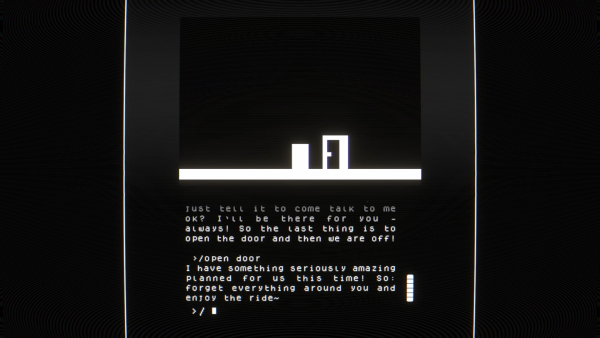
[I] Doesn’t Exist is, on its surface, a text-based adventure/puzzle-solving game. You are given a description of your environment and your text prompts dictate movement and actions. If you want to go left, you type left. If you want to open a door, you type “open door”. This is a concept that will be very familiar to any text-based adventure veterans. However, I’m new to the text-based adventure genre, so it was a new concept that I found very immersive. After about 30 minutes of text input, it began to feel like it was my own thoughts controlling the actions in the game. You can easily forget you’re typing and it feels like the game can just read your subvocalized thoughts. It’s eerie to say the least. Especially given the dark existential themes explored in the game.
While [I] Doesn’t Exist is a text-based adventure with a vintage feel, LUAL Games KIG managed to modernize it by implementing “Natural Language Processing” technology which allows the player to engage with the game in a much more natural and conversational way than the text adventures of old. You can essentially have a conversation with characters. I reached out to Dead XP, the publisher, for clarification on this technology and they told me that:
[We] Value the authenticity of human-made narratives and […] the game is not affiliated with ChatGPT or similar AI platforms. It uses only the player’s input to access pre-written responses by the game’s super-cool writers.
While the conversational aspects of the game are clearly limited and not perfect, the fact that they chose not to implement AI makes it even more impressive.
Graphics:
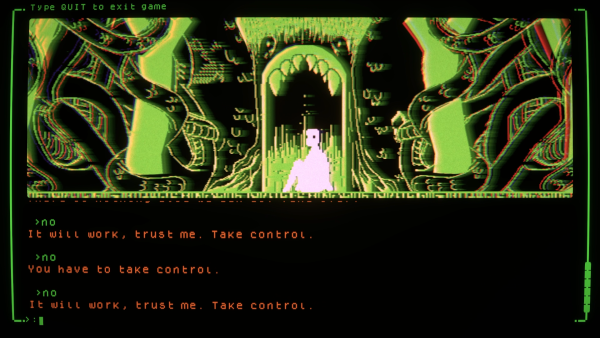
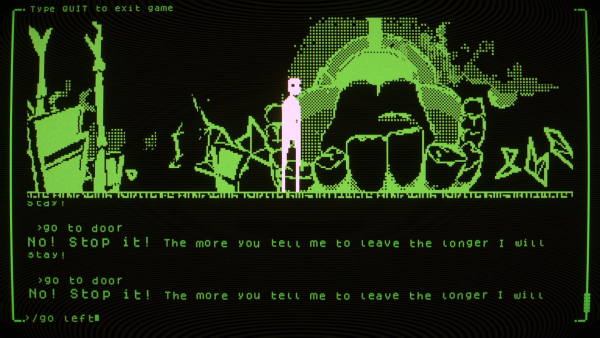
The graphics in [I] Doesn’t Exist is a wild mixture ranging from trippy pixel art to old IBM python coding screen texts and often changes mid-game to something you aren’t quite expecting. There are some options to tweak certain effects that you might not like or that hurt your eyes, but overall it’s a charming and eerie aesthetic that suits the narrative and gameplay very well.
Story:
This is the hardest part of the game to review, especially without getting too deep into spoilers. [I] Doesn’t Exist is a game about trust, choices, and the voices on your shoulders. You won’t travel very far on your journey, but the scenes will change often. Even when you arrive in a familiar place you will end up somewhere you don’t recognize. I went into the game expecting something like Doki Doki Literature Club and it does have some parallels, but I would compare it more to a short indie experience in line with How Fish is Made (a free game on steam that I would highly recommend). It’s a short experience that will leave you thinking about it for a few days.
Conclusion:
[I] Doesn’t Exist is a game I would recommend to veterans of text-based adventures and any games fans who make you question who you are and why you’re doing what you’re doing. It’s an intense, compact experience through existential dread that will leave you wanting more. If I could critique one thing, it would be that the game ends rather abruptly and while the build-up to the crux was captivating, It felt rushed in the end. Maybe that was the point, because I’m still thinking about it. I encourage you to Pick it up on steam and see for yourself.