Acoustics can make or break a room’s ambiance. While sometimes overlooked in room design, Acoustics plays a crucial role in shaping our interactions with the space around us. The design and material of acoustic treatments significantly dictate the quality of sound within a room, a fact that the experts at The Wood Veneer Hub, specialists in wooden acoustic paneling, are well-acquainted with.
Aesthetic appeal, while certainly essential, must harmoniously coexist with the practicality of acoustic treatment. Balancing the two can be challenging, but achieving that equilibrium becomes feasible with many options available. Wood veneer panels offer a compelling solution for those keen on leveraging the unique combination of aesthetics and acoustic enhancement.
Dive in as The Wood Veneer Hub team discusses the best material choices, the latest in acoustic innovations, and advice for those keen on perfecting their spaces. Their insights offer a roadmap for anyone looking to amplify the acoustic quality of a room.
Learn More About The Wood Veneer Hub Here
How do different materials affect the acoustic properties of a room?
When thinking about acoustics, multiple factors can be questioned depending on the project and what you want to achieve. What customers look for and what our panels will help you to achieve is a particular degree of sound absorption to aid in resolving one of two of the following:
1) Sound absorption and dampening between spaces (through walls, ceilings/ other surfaces).
2) Sound absorption to improve sound quality within a space (helping to reduce echo/reverberation).
We recommend screwing timber batons to the wall and then screwing the panels directly into the batons through the acoustic felt to improve sound absorption. Combined with Rockwool sound insulation behind the panels between the batons, this will achieve Class A sound absorption (with 2″ batons).
Although this is to help achieve optimum acoustic benefits, the steps involved can be amended slightly or removed (for example, you may not need the insulation or even batons necessarily, or you could reduce the baton thickness); this will be dependent on your preference, whether you believe it to be necessary for you particularly, and maybe due to budget or space that you have to work with.
What considerations should be made when choosing materials for acoustic treatment?
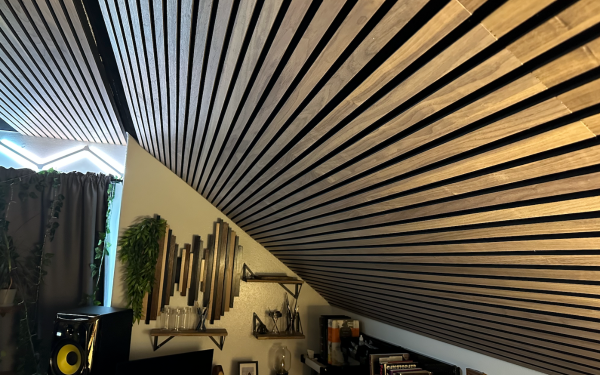
In terms of materials, a lot of it is down to the positioning/installation technique of the panels; a customer may want to find a balance between providing acoustics and aesthetics in design, whereas in other cases, customers put the panels up purely for how they will look. Others instead solely focus on the acoustic benefits. Although you will need to decide how you want to use the panels for your project, we would recommend if you want to block out sound, that you cover the whole wall or as much as possible.
The panels are best on the wall/ceiling where the sound is passing through, where the source of the sound is to get the best results. On the other hand, for improving reverberation, if, in this case, you are covering any reflective surfaces or areas again closest to where the source of the sound may be, this will help a lot (in some TV rooms, theatres, music rooms, for example).
If the customer wants to get the most out of the acoustics, they must consider acquiring some of the extras, i.e. rockwool and timber batons. This will also ask whether they are happy to lose a small amount of space in the room as this extra depth will come from the wall.
Can you share any exciting innovations in materials for acoustic treatment?

We have had many cases where satisfied customers have chosen and successfully implemented our specialized wall panels within recording studios. These panels have proven to be instrumental in effectively addressing and rectifying sound reverb challenges within the studio environment. This, in turn, has led to a distinct improvement in the audio quality of the final recording takes, rendering them notably crisper and cleaner.
Another fascinating dimension of our product’s impact, a remarkable innovation, is becoming increasingly popular within churches. The primary objective in these contexts is to echo what tends to be prevalent in most churches due to the large open areas.
Our panels have emerged as a pivotal tool, contributing significantly to creating more controlled and harmonious auditory experiences within these open and spiritually significant spaces.
What advice would you give someone trying to choose suitable materials for acoustic treatment in their studio?
We would advise potential clients to consider what their main intention is. If it is to reduce the noise pollution around the house, for example, from room to room. Applying the panels directly to the wall is the best way without too much technical installation.
To get the most out of a room’s acoustics, they should thoroughly install timber batons and rock wool behind the panels.
Learn More About The Wood Veneer Hub Here

Magnetic byline note: This byline is used for staff produced updates and short announcements, often based on press materials and official release information. Editorial responsibility: David Ireland (Editor in Chief) and Will Vance (Managing Editor). About: https://magneticmag.com/about/ Masthead: https://magneticmag.com/masthead/ Contact: https://magneticmag.com/contact/