Waxman (CA), a seasoned musician renowned for his delicate and dreamy tunes, has shared his expert advice on how to get the most out of one such tool – fabfilter’s Saturn 2. A versatile saturator, Saturn 2 offers detail and specificity that can add a unique character to any composition. Our latest interview with Waxman (CA) provides an insightful exploration into the utility of this tool, especially relevant considering the release of his two-track EP featuring original vocals by his friend and collaborator, Will RP Melville.
Waxman’s new EP, which includes the tracks ‘Home’ and ‘Remedy,’ is a testament to his evolution as an artist, showcasing his move toward original compositions. Released on David Hohme’s Where The Heart Is Records, the EP is a significant step forward for the artist, with the tracks capturing the essence of Waxman’s current musical journey. ‘Home’ brings a nostalgic undertone that resonates with listeners, while ‘Remedy’ adds an upbeat energy, balancing the collection’s mood.
In our feature, Waxman (CA) details his approach to using Saturn 2, sharing his wisdom on the various ways to manipulate the plugin’s features to achieve an enhanced, unique sound. Stay tuned for the full interview, where the artist divulges the secrets behind his refined production techniques.
Snag Premium House Music Samples Without Breaking The Bank With Our Massive Curated List Of Warm, Punchy Sounds From Across The Internet. Click Here To Get 4k+ Free Sounds and Samples
What features of Saturn 2 do you find yourself reaching for more often than have the most drastic effect on the output of the sound?
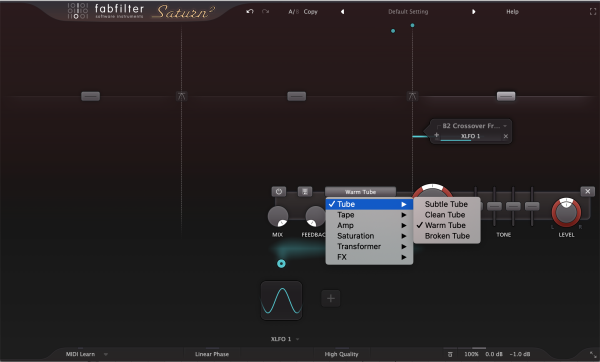
The thing I like the most about Fabfilter’s Saturn-2 plug-in is its versatility. It’s incredible how much detail you can go into with specific distortion/saturation on specific frequencies while modulating those frequencies or the distortion itself. Or, you can use it in its simplest form – as a subtle ‘analog-ized’ or sound warmer. With most production techniques, sometimes the biggest trick is the age-old ‘less is more’ adage. I’ll use Saturn-2 on many of the tracks in my songs, sometimes lightly enough that they’re barely noticeable.
Whenever I do this, I’ll think of them as a character piece of outboard gear where I’m just passing my signal through them to add a little bit of ‘analog’ warmth. So while it’s super easy to dive into an endless hole of modulation and bands, sometimes all you need is a basic bit of warmth (although even in doing this, Saturn-2 has 28 different styles/models of saturation to choose from to add that little bit of shine from tube effects to distorted guitar amp simulators.
Need To Upgrade Your Arsenal Of Softsynths? Check Out The Most Impactful Ones We’ve Used In All Our Latest Productions HERE
Which parameters are your favorite to modulate to add more life and excitement to your sounds using Saturn 2?
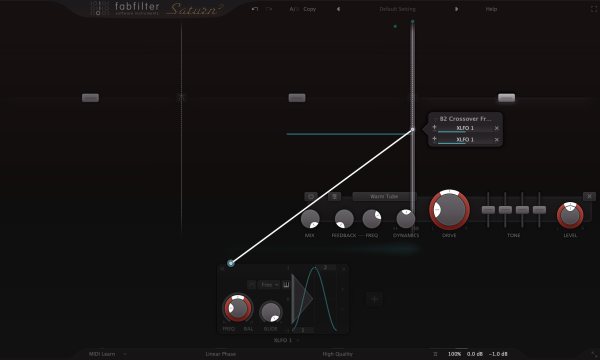
With that in mind, I love getting into the nitty-gritty with this plug-in. One of the best features of Saturn-2 is that it’s a multiband saturator so that you can affect extremely specific frequency bands with different saturation and modulation. And then you can even affect the band crossovers themselves.
I find that some subtle LFO movement on the actual crossover frequencies can create a very analog sort of randomness to what is being saturated and to what degree. A big part of what makes analog synths sound the way they do is that they’re not perfect. Weirdness happens and adds a certain magic to your sound. Softsynths are tremendous and mostly what I use, so recreating some random magic is essential to me so that my sounds aren’t dull or flat.
Having different frequency bands saturated in slightly different ways while shifting and moving can create unique textures for your sounds that will keep them fresh and exciting.
Looking for the best drum samples? Dive into ‘The Ultimate Library of Free Drum Samples: 7k+ Percussions and Drum Loops for Every Genre’ – access your free sounds here.
How do the different distortion models on Saturn 2 affect the sound? Which ones are your favorite for achieving your warm and lush sound?
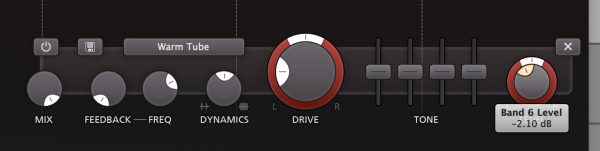
As I mentioned, this plugin has around 28 different saturation styles/models, and their use cases can vary. I tend to lean more toward the tube, tape, and saturation styles, which are great for creating the subtle warmth I mentioned.
These are great for warmth and lushness but can also be pushed for when you want things to get a bit grittier! Automating the drive on any of your bands of saturation throughout your song can help push a sound and build tension, excitement, etc., in a similar way to opening and closing a filter – you’re allowing more harmonics to come through and bring the sound forward or move it back in your mix.
I also love some guitar amp simulators for slightly more on-the-nose distortion. Running a dreamy piano sound through the ‘American Tweed Amp’ is a lot of fun if there’s space for it in your song.
What sets Saturn 2 apart from other distortion processors regarding its range of sounds?
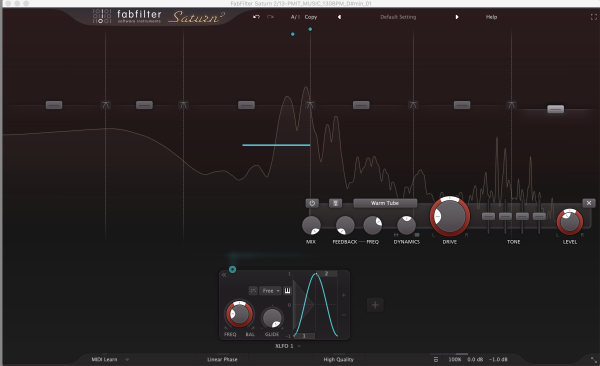
For me, the most significant and most exciting aspect of Saturn-2 is the multiband functionality. Creating custom frequency bands to hone in on specific frequencies and affect the different parts of a sound individually is incredibly useful and inspiring creatively. You can use different bands to add varying levels of distortion to different parts or also leave certain frequencies unaffected while saturating others to help bring a sound forward in the mix.
For example, suppose I want to bring a bass sound forward in my mix without adding additional low-end harmonics and distortion. In that case, I might create a band for everything 100hz and below and disable all saturation. Then I could create any number of bands for the frequencies above that to affect and distort however I like without worrying about affecting my low-end.
Keen on the latest music production tools? Check out ‘Six New Forward-Thinking VSTs All Music Producers Need to Know About in 2024’ – explore the cutting-edge here
Can you describe the process of fine-tuning sound in Saturn 2?
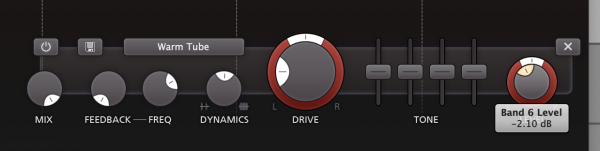
As with any plugin, it’s important to listen to the specific changes you’re making to your sound and how they affect that sound within the context of the whole mix. The same principle can be applied on a slightly more micro scale within the plugin. Let’s say we create a frequency band to affect the top end of a sound, from 3k and up.
We can solo that band and apply saturation very specifically to it, but equally (if not more importantly) we’ll want to A/B what we’ve done within the context of the full frequency spectrum (un-solo the affected band). Then taking it a step further, un-soloing the sound we’re working on within the mix and listening to the A/B of the specific frequency adjustments within the full context of the mix.
Is it doing something good? Is it doing something bad? Is it doing anything at all in this context? Another important tip here is to ensure you’re doing your A/B (before and after your saturation) with equal output volume levels. Fortunately, you can adjust the output gain of each band in Saturn-2 to make sure you’re not just making your sound louder (which will often sound better to your ear regardless of the changes to the sonic quality you’ve affected).
What is something about Saturn 2 that you wished you had learned earlier?
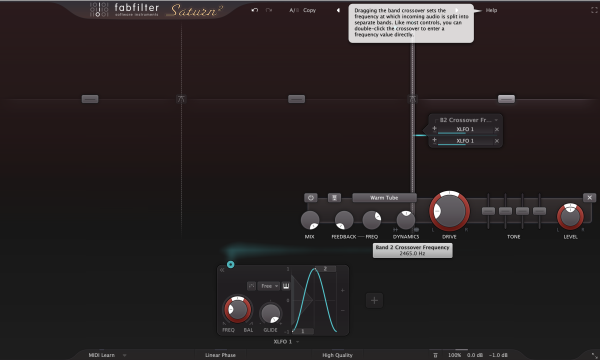
Another cool feature that each frequency band you create in Saturn-2 has is its EQ for generating harmonics. Four sliders in the control bar for each band can be adjusted to push the tonality of your saturation of that band up or down the frequency spectrum.
Again, it’s a bit like specific frequency adjustment within an already-specific frequency so it can take a moment to wrap your head around but is worth spending some time on early on to get full control over the kind of detailed tone-shaping you can use this fantastic plug-in for.
Looking to master plate reverb in production? Explore ‘How Producers Should Be Using Plate Reverb for Space, Modulation, and That Pro-Grade Polish’ – elevate your sound here. ️ ️ ️

Will Vance is a professional music producer who has been involved in the industry for the better part of a decade and has been the managing editor at Magnetic Magazine since mid-2022. In that time period, he has published thousands of articles on music production, industry think pieces and educational articles about the music industry. Over the last decade as a professional music producer, Will Vance has also ran multiple successful and highly respected record labels in the industry, including Where The Heart Is Records as well as having launched a new label with a focus on community through Magnetic Magazine. When not running these labels or producing his own music, Vance is likely writing for other top industry sites like Waves or the Hyperbits Masterclass or working on his upcoming book on mindfulness in music production. On the rare chance he's not thinking about music production, he's probably running a game of Dungeons and Dragons with his friends which he has been the dungeon master for for many years.