The battle between analog and digital has long been a topic of debate in the production community ever since digital software became first widely accessible and secondly complex enough to rival the tonality of outboard gear. The warmth, depth, and authenticity of sound offered by analog hardware are often hailed as incomparable, evoking a sense of nostalgia and richness that even the most premium quality digital gear struggles to replicate. But with the rise of modern technology, the question often arises: How relevant is analog in today’s digital age, and how can it be integrated, especially in budget-friendly interfaces?
Apogee, a leading name in audio interfaces, helps demystify this complex subject. With the resurgence of interest in analog hardware, many producers and sound engineers are keen to explore how analog components can enhance their sound.
In an exclusive interview, the team at Apogee shares insights into the importance of analog components in an audio interface, discussing everything from the fundamental sonic characteristics of analog gear to the challenges and considerations of integrating it into modern production setups. Whether you’re a seasoned professional or a budding producer, this guide offers valuable insights into analog sound.
Can you describe the importance of analog hardware in music production, especially in the context of affordable interfaces?
To put it simply, analog hardware offers sonic characteristics that modern digital processors can’t reproduce fully. It has been a staple of music production, mixing, and mastering for decades, oftentimes sound engineers will describe the sound of analog gear as being more “natural” or “musical” than digital gear.
This is because of the way that analog gear processes sound waves. It uses transistors and vacuum tubes to amplify and shape sound waves resulting in a more “continuous” sound than digital gear, which uses binary code to represent sound waves. There has been a resurgence of interest in analog hardware, as many producers believe that it offers a more authentic sound than digital gear.
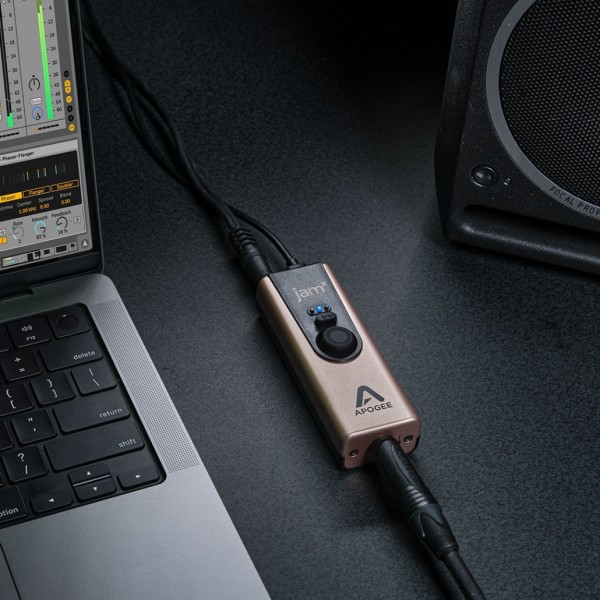
However, analog gear can be very expensive, making it out of reach for many aspiring producers. Fortunately, the Apogee JamX (pictured above) is an affordable and portable audio interface with a built-in analog compressor currently out on the market.
Learn More About This Interface While Supporting Magnetic’s Small Team Of Writers Through Our Affiliate Partnership With Sweetwater Here
How does analog hardware impact the overall sound quality in music production?
Similar to the answer mentioned above, analog gear uses transistors and vacuum tubes to amplify and shape sound waves resulting in a more” continuous” sound than digital gear, which uses binary code to represent sound waves. The continuous sound of analog hardware is what gives it its characteristic of producing sounds that have warmth and depth.
This is not to say that it’s impossible for digital gear to produce warm and deep sounds, rather it is more difficult to achieve. The nature of digital gear usually means that it is more likely to produce harsh and brittle sounds.
Can you discuss some of the challenges faced in integrating analog hardware into smaller, often budget-friendly, interfaces?
Typically when it comes down to it, 4 main challenges are faced. Power consumption, heat, size & weight, and cost. Analog hardware can be very power-hungry and generate a lot of heat, due to its use of transistors and vacuum tubes to amplify and shape the sound waves. And it uses large, heavy and expensive high-quality components to manufacture, making it a challenge when building an affordable analog interface.
What was a memorable project where the use of analog gear significantly enhanced your production?
I remember the first time I used analog gear was when I interned at a studio in New York. One of the perks when working for that studio is that when there weren’t any sessions happening, interns were allowed to use the studios for themselves.
During that time, I was finishing up with a master and decided to run it through the Manley Massive Passive EQ, and immediately I noticed that the master sounded warmer. I ended up taking out most of the digital plug-ins that were used initially and decided to run it through a bunch of analog gear instead. The result sounded significantly better, and I don’t think I could ever go back to mastering a track using only plug-ins to get the desired sound that I wanted.
Do new producers looking to add a bit of analog gear into their kit need to understand the technical aspects of analog hardware to get the most out of it?

The need to understand the technical aspects of analog hardware can depend on the type of analog gear they’re using, personal preferences, and their goals as a producer. Analog gear, such as an EQ or Compressor, can be beneficial to know the basic technical aspects of it to help the producer achieve their desired sounds.
Otherwise, analog gear such as synthesizers or drum machines, is not necessary for the producer as some producers find it more helpful to experiment with it. Ultimately, there is no need to have a deep understanding of the technical aspects of analog gear to be able to use it effectively, but it could help.
What advice would you give to someone considering investing in an interface with analog hardware for their music production?
The best advice to give someone when they’re considering investing in an interface is to follow this 5 step process.
1. Consider your budget.
It is essential to consider your budget before making a purchase; this should roughly narrow down your options.
2. Consider your needs.
Think about what type of music you want to make, what do you need to achieve that, and what hardware you are interested in. This should narrow down your options even more.
3. Do extensive research.
Read reviews, watch videos, and talk to other producers about what you’re trying to purchase; who knows, they might have used it before or have purchased it in the past.
4. Start Small.
Analog hardware can get very pricey quickly, it’s a good idea to start small, especially if it’s your first time purchasing and using one.
5. Experiment.
Always try out the analog hardware that you’re about to purchase. Ask your local music store and ask them to give you a demonstration if possible, and try out the gear yourself.

Will Vance is a professional music producer who has been involved in the industry for the better part of a decade and has been the managing editor at Magnetic Magazine since mid-2022. In that time period, he has published thousands of articles on music production, industry think pieces and educational articles about the music industry. Over the last decade as a professional music producer, Will Vance has also ran multiple successful and highly respected record labels in the industry, including Where The Heart Is Records as well as having launched a new label with a focus on community through Magnetic Magazine. When not running these labels or producing his own music, Vance is likely writing for other top industry sites like Waves or the Hyperbits Masterclass or working on his upcoming book on mindfulness in music production. On the rare chance he's not thinking about music production, he's probably running a game of Dungeons and Dragons with his friends which he has been the dungeon master for for many years.