In today’s music production spaces, the only thing that seems more of a buzzword than “powered by AI” is “Analog Emulation.” Analog emulation in music production refers to digital plugins mimicking the characteristics of analog hardware, bringing the unique warmth and richness of these vintage devices to the digital realm. This is achieved through complex algorithms and mathematical models replicating the behaviors of classic analog equipment. While no emulation can completely capture the full essence of original analog gear, many are high quality and offer a harmonious blend of modern convenience and nostalgic sonic character.
Learn More About Diva While Supporting Our Small Team Of Writers Through Our Affiliate Partnership With Plugin Boutique Here
u-He’s softsynth, Diva, has been hailed as one of the best of these analog emulation devices, so let’s set our sights on this synth specifically and talk about all of the different hardware modules and outboard synthesizers that all of Diva’s different features and sections are modeled after. Understanding the specific modules, Diva emulates not only provides you with a palette for unique sound design but also deepens your appreciation for u-He’s tribute to these incredible vintage synths. By combining historic sonic characters with the versatility of digital manipulation, analog emulation allows a fresh exploration of time-honored sounds in a modern production context.
Oscillators
Triple VCO

This oscillator module is a tribute to the Moog Minimoog Model D, a hallmark in synthesizer history. The original Model D is renowned for its three voltage-controlled oscillators, providing thick and powerful tones that were revolutionary in the 1970s. The Triple VCO in Diva captures this raw power and harmonic richness, offering three independent oscillators that can be combined in various ways.
Sound Design Tip: A classic sound design approach is to slightly detune the oscillators against each other, delivering the thick, chorus-like effect typical of the Model D.
Dual VCO
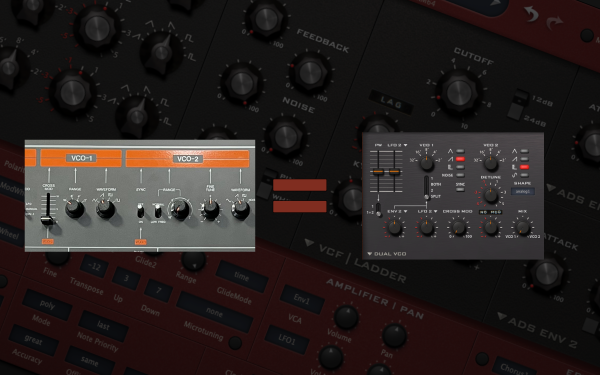
Emulating the Roland Jupiter series, this module brings forth the vibrant sonic essence of Jupiter 6 and Jupiter 8. These were some of the most influential polysynths from the 1980s, known for their clear and fat oscillators. The Dual VCO module in Diva aims to reproduce these characteristic tones, offering two oscillators with various waveforms.
Sound Design Tip: When designing sounds, consider utilizing the oscillator sync for creating sharp lead sounds reminiscent of the Jupiter series.
DCO
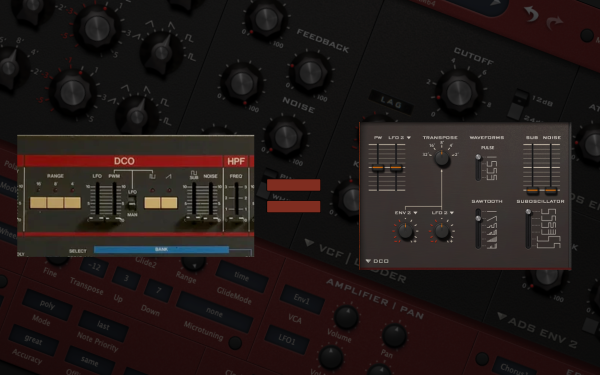
This oscillator is modeled after the digitally-controlled Roland Alpha Juno 2 oscillators. The Junos are recognized for their punchy and bright sounds; their DCOs played a significant role. The DCO module in Diva recreates this stability and precision, ideal for crafting bright leads or fat basses.
Sound Design Tip: For a classic Juno trick, apply pulse width modulation to the square wave, resulting in a wide, sweeping sound.
Dual VCO Eco
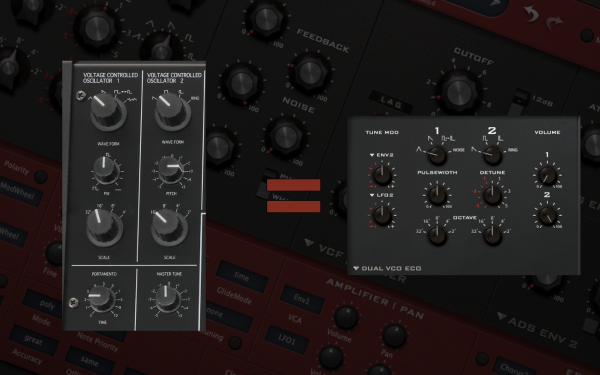
Inspired by the legendary Korg MS-20, this oscillator brings a touch of semi-modular synthesis to Diva. The MS-20 was a defining synth of the late 1970s, recognized for its sharp and distinctive tone. The Dual VCO Eco incorporates this tonal character, providing a pair of versatile oscillators perfect for raw, aggressive sounds.
Sound Design Tip: experiment with unconventional modulation routings in Diva’s modulation matrix to emulate the MS-20’s semi-modular nature.
Digital
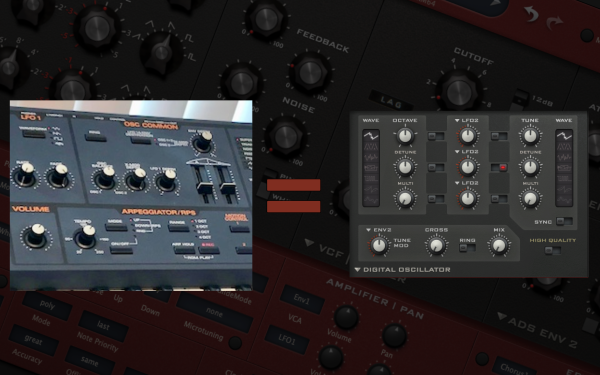
This oscillator pays homage to the Roland JP-8000, which brought digital synthesis to the forefront of electronic music. The JP-8000 was groundbreaking for introducing the “supersaw” waveform, a waveshape that has dominated countless electronic music genres. The Digital module in Diva is a refined interpretation of this oscillator, ideal for crafting lush, harmonic-rich sounds.
Sound Design Tip: For creating immersive pads and leads, use several slightly detuned sawtooth waves, mimicking the JP-8000’s “supersaw” method.
Filters
Ladder
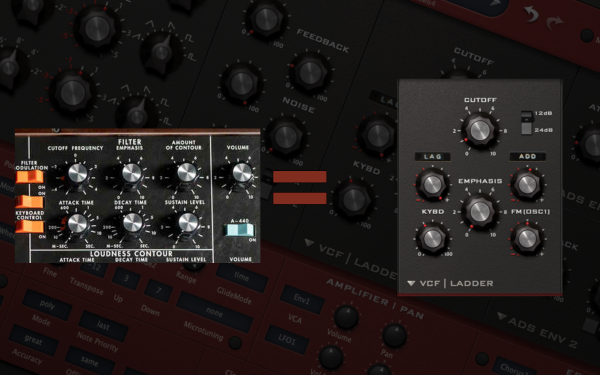
This filter module is a nod to the Moog Minimoog Model D, recreating its characteristic self-oscillating filter. This type of filter is known for its warm resonance and creamy sound, which contributed significantly to the iconic Moog tone. The Ladder filter in Diva captures this analog warmth, adding depth and character to your sounds.
Sound Design Tip: Increase the resonance and modulate the filter cutoff for squelchy, funky basslines to achieve a quintessential Moog sound.
Cascade
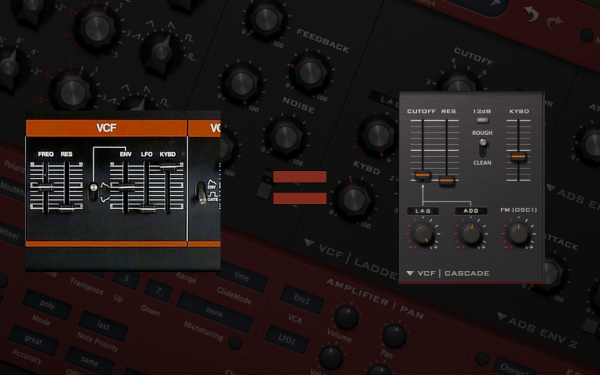
Inspired by the filters from the Roland Juno 60 and Jupiter 8, this module provides a variety of tonal characteristics. These synths were beloved for their smooth yet commanding filters, contributing to their timeless appeal. The Cascade filter in Diva replicates this sonic behavior, from silky smooth to rough and resonant.
Sound Design Tip: Use the Cascade filter with Diva’s chorus effect to create lush, ethereal pad sounds like the original Roland machines.
Multimode
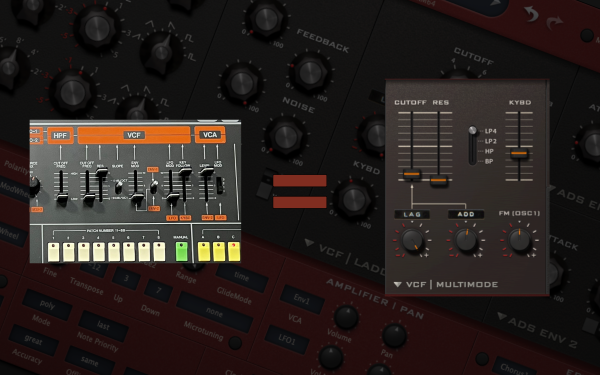
This module is modeled after the versatile filters of the Roland Jupiter 6. This synth was known for its flexible filters that could operate in multiple modes simultaneously. The Multimode filter in Diva mirrors this versatility, perfect for designing expressive, evolving patches.
Sound Design Tip: Experiment with different filter types and modulation options to produce dynamic, shifting sounds that move and breathe over time.
Bite
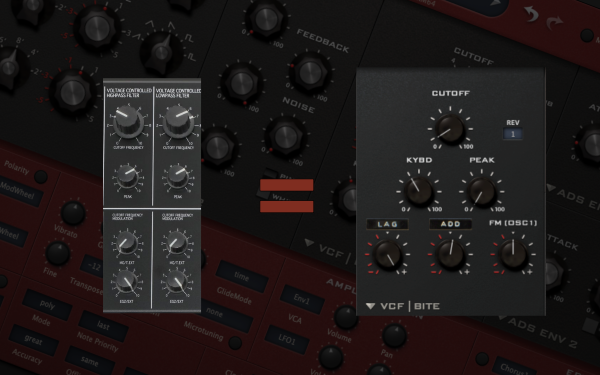
Modeled after the Korg MS-20’s distinct filters, this module is the tool for creating raw, aggressive sounds. The MS-20’s filter was known for its unique, biting character, contributing to the synth’s iconic status in electronic music. The Bite filter in Diva strives to emulate this character, bringing a touch of aggressive, vintage flavor to your patches.
Sound Design Tip: For a classic MS-20 technique, crank up the resonance and use the filter envelope to create those renowned, cutting bass sounds.
Envelopes:
ADS
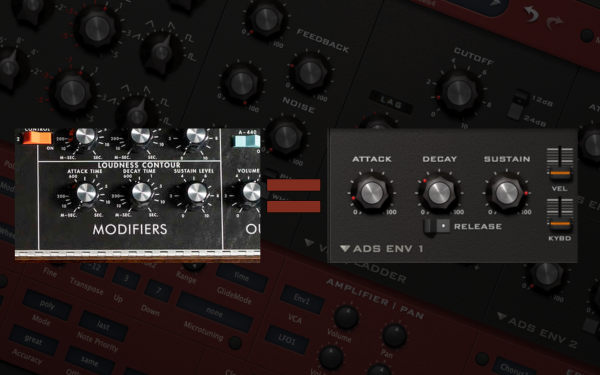
Based on the Moog Minimoog Model D, this envelope generator provides a straightforward and effective way to shape your sounds. The Model D was known for its snappy envelopes, contributing to its robust, punchy sounds. The ADS envelope in Diva offers similar functionality with a simple, three-stage (attack, decay, sustain) design.
Sound Design Tip: To emulate the Model D’s legendary plucky basses, use short attack and decay times with a moderate sustain level.
Analogue
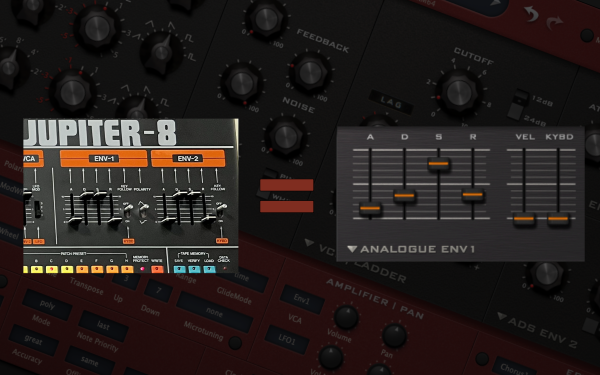
This module takes inspiration from the Roland Juno 60 and Jupiter 8 and brings the responsive envelope generators of these iconic synths to Diva. These Roland synths were famous for their lively and organic envelopes, adding motion and expression to their sounds. The Analogue module in Diva recreates this behavior, offering four-stage (attack, decay, sustain, release) envelopes.
Sound Design Tip: When crafting classic Roland-style pads, use longer attack and release times to create evolving, atmospheric sounds.
Digital
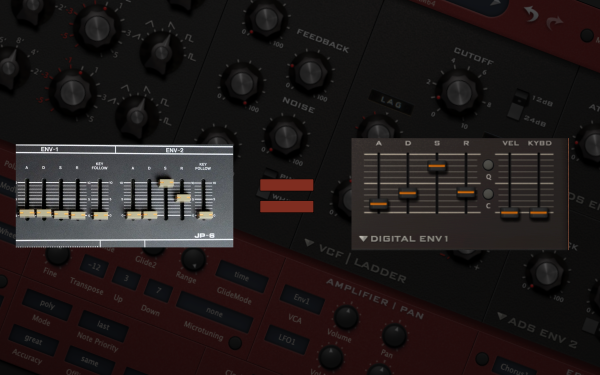
This envelope generator is modeled after the Roland Jupiter 6, a synth revered for its advanced envelope capabilities. The Jupiter 6 stood out for its digital control, offering short and versatile envelope shaping. The Digital module in Diva captures this flexibility with switchable quantization and curvature behavior, allowing for a wide range of envelope shapes.
Sound Design Tip: For a sound design approach, use different curvature settings to give your sounds a unique, evolving character.


Will Vance is a professional music producer who has been involved in the industry for the better part of a decade and has been the managing editor at Magnetic Magazine since mid-2022. In that time period, he has published thousands of articles on music production, industry think pieces and educational articles about the music industry. Over the last decade as a professional music producer, Will Vance has also ran multiple successful and highly respected record labels in the industry, including Where The Heart Is Records as well as having launched a new label with a focus on community through Magnetic Magazine. When not running these labels or producing his own music, Vance is likely writing for other top industry sites like Waves or the Hyperbits Masterclass or working on his upcoming book on mindfulness in music production. On the rare chance he's not thinking about music production, he's probably running a game of Dungeons and Dragons with his friends which he has been the dungeon master for for many years.




![How It Was Made: JOKESONYOU & DJ IP – OTTF [Teletech]](https://magneticmag.com/wp-content/uploads/2026/08/artwork-ottf.jpeg)

![How It Was Made: JOKESONYOU & DJ IP – OTTF [Teletech]](https://magneticmag.com/wp-content/uploads/2026/08/artwork-ottf-1024x1024.jpeg)