The video game industry sits on a precipice.
An industry worth nearly 100 billion dollars annually, smashing the music industry’s annual revenue and rivaling the film industry is largely being bent to the will of a few powerful corporations at the helm, throttling the art out of the people in the trenches who create the experiences we love. They have been finding ways to implement “legal” slot machine gambling into games to prey on often underage consumers, buying and dismembering competing businesses, and churning out an unfinished product with the intent to fix it later in the form of patches are all problems that run rampant. All these issues and much more need to be talked about, but I’d like to focus on the latter.
Recently, we saw the release of Star Wars Jedi: Survivor…
The anticipated sequel to Jedi: Fallen Order, which in my opinion is not just a good video game, but some of the best Star Wars content to be produced in the last decade. We weren’t given a review code for the game. EA failed to distribute review codes to many reviewers that tend to be critical of performance in games. Digital Foundry, a respected YouTube performance testing and review channel with over 1.3 million subscribers wasn’t given a code, which I’ve come to see as a pretty reliable red flag for how well a game will perform on launch. I encourage our readers to watch their videos on Jedi: Survivor’s performance.
The problem lies within the nature of the business we’re in. Writers want to write about big AAA games because big AAA games are impressive, cinematic, and have the potential to push the limits of the medium. Websites and magazines want to cover big game releases because they drive traffic and increase subscriber volume. AAA Developers and publishers want their games covered because it will increase sales. Ostensibly this is a symbiotic relationship, but the absurd growth and success of the gaming industry in the last 20 years has enabled predatory business practices that in turn have caused this relationship to swing to one side in favor of large Publishers and Developers.
Before its release, Jedi: Survivor was one of the top-selling games on Steam.
This exemplifies one of the ways our relationship with AAA developers has become toxic. They don’t even need to release a game to start making large amounts of money on it. They can even release a broken game and still hold number one on sales charts. When the press embargo was lifted for Jedi: Survivor, it was met with resounding praise with many if not most reviewers giving it an 8/10 and 9/10. Some even a perfect 10/10. Journalists will stomach the terrible, even game-breaking performance issues yet still give out excellent reviews. Because they hope it will get fixed in future patches? Because they’re afraid to ruffle the feathers and not get future review codes from heavy hitters like EA, Bethesda, or CDProjekt RED? Because most people who are just excited about an anticipated game will click on the articles with good scores while more “on the fence” readers will default to smaller sites they trust or user reviews?
Yes, all of the above.
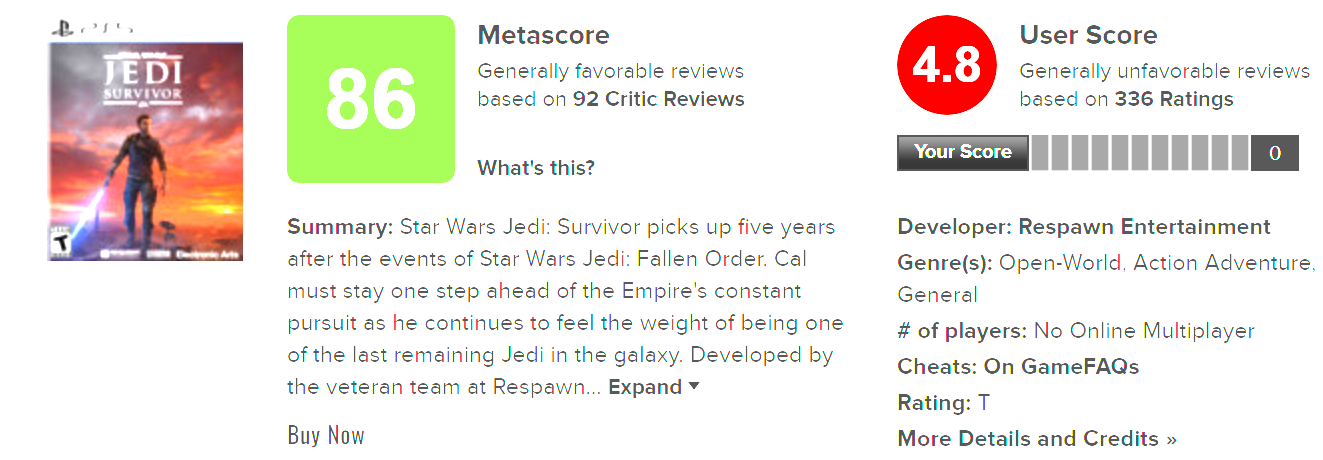
Now Jedi: Survivor sits at an 86 on Metacritic while its user score is 4.8. This disparity between media and user scores shows us that our system for reliable media is broken. Gaming journalists should be advocating for their readers instead of defending those who wish to sell them a broken product.
Two months before its release, Stig Asmussen, the project director for Jedi: Survivor was interviewed by IGN. Asmussen says he went to EA to delay the original release date by six weeks. He was given the option to delay longer, but said in the interview that they rejected the option and guess what happened?
Asmussen and his team did not get it done.
The game’s launch, while receiving stellar reviews, has been a disaster across all platforms. Performance on consoles is atrocious with poor rendering resolutions, screen tearing, stuttering, and broken HDR. The PC port is even worse with the highest-end machines money can buy not getting a stable frame rate at the lowest settings.
It’s not the fault of Asmussen, Respawn, or even EA. Respawn has to answer to EA and EA has to answer to shareholders. The fault lies with us. The journalists who are supposed to inform their readers about what they are purchasing are failing and the consumers are buying a broken and unfinished product because of it.
Broken games on release have been a problem for as long as I can remember, but recently it’s gotten so bad that it seems like 7 out of 10 games will be released in an unacceptable state. Even undeniable masterpieces like Elden Ring were released with and still struggle with subpar performance. But somewhere there has to be a line in the sand that says “If your game is this unplayable, we won’t support it. We won’t buy it.”
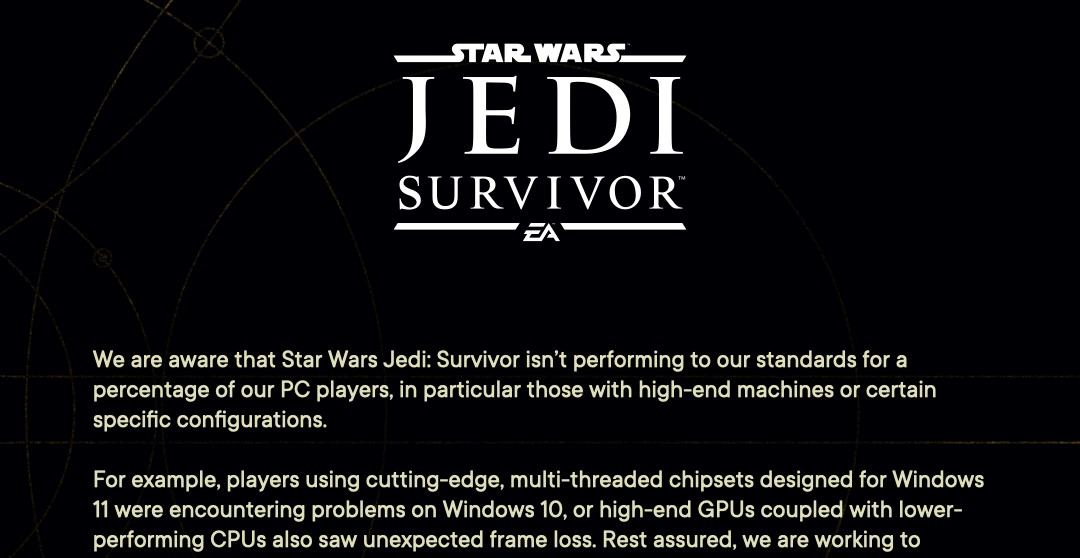
Star Wars Jedi: Survivor has a lot of potential to be a fantastic experience. It’s got great qualities that you can read about in all the other reviews that have been published, but as far as our readers go, we cannot recommend you purchase this product until it gets fixed.
When it does, we will gladly give you our full review.