UJAM has taken a clear step toward reshaping how audio plugins get built and shipped by opening Gorilla Engine to third-party developers, and the timing lines up with a broader shift across music production where developers are looking for tighter, more efficient workflows from idea to release.
The platform has already powered products for several established audio companies, and now it moves into public access with a single system that covers development, licensing, and delivery.
That matters because most plugin teams still split their process across multiple tools. One system for development, another for licensing, and another for distribution. That fragmentation slows things down and introduces extra maintenance overhead that has nothing to do with the actual product. Gorilla Engine brings those layers into a single workflow, which changes how quickly a plugin can move from prototype to release.
Further information and license options are available at gorilla-engine.com.
A development platform that removes backend friction
The most immediate shift comes from Product Hub, which sits inside Gorilla Engine as a built-in system for managing licensing, distribution, and updates. Developers can handle product releases, deliver installers, and connect storefront data without building their own backend infrastructure. That includes support for subscription licensing models, direct product activation, and branded download tools.
This type of integration has practical implications.
Teams no longer need to allocate time and resources to build systems that sit outside the core plugin. That allows smaller developers to operate with fewer constraints, while larger teams can reduce ongoing maintenance across multiple tools. The platform also supports standard plugin formats including VST, AU, and AAX, along with cross-platform compatibility on macOS and Windows, which keeps deployment aligned with current production environments.
A direct path for developers moving beyond Kontakt
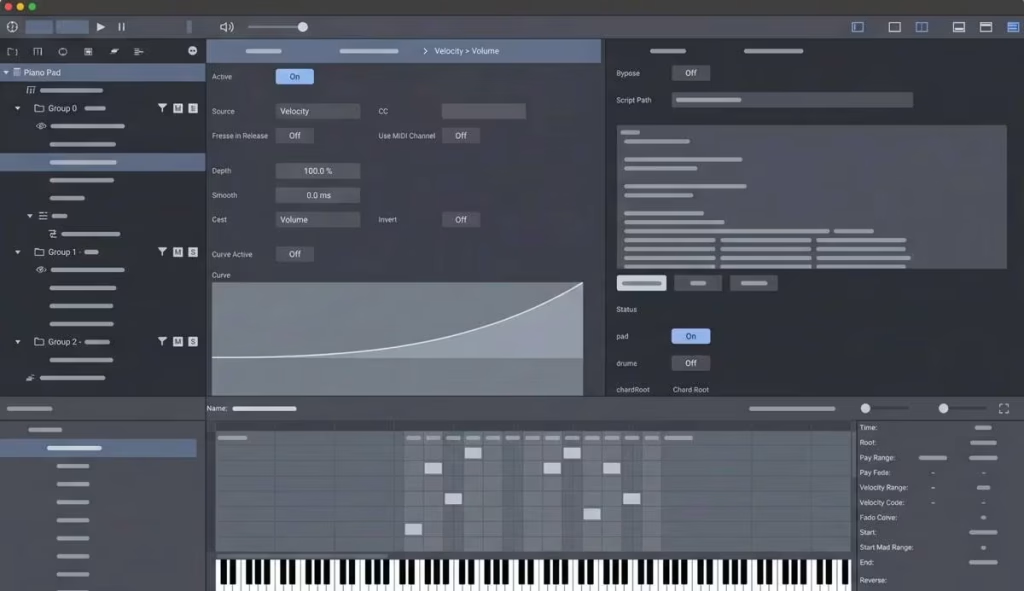
UJAM has also addressed one of the most common friction points in plugin development: transitioning away from existing ecosystems. Gorilla Engine includes a scripting environment that aligns closely with Kontakt’s workflow, allowing developers to carry over existing structures and logic without starting over.
That lowers the barrier for teams who have already invested years into building instruments and tools within Kontakt. Instead of rebuilding entire products, developers can migrate core elements and continue refining them inside a new system that supports standalone distribution and independent branding.
There is also a broader shift in how developers approach ownership and identity. Plugins built on Gorilla Engine ship as independent products with their own installers and ecosystems, which gives teams more control over how their tools are presented and distributed. With a free-entry tier for non-commercial use, the platform opens access to a wider range of developers, from hobbyists to established companies.
Gorilla Engine does not introduce a new category of plugin development, but it tightens the process, reducing friction at every stage. That kind of change tends to show up in the volume and quality of tools released over time, especially as more developers move toward systems that handle the full lifecycle in one place.

Will Vance is a professional music producer who has been involved in the industry for the better part of a decade and has been the managing editor at Magnetic Magazine since mid-2022. In that time period, he has published thousands of articles on music production, industry think pieces and educational articles about the music industry. Over the last decade as a professional music producer, Will Vance has also ran multiple successful and highly respected record labels in the industry, including Where The Heart Is Records as well as having launched a new label with a focus on community through Magnetic Magazine. When not running these labels or producing his own music, Vance is likely writing for other top industry sites like Waves or the Hyperbits Masterclass or working on his upcoming book on mindfulness in music production. On the rare chance he's not thinking about music production, he's probably running a game of Dungeons and Dragons with his friends which he has been the dungeon master for for many years.