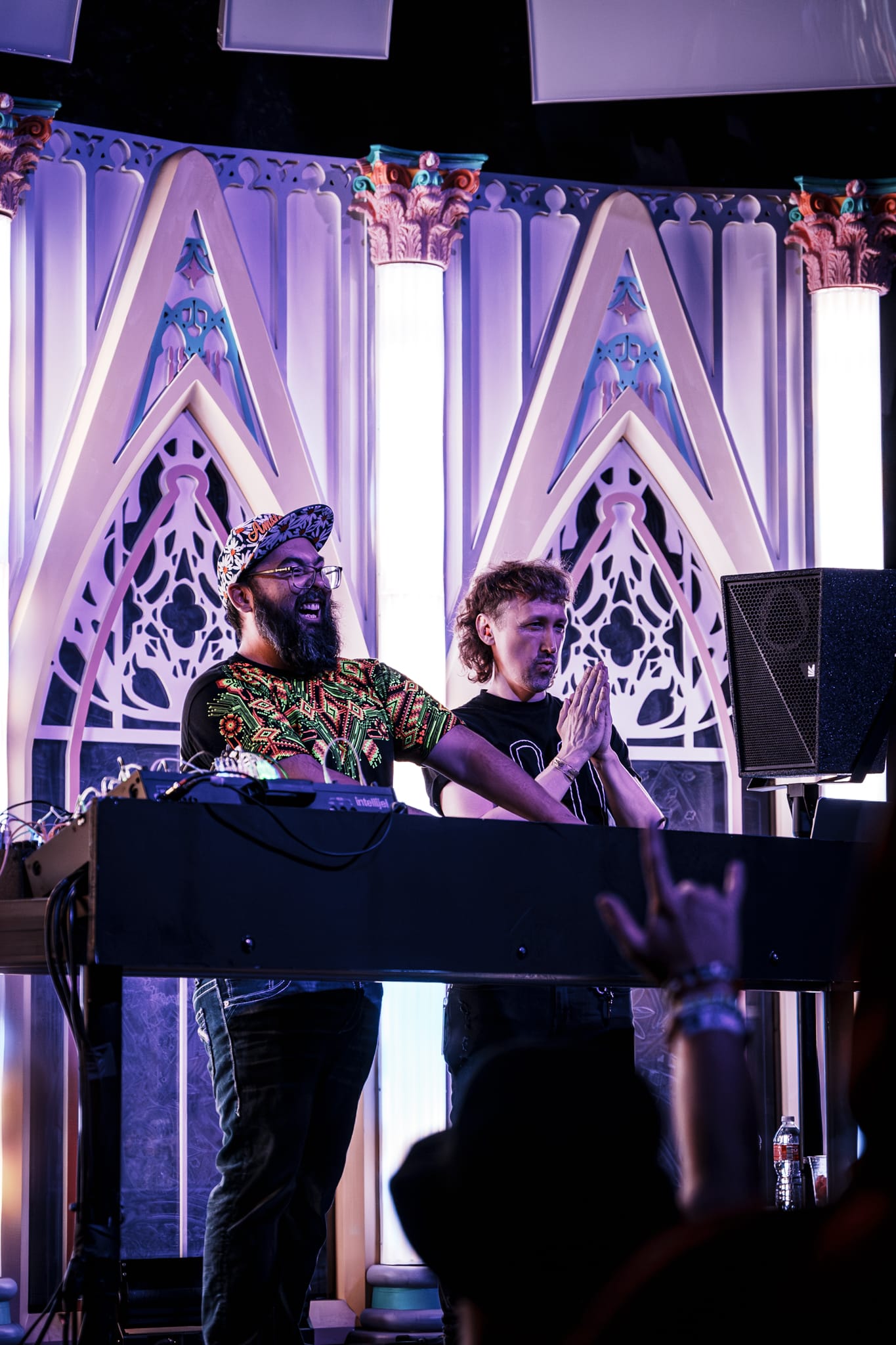
For more than a decade, Zebbler Encanti Experience (ZEE) has operated at the outer edges of electronic music and digital art, crafting immersive experiences that merge sound, vision, and technology into a singular, otherworldly form.
The duo, comprised of designer Peter “Zebbler” Berdovsky and producer Ben “Encanti” Cantil, has built a reputation for pushing boundaries, whether through the towering visual architecture of the Shpongletron stage or the intricate, genre-defying production that defines their catalog. With releases on Gravitas and Wakaan, collaborations alongside artists like Mr. Bill and Of The Trees, and a fully audio-visual album completed during the pandemic, ZEE has continually reinvented their approach while maintaining a one-of-a-kind signature style rooted in glitch, bass, and psychedelia.
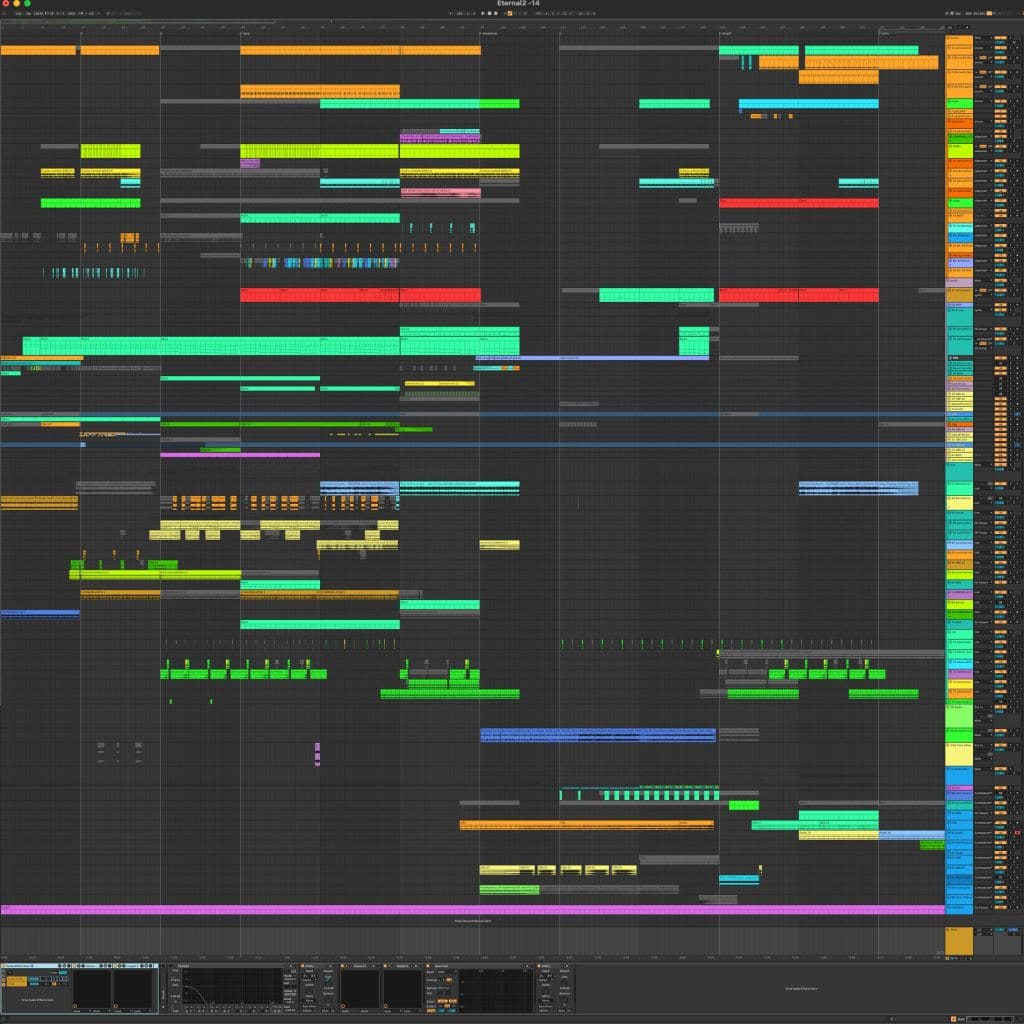
Now, as they prepare to unveil their forthcoming Ophelia Records album “Data Séance”, ZEE offers a glimpse of what’s to come with the tech house stormer “Eternal Recursion” – a track that is due out very soon. In this installment of our How It Was Made Series, the forward-thinking duo opens up their workflow to reveal just how this track came together. As you’d expect from an artist like ZEE, there’s a lot of forward thinking work but into this track – including ethical and creative uses of generative AI. If you’re interested in learning about how two true visionaries put a song like this together and gaining some tips on how to level up your sound design and harness modern technology, then take a read onwards!
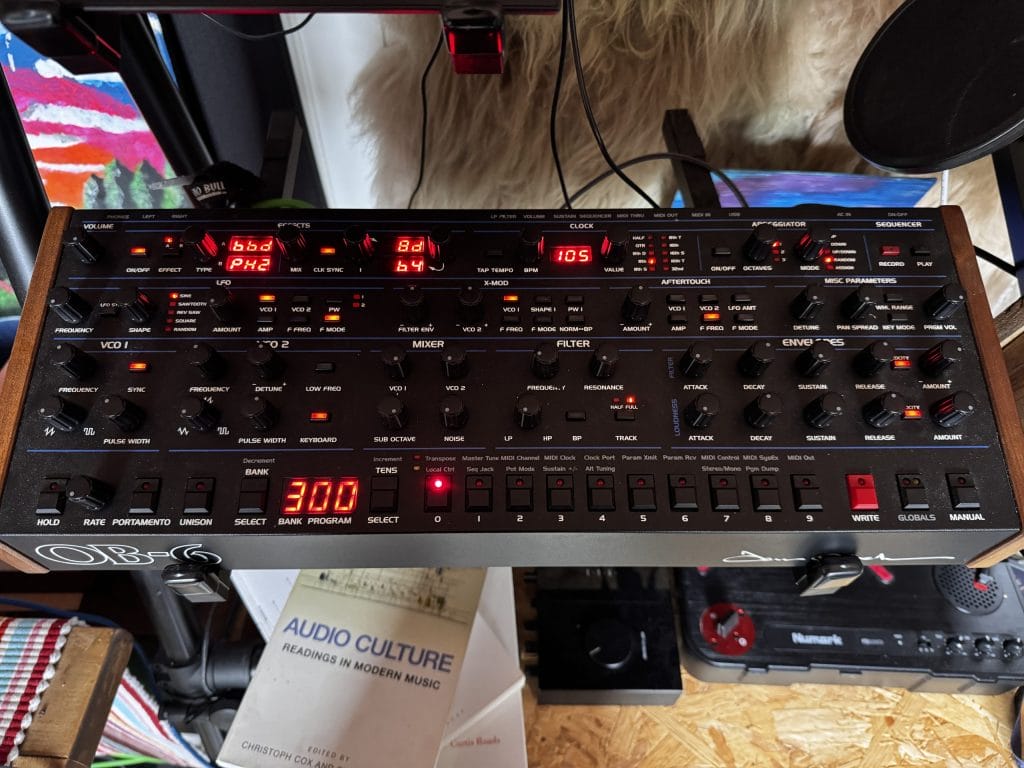
OB-6 by Dave Smith Instruments
“Eternal Recursion”, like many tracks on Data Séance, features a convergence of sounds that could only be analog, mixed with sounds that could only be digital.
Let’s start with the main synth on this track: OB-6 polyphonic analog synthesizer by Dave Smith Instruments. This is my favorite synth – the interface offers endless creative possibilities without any menu diving, and the sound is always warm and buttery right out of the box. I used this synth almost exclusively on our last full-length LP Syncorswim, and it’s still my ride-or-die for chord progressions, melodics, and drones.
Apart from a bit of compression and EQ, the OB-6 usually appears just as it sounded out of the box, using the built in reverbs, modulation, and circuit distortion to shape the tone. I prefer to make all of my presets while working on the track, so the recording is just capturing the sound of the moment. I think using analog synths like the OB-6 is like a delicate piece of tuna on sushi – it is best enjoyed raw, as its own distinct element.
This track started as a short chord progression on the piano, and then was gradually re-worked into a long-form syncopated 5/4 phrase over a 4/4 beat, which I think made it very hypnotic and interesting. The synth parts are not actually that hard to re-create, so I think the real magic is in the composition behind the notes and the rhythms. Remember that every song you create is just a “version” – as producers, we’re trying to culminate on the one that appeals to us the most, so it’s not enough to just flip a chord progression into music. You have to keep flipping until it has the maximum impact.
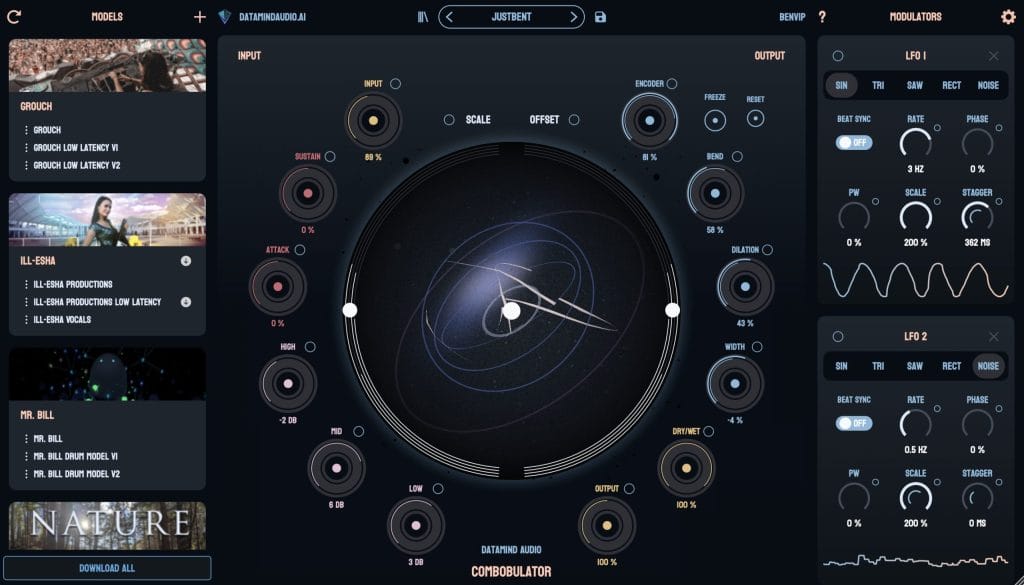
Combobulator by DataMind Audio
For much of the percussive parts on this tune, I used Combobulator, a plugin made by my own music software company DataMind Audio. This plugin has been a long-form collaboration with some of my electronic music heroes, Rob Clouth and IRCAM. Combobulator uses generative AI to make sound in realtime, but instead of inputting text prompts, you input an audio signal and the neural network tries to imitate the input signal based on what it’s learned about sound from the model training data.
I actually wrote the drums and percussive patterns for this track in an entirely uninteresting way, and then the Combobulator took care of making it sounds interesting. DataMind Audio partnered with several incredible sound designers to train small bespoke neural networks for Combobulator: For this track, I used models trained on sounds by ill-esha, Form/Null, Somatoast, Rob Clouth, and myself (my favorite being the high hats which were created with the ill-esha vocal model, sounding like percussive whispering). These models especially sound nice when you add Spiff & Soothe by oeksound to make the transients and spectral parts hit just right.
Ingredients are important: Realtime neural audio is a completely new field of audio design, and to use this alongside analog synthesis felt like a remarkable combination of paradigms. Pushing music forward doesn’t need to mean that every single idea is original – sometimes music can reach new levels through a combination of existing ideas that may have never been put together before.
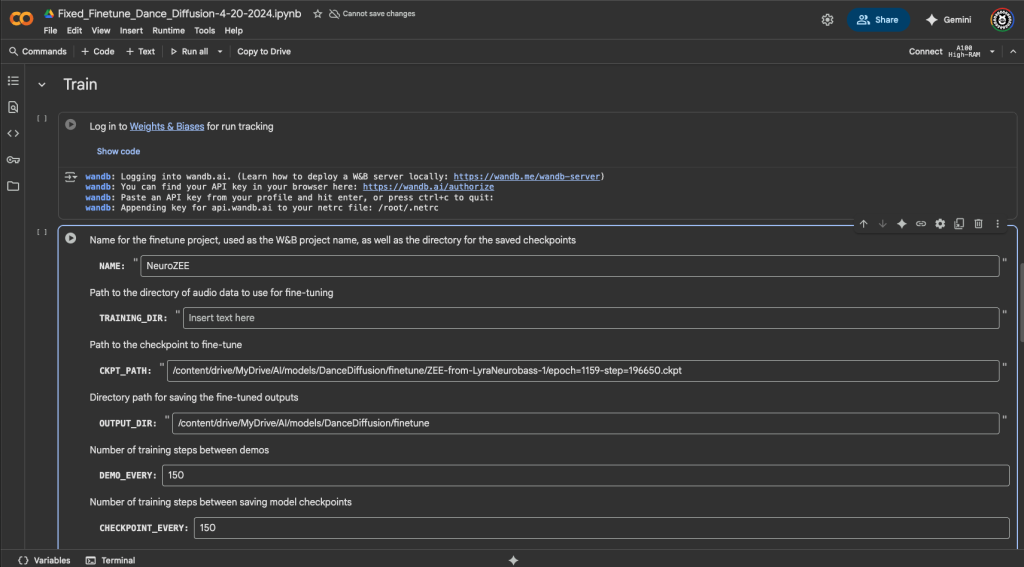
Dance Diffusion by Harmonia
This is not a plugin, but instead a free tool for people to train their own neural networks to generate infinite variations of an audio data set. Dance Diffusion works inside of Google Colab, with two scripts aka “Notebooks” – the first one connects with a Google Drive folder and trains a model based on the sounds inside of the folder. The second one takes that model and uses it to generate new sounds based on the sounds it was trained on. It’s a bit tricky, with an entirely text-based interface, but once you get the hang of it, you can create unlimited samples that are up to 1.5 seconds long – perfect for drum hits, bass hits, and cool assets like random vocal utterances.
Dance Diffusion was used all throughout Data Séance, but on this track I used a model that was downloaded from the Harmonai discord server in #dd-model-sharing channel, I believe it was one of the variations of “Vague Phrases”. Basically it generates short bursts of pop vocals. The catch here is that the model is not trained on language, so it’s all in gibberish, which is a recurring theme of the record: Almost all of the vocals on Data Séance are AI models that reproduce the timbre of the human voice without knowing language, resulting in a kind of techno-babble that has an uncanny resemblance to human pop vocals.
You need a few hundred samples to make your own Dance Diffusion model, at least 1gb in your Google Drive to get started in training your own model. It’s great for one-hits like drum hits and bass hits, but if you only use long recordings in the training data, it will take much longer to train and will give you mixed results. I recommend getting started trying to make a sound with other people’s models and then training your own after you get your head around the diffusion part.
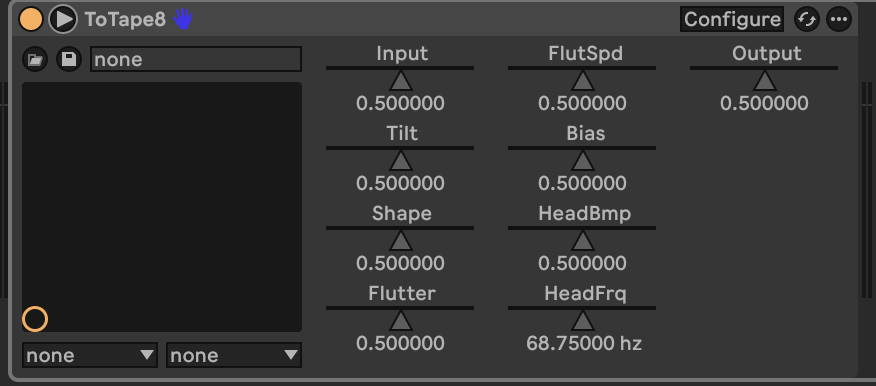
ToTape
There is one obscure free plugin that is used throughout this entire record which deserved a proper shout out: ToTape. ToTape is a tape machine emulator, which gives the user the ability to push into extreme settings with the bias and overdrive. There is no fancy interface, no presets, only nine different knobs, and it smokes every other tape emulator out there.
I’d use ToTape on just about everything, but this is the kind of effect that pairs especially well with anything that sounds too “digital” where you want to wrangle it back to a warmer, magnetic reality. You can make anything that comes into it disappear if you crank the bias knob enough, so if you’re looking for a good transition automation that is cooler than tweaking the volume knob, automate the bias!
If you want to hear how effective a tape emulator can be on an aesthetic level, check out Flume’s Palaces LP, which has tape emulation all over the synth tones. Also check out the complete discography of Alex Somers, who is one of my all time favorite composers. This can be used on any genre as an augmentation and replacement for standard compression, saturation, and gain boosting.
Quick Fire Production Tips
- Sometimes the tools you use define the direction of the music you produce. Don’t force your instruments to work a certain way for the genre, but instead change your genre to work best for the instruments, and you will find creative liberation breaking free from the expectations.
- You can use AI the right way to make insane sound design if you dig deeper than the Suno/Udio plagiarism machines – with plugins from companies like DataMind Audio, and free Google Colab notebooks from labs like Harmonai, where you can get extraordinary sounds with by tweaking knobs like a synthesizer, and even models on your own music.
- Data Séance is a bass music record – even though “Eternal Recursion” is more like a tech house track, the ultimate point of bass music is to push the subwoofers. When you distill bass music down to the low end, beyond the tempo and beat conventions, it liberates you to be truly creative and freely explore unconventional delivery methods.

Ben Lepper is a music producer and journalist from Boston, Massachusetts.







![How It Was Made: Low Steppa & Roel – Dreamliner [Low Trax]](https://magneticmag.com/wp-content/uploads/2026/09/DSC07195-1024x608.jpg)