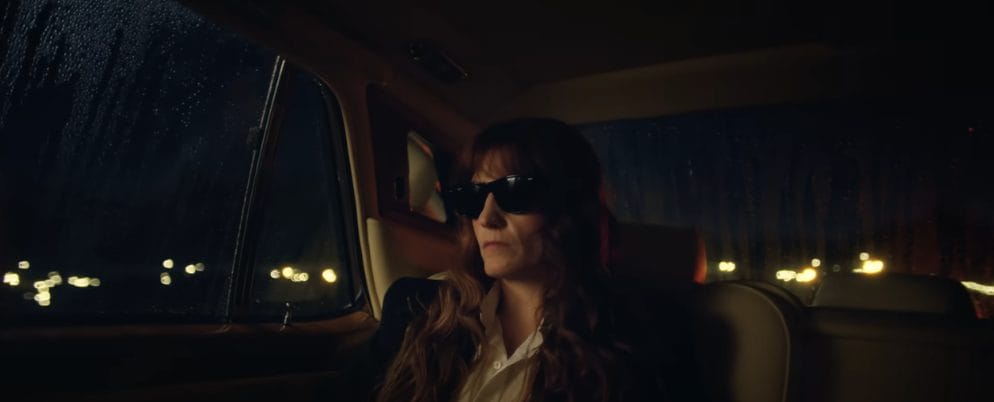
Header image: Screengrab from the official “One of the Greats” music video. Directed by Autumn de Wilde. Presented by Anonymous Content.
Florence Welch has said she wrote “One of the Greats” in a single take with IDLES guitarist Mark Bowen—he played, she sang straight from the page—and they never went back to re-record it. That part matters. The track has a live-wire edge to it that pulls you in before you even know what it’s saying. Then Aaron Dessner stepped in and helped stretch that first take into something stranger and bigger. You hear that in the way the ending falls apart. She wanted it to feel like disintegration, and it does. It sounds like an artist giving in to the process fully, not just shaping a song but letting it shape her right back.
The song dropped ahead of the Everybody Scream album, right after the title track and its grim little music video. This one’s darker, looser, and heavier in a different way. It pushes past the cinematic gloss of Dance Fever and walks straight into something more exposed. Welch said she nearly died during the last tour. The song sits inside that memory. It opens in the dirt and stays there longer than most artists would allow. She sings about clawing her way back up, about trying to win the prize, about trying to be remembered for more than just bleeding on stage.
She called the track a long poem and said it might be a fifteen-year outpouring of frustration. I can hear that. You can tell she has carried these thoughts for a while. The ridicule, the bigness, the silence, the spotlight. In her own words, she’s always digging herself up to try again.
That’s what this piece is responding to. I’m using my background in literature and creative writing to sit with the lyrics and pull at them a little, the same way I’d teach a good poem. These are just my own opinions and interpretations, but it felt like a good excuse to stretch the comparisons and see what modern fiction, old poetry, and literary history can show us when we hold them up next to a song like this.
One of the Greats Meaning
“I crawled up from under the earth / Broken nails and coughing dirt”
When Florence Welch sings these lines, she places herself beneath the surface, clawing her way back up through dirt and damage. The imagery is harsh, physical, and unclean—broken nails, coughing dirt, a body returned to motion through force. In recent interviews, she has spoken candidly about a near-death experience during the Dance Fever tour and how it shaped the music that followed. This opening feels like a response to that. The act of survival is portrayed as violent and unfinished, more like digging out of wreckage than stepping into light.
Welch builds her resurrection with mud and breath, not miracle. The song’s first verse sets up that returning from the edge means dragging pieces of yourself through it. For her, this return ties directly to creativity. Coming back from the dead means writing again, performing again, letting herself be seen. The body rises, but it brings all its pain with it. That’s the version of resurrection she commits to in the song, and it sets the tone for everything that follows.
In Sonnet XLIV, Charlotte Smith writes of coastal graves being torn open by wind and tide—”Tears from their grassy tombs the village dead, / And breaks the silent sabbath of the grave!” Smith looks at how even burial offers no real peace, no lasting place in the world’s memory. Her speaker stands in a churchyard watching time erode what was supposed to be final. Florence’s image of clawing out of the earth mirrors that same unease. She makes the silence temporary. She returns. She sings through it.
“Spitting out my songs so you could sing along / And with each bedraggled breath, I knew I came back from the dead”
These lines set the relationship between artist and audience. She positions the act of making music as an exertion. Her songs emerge not freely but forced, as if they have to be wrung from her lungs. She presents the gift of a song as something bought with effort and pain. I read this as her claiming that creative labor is real bodily labor.
She stresses each breath as “bedraggled.” That word shows her effort is stained, worn. She knows her return from the brink ties to each song she gives to others. In conversation she has said she feared never singing again. The lyrics carry that fear forward: she sings to validate her survival.
Landon’s lines, “We are like the insect, which / Sports its brief hour in the sun,” draw a parallel. L.E.L. reflects on how brief visibility feels. Florence extends that brief hour into songs. She gives us her breath, her urge, her return—and she demands we listen.
“Did I get it right? Do I win the prize? / Do you regret bringing me back to life?”
Here she voices doubt. She wonders whether her return was welcomed or regretted. Those questions repeat. They become internal. She seeks validation even while she knows validation may not relieve her. I believe she is asking about legacy, audience, worth, and risk. In interviews she has said she feels she must prove her survival through art.
These lines become a hinge in the song. They expose vulnerability. She opens herself to judgment. I read that as strength—opening cracks so we see the weight she carries. Her questions push listeners to feel alongside her doubts.
When Anne Sexton writes, “Suicides have a special language. / Like carpenters they want to know which tools,” she enters despair and technicality. She describes the detail behind pain. Florence’s questions mirror that: she wants to know whether her survival is welcomed, admired, or feared. Her question becomes a tool.
“So like a woman to profit from her madness / I was only beautiful under the lights”
These lines take direct aim at how women are expected to present their pain. Florence Welch frames her visibility as something conditional, tied to performance. When she says she was “only beautiful under the lights,” she draws a boundary around the kind of power she’s been allowed to hold—real, but temporary, and always under someone else’s control. She opens up the contradiction of needing to be seen while being aware that the seeing comes with a cost. The spotlight grants access but never permanence.
She returns again to this tension when she sings, “So like a woman to profit from her madness.” That lyric is heavy with frustration. Welch has said in interviews that she grew tired of the tortured artist myth, especially as it’s applied to women. There’s pressure to collapse in public, to make something poetic out of self-destruction. What she does in this section of the song is acknowledge how familiar that narrative is, and how hard it is to shake. She does not resolve it. She places it plainly in front of the listener.
Letitia Elizabeth Landon, writing under the initials L.E.L., reflected on a similar exhaustion in Lines of Life. In one of the most remembered stanzas, she writes: “We are like the insect, which / Sports its brief hour in the sun.” That line carries the same awareness of limited visibility. Landon understood that praise and performance both fade quickly. Her work keeps returning to the fear that the audience disappears just as fast as it arrives. Florence brings that same knowledge into the modern frame—when the lights go out, the voice remains, but she has to choose whether to keep using it. She does.
“It must be nice to be a man and make boring music just because you can”
This line makes visible gender bias. She claims men enjoy a freedom she was denied. She implies that men’s creativity rarely faces scrutiny of legitimacy; they may rest on reputation or system. In her interviews she has criticized how the music industry valorizes male figures even in mediocrity. In my view this lyric is her sharp critique of that system, voiced with a bit of irony and anger.
She stands firm. She asserts that her greatness must be measured on her terms, not through a masculine lens. She refuses to accept that her struggle makes her less valid. I read that line as her reclaiming agency, stating she will not pale in comparison.
Charlotte Smith’s graveyard meditation warns of silent erasure. In her sonnet she fears no hand will write her name. Florence demands a hand write hers. She does not excuse male privilege. She demands her space.
“I will let the light in / I will let some love in / I will be happy / It will be perfect”
This closing offers tentative hope. She repeats these lines as if she speaks into a mirror. She does not claim immediate redemption. She allows possibility. I believe she reaches for healing, for acceptance, even in the ruins she describes. In interviews she has said she wants art to heal her and others. These lines stand as her pact to try.
She accepts imperfection while trying for perfection. That tension remains. She knows she may fail, but she tries. Her repetition becomes resolve, rising from all the doubts. She will let light, love, healing in again.
Sexton’s line “Even so, I must admire your skill. / You are so gracefully insane” holds space with her. Florence sings in that same space: flawed, brave, loud, wounded. She lets light in not because she has no darkness—but because she claims room for both.
How I Connected All The Dots
Florence Welch called “One of the Greats” a song about the cost of greatness, and from the first line she starts paying it. She opens with broken nails, coughing dirt, and the sense that survival means starting from below again. That image of digging up your own body reappears across her interviews, where she said, “I feel like I die a little bit every time I make a record.”
That description—brutal and honest—brings to mind Charlotte Smith’s Sonnet XLIV, where she stands in a graveyard watching the sea wear down the tombs of forgotten people. Welch, like Smith, is making a case for being remembered, not in a polished way, but in a way that admits how fragile the whole idea of legacy really is.
The tension between being seen and being consumed runs throughout the song. When Welch sings, “So like a woman to profit from her madness,” she points directly at the expectation that women’s pain should be theatrical, meaningful, and marketable. In Lines of Life, L.E.L. describes public praise as a kind of illusion that hides a much quieter despair underneath.
Florence gives us both parts: the dresses, the spotlight, the flowering sadness, and then the private collapse. She has talked openly about crying in hotel closets after getting everything she thought she wanted. Those details matter. They show how performance, even at the highest level, can flatten a person until they only exist in the version others expect to see.
That inner collapse comes into sharpest focus in the bridge, when Welch questions whether she could ever be great in a space shaped by male taste. Anne Sexton’s Wanting to Die speaks from the same place—where the need to keep producing feels mechanical and cruel, but still necessary. Sexton wrote with precision about how tiredness and artistic pressure can blur together, and Florence leans into that feeling when she asks, “Do I win the prize?” The answer never comes, which is part of the point.
There is no clear reward at the end of resurrection. Only more work. More breath. More light. The poems help name what Welch is singing toward—survival without finish, and recognition that still leaves room for regret.

Will Vance is a professional music producer who has been involved in the industry for the better part of a decade and has been the managing editor at Magnetic Magazine since mid-2022. In that time period, he has published thousands of articles on music production, industry think pieces and educational articles about the music industry. Over the last decade as a professional music producer, Will Vance has also ran multiple successful and highly respected record labels in the industry, including Where The Heart Is Records as well as having launched a new label with a focus on community through Magnetic Magazine. When not running these labels or producing his own music, Vance is likely writing for other top industry sites like Waves or the Hyperbits Masterclass or working on his upcoming book on mindfulness in music production. On the rare chance he's not thinking about music production, he's probably running a game of Dungeons and Dragons with his friends which he has been the dungeon master for for many years.