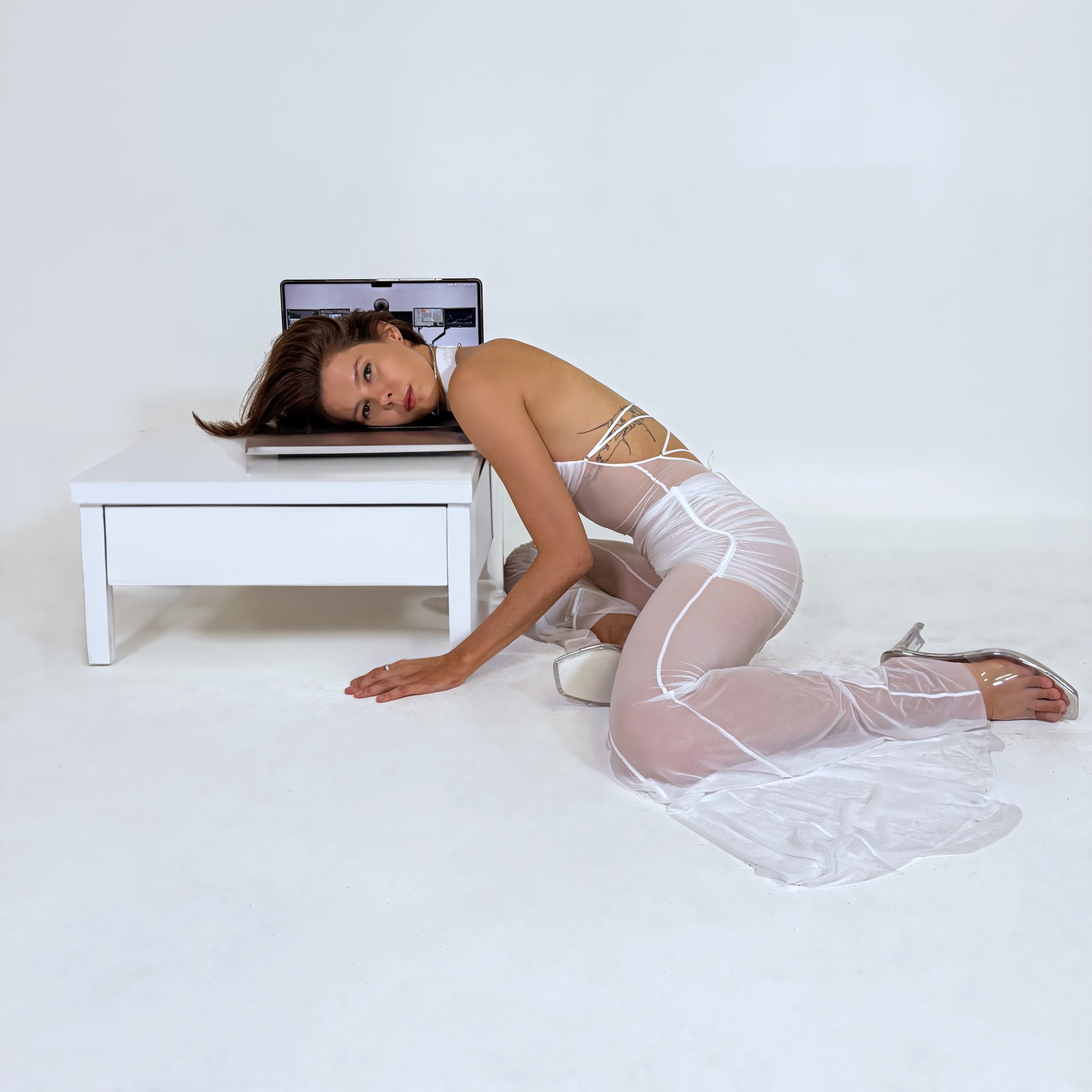
In today’s increasingly digital world, where the self is uploaded, shaped, and endlessly re-performed, DARYNKA consistently finds the most inspiration at the intersection of real and virtual.
A Ukrainian-born music producer and visual artist, she’s now constantly on the move, splitting time between cities like San Francisco, Dubai, and Bangkok. The fluidity and unpredictability of her daily life mirrors that of her musical output: her newest EP, “body.404“, is a highly experimental, fractured journey through identity, intimacy, and embodiment in a digital world that erodes the boundaries of each.
Once an art curator with a strong foundation in visual storytelling, DARYNKA now creates soundscapes that are sculptural, atmospheric, and emotionally raw. Her music speaks from a space between collapse and transformation, blending deconstructed club rhythms, cinematic swells, and hyper-personal vocal fragments into structures that feel both familiar and uncertain. She often forgoes traditional musical form, and lets tension and urgency take center stage.
With “body.404”, she performs the disintegration of the physical body and the creation of the virtual one. The result is a sensory architecture of shifting forms, where touch is virtual, desire is glitchy, and identity is fluid by design. We had the chance to sit down with DARYNKA to see how she uses her art to navigate instability, find meaning in motion, and stitch together new forms of being in the blur between real and virtual. Take a listen to “body.404”, and read onwards!
“body.404″ explores identity in a hyper-digital world — how do you personally define identity when it’s constantly in flux?
For the last year I’ve been a traveler without a permanent base. I’ve stayed in Sri Lanka, Indonesia, Thailand, Saudi Arabia, Pakistan, and the US (California, Florida, New York). This constant movement makes you see yourself in different contexts and cultures. Identity is not a fixed thing — it shifts depending on where you are, who you’re with, and especially how you’re seen.
That experience made me reflect a lot on what I’m actually made of — how many versions of me exist depending on the space I’m in. Seeing the diversity of the world, and the endless ways people perceive and express themselves, made me realize how fluid self-perception can be.
At the same time, I was living heavily online — carrying my whole world in a backpack, staying emotionally connected to people who were often far away. In real life, I barely knew anyone around me, but online I was constantly surrounded with people.
This life situation is probably what inspired me in the first place to explore how our identity / representation works with the virtual world and our physical bodies.
I think identity isn’t our personality or something we’re born with. It’s more about how we’re represented — how we show up in different spaces, and how others reflect that back. “body.404” is a collection of those versions — uploaded, extended, fragile, sensual, imagined. It doesn’t try to resolve the fragmentation. It simply allows all versions to exist at once.
When you’re building out a story like the one in “body.404”, where does the “real” body end and the virtual one begin?
Honestly, I’m not even sure where the real body ends anymore. I feel like we carry our virtual selves with us all the time — in our phones, our profiles, the way we think about how we’re being seen. For example, we intentionally take photos which we know we are going to share online. It’s not just something we “log into” — it’s part of how we exist now. We watch each other’s life’s and updates online, and that’s how we often feel that we are staying in touch with someone without even texting or speaking with this person for years
But at the same time, life is all about our physical body and our presence in the moment in one place at one time. It’s a contrast to what we experience online. And, this tension was the most interesting when I was building this EP.
This is a fictional EP — none of the described situations are real, but they are possible in a future world where AI becomes more human-like and forms emotional connections with people, and where the body is seen as a limiting thing in the endless cyber space
I started exploring ideas like these in my visual art projects, like “Inside the Unknown”, which also explores the body in virtual systems and identity under technological pressure.
Your music often favors atmosphere and tension over traditional form. What are the benefits to ditching conventional structure when it comes to the kind of story you try to tell in your music?
I feel like this form reflects better the idea of the EP: fragmentation of identity, of feeling, of the body itself. So, I didn’t want to make it in clean, predictable forms. The tension and atmosphere are there to reflect that emotional dissonance. It’s not supposed to resolve — it’s supposed to reflect the state of living in this messy digital world.
When you do something unconventional, you can surprise people. You can make them feel something unexpected — and that’s where the real connection happens. I personally like to be surprised, so that’s what I bring to my music, too
This way of thinking comes from my work as a visual artist and curator — where storytelling is often nonlinear and based on spatial, immersive, or symbolic logic rather than strict structure.
What does your sound design workflow look like when trying to create textures that feel both digital and deeply human?
I look for patterns which feel like an error, but still stay a pattern and make us wonder if that was a mistake or not. Because errors, they are human. And patterns, they are musical and they can feel machine-like. That tension — between something that could be an error and something that feels intentional — is where I find a sweet spot.
I often use tools like a granulator to achieve this. It allows me to stretch, fragment, and manipulate recordings in ways that introduce unexpected textures — something breathy, torn, or trembling. I’ll take a raw instrumental sound and break it apart until it feels like it’s on the edge of falling apart, but still holds together emotionally.
When producing, how do you translate abstract emotions into something that listeners can actually feel?
I imagine myself being an AI! I don’t feel cold or detached from these tech-y topics anymore — it actually gives me a completely different perspective. It’s like processing emotions through a system trained on human experiences, but interpreting them in a new, slightly alien way.
Are there particular tools, plugins, or techniques you use on the EP to intentionally blur the line between human and machine?
Yes — both in sound design and in lyrics. I try to keep the listener unsure: is this voice human or AI? I intentionally write words that could come from either — phrases that feel emotionally true but contextually ambiguous. You’re never quite sure who’s speaking, and that’s the point.
I also manipulate the voice a lot — slicing, glitching, automating pitch and formants so it shifts between sounding masculine, childlike, synthetic, and real. It creates this strange feeling where the voice doesn’t feel fully real, but still comes very close — almost too close. That intimacy makes it feel deeply human, even when it clearly isn’t.
What would you say to a producer who wants to explore more conceptual or emotional territory but doesn’t know where to begin?
I guess it always starts with asking yourself what you want to say — and what it really personally means to you.
For me, it’s important not to slip into something that sounds nice or feels cool, but has nothing to do with the topic I started from. I try to keep a clear vision — but not make it so tight that it becomes too literal or leaves no room for interpretation.
I also feel that finding a personal angle is essential. Even if the project is completely fictional, something inside it should still be real (you can leave your listeners guessing what part that was). It will give unique and unexpected details to the music and that’s usually what makes it emotionally resonant.
I started out as a curator of art exhibitions. Before inviting artists (and some projects included up to 50 artists and hundreds of artworks) I would always begin by writing down the concept. I’d imagine the atmosphere of the space and how I wanted people to feel in it. This is the same approach I now use when creating my EPs: I start by writing down the concept and imagining how it should feel — and only then do I begin producing.
What excites (or worries) you most about the future of music in a world that’s increasingly virtual and increasingly intimate?
It’s both fascinating and a little unsettling. On one hand, I love how close music can feel now — a voice singing in your ear, a tiny world inside your headphones. There’s something beautiful about how intimate it’s become.
But at the same time, it’s happening in a space that’s not physical — and that changes how we connect. Everything is curated, filtered through algorithms recommendations. You can reach people across the world instantly, but sometimes I wonder if we’re actually connecting.
I think I’m drawn to that contradiction — the closeness and the disconnection. That’s what I try to explore in my music too.
Check out “body.404” here.

Ben Lepper is a music producer and journalist from Boston, Massachusetts.