Coldplay’s “The Karate Kid” is one of those songs that, on the surface, feels pretty straightforward. But dig a little deeper, and you start to see how it taps into some universal themes that poets have been wrestling with for centuries—things like longing, disconnection, and the search for meaning.
As someone with a background in English Literature and Creative Writing, I’m naturally drawn to pulling apart lyrics like these, looking for layers that might not be obvious at first. These are just my thoughts and interpretations, but I think using classic poetry as a lens can really open up new ways to see what’s going on in a song like this.
In this analysis, I want to take a closer look at how Coldplay’s lyrics intersect with the works of Rainer Maria Rilke, Robert Frost, and Pablo Neruda.
Why?
Because all three poets are masters of capturing that same sense of searching and uncertainty that runs through the lyrics of “The Karate Kid.” Rilke’s existential questioning in Duino Elegies, Frost’s solitary walks through the night, and Neruda’s meditations on lost love and regret—all of these provide a great framework to break down the song’s deeper meanings. This is just a good excuse to stretch some literary comparisons and see what these classic writers can tell us about Coldplay’s modern take on these timeless themes.
See Coldplay Live On Tour Here👈
Snag Coldplay On Vinyl Here👈
the karate kid coldplay lyrics
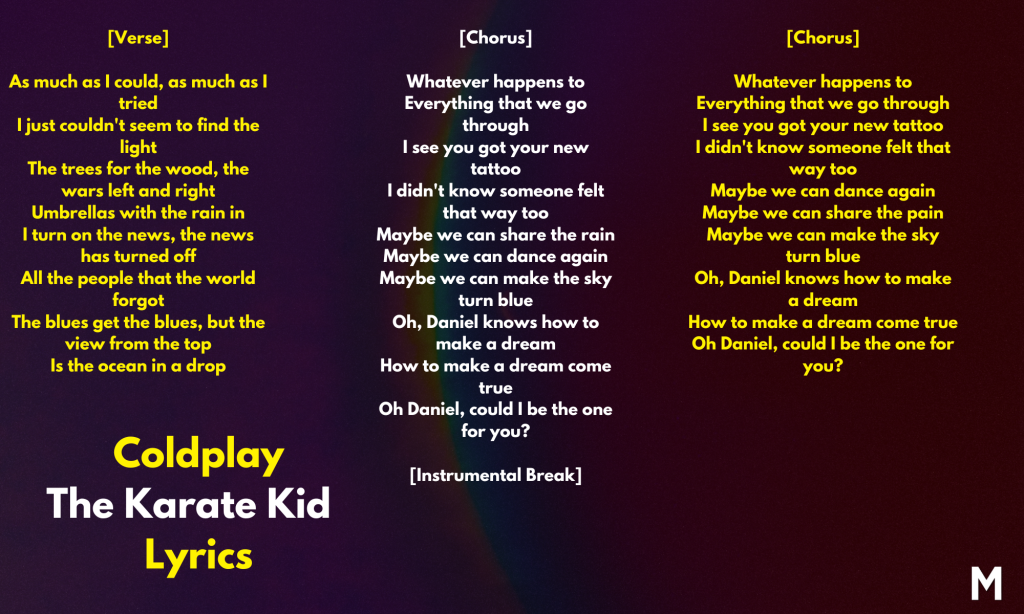
The Karate Kid Coldplay Meaning
When I look at these lyrics, I’m struck by how the narrator’s struggle for clarity and meaning feels so familiar, yet intensely personal. The opening lines of the verse set the tone perfectly:
“As much as I could, as much as I tried
I just couldn’t seem to find the light.”
The repetition here captures a relentless effort—almost a desperation—to find something that keeps slipping out of reach. To me, this idea of striving and failing to find “the light” suggests the search for hope or understanding, something that feels lost or obscured. It reminds me a lot of Rainer Maria Rilke’s reflections in Duino Elegies, where he wrestles with the human desire to grasp meaning. In the first elegy, Rilke poses the question, “Who, if I cried out, would hear me among the angelic orders?” That same sense of crying out, of wanting to be heard or to understand, runs through these lyrics. Both Rilke and the narrator here are grappling with an existential uncertainty—trying to find light, meaning, or connection in a world that feels indifferent.
The verse continues with:
“The trees for the wood, the wars left and right
Umbrellas with the rain in.”
These images are complex and layered. The phrase “trees for the wood” flips the typical idiom “can’t see the forest for the trees,” which usually means getting caught up in small details and missing the bigger picture. Here, the speaker seems lost in the vastness of their surroundings—the “wood” becomes overwhelming, and the “trees” disappear into this larger, unmanageable chaos. That disorientation extends further with “the wars left and right,” suggesting conflict on all sides, both personal and external. There’s a sense that no matter which direction the speaker turns, they’re confronted by challenges they can’t control.
Robert Frost’s Acquainted with the Night echoes this feeling of disconnection and wandering through a world that’s dark and uncertain. In Frost’s poem, the speaker says:
“I have been one acquainted with the night.
I have walked out in rain—and back in rain.”
This image of walking back and forth through the rain—just as the song lyrics use “umbrellas with the rain in”—reinforces the idea of being in a place where you’re supposed to be protected or safe, yet still feeling exposed and vulnerable. It’s like no matter what the speaker in the song tries to do, the rain seeps in and touches them, just as Frost’s narrator remains drenched and isolated despite being surrounded by the familiar.
When the song says:
“I turn on the news, the news has turned off
All the people that the world forgot,”
there’s a clear sense of disillusionment. Turning on the news should offer information or clarity, but instead, it’s “turned off,” leaving the speaker disconnected and unaware. This line isn’t just about the literal news; it’s about feeling cut off from the world’s events, a passive observer rather than an engaged participant. The mention of “all the people that the world forgot” suggests a world that’s moving on without acknowledging those left behind. This isolation and sense of invisibility aren’t just societal—they’re deeply personal.
As we move into the chorus, we see a shift toward a desire for connection and hope:
“Whatever happens to
Everything that we go through.”
There’s something tentative in these lines, like the speaker is reflecting on shared experiences and wondering where they’ve gone. This questioning brings to mind Pablo Neruda’s Tonight I Can Write the Saddest Lines, where he writes:
“Love is so short, forgetting is so long.”
Neruda’s line captures the pain of realizing that something so intense and meaningful can dissipate over time. The song’s narrator is experiencing a similar feeling, looking back at what “we go through” and wondering what’s left of it now. It’s a yearning to hold onto those moments, to find significance in them, even as they slip away.
The next few lines in the chorus reveal a flicker of hope:
“Maybe we can share the rain
Maybe we can dance again.”
To me, “sharing the rain” is a poignant image. Rain typically symbolizes sadness or hardship, but the act of sharing it suggests a willingness to face those difficulties together. There’s something almost hopeful in this—if two people can stand together in the rain, they’re not alone anymore. The line “maybe we can dance again” hints at rekindling joy or spontaneity that’s been lost. It’s a subtle suggestion that things could get better, that there’s still room for movement and grace even amidst the downpour.
Rilke touches on this idea of hope and transformation through suffering in his elegies as well. In the ninth elegy, he writes:
“Perhaps the keeping still of the heart is the beginning of a new embrace.”
Rilke suggests that embracing stillness or hardship can be the first step toward renewal, and I think the song is hinting at a similar sentiment. The rain, while uncomfortable and difficult, could be a prelude to something beautiful like dancing. The juxtaposition of these two images—rain and dance—creates a sense of possibility.
The repeated lines in the chorus:
“Oh Daniel knows how to make a dream
How to make a dream come true.”
position Daniel as a figure of hope or aspiration. It’s as if Daniel holds the key to transforming these dreams into reality, making the ambiguity of life more bearable. I see Daniel not as a literal person, but more as a representation of whatever it is that the speaker believes will bring fulfillment—a kind of ideal or inspiration. This reminds me again of Frost’s reliance on the luminary clock in Acquainted with the Night. The clock doesn’t speak, and it doesn’t answer the narrator’s questions, but it’s a presence that offers a quiet, almost distant reassurance.
Finally, when the narrator asks, “Oh Daniel, could I be the one for you?” it’s a vulnerable plea for validation and acceptance. It’s like saying, “I want to be a part of whatever it is that makes dreams come true.” There’s a deep longing here—to be seen, to be part of something meaningful, and to share the burden of existence. Pablo Neruda expresses a similar sentiment in Tonight I Can Write the Saddest Lines, when he concludes:
“I no longer love her, that’s certain, but maybe I love her.
Love is so short, forgetting is so long.”
Both Neruda and the song’s speaker wrestle with the pain of distance and disconnection but hold onto a thread of hope that love or connection can somehow bridge the gap, no matter how wide.
So, through these lyrics, we see how longing, disconnection, and the search for meaning play out against a backdrop of societal disillusionment and personal reflection. By drawing on the works of Rilke, Frost, and Neruda, we can see how these themes are not just contemporary concerns but part of a larger, ongoing dialogue about what it means to be human—to search, to yearn, and ultimately, to hope.
Themes, Meanings, and Main Takeaways
The themes explored in this song’s lyrics—longing, disconnection, and the pursuit of meaning—find parallels in the works of Rainer Maria Rilke, Robert Frost, and Pablo Neruda. All three poets delve into similar struggles, wrestling with the complexities of human experience, which ultimately helps us better understand the deeper truths embedded in the song.
The sense of yearning conveyed in lines like “As much as I could, as much as I tried / I just couldn’t seem to find the light” echoes Rilke’s own reflections on the desire to reach beyond our limitations. Rilke, particularly in Duino Elegies, speaks to this eternal striving when he writes, “Who has turned us around like this, so that we always, whatever we do, retain the attitude of someone who is departing?”
This shared imagery of seeking something just out of reach positions the song’s narrator alongside Rilke’s speaker, both caught in a state of perpetual searching—whether for light, meaning, or connection—without ever truly arriving at their destination.
Moreover, the motif of isolation in the song’s verses—such as the detached observation that “the news has turned off / All the people that the world forgot”—mirrors the introspective solitude that Robert Frost captures in Acquainted with the Night. Frost’s narrator also feels cut off from the world, wandering through a night that offers no answers or comfort. When Frost writes, “I have looked down the saddest city lane,” he’s evoking the same kind of disengagement and loneliness that the song’s narrator feels when confronting a world that seems indifferent and distant.
This alignment between the lyrics and Frost’s poem highlights a shared sense of separation from a world that no longer communicates or cares, deepening the song’s themes of disconnection and societal alienation.
Lastly, the repeated references to “Daniel” as someone who “knows how to make a dream come true” reflect a glimmer of hope amidst all this uncertainty. It’s as if Daniel embodies the possibility of transformation and renewal, much like the fleeting hope expressed in Pablo Neruda’s Tonight I Can Write the Saddest Lines.
When Neruda concludes, “I no longer love her, that’s certain, but maybe I love her,” he captures a contradictory desire to move on while still yearning for a connection. Similarly, the song’s narrator oscillates between acknowledging past disillusionments and reaching out for something new, perhaps with the hope that Daniel—or anyone capable of bringing dreams to life—could be the catalyst for change.
Together, the song and these poems create a tapestry of themes that examine the complex interplay between disconnection and longing, ultimately suggesting that while pain and uncertainty are constants, the potential for renewal and connection always remains within reach.

Will Vance is a professional music producer who has been involved in the industry for the better part of a decade and has been the managing editor at Magnetic Magazine since mid-2022. In that time period, he has published thousands of articles on music production, industry think pieces and educational articles about the music industry. Over the last decade as a professional music producer, Will Vance has also ran multiple successful and highly respected record labels in the industry, including Where The Heart Is Records as well as having launched a new label with a focus on community through Magnetic Magazine. When not running these labels or producing his own music, Vance is likely writing for other top industry sites like Waves or the Hyperbits Masterclass or working on his upcoming book on mindfulness in music production. On the rare chance he's not thinking about music production, he's probably running a game of Dungeons and Dragons with his friends which he has been the dungeon master for for many years.