Table of Contents
Artwork C/O Lady Gaga Press & Interscope Records
Lady Gaga’s new single “Disease” gives us a lot to think about, especially when you start looking at its themes of suffering, control, and salvation. As someone with a background in English lit and creative writing, I can’t help but use this as a good excuse to stretch some literary comparisons and see what classic poetry and even modern fiction can tell us about the deeper meaning of Gaga’s lyrics.
These are just my own thoughts, but by drawing on what poets like John Donne, Sylvia Plath, and Charles Baudelaire have said about pain and healing, I hope to offer a new way of looking at the song.
In “Disease,” Gaga positions the narrator as both a healer and someone who holds power over another’s pain—a mix of help and control that poets have been writing about for centuries. We’ll closely examine the lyrics and how they echo what we see in classic literature. I’m excited to dig into how writers like Donne’s spiritual struggle in Holy Sonnet XIV or Plath’s Lady Lazarus can help us explore what “Disease” might be getting at. Whether Gaga intended these connections or not, it’s always fun to see how songs like this fit into the bigger picture of literary history.
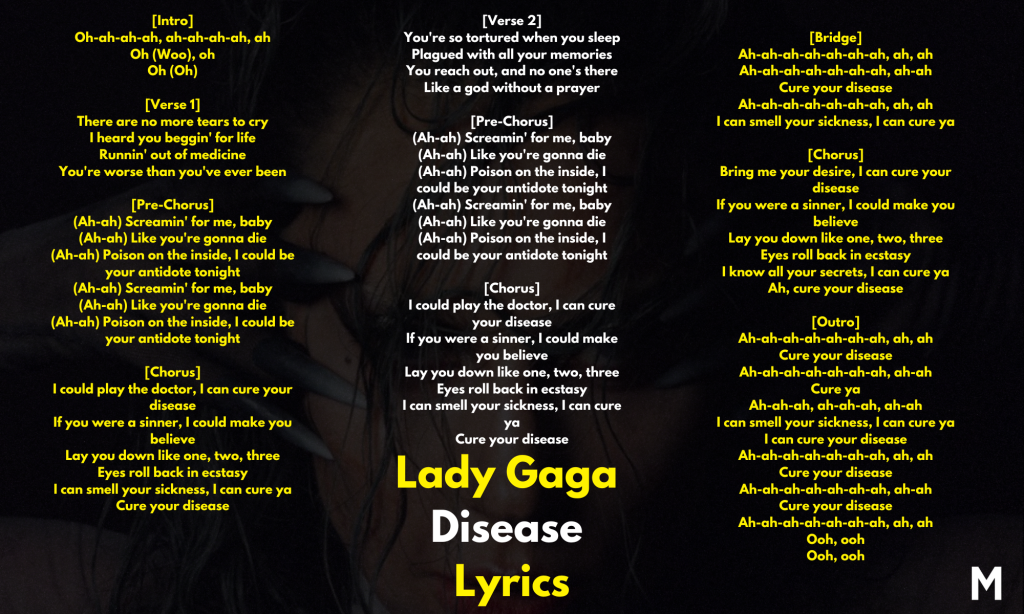
Lady Gaga Disease Lyrics
Lady Gaga Disease Meaning
Alright, let’s keep the focus on the lyrics themselves while using Donne, Plath, and Baudelaire to support and deepen our understanding of what the song is saying. I’ll keep it structured with simple subheadings to guide the analysis.
“There Are No More Tears to Cry”
This opening line, “There are no more tears to cry,” suggests someone who’s gone through a lot of pain—they’re so hurt they can’t even cry anymore. Then, with “I heard you begging for life,” the person in the song is not just sad but desperate, almost like they’re pleading to be saved. This theme of wanting to be saved reminds me of John Donne’s line in “Holy Sonnet XIV” where he says, “Batter my heart, three-person’d God.” Just like the person in Donne’s poem begs for God’s help, the one in the song is pleading for some sort of rescue, showing us how intense their pain has become.
This pain in both Donne’s poem and the song isn’t just simple sadness; it’s almost like they’re asking to be completely changed. The narrator here seems drawn to this suffering, like they want to be the person who can help fix it.
“Screamin’ for Me, Baby, Like You’re Gonna Die”
In the pre-chorus, the line “Screamin’ for me, baby, like you’re gonna die” brings a new intensity. The narrator isn’t just offering comfort—they’re placing themselves as the only solution, almost like they want to become necessary to the person in pain. They add, “Poison on the inside, I could be your antidote tonight,” which makes them sound like they’re saying, “I am the cure you need.” This line feels powerful, but it also brings up the idea of control, as if the narrator’s “antidote” could make the person dependent on them.
This reminds me of Sylvia Plath’s “Lady Lazarus,” where she writes, “Dying / Is an art, like everything else. / I do it exceptionally well.” Plath’s speaker has a complex relationship with her own suffering, almost embracing it as something she can control. In the song, though, the narrator is stepping in as the “cure” for the other’s suffering, which suggests a different kind of power—one where they want to own or control that pain rather than letting the person go through it on their own.
“I Could Play the Doctor, I Can Cure Your Disease”
The chorus makes the narrator’s promise even clearer: “I could play the doctor, I can cure your disease.” They’re stepping into a role that’s almost god-like here, saying they can “cure” whatever is causing pain. But they go further with, “If you were a sinner, I could make you believe.” Now, it’s not just about healing; it’s also about making the other person believe in them, maybe even trust them completely.
John Donne speaks to this in “Holy Sonnet XIV,” where he writes, “Take me to you, imprison me, for I, / Except you enthrall me, never shall be free.” Here, Donne’s speaker sees freedom as something that can only come from surrender. In the song, the narrator seems to be offering a similar kind of “freedom” that involves trust and belief, but it might come at a price—giving up control to the narrator who claims to be the cure.
“Like a God Without a Prayer”
In the second verse, the song adds another layer: “You’re so tortured when you sleep / Plagued with all your memories.” This person is haunted by their own past, unable to escape from their memories. Then, the line “Like a god without a prayer” suggests they feel alone, like they should be strong but have no one to turn to for support.
This echoes Charles Baudelaire’s “The Sick Muse” where he says, “My poor Muse, alas! What ails you today? / Your hollow eyes are full of nocturnal visions.” Baudelaire’s Muse, like the person in the song, is burdened by dark visions that she can’t escape. In both cases, there’s an inner darkness that pulls them down, making them feel alone. This struggle seems to make the person in the song need the narrator even more, almost as if their loneliness draws the narrator closer, wanting to be the one who fills that void.
“Ah-ah-ah-ah-ah-ah-ah, Cure Your Disease”
The bridge chants “Ah-ah-ah-ah-ah-ah-ah, Cure your disease” over and over, as if the narrator is trying to hypnotize or convince the other person that they have the power to heal them. This repetition feels almost like a spell, reinforcing that the narrator believes they’re the only answer.
In “Holy Sonnet XIV,” Donne’s speaker uses repetition in a similar way, asking God to save him with a powerful, almost forceful kind of love. Here, the narrator in the song repeats their promise of a “cure” as if they want to make it impossible for the other person to resist. This chant-like phrasing adds to the sense that the narrator might be taking control, even if it seems like they’re helping.
“Bring Me Your Desire, I Can Cure Your Disease”
In the final chorus, the narrator goes even further, saying, “Bring me your desire, I can cure your disease.” Now, they’re not just offering help—they’re asking for something in return. They want the person’s desire, their secrets, making the “cure” sound like it has a cost. The narrator might want to know everything about the other person, showing that their help comes with strings attached.
Baudelaire’s line in “The Sick Muse”—“The Muse’s blood, her sacred juice, is oozing like a wound”—relates here. Baudelaire’s speaker sees beauty in pain, and it almost feels like the narrator in the song does too. They want to get close to this suffering and maybe even take something from it, making the “cure” sound like it could bind the other person to them.
Themes, Meanings, and Main Takeaways
Lady Gaga’s “Disease” explores a central tension between pain and salvation, with the narrator offering themselves as both healer and controller. The song’s lyrics repeatedly emphasize themes of suffering—“There are no more tears to cry / I heard you begging for life”—revealing the desperate state of someone in deep emotional turmoil. This echoes the plea for salvation in John Donne’s “Holy Sonnet XIV” where Donne writes, “Batter my heart, three-person’d God”—asking to be forcibly purified, much like the narrator in “Disease” offers to “cure” another’s pain. Both show a dynamic where healing can require painful surrender, and both imply that salvation might come at the cost of control.
In the song, we also see the narrator assert themselves as the only antidote for the other’s suffering—“Poison on the inside, I could be your antidote tonight.” This mirrors Sylvia Plath’s exploration of pain and rebirth in “Lady Lazarus,” where she writes, “Dying / Is an art, like everything else.” Both Plath and Gaga’s narrator use imagery of sickness and resurrection to suggest that healing comes from embracing the darker aspects of life, but the power of this healing is also tied to control. The narrator’s repeated promise to “cure” the other person’s disease starts to feel like it blurs the lines between true salvation and a kind of emotional captivity, something we also see in Plath’s relationship with her own suffering.
Finally, Baudelaire’s “The Sick Muse” presents a similar duality of suffering and creativity, where pain produces art but leaves the muse trapped. In “Disease,” Gaga’s narrator embodies this concept, as they seem both drawn to and needed by the other person’s torment. Lines like “I know all your secrets, I can cure ya” emphasize the desire to take control over the other’s vulnerability. This mirrors Baudelaire’s view that beauty and pain are intertwined, where suffering becomes not just a condition but a source of power. Both the song and these poems reveal how healing can sometimes feel inseparable from the control or manipulation of another person’s pain, creating a complex and nuanced relationship between savior and sufferer.
Find A Meaning Unique To You!

Want to unlock even more layers of meaning in songs like “Disease”?
Download our free eBook, The Art of Interpretation: Discovering Personal Meaning in Music. In it, I share techniques that help readers connect song lyrics to deeper emotional truths, themes, and personal experiences.
In the same way I’ve tied Lady Gaga’s lyrics to classic poems, you’ll learn how to find your own unique connections—whether they come from literature, your life experiences, or even modern fiction and fantasy. It’s a great way to explore how music speaks to you on a deeper level, and you might be surprised at what you discover.
The best part? You don’t need to rely on my interpretations—you can arrive at your own! The Art of Interpretation walks you through ways to break down song lyrics and make them resonate in ways that feel personal to you.
Whether you’re diving into the meaning of your favorite songs or just starting to think more deeply about music, this free guide will help you find new ways to connect with what you’re listening to. Download it today and start interpreting music in a whole new way!

Will Vance is a professional music producer who has been involved in the industry for the better part of a decade and has been the managing editor at Magnetic Magazine since mid-2022. In that time period, he has published thousands of articles on music production, industry think pieces and educational articles about the music industry. Over the last decade as a professional music producer, Will Vance has also ran multiple successful and highly respected record labels in the industry, including Where The Heart Is Records as well as having launched a new label with a focus on community through Magnetic Magazine. When not running these labels or producing his own music, Vance is likely writing for other top industry sites like Waves or the Hyperbits Masterclass or working on his upcoming book on mindfulness in music production. On the rare chance he's not thinking about music production, he's probably running a game of Dungeons and Dragons with his friends which he has been the dungeon master for for many years.