Table of Contents
Image C/O Debbie Ellis & Black Brunswicker
We sat down with Black Brunswicker to get the inside scoop on how “Down at the Creek” came to life. Known for blending delicate fingerpicking with ambient textures, the Chicago-based artist walks us through the tools and techniques that shaped the track. From layering tape loops on a Tascam 424 to running guitar swells through the OP-1, this one’s a deep dive into gear-driven creativity.
At the core of the track is the acoustic guitar—recorded with minimal fuss but maximum vibe. Brunswicker leans heavily on delay and reverb pedals to craft those lush, atmospheric swells, and the pedalboard runs straight into analog tape loops. The result? A mix that feels organic, raw, and refreshingly hands-on. And when it came time to stitch it all together, Reason handled the mix—no frills, just EQ, compression, and panning to let the tape loops and field recordings breathe.
In this interview, we break down every step of the process. Whether you’re a pedalhead, an analog purist, or just looking for ways to keep your music organic, Brunswicker drops some serious gems on staying inspired and finding your own workflow. Let’s get into it!
Guitar + Pedalboard

First and foremost, I’m a guitar player. Acoustic guitar is the primary instrument that I use to compose and record all of my music, including the textural ambient parts that stretch beyond typical guitar sounds. My typical workflow is to run my guitar through my pedalboard and use a lot of delay and reverb to create a washy ambient sound. Using a volume pedal allows me to cut the attack and create nice ambient swells
I recorded everything using one guitar, my Recording King RO-T16 000 equipped with an LR Baggs M1 pickup in DGDEGD tuning (with a capo on the 4th fret). Everything on this album was recorded using the same guitar setup for a cohesive sound and feel.
Acoustic guitar tends to be underrated and underutilized in the ambient guitar community, which I think is a shame. Acoustic guitars just have so much depth, beauty, and resonance that it’s a real shame that more folks aren’t using them more to create this kind of music. Acoustics can be a bit of a challenge to get a good ambient sound with pedals and effects depending on whether you’re using a pickup or micing your guitar. I typically find magnetic pickups tend to sound better when using effects (and I’ve found you can tell the difference between using an acoustic equipped with a magnetic pickup versus a regular electric guitar).
Tascam 424 (for tape loops and recording)
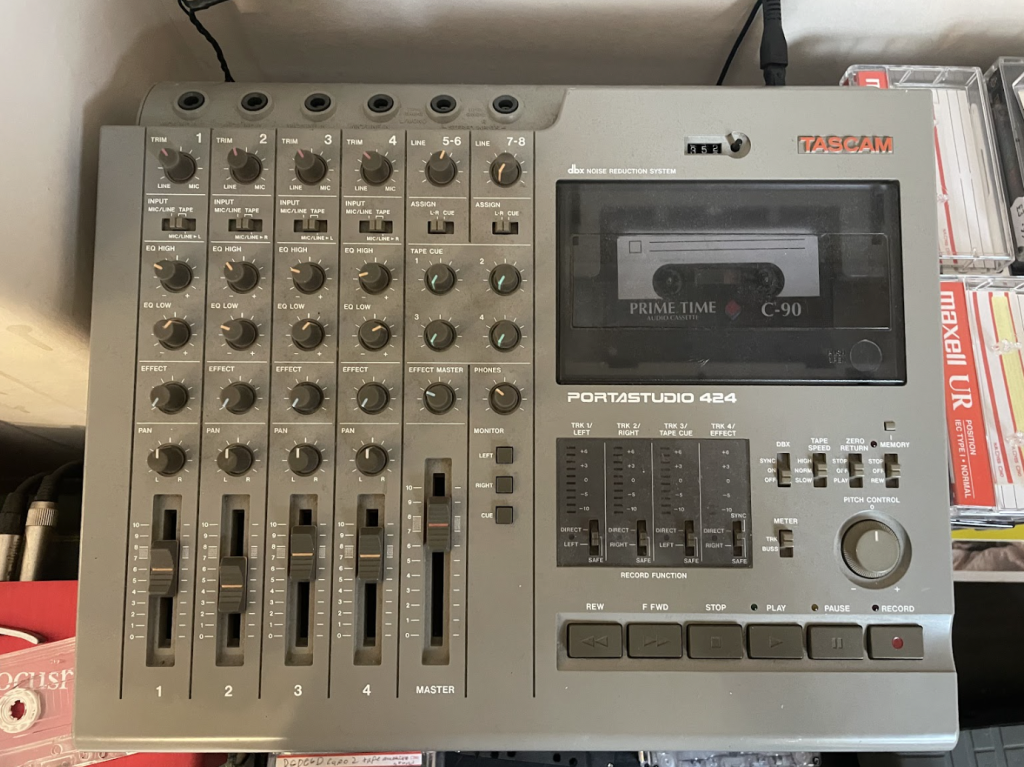
Tascam recorders and tape loops have played a big role in the way I create music since starting Black Brunswicker. I use a computer or DAW when necessary, but I prefer recording to tape. I like working with tape and analog equipment because I like having something I can touch and physically manipulate. With tape, there’s also a bit of a chaotic element at play too – tapes can warp, distort, or blank out – which I’ve really grown to love the unpredictability of tape.
Down at the Creek was a bit of a throwback track for me to the early days of Black Brunswicker, when I used tape loops of ambient guitar as the primary compositional tool. Ahead of creating the track, I recorded some improvised guitar onto some cassette tape loops using my Tascam 424. These loops formed the primary ambient textures you hear on this track and others from my new album. For this track, I ran the tape loops through my pedalboard and into my OP-1 which I was using to record. I controlled the faders on the 4-track to blend in and swell in each layer, giving some life and movement to the textures and ambience. From there, I layered in more tape loops and field recording loops. I recorded both Down at the Creek and View from the Lookout Tower in the same session using the same tape loops.
Working with tape loops can be fun but challenging. They’ve picked more prominence in recent years with social media influencers sharing their tape loop experiments for thousands of followers to see. For me though, it’s an alternative to the modern digital way of working in a box. I find it uninspiring to work on music on a screen, so having analog equipment that I can touch and feel while I work on my craft is very meaningful to me.
Teenage Engineering OP-1 Tape Mode (for vocal and trumpet loops)

I was a bit apprehensive at first to try an OP-1. I felt like an OP-1 might be too electronic for someone who sees themself primarily as a folk guitar player. What I’ve found though is that the tape mode shares many of the similarities to what I love about working with a Tascam. It’s a 4-track, it’s quite limited, and has very few mastering effects. I see it more now as a portable tape machine and as another effect for my guitar rather than a toy that makes bleep bloops that I cannot comprehend.
For Down at the Creek and the rest of my new album, I used the OP-1 in two ways. Firstly, to compile and mix the music itself, whether it was acoustic guitar, field recordings, tape loops, or the collaborative loops provided by my Mancunian friends. Secondly, I also used the OP-1 as a looper of sorts by loading Joel Harries’ trumpet and Emily Mercer’s vocal loops onto it and creating playback loops in the Tape mode. From there, I ran the output of the OP-1 into my pedalboard again and used my volume pedal to control the attack to subtly swell in the loops. The forward/reverse playback also came in very handy, and I was able to turn two simple vocal loops into an ethereal sea of sound.
I set so many creative constraints for my music, like avoiding a DAW and a ban on synths, so trying something new like using an OP-1 was a big change for me. Don’t expect to hear any synth pop or drumbeats from me in the future, but I do think challenging yourself to try something new while keeping true to yourself and the creative constraints you’ve set for yourself can be a really worthwhile endeavor. It’s ok to stick to what you know best, but it’s also nice sometimes to try new things.
Mixing in Reason
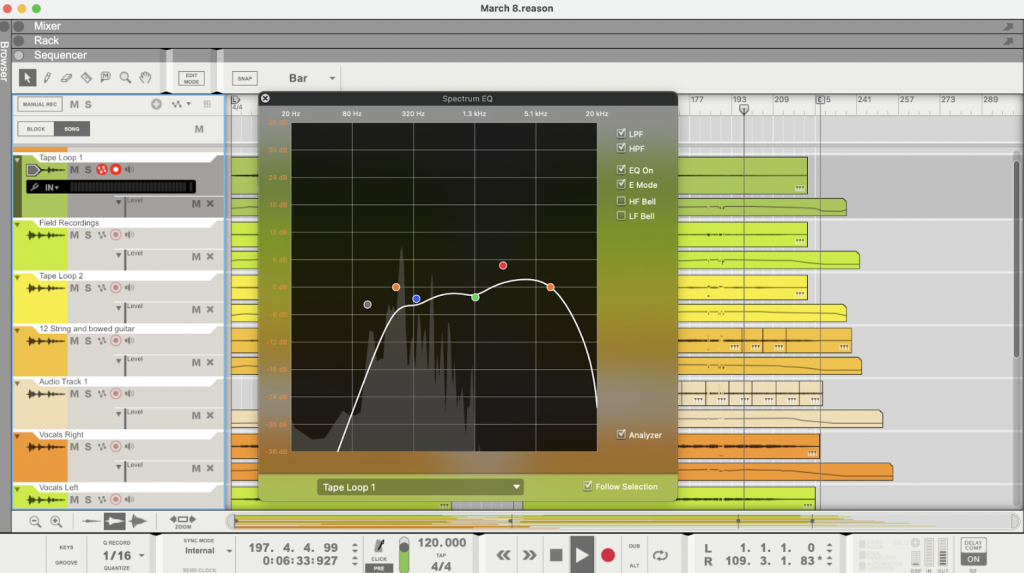
Now for the boring part. The DAW is where music generally goes to die for me. I record primarily to tape and have loads of tapes sitting around with music ready to go, but I always dread when I have to digitize it and mix it in the DAW. I find this process tedious, but I’ve created some workflows for myself to make it easier and less painful. I use Reason to mix and Reaper to master my tracks. I learned how to use Reason when I was in college at Indiana University when I took a music production course and have stuck with it. I like the fact that the UI emulates old rack mounted equipment and that sounds change in real time when you twiddle knobs– yay good UX!
The bulk of the mixing work I do in Reason is mainly EQ, some compression, and stereo panning the individual tracks. Working with so many layers and textures, I spend the bulk of my time in a Parametric EQ dialing in the right mix to make sure everything feels very level. I apply effects and EQ across each individual track, every instrument, loop, and layer. I don’t know what a sidechain, automation, or a send is, nor do I care to learn. I have a pretty fixed way of mixing everything, and find that if I’m able to get a good recording and mix using my Tascams and OP-1, then I don’t have to spend as much time working in Reason.
I realize that I have a unique workflow to recording music that skews more towards an organic analog approach with guitar and pedals, and that it might not be for everyone. I know that you can do a lot “in the box,” and that there’s exciting and creative ways to use a DAW and synths to make interesting music, but it just doesn’t really resonate with me or excites me in the same way that testing out a new pedal chain or messing around with tape loops. Whatever way you create music is fine and valid, but I think the key is to find a process that resonates with you creatively. I found this way of working through years of tinkering and experimenting, so I think there’s nothing wrong with trying new things till you find the right way of creating music for yourself.
Quick Fire Tips For Making Ambient Folk
Tip #1: Sell your synths. Buy a guitar and some delay pedals. Stack some fuzzes. Drone out. (I say in a half joking way)
Tip #2: It’s ok to take time to find a sound or workflow that’s right for you. Experimenting is part of the joy of creating music!
Tip #3: If you’re a guitar player, explore playing around with open tunings. Finding open tunings that work with my fingerpicking technique opened so many new doors for me, especially when paired with lots of delay and reverb.

Will Vance is a professional music producer who has been involved in the industry for the better part of a decade and has been the managing editor at Magnetic Magazine since mid-2022. In that time period, he has published thousands of articles on music production, industry think pieces and educational articles about the music industry. Over the last decade as a professional music producer, Will Vance has also ran multiple successful and highly respected record labels in the industry, including Where The Heart Is Records as well as having launched a new label with a focus on community through Magnetic Magazine. When not running these labels or producing his own music, Vance is likely writing for other top industry sites like Waves or the Hyperbits Masterclass or working on his upcoming book on mindfulness in music production. On the rare chance he's not thinking about music production, he's probably running a game of Dungeons and Dragons with his friends which he has been the dungeon master for for many years.