Table of Contents
Charli XCX’s “Sympathy Is a Knife” hits hard with its raw honesty and unfiltered look at insecurity, envy, and mental struggle. II want to take a step back and dive into these lyrics from a different angle, using my background in English literature and creative writing to draw some broader connections to themes we see across both classic and modern poetry.
These are just my personal takes, but I’m hoping to add a new layer of interpretation by exploring how Charli’s work lines up with—and sometimes challenges—literary history’s most well-known depictions of emotional turmoil.
I’ll be referencing poets like Elizabeth Bishop and Fernando Pessoa, as well as touching on more contemporary voices like Louise Glück, to highlight how Charli’s lyrics speak to experiences that transcend genre and time. It’s a good excuse to stretch out some literary comparisons and see what Pessoa’s fragmented identity, Bishop’s anxiety, or Glück’s existential angst might add to our understanding of “Sympathy Is a Knife.”
Ultimately, I think it’s all about showing how even pop lyrics can dig into these deep emotional spaces, making them both deeply personal and widely relatable.
🔥 🔥 🔥 See Charli XCX Live In Concert! 🔥 🔥 🔥
Sympathy Is a Knife Lyrics
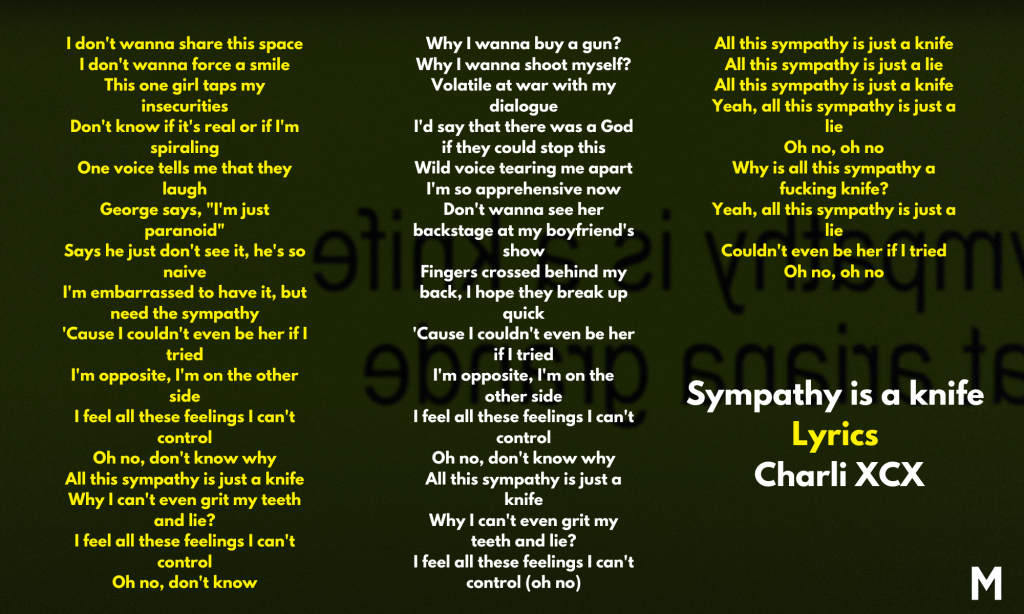
Charli XCX Sympathy Is a Knife Meaning
Alright, let’s dive deeper into these lyrics. What immediately jumps out at me is that the song’s narrator is grappling with feelings of jealousy, mental health struggles, and isolation—all while reaching for some kind of connection or understanding.
These themes are pretty universal and have been explored by countless poets over time, but what makes these lyrics compelling is how they frame these struggles in the context of modern, everyday experiences.
“This one girl taps my insecurities”: Insecurity and Self-Doubt
The song’s opening line, “This one girl taps my insecurities,” immediately sets the tone by highlighting the speaker’s deep-rooted self-doubt. The use of the verb “taps” suggests that these insecurities are always present, but it takes a particular person to bring them to the surface. The speaker’s discomfort around this unnamed girl goes beyond typical envy—it’s more of a confrontation with their own perceived shortcomings. They feel destabilized, and the girl’s mere presence triggers a spiral of negative thoughts.
This kind of self-consciousness and sudden realization of one’s inadequacies is reminiscent of Elizabeth Bishop’s “In the Waiting Room”. In that poem, the young narrator experiences a moment of disorienting self-awareness while reading a magazine. The sensation of suddenly being thrown into a state of acute self-awareness parallels the speaker’s experience in these lyrics, where they are forced to confront themselves through the lens of comparison. Bishop captures how a small trigger can unravel a person’s sense of identity, just as the girl in the song catalyzes the speaker’s emotional turmoil.
🔥 🔥 🔥 See Charli XCX Live In Concert! 🔥 🔥 🔥
“I couldn’t even be her if I tried”: Jealousy and Envy
The lyrics continue, “I couldn’t even be her if I tried / I’m opposite, I’m on the other side.” This refrain emphasizes the speaker’s feelings of inadequacy. The repeated “I’m opposite” underscores a sense of unbridgeable distance between the speaker and this other person, who seemingly embodies everything the speaker wishes they could be. The jealousy here is underscored by frustration and a deep self-criticism that makes the speaker feel like they’ll never measure up.
Louise Glück’s “The Wild Iris” similarly deals with the themes of pain and self-transformation. In her poem, the speaker acknowledges the harshness of existence and the cyclical nature of suffering. The repeated refrain of “I couldn’t even be her if I tried” in the lyrics feels like a resignation to this suffering—a recognition that the gap between the speaker and the girl is insurmountable. While Glück’s poem ultimately finds a sense of rebirth, the lyrics here suggest that the speaker is still trapped in this cycle of comparison and despair.
“Why I wanna buy a gun? / Why I wanna shoot myself?”: Mental Health Struggles
The lyrics suddenly take a dark turn with these lines, bringing the speaker’s internal struggle with self-destructive thoughts to the forefront. The blunt phrasing, “Why I wanna buy a gun? / Why I wanna shoot myself?” communicates a sense of resignation and detachment, as if the speaker is asking these questions almost rhetorically, already familiar with the answers. The emotional turmoil has escalated from insecurity to a place of deep despair, where the speaker feels overwhelmed by their own thoughts.
Fernando Pessoa’s “The Book of Disquiet” explores this kind of fragmented identity and self-alienation. Pessoa’s narrator frequently describes feeling at odds with himself, overwhelmed by conflicting internal voices and a lack of emotional stability. The lyrics’ use of imagery like “volatile at war with my dialogue” reflects this same sense of internal conflict. The speaker is caught in a struggle between wanting to stop the pain and not knowing how to, much like Pessoa’s narrator, who is constantly searching for a way out of his own mind but never quite finds it.
“All this sympathy is just a knife”: Sympathy as a Double-Edged Sword
The line “All this sympathy is just a knife” provides one of the song’s most striking metaphors. Sympathy, often seen as comforting, is perceived here as something sharp and harmful. The speaker rejects the idea that sympathy could help, instead viewing it as a reminder of their own vulnerabilities. The metaphor of a knife suggests that well-meaning words or gestures only serve to cut deeper, making the speaker feel exposed and misunderstood.
Pessoa’s “The Book of Disquiet” also touches on the complexities of human connection. Pessoa often portrays relationships and empathy as ultimately futile, emphasizing that people are fundamentally alone in their experiences. Similarly, the speaker in the song can’t accept sympathy without feeling hurt or resentful. They label it as a “lie,” implying that it doesn’t offer real understanding or comfort.
This sentiment of mistrusting sympathy adds another layer to the speaker’s isolation—they can’t even take solace in others’ attempts to care for them.
“I’m opposite, I’m on the other side”: Isolation and Alienation
The refrain “I’m opposite, I’m on the other side” is repeated throughout the song, reinforcing the speaker’s sense of separation and alienation. This line captures the speaker’s feelings of being emotionally and socially out of place. They are constantly on the “other side,” indicating a deep-seated sense of disconnection not only from the girl they envy but also from everyone around them.
This refrain underscores the theme of isolation that permeates the song.
Elizabeth Bishop’s “In the Waiting Room” captures a similar moment of alienation when the young narrator feels herself detached from her surroundings and her identity. The lyrics echo this sentiment, showing how the speaker’s internal dialogue creates a barrier between them and others. This alienation becomes self-perpetuating, as the speaker can’t bridge the gap between their internal reality and the external world.
“All this sympathy is just a lie / All this sympathy is just a knife”: Conflict Between Internal and External Realities
As the song closes, the repetition of “All this sympathy is just a lie / All this sympathy is just a knife” leaves the listener with a sense of unresolved tension. The speaker’s inability to accept sympathy—seeing it as a source of pain rather than comfort—captures the fundamental conflict in the song. The speaker can’t reconcile their internal turmoil with the way others perceive and try to support them. Sympathy, instead of being a bridge, becomes a wedge that drives them further into isolation.
The juxtaposition between internal emotions and external perceptions is a key theme in Pessoa’s “The Book of Disquiet.” Pessoa’s work often portrays the mind as a battleground where external realities clash with internal chaos. The lyrics mirror this struggle, where the speaker’s inner turmoil is exacerbated by the well-meaning but ultimately painful gestures from others. Sympathy becomes a reminder of their own disconnection, and the refrain of “I feel all these feelings I can’t control” sums up the sense of helplessness and estrangement that defines the entire song.
By comparing these lyrics to the works of Bishop, Glück, and Pessoa, it becomes clear that the song is not just about personal insecurity—it’s a profound exploration of how external triggers can intensify internal conflict, leading to a painful cycle of envy, isolation, and self-doubt. The speaker’s journey through these emotions resonates with these literary themes, showing how the struggle for self-understanding and connection is both deeply personal and universally human.
🔥 🔥 🔥 See Charli XCX Live In Concert! 🔥 🔥 🔥
Themes, Meanings, and Main Takeaways
At its heart, “Sympathy Is a Knife” is a brutal, unflinching look at the way insecurity and jealousy can twist even the most well-intentioned emotions into something harmful. The central refrain—“All this sympathy is just a knife”—captures the painful irony of feeling even more alienated by others’ concern. It’s like the more sympathy the speaker receives, the sharper the sting of their own inadequacy becomes. This tension reminds me a lot of Elizabeth Bishop’s “In the Waiting Room,” where Bishop’s young narrator is suddenly confronted with her own otherness and thrust into a crisis of identity.
Similarly, Charli’s speaker is forced to see themselves through the lens of comparison, feeling small and out of place. The lyrics practically buzz with that same anxious energy, where even the smallest sense of separateness can unravel your entire sense of self.
Lines like “This one girl taps my insecurities” and “I couldn’t even be her if I tried” take this comparison to the extreme, locking the speaker into a cycle of jealousy and self-hatred. It’s not just envy—it’s a complete emotional breakdown. This reminds me of Louise Glück’s “The Wild Iris,” where the poem’s speaker grapples with the inevitability of their own suffering and transformation. In Glück’s world, suffering is both painful and essential, but in Charli’s lyrics, there’s no promise of renewal or escape.
The speaker admits they’re on the “other side,” a place where they can see what they want but can never reach it. That’s the real knife here: the understanding that no matter how much you contort yourself, you’ll always feel like you’re falling short. It’s a kind of self-imposed exile, and that longing to be something you’re not only makes the pain sharper.
This sense of inner turmoil reaches its peak in lines like “Why I wanna buy a gun? / Why I wanna shoot myself?” where the speaker’s thoughts spiral into darker territory. There’s a volatility here that mirrors Fernando Pessoa’s “The Book of Disquiet,” where the narrator is constantly at odds with himself, torn between wanting relief and not knowing how to find it. Charli’s speaker is locked in a similar war with their own mind. “All this sympathy is just a lie”—they can’t accept help or comfort because it only makes them feel more misunderstood.
Pessoa’s relentless self-examination and Charli’s depiction of self-destructive thoughts both show us how damaging it can be when your inner dialogue becomes your worst enemy.
For both writers, the real agony isn’t in being alone but in feeling trapped within yourself, unable to reconcile your internal chaos with the world around you.

Will Vance is a professional music producer who has been involved in the industry for the better part of a decade and has been the managing editor at Magnetic Magazine since mid-2022. In that time period, he has published thousands of articles on music production, industry think pieces and educational articles about the music industry. Over the last decade as a professional music producer, Will Vance has also ran multiple successful and highly respected record labels in the industry, including Where The Heart Is Records as well as having launched a new label with a focus on community through Magnetic Magazine. When not running these labels or producing his own music, Vance is likely writing for other top industry sites like Waves or the Hyperbits Masterclass or working on his upcoming book on mindfulness in music production. On the rare chance he's not thinking about music production, he's probably running a game of Dungeons and Dragons with his friends which he has been the dungeon master for for many years.