Table of Contents
Image C/O Giant Soul Records LLC W/ S-Curve Records
Andy Grammer’s “Magic” is a song that’s laser-focused on one thing—breaking free from the ordinary and tapping into something bigger. With my background in English literature from the University of Oregon, I see how these lyrics are channeling the same drive for transcendence that poets like William Wordsworth, Rainer Maria Rilke, and William Blake explored in their work. Wordsworth found spiritual meaning in nature, Rilke wanted to squeeze the extraordinary out of the everyday, and Blake believed that if we just cleaned up our perception, we’d see that reality is way more intense than it appears.
By analyzing Grammer’s song alongside these heavyweights, we’ll see how he’s connecting to this long tradition of reaching for something more—a life that’s fully alive, packed with meaning, and, yeah, filled with a little magic.
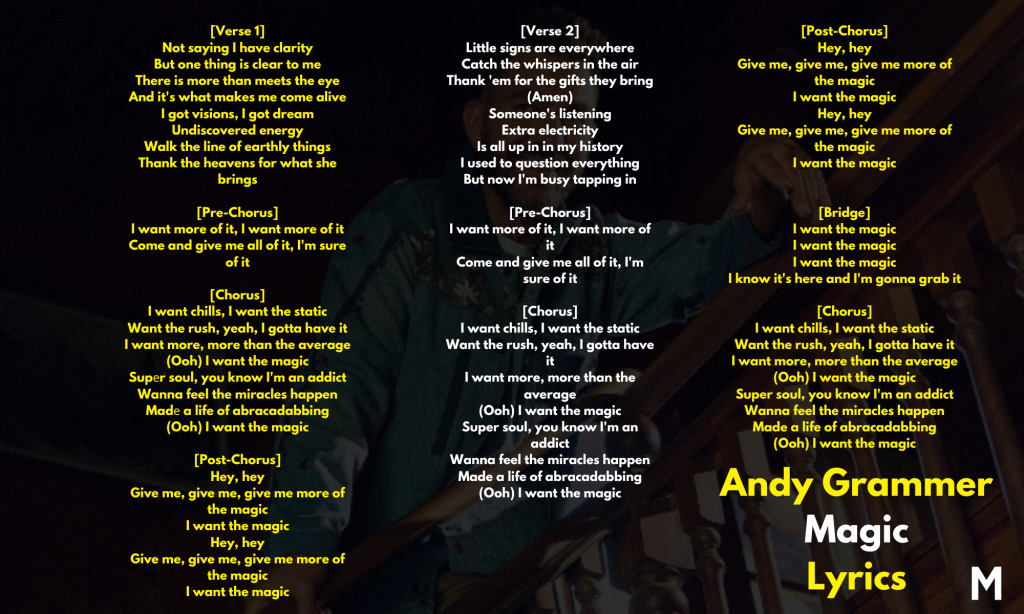
Andy Grammer Magic Lyrics
Andy Grammer Magic Meaning
Desire for Transcendence and Spiritual Awakening
The lyrics immediately set up a theme of seeking more than what’s visible. In the first verse, Grammer sings:
“Not saying I have clarity / But one thing is clear to me / There is more than meets the eye / And it’s what makes me come alive.”
Right here, the speaker acknowledges that while they may not fully understand everything, they are certain there’s more to life than the surface level. This is where Wordsworth’s poem “Lines Composed a Few Miles Above Tintern Abbey” comes into play. In it, Wordsworth talks about how the natural world can lead to a deeper awareness: “We see into the life of things.”
What Grammer is getting at with his reference to “visions” and “dreams” is that same sense of discovering a hidden layer of reality, a place where “undiscovered energy” exists. Both the song and Wordsworth’s poem emphasize that tapping into this deeper understanding can be transformative—it’s what “makes me come alive.”
The desire for transcendence continues in the pre-chorus:
“I want more of it, I want more of it / Come and give me all of it, I’m sure of it.”
This insistence on wanting “more” indicates a yearning that goes beyond material or conventional success. The speaker is seeking an experience that’s almost spiritual, much like what Rilke describes in “The Ninth Elegy.” Rilke wrestles with the limitations of human experience and the desire to break free of those boundaries.
He writes: “Perhaps we are here in order to say: house, bridge, fountain, gate… but to say them, you must understand, oh to say them more intensely.” Just like Rilke’s speaker, Grammer’s character wants to experience life with an intensity that goes beyond the mundane.
The Search for Magic and Wonder in Life
In the chorus, Grammer crystallizes this yearning with the repeated line:
“I want chills, I want the static / Want the rush, yeah, I gotta have it / I want more, more than the average / (Ooh) I want the magic.”
The emphasis on “magic” throughout the song signals a desire to experience something that defies logical explanation—moments that feel miraculous or supernatural. This magic motif isn’t just about seeking thrills; it’s about wanting to feel truly alive, to encounter the world with the wonder of a child.
This is where Rilke’s poetry becomes particularly relevant. In “The Ninth Elegy,” Rilke talks about the difficulty of experiencing life fully, saying: “But because being here is much, and because all / that’s here, vanishing, seems to need us and strangely / concerns us— / we, the most vanishing of all.” He’s grappling with the fact that we rarely get to engage with life in a way that lets us feel its fullness.
Grammer’s plea for “the magic” is a way of expressing this same longing for an unfiltered, unmediated encounter with the world.
Connection with a Higher Power or Cosmic Forces
The second verse shifts slightly, focusing on the idea of being guided by something greater than oneself:
“Little signs are everywhere / Catch the whispers in the air / Thank ’em for the gifts they bring (Amen) / Someone’s listening.”
This reference to “little signs” and “whispers” suggests the presence of a guiding force, a belief that there are subtle hints being sent from a higher power or cosmic entity. This resonates strongly with William Blake’s perspective in “The Marriage of Heaven and Hell.”
Blake writes: “If the doors of perception were cleansed everything would appear to man as it is, infinite.” In other words, if we could see the world clearly, we’d recognize its true, boundless nature. The speaker in Grammer’s song seems to be experiencing a similar moment of revelation—they’re beginning to see beyond the veil, catching glimpses of a reality that’s usually hidden from view.
The line “Thank ’em for the gifts they bring (Amen)” suggests a sense of gratitude for these moments of clarity, which Blake might have described as “cleansed perception.” Blake’s idea that our senses cloud our understanding of reality comes through here—the speaker is acknowledging the value of these fleeting signs as something precious, almost sacred.
Manifesting the Magic: From Passive to Active Seeking
In the bridge, the song reaches a turning point:
“I want the magic / I know it’s here and I’m gonna grab it.”
At this point, the speaker transitions from a passive desire to an active determination. This line suggests a shift toward manifesting these extraordinary experiences rather than just hoping for them to appear.
Blake’s “The Marriage of Heaven and Hell” similarly advocates for active engagement with one’s own perception to unlock greater truths. For Blake, it’s not enough to recognize signs; you have to change the way you see the world in order to fully grasp them.
The final chorus then reinforces this idea:
“Made a life of abracadabbing / (Ooh) I want the magic.”
This playful line reflects the speaker’s new mindset—actively creating or conjuring these moments of wonder. It’s no longer just about looking for magic; it’s about making it happen through sheer will and determination. This ties back to Rilke’s notion of saying “things more intensely” or Wordsworth’s belief that through deeper awareness, one can perceive the “motion and a spirit” that animates all life.
Themes, Meanings, and Main Takeaways
“I Want the Magic” is all about breaking out of the ordinary and tapping into something more meaningful. Throughout the song, Grammer is clear—he’s not interested in playing it safe or living a life that’s just “average.” When he sings, “I want more, more than the average,” it’s a direct call for transcendence, similar to what William Wordsworth expresses in “Lines Composed a Few Miles Above Tintern Abbey.”
In that poem, Wordsworth finds a deeper spiritual truth by looking beyond the surface of nature, tapping into what he calls “a motion and a spirit.” That’s exactly what Grammer’s speaker is reaching for too—he wants to unlock this “undiscovered energy” that brings everything to life and makes him feel truly alive.
The chorus—“I want chills, I want the static / Want the rush, yeah, I gotta have it / I want more, more than the average / (Ooh) I want the magic”—makes it clear that this song is all about intensity. Grammer’s speaker wants experiences that make him feel electric, almost like he’s chasing the divine in everyday life. This parallels Rainer Maria Rilke’s “The Ninth Elegy,” where he talks about wanting to engage with life so deeply that even mundane things like a “house” or “bridge” feel profound and magical.
Rilke believed that we should experience life with such intensity that everything seems more vivid and meaningful. That’s the same energy Grammer brings here—the “magic” he’s after isn’t some fairy-tale fantasy; it’s the feeling of being fully present and alive, where every moment is buzzing with possibility.
Then there’s the mention of “little signs” and “whispers in the air,” which shows that Grammer’s speaker thinks these flashes of magic are already around us, just waiting to be noticed. That idea ties perfectly with William Blake’s line from “The Marriage of Heaven and Hell,” where he says, “If the doors of perception were cleansed, everything would appear to man as it is—infinite.” Blake’s whole point is that reality is more connected and meaningful than we usually perceive. When Grammer sings, “Thank ’em for the gifts they bring (Amen),” it’s like he’s acknowledging that these small moments are gifts—proof that something bigger is at play.
The bottom line?
“I Want the Magic” isn’t just about wanting more excitement—it’s about being open to the extraordinary that’s hidden in plain sight and learning to see the magic that’s already there.

Will Vance is a professional music producer who has been involved in the industry for the better part of a decade and has been the managing editor at Magnetic Magazine since mid-2022. In that time period, he has published thousands of articles on music production, industry think pieces and educational articles about the music industry. Over the last decade as a professional music producer, Will Vance has also ran multiple successful and highly respected record labels in the industry, including Where The Heart Is Records as well as having launched a new label with a focus on community through Magnetic Magazine. When not running these labels or producing his own music, Vance is likely writing for other top industry sites like Waves or the Hyperbits Masterclass or working on his upcoming book on mindfulness in music production. On the rare chance he's not thinking about music production, he's probably running a game of Dungeons and Dragons with his friends which he has been the dungeon master for for many years.