
Table of Contents
Snow Patrol’s latest single, “Everything’s Here And Nothing’s Lost,” is big return for the group, highlighting the band’s unique ability to encapsulate the complexities of the human experience. It’s been six years since their last album, and The Forest Is The Path brings us back to their signature sound, but with a new layer of introspection that feels both fresh and familiar. Produced by Fraser T Smith and written during a pivotal session in Somerset, this record stands out for its grappling with the complex elements of love and isolation, themes that hit hard both in the lyrics and the broader context of the album as a whole.
As someone who studied English Literature at the University of Oregon and have been low-key obsessed with older and oftentimes more archaic poetry (at least by today’s standards and popular styles), I can’t help but draw connections between these lyrics and the timeless themes found in some of the most iconic poetry.
Snow Patrol’s exploration of dualities—like the tension between love and isolation—mirrors the work of poets like T.S. Eliot and John Keats, who also grappled with the push and pull of human relationships. In this article, I’ll dig into the meaning that I personally take away from “Everything’s Here And Nothing’s Lost” which itself is a lens heavily influenced by the authors and poets who I’ve learned the most from, in hopes of discovering the meaning behind the song and how other authors have explored similar themes and motifs through the ages to explore how the band’s latest work continues to echo the universal truths that have been central to some of the greatest writing in the English language.
💿 💿 💿 Purchase The Vinyl Of Snow Patrol’s Latest Album Here 💿 💿 💿
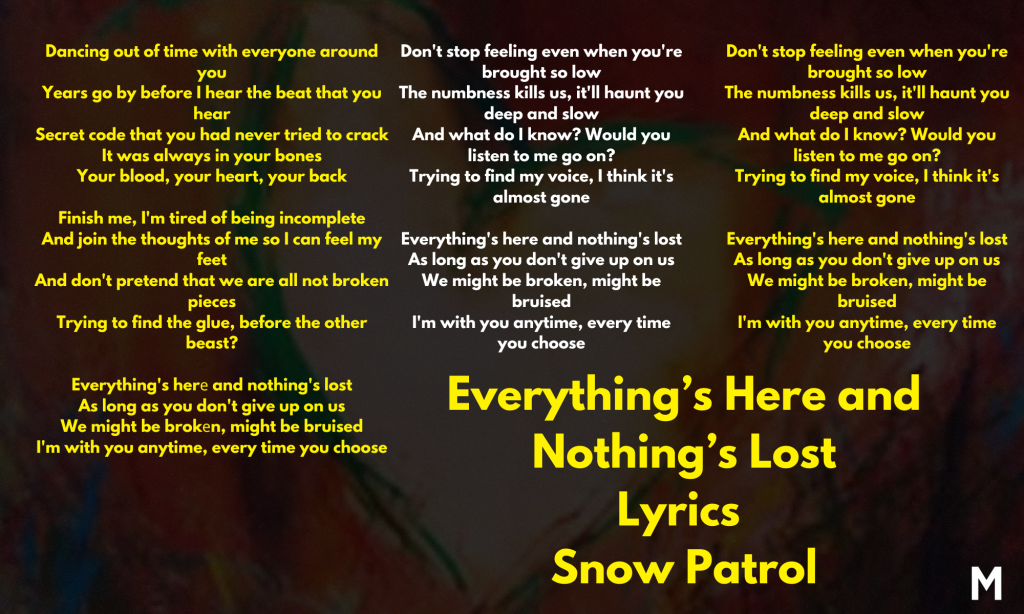
Snow Patrol Everything’s Here And Nothing’s Lost Lyrics
Everything’s Here And Nothing’s Lost Meaning
The lyrics explore the themes of incompleteness, resilience, brokenness, and enduring love. These are universal ideas that have been echoed throughout literature and poetry for centuries and SP are far from the first to put such ideas and experiences into rhyme. What is particularly striking, though, about these lyrics is how they communicate a deeper sense of longing and the struggle to find connection, not just with others, but within oneself. The speaker/singer wrestles with feelings of isolation and the desire to be made whole.
As we break down these lyrics, I’ll also draw connections to poems that tackle similar ideas, showing how these contemporary lyrics fit into a broader literary tradition. This comparison not only deepens our understanding of the song but also highlights the timeless nature of the themes it explores.
Verse 1: Disconnection and Incompleteness
“Dancing out of time with everyone around you
Years go by before I hear the beat that you hear
Secret code that you had never tried to crack
It was always in your bones
Your blood, your heart, your back”
These lines hit hard on the theme of disconnection.
“Dancing out of time with everyone around you” perfectly nails that feeling of being out of sync with the world. It’s like the speaker is moving to a rhythm only they can hear—a rhythm no one else gets. This sense of being out of step mirrors the isolation T.S. Eliot captures in The Love Song of J. Alfred Prufrock.
In Eliot’s poem, Prufrock is stuck in his head, feeling miles apart from everyone around him, trapped by his own insecurities. Like Prufrock, the speaker in these lyrics can’t connect because no one else hears the same “beat.” It’s that personal rhythm, that private understanding, that deepens the sense of being alone in a crowd.
Then there’s the “secret code,” which adds another layer to this disconnect. This code is “in your bones, your blood, your heart, your back”—it’s fundamental, something that’s part of you but that you’ve never unlocked. It’s similar to how Prufrock carries around unspoken thoughts and fears, things he never dares to fully confront or reveal. Prufrock is always holding back, too scared to break out of his internal world. The speaker in the song carries this uncracked code, this buried truth, and it keeps them apart from others, just like Prufrock’s hidden self keeps him isolated.
Both the song and Eliot’s poem wrestle with the tension between wanting connection and being stuck in isolation. Prufrock famously asks, “Do I dare / Disturb the universe?”—a question loaded with fear of breaking the silence, of letting others see who he really is. The lyrics’ mention of the secret code suggests something similar: a part of the self that’s never been shared, never understood by others. It’s like a wall that keeps the speaker out of sync, just like Prufrock’s self-doubt builds a barrier around him.
In both cases, there’s a deep sense of incompleteness.
The speaker in the song, like Prufrock, feels like they’re missing something crucial, something that’s there but out of reach. Eliot’s poem and these lyrics both capture the frustration of living in your own head, feeling disconnected from the world around you, and carrying a truth you can’t—or won’t—share. It’s that feeling of being “out of time” with everyone else, moving to a beat that no one else hears.
Chorus: Searching for Wholeness
“Finish me, I’m tired of being incomplete
And join the thoughts of me so I can feel my feet
And don’t pretend that we are all not broken pieces
Trying to find the glue, before the other beast?”
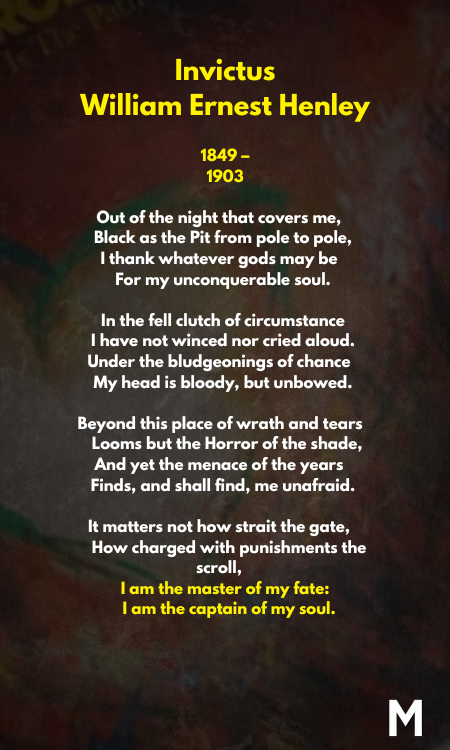
The chorus amplifies the theme of incompleteness with the plea, “Finish me, I’m tired of being incomplete.” This suggests a deep desire for someone else to help make the speaker whole, indicating that they feel fragmented or unfinished on their own. This theme of seeking wholeness through another person reminds me of the sentiment in William Ernest Henley’s Invictus. Henley’s speaker, though battered by life, declares that he is “the master of my fate,” asserting a kind of self-reliance and completeness that the speaker in these lyrics lacks. Here, there’s a vulnerability as the speaker looks to someone else to “finish” them, to fill the gaps and make them whole.
The line “don’t pretend that we are all not broken pieces” is a powerful acknowledgment of universal human imperfection. It suggests that everyone is dealing with their own forms of brokenness, trying to piece themselves back together. This brings to mind the resilience found in Rudyard Kipling’s If—, a poem that encourages perseverance and calm in the face of adversity. Kipling’s advice to “hold on when there is nothing in you” mirrors the idea of trying to “find the glue” to hold oneself together. Both the song and Kipling’s poem suggest that while we are all imperfect and broken in some way, there is still hope in trying to mend those pieces, even if the task feels daunting.
Verse 2: Resilience and Enduring Love
“Don’t stop feeling even when you’re brought so low
The numbness kills us, it’ll haunt you deep and slow
And what do I know? Would you listen to me go on?
Trying to find my voice, I think it’s almost gone”
This verse cuts straight to the struggle of staying emotionally alive when life drags you down. “Don’t stop feeling even when you’re brought so low” isn’t just a plea—it’s a warning. Shutting down might seem easier, but it’s the start of losing yourself. This echoes William Ernest Henley’s Invictus once again, where the speaker refuses to be beaten by pain, holding onto his identity. Henley’s strength is in standing firm, no matter what.
But these lyrics go further. “The numbness kills us, it’ll haunt you deep and slow” drives home the point that closing off isn’t protection—it’s slow self-destruction. Numbness doesn’t just block out pain; it erodes who you are, bit by bit.
The fight to “find my voice” shows the speaker’s fear of losing themselves entirely. Saying “I think it’s almost gone” reveals the real danger here: the risk of losing touch with who you are. Henley’s Invictus shows resolve, but these lyrics hit harder by acknowledging how easy it is to feel that resolve slipping away.
The urgency here is clear.
Staying emotionally engaged, fighting to keep your voice, your identity, is the only way to avoid losing yourself completely. While Henley talks about standing strong, these lyrics remind us that resilience isn’t just about enduring—it’s about staying connected to your emotions and your sense of self, no matter how much life tries to grind you down. The urgency in “Trying to find my voice” shows how important it is to stay emotionally engaged, to keep fighting for your identity even when everything seems stacked against you.
While Henley’s poem talks about a kind of stoic, almost defiant resilience, these lyrics are more about the personal struggle to keep your emotions alive and your sense of self intact when life is trying to grind you down. Both are about resilience, but this song takes a more intimate approach, focusing on the battle within, where losing touch with your emotions can mean losing yourself altogether.
Bridge: Love as a Vast, Enduring Force
“Well, maybe I love you like the ocean
Like the ocean loves the sky
Never gonna find a way to reach you
No matter how I try”
The bridge of this song uses the metaphor of love as a vast, natural force—specifically, “like the ocean loves the sky.” This image paints a picture of love that is immense and enduring, yet also distant and unattainable. The ocean and the sky are forever connected by the horizon, but they never truly meet. This suggests a deep and unbreakable connection that still feels incomplete, no matter how hard the speaker tries to bridge the gap.
This idea of love as an “ever-fixed mark,” unwavering and constant, is straight out of Shakespeare’s Sonnet 116. Shakespeare describes true love as something that “looks on tempests and is never shaken,” highlighting love’s enduring nature even in the face of adversity. However, the frustration in these lyrics—”Never gonna find a way to reach you”—adds a layer that Shakespeare doesn’t touch on as directly. While Shakespeare’s sonnet celebrates the constancy of love, the song acknowledges the pain and difficulty of loving someone you can’t fully connect with, no matter how intense the bond feels. The love described here is both steadfast and out of reach, echoing Shakespeare’s idea that true love doesn’t falter, but with the added twist that it doesn’t always fulfill the desire for closeness.
“Maybe I can love you like the mountain
Like the mountain loves the snow
I can let you fall on me forever
Till it’s all we know”
In these lines, the metaphor shifts to a mountain and snow, which suggests a form of love that is both accepting and enduring. The mountain doesn’t resist the snow—it allows it to fall, to cover and transform it. This idea ties back to Shakespeare’s portrayal of love as something that doesn’t change under pressure or burden. In Sonnet 116, love is unaltered by time or circumstance, much like the mountain that stands firm under the weight of snow.
The image of the snow “falling” on the mountain also hints at the idea of love as something that can be overwhelming, yet the mountain supports it without question, just as Shakespeare’s love “bears it out even to the edge of doom.”
What’s striking about these lyrics is how they capture the same essence of enduring love that Shakespeare wrote about, but with a more grounded acknowledgment of the challenges. Shakespeare’s Sonnet 116 presents an idealized view of love as something unbreakable and perfect. The song, however, brings in the reality that even such a love can feel distant or unfulfilled.
The metaphors of the ocean and sky, the mountain and snow, both reflect the unshakeable nature of love that Shakespeare champions, but they also highlight the speaker’s struggle with the distance and burden that can come with it. In essence, the lyrics echo Shakespeare’s belief in love’s constancy while also recognizing that love doesn’t always close the gap between people, no matter how deeply it’s felt.
Last Minute Connections And Motifs
As we bring these ideas together, it’s clear that these song lyrics are in conversation with a long tradition of poetry that explores similar themes. The sense of disconnection and longing in the lyrics parallels T.S. Eliot’s The Love Song of J. Alfred Prufrock, where Prufrock famously laments, “I have heard the mermaids singing, each to each. / I do not think that they will sing to me.”
Just as Prufrock feels excluded from a deeper, more meaningful connection, the speaker in these lyrics feels out of sync with the world, hearing a different beat that others cannot perceive. Both speakers are isolated by their unique perspectives, unable to fully connect with those around them.
Shakespeare’s Sonnet 116 adds another layer to our understanding of these lyrics, particularly in its portrayal of love as unchanging and constant. “Love is not love / Which alters when it alteration finds,” Shakespeare writes, capturing the steadfastness of true love. The song echoes this sentiment in its depiction of love as oceanic or mountainous—vast, enduring, and unshakeable, even in the face of distance or difficulty.
💿 💿 💿 Purchase The Vinyl Of Snow Patrol’s Latest Album Here 💿 💿 💿

Will Vance is a professional music producer who has been involved in the industry for the better part of a decade and has been the managing editor at Magnetic Magazine since mid-2022. In that time period, he has published thousands of articles on music production, industry think pieces and educational articles about the music industry. Over the last decade as a professional music producer, Will Vance has also ran multiple successful and highly respected record labels in the industry, including Where The Heart Is Records as well as having launched a new label with a focus on community through Magnetic Magazine. When not running these labels or producing his own music, Vance is likely writing for other top industry sites like Waves or the Hyperbits Masterclass or working on his upcoming book on mindfulness in music production. On the rare chance he's not thinking about music production, he's probably running a game of Dungeons and Dragons with his friends which he has been the dungeon master for for many years.