In search of strange textures and sounds, Techno and Experimental artist Mentrat Noihr, from Normandy’s mystical landscapes and vibrant art scene, delivers his vision of music by dark and intimate interpretation, shamanic beats where frequencies and syncopated convulsions collide with the conscious and unconscious of the listener.
The echoes of his past solo (as Goldthwait) or collaborative (as part of Conformance, with techno expert The Botched Noise Maker Committee) projects, his long-time activism through various collectives (now M.A.D Brains), and a strong attachment for hardware & modular synths laid the foundation for Mentrat Noihr’s distinctive identity and sound.

His productions, a balance between experimental music and hypnotic techno, create unique and dizzying atmospheres, almost uncomfortable yet often fascinating. On stage, tracks are built up live through modular synth, seamlessly blending heavy beats, industrial vibes, and atmospheric depths. In this feature, he breaks down his live set and walks us through how he does what he does best.
For me, playing live is all about having fun. Being a DJ taught me to observe a crowd and understand its expectations. So, I wanted to have a lot of “leeway” for the live performance, which is largely improvised and allows me to steer the set as I desire. For this, machines are great because they provide a lot of freedom.
In my current basic setup, my live rig consists of three pieces of equipment: a modular synth in Eurorack format with 6U and 104HP, an Analog Rytm MK1, and an Octatrack MK2 from Elektron. The modular synth provides three channels: lead, bassline, and percussion / drone / noise. The Analog Rytm is dedicated to drums duty. These two elements are then directed in stereo to the Octatrack, which is used as a performance mixer and effects unit. Having a few machines and knowing them inside out helps to avoid getting lost and gives better control.

The modular rig:
I got into modular synths around 2014. I wasn’t necessarily chasing the famous ‘analog sound,’ but rather a workflow that suited me. Nowadays, I primarily use digital modules. My case is divided into several sections: Triggers generator, sound generators, modulations and envelopes, filters and dynamic processing, and finally, the FXs.
For the VCO section, I use a ‘Loquelic Iteritas’ and a ‘Basimilus Iteritas Alter’ from Noise Engineering. The LI is a complex VCO that allows me to create really wild, very cold, and digital sounds – perfect raw material for my tracks. The BIA is a percussion generator, ideal for creating heavy basslines. I also use the ‘Rings’ module from Mutable Instruments, perfect for more natural percussion or creating drones from white noise. All these sounds are then processed by filter modules (currently using a ‘Polivoks VCF’ replica by Erica Synths and the ‘Pole Zero’ by WMD & SSF) or other effects like XAOC ‘Kamieniec’, a superb analog phaser, or Mutable Instruments ‘Warps’, which can be both a frequency shifter and a delay.
At the end of the chain, I use a Mutable Instruments ‘Clouds’ combo for generating texture (Looping Delay and Spectral Madness modes are fantastic), a ‘Desmodus Versio’, an incredible DSP reverb from Noise Engineering, and a Messor from Cosmotronic for analog compression / limiting / ducking. These three modules bring intensity and dynamics to the sounds generated by the modular setup.
The modulation source also is crucial to bring everything to ‘life’. For this, I mainly use a XAOC ‘Zadar’, a complex envelope generator, a ‘Mod Medusa’ from Shakmat Modular, which is a Euclidean LFO generator synchronized to the tempo, and a Turing Machine from MusicThingModular, a random melody generator and one of the first modules I owned. The creative possibilities with this tools are endless.”
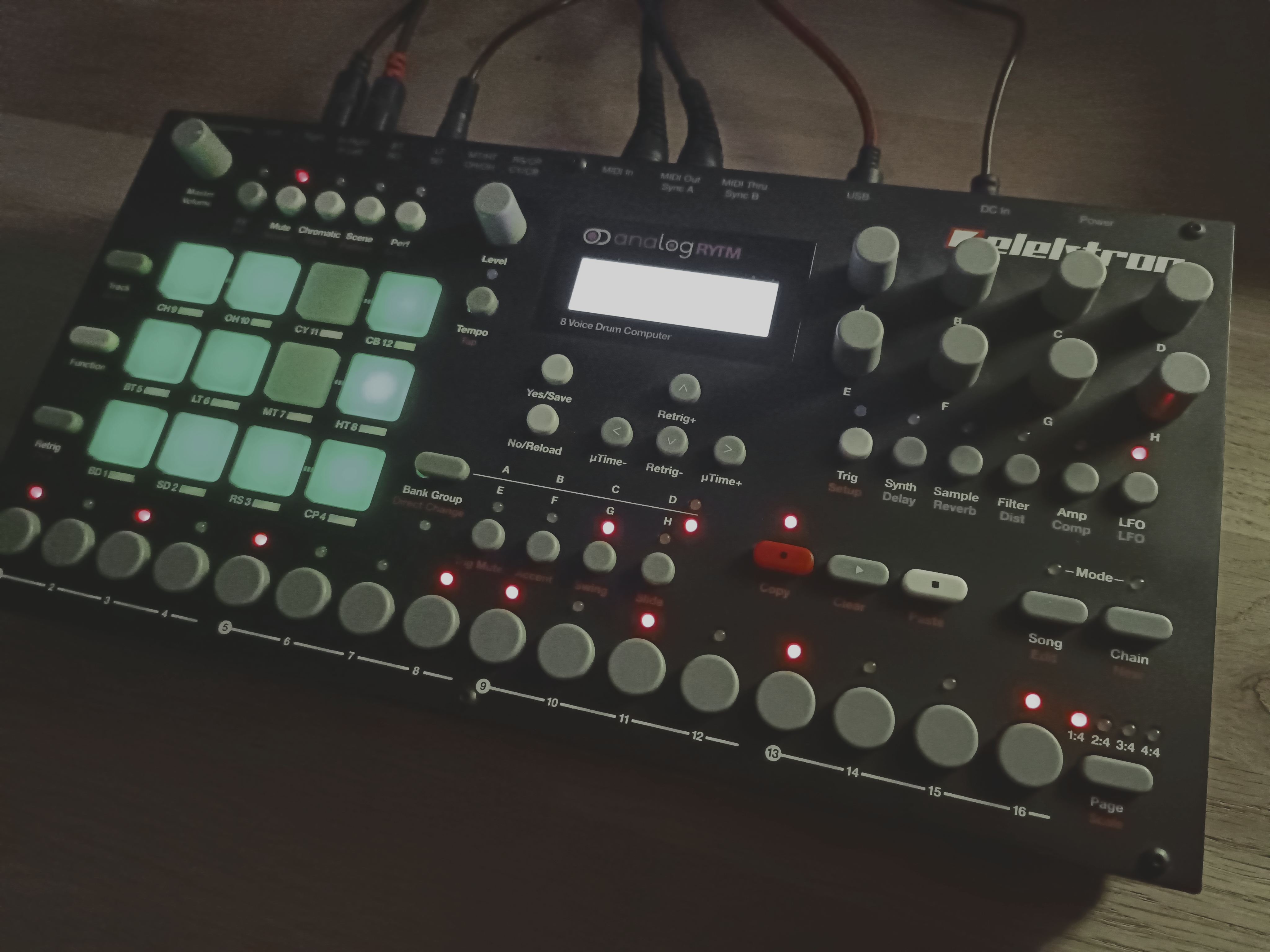
The Analog Rytm:
The rhythmic elements are managed by the Analog Rytm, a drum machine that I’ve had for years and is really enjoyable to play live. The sound hits so hard! The extensive sound design possibilities, coupled with the mighty Elektron sequencer, allow for the creation of evolving and complex patterns. I use the separate kick output to trigger the sidechain on the compressor module. This brings dynamics to the set. For a live performance, I usually have around 15 to 20 different kits, each with several pattern variations. I don’t play them in any particular order, but my kits are organized based on their intensity, so I can choose them wisely.
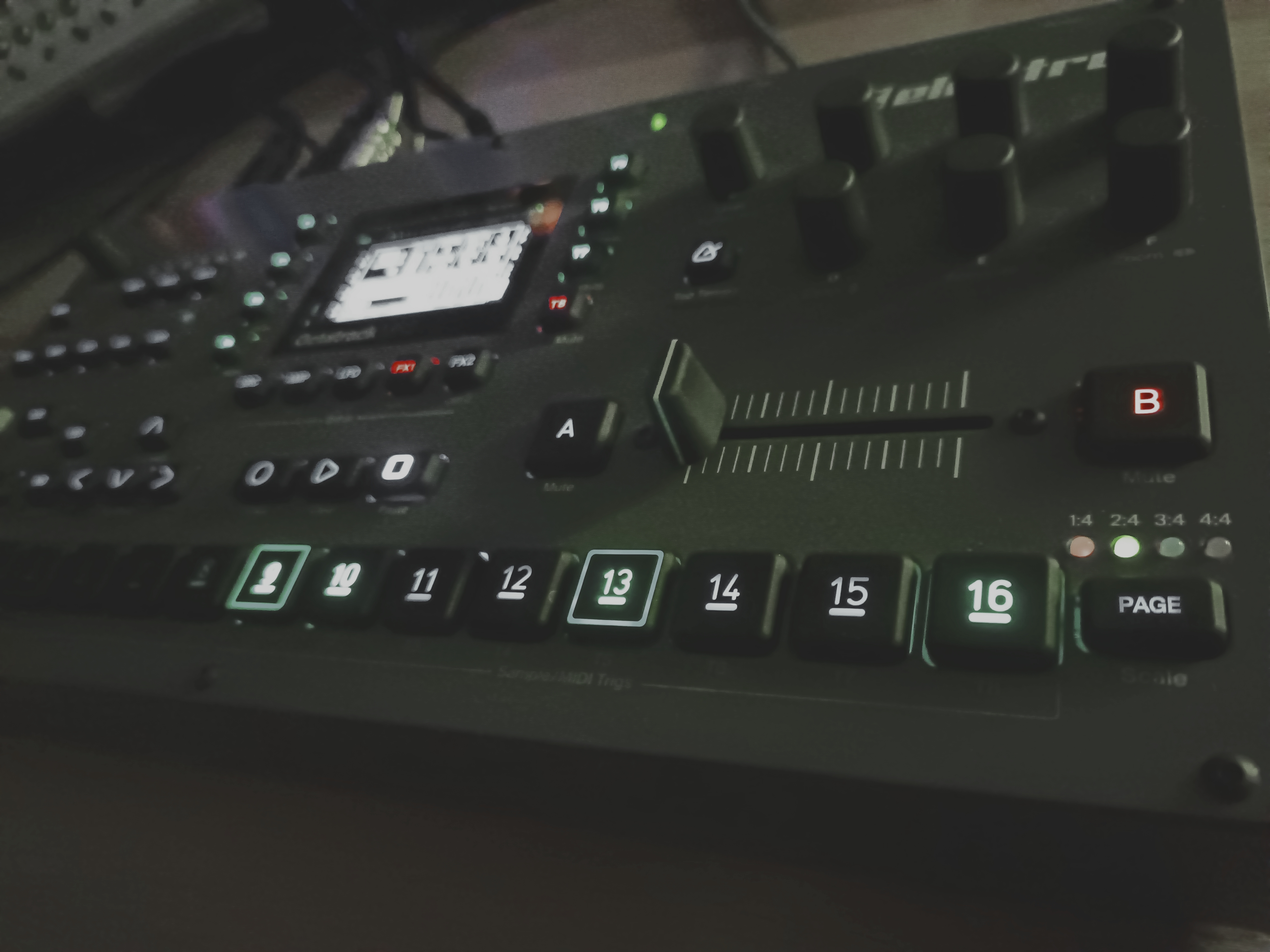
The Octatrack:
Finally, the Octatrack is used as a “2-voices performance mixer” in a very basic way. I’ve created a set of scenes (macros allowing control of multiple parameters at once) that enable me to apply filters (LP, HP), effects (Delay, reverb, Bite Reduction, etc.), play with volumes, and help to ‘glue’ the modular synth and Analog Rytm together. Playing with the crossfader and scenes adds a lot to the performance by allowing me to arrange different parts of the set, making transitions easier; and adding life and tension to the very mechanical and synthetic aspect of my music.
Grab your copy here.